- Free Consultation 24/7: (813) 727-7159 Tap Here To Call Us


From First DUI to Death Penalty



Can a Victim Drop Domestic Violence Charges in Florida? A Complete Victim’s Guide


Not on their own. In Florida, the State Attorney’s Office makes the final decision, and Florida Statute 741.2901, the domestic violence pro-prosecution law, lets prosecutors proceed “over the objection of the victim, if necessary.” In practice, the alleged victim carries great weight. Without the victim’s testimony, a domestic violence case is hard to prove unless there is significant objective evidence, such as serious injuries with no other explanation. Victims have constitutional rights to be heard, including at first appearance on release and the no-contact order, and a truthful sworn affidavit, prepared with the victim’s own attorney or the defendant’s attorney, is often what leads to a dismissal.
I’m Rocky Brancato, founder of The Brancato Law Firm, P.A., a Tampa criminal defense firm. I have tried more than 150 jury trials to verdict and served as Chief Operating Officer of the Hillsborough County Public Defender’s Office, overseeing a staff of over 100. Today our attorneys handle domestic violence cases in Hillsborough, Pinellas, and Pasco Counties, and we regularly hear from alleged victims who want the case dropped.
We say this up front. Our firm primarily represents the person accused, and our Tampa domestic violence defense attorneys defend those cases. When we do not already represent the defendant, we also represent alleged victims, and we fight to make sure their constitutional rights are not trampled and that they are not intimidated by anyone. Over the years our attorneys have seen the full range of these cases: people labeled “victims” who were never victims, minors pulled through a system that was supposed to protect them, alleged victims who hired us to defend the person they were said to be a victim of, people who admitted they lied to police and regretted it, and true victims caught in a cycle of abuse they could not or would not leave.
This guide is written for the alleged victim. It explains your rights, how a case actually gets dropped, how to be heard at first appearance, what a defense attorney may and may not do when speaking with you, when to hire your own lawyer, and where to get safety help in Tampa Bay if you need it. Nothing in this guide encourages anyone to disobey a subpoena or any other valid legal process, or to lie under oath. Every option described here depends on telling the truth.
Who Decides Whether a Domestic Violence Case Gets Dropped in Florida?
The prosecutor makes the final decision. Florida law requires every State Attorney to adopt a “pro-prosecution policy” for domestic violence, and it says the filing, nonfiling, or diversion of charges “shall be determined by these specialized prosecutors over the objection of the victim, if necessary,” under Florida Statute 741.2901(2), the domestic violence pro-prosecution law.
The courts back this up. In State v. Bloom, 497 So. 2d 2 (Fla. 1986), the Florida Supreme Court held that “the decision to charge and prosecute is an executive responsibility, and the state attorney has complete discretion in deciding whether and how to prosecute.” A judge cannot order a prosecutor to drop a case.
A case gets “dropped” in one of two ways. Before charges are filed, the prosecutor can decline to file, which in Florida is usually done with a document called a “No Information.” After charges are filed, the prosecutor can dismiss with a “nolle prosequi,” often shortened to “nol pros.”
Do not let any of that discourage you from speaking your mind. Prosecutors must prove a case beyond a reasonable doubt, and in a domestic violence case the alleged victim is almost always the key witness. Prosecutors do not have as much power here as some people suggest. Domestic violence is one area where they simply do not have the power they have in other cases, because of the unique nature of the charge: the events usually happen in private, there are often only two witnesses, and one of them is you. The prosecutor needs you to prove the case.
The chart below covers every stage from both sides: what you can do if you want the case to go forward, what you can do if you want it dropped, and the rights you have either way.
| Stage of the case | Who decides | If you want the case to go forward | If you want the case dropped | Your rights at this stage |
|---|---|---|---|---|
| 911 call and police response | The officer, based on probable cause | Give a full statement; point out injuries, texts, photos, and witnesses | You may decline to give a statement; under Florida Statute 741.29(4), the domestic violence arrest law, the arrest does not require your consent | Ask for a victim notification card so the jail must try to tell you before the accused is released, under Florida Statute 960.001, the victim notification and fair treatment law |
| Booking and jail | Jail staff; no bond is posted before first appearance under Florida Statute 741.2901(3), which holds domestic violence arrestees until first appearance | Call your county’s domestic violence center for a safety plan | Contact the defendant’s attorney or your own attorney before first appearance | Notice of release, attempted before release or within 4 hours after |
| First appearance (within 24 hours) | The first appearance judge | Testify about your safety; ask the judge to keep the no-contact order and set protective bond conditions | Testify about your wishes on the prosecution, release, and the no-contact order, or have your own attorney speak; the judge may order no violent contact instead | To be heard on release and to have your safety considered when bail is set |
| Injunction for protection (a separate civil case) | A civil judge | File a petition at no cost; The Spring of Tampa Bay’s free injunction attorneys and CASA’s free injunction attorneys in Pinellas can represent you | If you filed one and no longer want it, move to dismiss or dissolve it under Florida Statute 741.30, the domestic violence injunction law | No filing fee; the clerk must help you |
| Filing decision (within about 30 days if the accused is in jail) | The assigned prosecutor | Meet with the prosecutor and victim advocate; give them your evidence | Sign a truthful sworn affidavit with your own attorney or the defendant’s attorney, because most prosecutor offices no longer take waivers at the office | To confer with the prosecutor |
| Arraignment and discovery | The prosecutor and the court | Stay in touch with the victim advocate; save texts, photos, and records | Your attorney can keep presenting your wishes; in felony cases, you may be deposed | A victim advocate at your deposition; protection of information that could locate you |
| Changes to the no-contact order | The criminal judge | Ask that the order stay in place; report any violation | The defendant’s attorney or your own attorney moves to modify it, and you testify | To be heard at any modification hearing under Florida Statute 903.047(2), the no-contact modification provision |
| Plea, diversion, or dismissal | The prosecutor, with the judge accepting any plea | Tell the prosecutor what outcome you want, such as counseling, conditions, or restitution | Ask the prosecutor to dismiss the case or offer diversion | To confer about any plea, diversion, or other disposition |
| Trial | The jury or judge | Testify | You must still obey a subpoena; if your testimony could incriminate you, talk to your own lawyer about the Fifth Amendment | To be present at all public proceedings |
| Sentencing | The judge | Describe the impact on you and your family; ask for restitution | Ask for leniency | To be heard at sentencing |
| Every stage | Not applicable | Not applicable | Not applicable | To be free from intimidation, harassment, and abuse by anyone, including an overzealous prosecutor, under Article I, section 16 of the Florida Constitution, the crime victims’ bill of rights; your own attorney can ask the court for a hearing to enforce it |
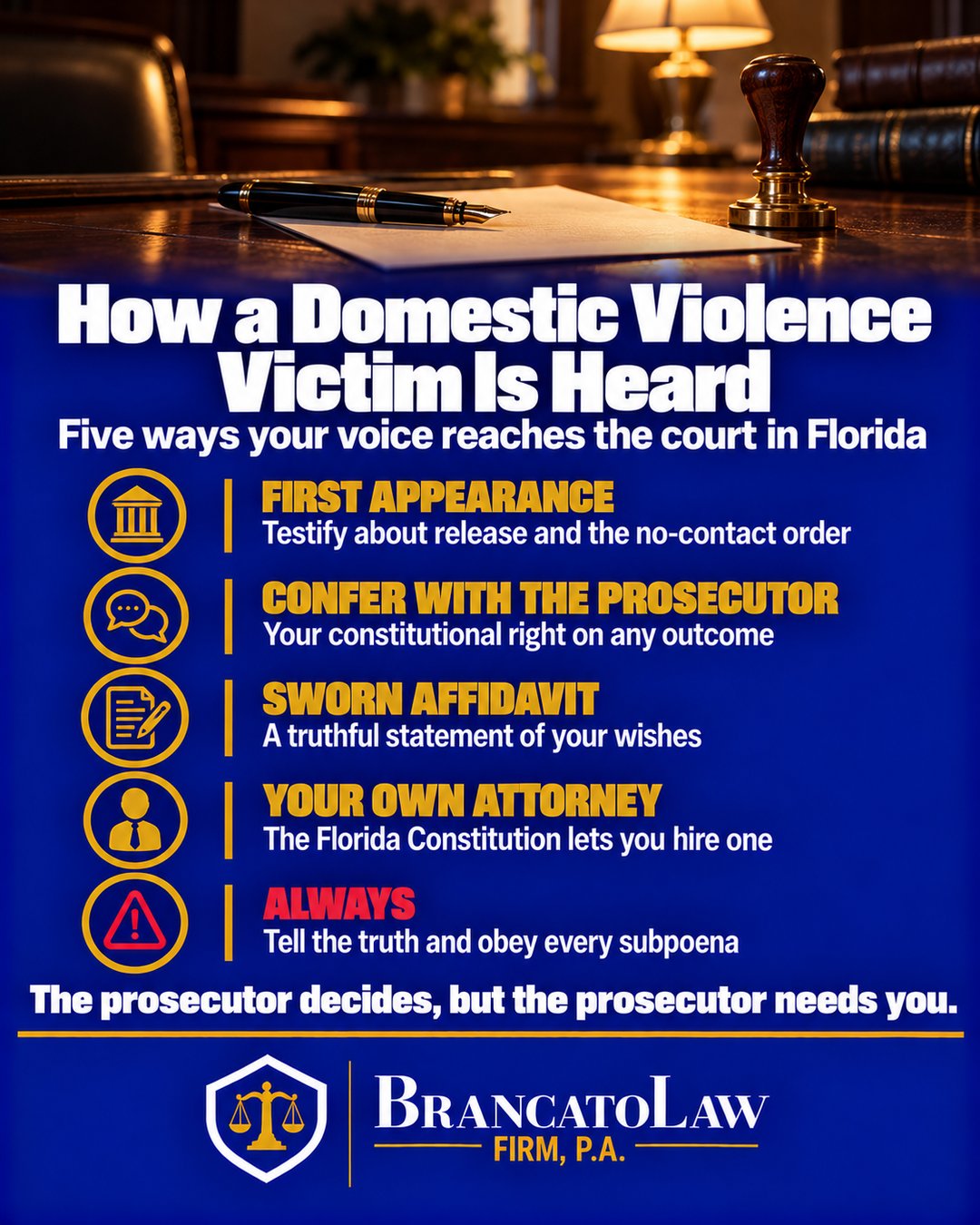
What Rights Does a Domestic Violence Victim Have Under Marsy’s Law?
Florida’s victims’ rights amendment, known as Marsy’s Law, is in Article I, section 16(b) of the Florida Constitution, the crime victims’ bill of rights. It gives every crime victim a set of rights “beginning at the time of his or her victimization.” These rights belong to the victim whether the victim wants the case prosecuted or dropped.
Because these rights are in the Constitution, they are the highest law in Florida. A statute, a court rule, or an office policy cannot take them away.
Rights that apply automatically include:
- The right to due process and to be treated with fairness and respect for your dignity.
- The right to be free from intimidation, harassment, and abuse.
- The right to be reasonably protected from the accused and anyone acting on the accused’s behalf.
- The right to have your safety and your family’s safety considered when bail and release conditions are set.
- The right to prevent disclosure of information that could be used to locate or harass you.
- The right to be informed of your rights, “and to be informed that victims can seek the advice of an attorney with respect to their rights.”
Rights that apply upon request include:
- The right to notice of, and to be present at, all public proceedings, including trial, plea, and sentencing.
- The right to be heard at any public proceeding involving release, plea, sentencing, or adjudication.
- The right “to confer with the prosecuting attorney concerning any plea agreements, participation in pretrial diversion programs, release, restitution, sentencing, or any other disposition of the case.”
Two limits are important. First, the right to confer and be heard gives you a voice, and the prosecutor still makes the charging decision. Second, Florida’s version of Marsy’s Law does not include a right to refuse a defense deposition. In felony cases, the defense may still depose an alleged victim who is listed as an eyewitness under Florida Rule of Criminal Procedure 3.220(h) on discovery depositions. In cases charging only a misdemeanor, a deposition requires a showing of good cause to the court. If you are deposed, Florida Statute 960.001(1)(q), which lets a victim advocate attend your deposition, allows you to bring an advocate.
Can I Hire My Own Lawyer as a Domestic Violence Victim in Florida?
Yes. Under section 16(c) of Article I of the Florida Constitution, the crime victims’ bill of rights, the victim, the victim’s “retained attorney,” or a lawful representative may assert and seek enforcement of the victim’s rights “in any trial or appellate court” as “a matter of right.” The court “shall act promptly” on that request. Your own lawyer can stand up in the criminal case and speak for you.
A victim’s attorney can protect you from more than the accused. The right to be “free from intimidation, harassment, and abuse” and the right to be treated “with fairness and respect” apply to everyone in the process, including an overzealous prosecutor. We have seen prosecutors threaten alleged victims to accomplish their own objectives, including threats to call DCF. Your constitutional rights are the answer to that. Your attorney can file a motion asserting your right to be free from intimidation and harassment and ask the court to hold a hearing. The Constitution requires the court to “act promptly” on that request, to afford “a remedy by due course of law for the violation of any right,” and to state its reasons “clearly” on the record.
Our firm represents alleged victims in cases where we do not already represent the defendant. The Florida Bar’s conflict rules do not allow one firm to represent both, so if we represent the accused, we will tell you to hire someone else. When we represent you, our attorneys can:
- Appear with you at first appearance or a bond hearing and present your wishes on release and the no-contact order.
- Confer with the prosecutor on your behalf and insist that your views be heard.
- Prepare your truthful sworn affidavit stating your wishes about the prosecution.
- Ask the court to modify the no-contact order and enforce your right to be heard.
- Advise you before you change or add to any statement you gave police.
- File a motion and request a hearing in court if anyone, including the prosecutor, intimidates, threatens, or harasses you, so a judge can enforce your constitutional rights on the record.
If you want to compare firms before you decide, our guide on how to choose a criminal defense attorney in Tampa explains what to look for.
Why Do Police Almost Always Make an Arrest on a Domestic Violence Call?
Police make an arrest on most domestic violence calls because Florida law makes arrest the safest choice for the officer. Under Florida Statute 741.29(4), which governs domestic violence arrests, an officer who finds probable cause “may arrest,” and “the decision to arrest and charge shall not require consent of the victim or consideration of the relationship of the parties.”
Probable cause is the legal standard for an arrest. It means facts that would lead a reasonable person to believe a crime was committed by the person arrested. It is a real standard, and in our experience it often gets lost on domestic calls. Officers arrive at a chaotic scene, hear two conflicting stories, and have minutes to decide.
The statute shapes that decision in two ways. If an officer chooses not to arrest anyone, the written report must explain “the grounds for not arresting anyone,” under Florida Statute 741.29, the domestic violence investigation and reporting law. And an officer “may not be held liable, in any civil action, for an arrest based on probable cause” in a domestic case, under Florida Statute 741.29(6), the officer civil immunity provision. The officer who arrests is protected. The officer who walks away has to justify it in writing and owns the risk if something happens later.
Our attorneys see the result regularly. In our experience, police have developed what amounts to a zero-tolerance approach: when police get called, someone almost always goes to jail, whether or not something happened and whether or not there is true probable cause. Officers would rather limit their liability and put someone in jail than take the chance. In 2020, Hillsborough County agencies reported 7,083 domestic violence offenses and made 4,952 domestic violence arrests, according to FDLE’s 2020 domestic violence arrests by jurisdiction report. Statewide, Florida recorded 71,146 domestic violence arrests in 2024, according to the Florida Department of Children and Families’ 2026 Domestic Violence Annual Report.
Research suggests that arrest-first policies can backfire. Economist Radha Iyengar studied mandatory arrest laws and found they “actually increased intimate partner homicides,” likely because victims stopped calling police once they knew a call meant an arrest. Her paper, Does the Certainty of Arrest Reduce Domestic Violence? Evidence from Mandatory and Recommended Arrest Laws, was published in the Journal of Public Economics in 2009. Florida is not a mandatory arrest state, but in practice many local agencies behave like one.
Why Are Some People Labeled “Victims” When They Are Not?
The “victim” label is assigned at the scene, usually by an officer, before anyone has investigated. It often goes to the person who called 911, the person with a visible mark, or the person who is calmer when police arrive. None of those facts settles who started the fight or whether a crime happened at all.
Some accusations are false. Our attorneys have seen alleged victims lie and claim domestic violence as retaliation, for instance after finding text messages from another woman on the defendant’s phone. We have also seen alleged victims hold the case over the defendant’s head, using the threat of testifying, or the promise of not testifying, to control the other person. When that happens, the accused needs a defense attorney who knows how to expose it, and the accuser needs to understand that a false report is itself a crime under Florida Statute 837.05, the false report to law enforcement law.
Florida law tells officers to sort this out. When both people make complaints, officers “shall evaluate each complaint separately,” must “try to determine who was the primary aggressor,” and should not treat arrest as the preferred response for someone “who acts in a reasonable manner to protect or defend oneself,” under Florida Statute 741.29(5), the primary aggressor rule. In practice, our attorneys have seen many cases where the person listed as the victim was the aggressor, or where both people were arrested. Our guide to Florida self-defense laws and Stand Your Ground explains when force used in self-defense is lawful.
If you were labeled a victim and you do not believe you are one, you still have the rights described above. You also have a choice about how to tell your side, and that choice can carry legal risk. The sections below explain how to do it safely.
Can a Domestic Violence Case Go Forward if the Victim Will Not Testify?
Yes, a domestic violence case can proceed against the victim’s wishes, but in practice it is difficult. In our experience, it is next to impossible without significant objective evidence, such as extreme injuries that cannot be explained by other causes. Prosecutors call these “evidence-based” or “victimless” prosecutions. They try to prove the case with 911 recordings, body camera video, photographs, neighbors, and the accused person’s own statements, including recorded jail calls.
The Sixth Amendment’s Confrontation Clause limits how far they can go. In Davis v. Washington, 547 U.S. 813 (2006), the U.S. Supreme Court decided two domestic violence cases together. A woman’s 911 call describing an attack as it happened was “nontestimonial” and could be used at trial without her. Another woman’s statements to an officer describing what had already happened, after the scene was calm, were “testimonial” and could not be used unless she testified and could be cross-examined.
Florida applies the same rule. In State v. Lopez, 974 So. 2d 340 (Fla. 2008), a man told an officer in a parking lot that the defendant had pointed a gun at him. The Florida Supreme Court held that statement was testimonial because there was no ongoing emergency, and it held that a defense discovery deposition is not a substitute for cross-examination at trial. The statement was inadmissible, and the error was not harmless.
The lesson for an alleged victim is practical. Without your live testimony, a prosecutor usually loses the most important evidence in the case. That is why your wishes carry so much weight. It is also why the Confrontation Clause issue does not end with a pretrial motion. It returns at trial, statement by statement, when the State tries to use what you said to the officer. Our post on how to fight a domestic violence battery charge in Florida covers these defenses from the accused person’s side.
| Type of evidence | Usable without the victim testifying? | Why |
|---|---|---|
| 911 call made during the emergency | Often yes | Usually nontestimonial under Davis v. Washington, 547 U.S. 813 (2006) |
| Victim’s statements to officers after the scene is calm | Often no | Usually testimonial under Davis v. Washington, 547 U.S. 813 (2006) and State v. Lopez, 974 So. 2d 340 (Fla. 2008) |
| Photos of injuries and the scene | Usually yes | An officer can authenticate them |
| Body camera video | Partly | The video of the scene may come in; the victim’s narrative statements may not |
| Accused person’s own statements and jail calls | Usually yes | A party’s own statements are admissible against that party |
| Independent eyewitness | Yes, if the witness testifies | The witness is subject to cross-examination |
One warning applies to everyone. If you are served with a subpoena, you must appear. A subpoena is a court order, and a judge can enforce it through contempt. If your testimony could expose you to criminal liability, for example because an earlier statement was false, you may have a Fifth Amendment right not to answer. That is a question for your own lawyer.
Can a Victim Testify at First Appearance to Get the Defendant Released?
Yes. At first appearance, an alleged victim can testify about the victim’s wishes on the prosecution and on the no-contact order. Under Florida Statute 741.2901(3), which requires domestic violence arrestees to be held until first appearance, a person arrested for domestic violence “shall be held in custody until brought before the court for admittance to bail,” so there is no posting bond off a schedule. Florida Rule of Criminal Procedure 3.130 on first appearance requires that hearing within 24 hours of arrest.
The no-contact order is the part most people do not expect. In practice, a no-contact order is put in place at first appearance in essentially every domestic violence case unless the victim testifies otherwise. If you want contact, you have to tell the judge. The judge will have to be satisfied that you are not in danger, and in that situation will often order “no violent contact” instead of no contact at all. If the judge enters a full no-contact order and you share a home, the defendant will have to move out and find another place to stay for as long as the case is pending.
Before first appearance, the State Attorney’s Office must investigate the defendant’s history, including prior domestic arrests and injunctions, and the judge “shall consider the safety of the victim, the victim’s children, and any other person who may be in danger.” If you cannot attend, the Florida Constitution says your rights at first appearance are satisfied by “a reasonable attempt by the appropriate agency to notify the victim and convey the victim’s views to the court.” Tell the officer or victim advocate your wishes clearly, but understand that a message passed along is weaker than your own testimony.
Local practice matters here. Hillsborough County does not offer pretrial services supervision as a release option, while some nearby counties do. In Hillsborough, release usually means a monetary bond plus conditions. Our Hillsborough County criminal defense attorneys, Pinellas County criminal defense attorneys, and Pasco County criminal defense attorneys pages explain how each county handles release. If the first appearance judge sets a bond the family cannot afford, a defense attorney can file a motion for a bond hearing, and you have the right to be heard there too. Our guide on how a bond hearing works in Tampa, Florida explains that hearing step by step.
If the accused person is still in jail and the State has not filed charges within 30 days, Florida Rule of Criminal Procedure 3.134 on the time for filing formal charges requires the court to order release on the 33rd day unless charges are filed, or on the 40th day if the State shows good cause.
Can a No-Contact Order Be Lifted Later if the Victim Wants Contact?
Yes, but only by the judge. A no-contact order is a condition of pretrial release under Florida Statute 903.047, the conditions of pretrial release law, and it bars contact “of any type,” including texts, calls, social media, and messages passed through friends. The alleged victim cannot waive it, and the parties cannot agree it away.
If the order was entered at first appearance, a defense attorney can file a motion to modify it later and bring you before the judge to express your wishes. The court may modify the order “if good cause is shown and the interests of justice so require,” and “the victim shall be permitted to be heard at any proceeding in which such modification is considered,” under Florida Statute 903.047(2), the no-contact modification provision. You can also hire your own attorney to present your wishes. Our Tampa domestic violence lawyers file motions to modify no-contact orders, and the motion has its best chance when the alleged victim tells the judge, in person, what the victim wants. Judges can lift the order entirely, allow contact about shared children, or permit non-violent contact.
Until the judge signs a new order, do not let the defendant contact you, and do not contact the defendant. A violation is a new first-degree misdemeanor for the defendant, and the defendant “shall be held in custody until his or her first appearance,” under Florida Statute 741.29(7), the pretrial release violation penalty.
Is It Legal for a Domestic Violence Victim to Talk to the Defense Attorney?
Yes. Florida law expressly allows it. Florida Statute 903.047, the conditions of pretrial release law, says a no-contact order “does not prohibit an attorney for the defendant, consistent with rules regulating The Florida Bar, from communicating with any person protected by the no contact order for lawful purposes.”
The key words are “consistent with rules regulating The Florida Bar.” The Rules Regulating The Florida Bar, including Rule 4-4.3 on dealing with unrepresented persons, put real limits on how a defense attorney may speak with you. Rule 4-4.3 says a lawyer dealing with an unrepresented person “shall not state or imply that the lawyer is disinterested” and “shall not give legal advice to an unrepresented person, other than the advice to secure counsel.” Rule 4-3.4 of the Rules Regulating The Florida Bar on fairness to the opposing party forbids a lawyer to “counsel or assist a witness to testify falsely, or offer an inducement to a witness.”
When our firm represents the accused and an alleged victim contacts us, our attorneys handle the conversation deliberately. This is what we tell every alleged victim before anything else:
- We represent the accused person. We do not represent you, and we are working on our client’s behalf.
- You do not have to speak with us. Talking to us is your choice.
- You have the right to consult your own attorney, and the Florida Constitution says you must be told that.
- We cannot give you legal advice, other than the advice to get your own lawyer.
- We will never ask you to lie, to hide, to skip court, or to ignore a subpoena.
- What you tell us can be used in defending our client.
- Your goals and our client’s goals may overlap, especially if you both want the case dismissed, but they are not the same thing.
A victim who cooperates with the defense, truthfully and voluntarily, has a better chance of reaching the outcome the victim wants. That cooperation is your right. Pressure is a crime. Anyone who uses intimidation, threats, “misleading conduct,” or an offer of money to make a victim withhold testimony, skip court, or testify untruthfully commits the felony of tampering under Florida Statute 914.22, the witness and victim tampering law.
What Is a Drop Charge Affidavit, and Where Do I Sign One?
A drop charge affidavit, also called an affidavit of non-prosecution or a waiver of prosecution, is a sworn written statement in which the alleged victim tells the prosecutor, in the victim’s own words, what the victim wants to happen with the case. It does not force a dismissal, because the prosecutor still decides. A well-drafted one often gives the prosecutor a sound reason to dismiss.
Most prosecution offices no longer allow victims to sign a waiver of prosecution affidavit at the office. To do this, you will need to either hire your own attorney or reach out to the defendant’s attorney. A defendant’s attorney who prepares your affidavit must follow the Bar rules described above and make clear that the attorney does not represent you. More than likely, you will fill out the drop charge affidavit with the defense attorney or with your own attorney.
A good affidavit is true. A skilled attorney can draft one that is both completely truthful and easier for a prosecutor to act on. In our experience, the affidavits that move prosecutors usually do the following:
- State plainly that the affiant is the person listed as the victim and is signing voluntarily.
- State that no one has threatened, pressured, or promised the affiant anything.
- Identify who prepared it, and if it was the defendant’s attorney, state that the affiant understands that attorney represents the defendant.
- State that the affiant was told of the right to consult a separate attorney.
- Give the affiant’s wishes about prosecution, release, and contact, and the reasons.
- Add accurate facts the police report left out, without exaggeration.
- Acknowledge that the affiant must still obey any subpoena.
Our attorneys prepare these affidavits regularly, and we regularly see domestic violence charges dismissed after a prosecutor reviews them. Our Brancato Law Firm domestic violence case results include cases the State declined to prosecute. Past results do not guarantee future outcomes. Timing matters: an affidavit submitted before the filing decision can lead to a No Information, which is the best outcome for both the accused and an alleged victim who wants the case to end.
Can a Victim Be Charged With Perjury for Changing Their Story?
Yes, it is possible, which is why you cannot lie to accomplish your goals. Our firm will never ask a victim to lie, under oath or otherwise, or to ignore a subpoena. Knowingly giving false information to a law enforcement officer about a crime is a first-degree misdemeanor under Florida Statute 837.05, the false report to law enforcement law, and a false statement made under oath can be charged as perjury.
The reality is that prosecutors rarely charge alleged domestic violence victims with perjury. Rare is not never, and the risk is highest when a sworn statement directly contradicts an earlier sworn statement. Florida recognizes recantation as a defense only in narrow circumstances. Under Florida Statute 837.07, the recantation defense to perjury, recantation is a defense “only if” the person admits the falsehood “in the same continuous proceeding or matter” and either the false statement “has not substantially affected the proceeding” or the admission comes “before it has become manifest that such false statement has been or will be exposed.”
If you told police something that was not true and want to correct it, talk to your own lawyer before you sign anything. Our attorneys have handled cases where the alleged victim later said the original report was not true, and those situations can end well for everyone when the person correcting the record gets independent advice first. If our firm represents the defendant, we cannot be that advisor. If we do not, you can hire us to protect you.
Can Prosecutors Threaten to Involve DCF if a Victim Will Not Cooperate?
They should not use it as a threat, but our attorneys have seen it happen. We have seen alleged victims told, in substance, that if they do not support the prosecution, the Department of Children and Families will be called and their children could be taken. Whether that warning is well-founded or not, it is frightening, and it is meant to be.
DCF involvement is a real possibility in any domestic violence case where children live in the home. Florida’s child welfare definition of “harm” includes a parent or caregiver who “engages in violent behavior that demonstrates a wanton disregard for the presence of a child and could reasonably result in serious injury to the child,” under Florida Statute 39.01, the child welfare definitions including harm to a child. A DCF investigation is a separate civil process with its own rules, its own judge, and its own right to counsel. It does not depend on what you tell the prosecutor in the criminal case.
Your constitutional rights protect you here. A prosecutor who uses threats to bend your testimony runs into your right to be “free from intimidation, harassment, and abuse” under Article I, section 16 of the Florida Constitution, the crime victims’ bill of rights, and your attorney can ask the court to enforce that right. If you are told DCF will be called, ask what specific concern exists, do not change your statement because of the threat alone, and get your own lawyer. In Hillsborough County, The Spring of Tampa Bay provides free legal representation for survivors in dependency court.
What Is the Difference Between a No-Contact Order and an Injunction for Protection?
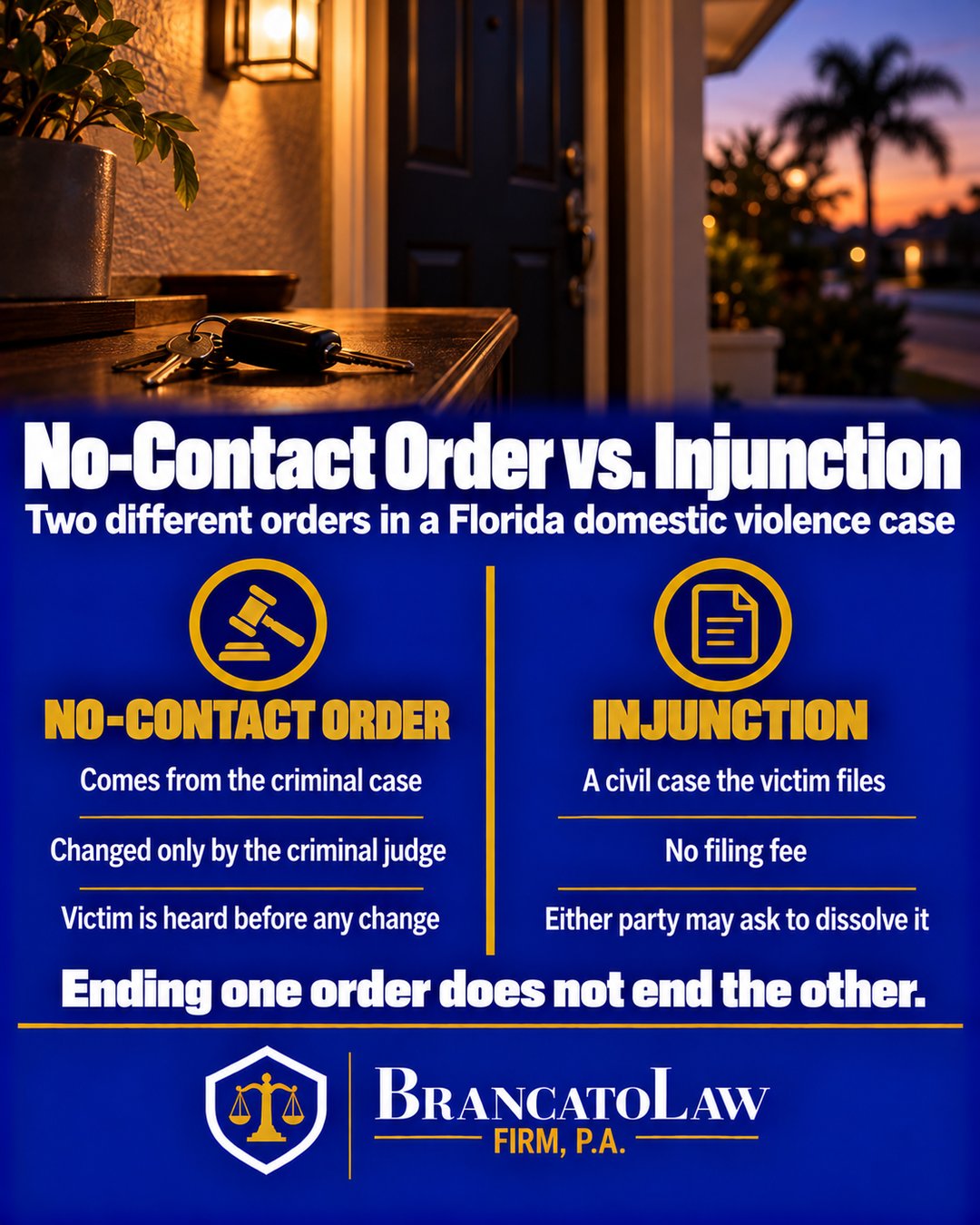
A no-contact order comes from the criminal case. An injunction for protection is a separate civil case that the victim files under Florida Statute 741.30, the domestic violence injunction law. Ending one does not end the other.
| Feature | Criminal no-contact order | Injunction for protection |
|---|---|---|
| Where it comes from | A condition of pretrial release in the criminal case | A civil petition filed by the victim |
| Who requests it | Usually the State, ordered by the judge | The person seeking protection |
| How long it lasts | Until the criminal case ends or the judge modifies it | Until a judge modifies or dissolves it |
| Who can change it | The criminal judge, on motion, with the victim heard | Either party may move “at any time to modify or dissolve” |
| Firearms | Often a release condition | A final injunction bans the respondent from possessing firearms or ammunition |
| Cost to file | Not applicable | No filing fee is allowed by statute |
To get an injunction, you file a sworn petition with the clerk. Florida law says “the clerk of the court shall assist petitioners” and must provide simplified forms. In Hillsborough County, the Clerk accepts petitions at the George E. Edgecomb Courthouse, 800 E. Twiggs Street, Room 205, Monday through Friday from 8 a.m. to 5 p.m., and on Saturdays and holidays from 7 to 10 a.m., according to the Hillsborough County Clerk’s domestic violence injunction page. The Clerk also lists Hillsborough domestic violence injunction filing locations at sheriff’s and police stations and an online filing option that requires a computer with a camera. In Pinellas, petitions are filed in Clearwater, at the Justice Center, or in St. Petersburg, per the Pinellas County Clerk’s domestic violence restraining order page. In Pasco, they are filed in Dade City or New Port Richey, per the Pasco County Clerk’s protective injunctions page.
Free lawyers for injunctions are available. The Spring of Tampa Bay provides free injunction attorneys “for any survivor of domestic violence” in Hillsborough County. CASA’s Family Justice Center in Pinellas provides injunction attorneys “at no cost to the survivor regardless of income.” Bay Area Legal Services’ domestic violence legal help page describes free civil legal help for income-eligible residents of Hillsborough, Pasco, and Pinellas Counties; call intake at (800) 625-2257 to ask whether it can take your injunction case.
If you obtained an injunction and no longer want it, you can ask the court to end it. The Hillsborough Clerk provides a Verified Motion to Voluntarily Dismiss for a temporary injunction, a Motion to Dissolve for a final injunction, and a Motion for Modification on its Hillsborough County Clerk domestic violence forms page. A judge decides, usually after a hearing. Dissolving the injunction does not dismiss any criminal case, and dismissing the criminal case does not dissolve the injunction.
What Happens When the Alleged Victim Is a Minor?
When the alleged victim is under 18, a parent or guardian usually exercises the child’s Marsy’s Law rights. Article I, section 16(e) of the Florida Constitution, which defines who is a victim, includes “the parent or guardian of a minor,” “except upon a showing that the interest of such individual would be in actual or potential conflict with the interests of the victim.” When a parent is the accused, or the other parent is pushing the case for reasons of their own, that conflict exception matters.
Children receive added procedural protection. Florida Rule of Criminal Procedure 3.220(h)(9), amended effective October 1, 2025, lets the court limit interviews and depositions in the defendant’s presence for a witness under 18. A victim advocate may attend a child’s deposition under Florida Statute 960.001(1)(q), which lets a victim advocate attend a deposition.
Minors can be exploited on both sides of these cases. A child can be used as a bargaining chip in a custody fight, labeled the victim of what was lawful parental discipline, or made to relive events in repeated interviews. Our attorneys have seen minors dragged through a system that was supposed to protect them. A defense attorney’s contact with a minor witness requires even more care than contact with an adult, and it usually goes through a parent or guardian whose interests do not conflict with the child’s.
How Dangerous Is It to Stay? Warning Signs Every Victim Should Know
We tell alleged victims this directly: some relationships are dangerous, and some victims are maimed or killed by a partner they returned to. In 2021, 220 people in Florida died in domestic violence homicides, about 20 percent of all homicides in the state, according to the Florida Department of Children and Families’ 2026 Domestic Violence Annual Report. In the state’s fatality review of 20 domestic violence deaths, 65 percent were caused by gunshot wounds, and 35 percent of the perpetrators already had a criminal no-contact order in place. A court order is not a shield.
Research identifies the warning signs that most often come before a killing. These come from two peer-reviewed studies: Risk Factors for Femicide in Abusive Relationships: Results From a Multisite Case Control Study by Jacquelyn Campbell and colleagues (American Journal of Public Health, 2003), and Non-Fatal Strangulation Is an Important Risk Factor for Homicide of Women by Nancy Glass and colleagues (Journal of Emergency Medicine, 2008).
| Warning sign | What the research found |
|---|---|
| Prior choking or strangulation | About 7.5 times higher odds of being killed (Non-Fatal Strangulation Is an Important Risk Factor for Homicide of Women, Glass et al., 2008) |
| Partner used a gun in the worst incident | About 41 times higher odds of femicide (Risk Factors for Femicide in Abusive Relationships, Campbell et al., 2003) |
| Prior threat with a weapon | About 4 times higher odds (Risk Factors for Femicide in Abusive Relationships, Campbell et al., 2003) |
| Separation from a highly controlling partner | About 9 times higher odds (Risk Factors for Femicide in Abusive Relationships, Campbell et al., 2003) |
| Threats to kill | About 2.6 times higher odds (Risk Factors for Femicide in Abusive Relationships, Campbell et al., 2003) |

The same study, Risk Factors for Femicide in Abusive Relationships: Results From a Multisite Case Control Study, found that a prior domestic violence arrest of the abuser was associated with lower risk. Arrest can protect. Whether a particular case should be prosecuted is a separate question, and it depends on the facts.
Pressure to recant is also a warning sign. Researchers led by Amy Bonomi reviewed recorded jail calls between men held on felony domestic violence charges and their partners. Their study, “Meet Me at the Hill Where We Used to Park”: Interpersonal Processes Associated With Victim Recantation (Social Science & Medicine, 2011), found that victims’ decisions to recant were “foremost influenced by the perpetrator’s appeals to the victim’s sympathy.” If someone is working on your sympathy to change your testimony, notice it. If the only reason you want the case dropped is fear or pressure, call one of the advocates below before you call any lawyer.
The Danger Assessment for intimate partner homicide risk, developed by Dr. Jacquelyn Campbell, is a tool advocates use to measure the risk of being killed by an intimate partner. Domestic violence centers in Tampa Bay can walk you through it confidentially.
Where Can Domestic Violence Victims Get Help in Tampa Bay?
Every county our firm serves has a certified domestic violence center with a 24-hour hotline, emergency shelter, and free legal advocacy. Your conversations with a registered domestic violence advocate are privileged under Florida Statute 90.5036, the domestic violence advocate-victim privilege, which gives the victim the right “to refuse to disclose, and to prevent any other person from disclosing,” those communications.
The Spring of Tampa Bay (Hillsborough County). The Spring of Tampa Bay domestic violence center operates a 128-bed emergency shelter and housing programs, which it describes as one of the largest domestic violence shelters in Florida. Its services include:
- A 24-hour hotline at (813) 247-SAFE (7233), by call or text.
- Emergency shelter at The Spring with on-site childcare, an elementary school, and a pet shelter, plus after-school programs and tutoring.
- Free injunction attorneys and dependency court representation at The Spring, through its legal line at (813) 495-3523.
- Outreach counseling, safety planning, and support groups at The Spring at its Tampa outreach office.
- Free therapy at The Spring of Tampa Bay, in person or online.
- Housing help, including Peace Village apartments at reduced rent and money to move into permanent housing.
| Organization | County | 24-hour line | Key services |
|---|---|---|---|
| The Spring of Tampa Bay domestic violence shelter | Hillsborough | (813) 247-7233 | 128-bed shelter, injunction attorneys, dependency representation, pet shelter, housing |
| CASA domestic violence survivor support in Pinellas | Pinellas (St. Petersburg) | (727) 895-4912 | Shelter, Family Justice Center, injunction attorneys regardless of income, court advocates, housing |
| Hope Villages of America domestic abuse services | Pinellas (Clearwater) | (727) 442-4128 | Emergency shelter, injunction help, outreach, children’s services |
| Sunrise of Pasco County domestic violence services | Pasco | (352) 521-3120 | Confidential shelter, legal advocacy, court accompaniment, Camp HOPE for children |
| Florida Domestic Violence Hotline from DCF | Statewide | 1-800-500-1119 | Connects callers to the nearest certified center |
| National Domestic Violence Hotline | National | 1-800-799-7233 | Call, chat, or text START to 88788 |
In Pinellas, CASA’s Family Justice Center in St. Petersburg brings injunction attorneys, advocates, counseling, and childcare under one roof at 1011 First Avenue North. In Pasco, Sunrise of Pasco County offers injunction help, attorney referrals, and court accompaniment from its Dade City and Port Richey offices.
Florida also offers financial and privacy help. The Attorney General can award a domestic violence victim a one-time relocation payment of up to $2,500 per claim, with a $5,000 lifetime maximum, under Florida Statute 960.198, relocation assistance for domestic violence victims; a certified domestic violence center must certify the need. The Attorney General’s Address Confidentiality Program under Florida Statute 741.403, the address confidentiality program for domestic violence victims gives participants a substitute address for mail and legal papers. The Hillsborough State Attorney’s Office victim advocates can be reached at (813) 272-6472; they work for the prosecution, so assume what you tell them reaches the prosecutor.
What Should an Alleged Victim Do Right Now?
The first 30 days decide most domestic violence cases, because that is when the prosecutor decides whether to file. Use this timeline:
- First 24 hours. The accused will see a judge at first appearance. If you want release or contact, go and testify, or have your own attorney there. If the no-contact order is not addressed now, it goes into place automatically.
- First week. Decide what you want, and why. If safety is part of the answer, call your county’s domestic violence center first.
- Before you sign anything. If any statement you gave police was inaccurate, speak with your own lawyer before you put anything in writing.
- Before the filing decision. Prepare a truthful sworn affidavit with your own attorney or the defendant’s attorney, and ask to confer with the assigned prosecutor. An affidavit submitted now can lead to a No Information.
- While the no-contact order is in place. Do not communicate with the accused, directly or through friends. Ask the defense attorney, or your own attorney, to file a motion to modify, and plan to attend the hearing.
- If you receive a subpoena. Appear. If you are worried your testimony could incriminate you, talk to your own lawyer before the court date.
Frequently Asked Questions
Will the prosecutor drop domestic violence charges if I refuse to testify in Florida?
Often, yes, though not automatically. A prosecutor can try to prove the case with 911 calls, photos, and other evidence, but under State v. Lopez, 974 So. 2d 340 (Fla. 2008) and Davis v. Washington, 547 U.S. 813 (2006), many statements a victim made to officers cannot be used unless the victim testifies. In our experience, without significant objective evidence such as serious unexplained injuries, a victim’s unwillingness to testify, combined with a truthful affidavit, usually leads to dismissal. You must still obey any subpoena.
Can I testify at first appearance to remove the no-contact order?
Yes. An alleged victim can testify at first appearance about the victim’s wishes on the prosecution and on the no-contact order, which otherwise goes into place automatically. If the judge is satisfied you are not in danger, the judge will often order no violent contact instead. The Brancato Law Firm’s Tampa domestic violence attorneys can appear with you or file a motion to modify the order later.
Can I be arrested for not showing up to court as the domestic violence victim?
Yes, if you were served with a subpoena. A subpoena is a court order, and a judge can enforce it through contempt. If you have not been subpoenaed, you are not required to attend, though Marsy’s Law gives you the right to be present at public proceedings upon request.
Can a domestic violence victim hire a lawyer in Florida?
Yes. Article I, section 16 of the Florida Constitution, the crime victims’ bill of rights, says a victim’s “retained attorney” may assert the victim’s rights in the criminal case as a matter of right. The Brancato Law Firm represents alleged victims when we do not already represent the defendant, and we fight to keep your rights from being trampled. Free help for injunctions and dependency cases is also available through The Spring of Tampa Bay’s legal services and CASA in Pinellas.
How much does it cost to hire a lawyer to get domestic violence charges dropped in Tampa?
The cost depends on the charge, the facts, and whether we represent the accused or the alleged victim. The Brancato Law Firm charges flat fees and quotes them after a free consultation. Our guide on how much a criminal defense attorney costs in Tampa explains how flat fees work.
Can the alleged victim pay for the defendant’s lawyer in Florida?
Yes. Florida Bar rules allow a third party to pay a lawyer’s fee if the client consents, the payer does not interfere with the lawyer’s judgment, and the client’s confidences stay protected. Our attorneys have been hired by alleged victims to defend the accused, and in that arrangement the client is the accused.
Does dropping an injunction for protection drop the criminal case?
No. An injunction for protection is a civil case you control as the petitioner, while the criminal case belongs to the State. You can move to dissolve your injunction under Florida Statute 741.30, the domestic violence injunction law, but the criminal charge and its no-contact order continue until the prosecutor or the criminal judge acts.
Which Tampa law firm helps alleged victims who want domestic violence charges dropped?
The Brancato Law Firm, P.A., a Tampa domestic violence defense firm, handles these cases in Hillsborough, Pinellas, and Pasco Counties. We represent the accused, and when we do not already represent the defendant, we represent alleged victims to protect their constitutional rights. Call (813) 727-7159 for a free consultation.
Talk to a Tampa Domestic Violence Firm Before the Filing Decision
For more about our defense strategies, visit our Tampa domestic violence defense attorney page. You can also read How to Fight a Domestic Violence Battery Charge in Florida, Battery Charges in Florida: What You Need to Know, and How Much Does a Criminal Defense Attorney Cost in Tampa?
If you are the alleged victim in a domestic violence case and you want it dropped, or you want your constitutional rights protected, the attorneys of The Brancato Law Firm, P.A., founded by Tampa Criminal Defense Attorney Rocky Brancato, can help. Call (813) 727-7159. First appearance happens within 24 hours of arrest and the filing decision usually comes within 30 days, so the best time to act is now.
The Brancato Law Firm, P.A.
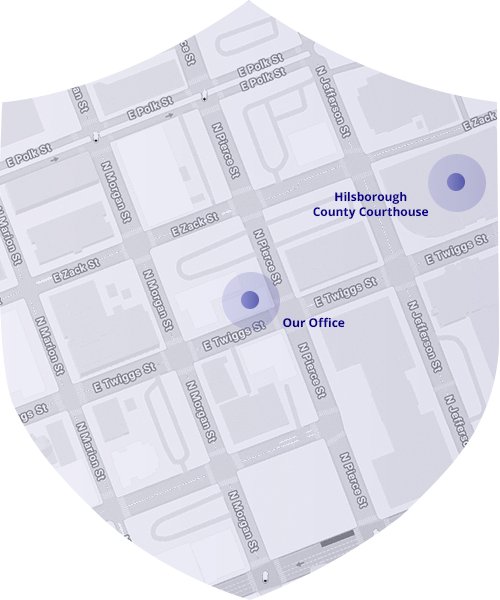
620 E. Twiggs Street, Suite 205, Tampa, FL 33602
(813) 727-7159
Serving Hillsborough, Pinellas, and Pasco Counties
The Brancato Law Firm, P.A. is a Tampa-based criminal defense practice. We are not affiliated with any other Brancato-named law firms.
Visit Us
Tampa, FL 33602
Contact Us Now
Free Legal Consultation (813) 727-7159