- Free Consultation 24/7: (813) 727-7159 Tap Here To Call Us


From First DUI to Death Penalty



Will a Domestic Violence Charge Cost You Your Gun or Your Job in Florida? (2026)


| A conviction for a misdemeanor domestic violence offense that involves force, such as battery on a spouse, partner, or co-parent, triggers a federal firearm ban under 18 U.S.C. § 922(g)(9) that usually lasts for life. There is no exception for police officers, deputies, corrections officers, or service members, so the ban can end any career that requires carrying a gun. Florida adds its own penalties: a withhold of adjudication blocks a concealed weapon license for three years, and a certified officer can be disciplined for the conduct even if no charge is ever filed. The best protection is a case that is never filed or that resolves without a plea to a force offense. |
For a police officer, a deputy, a soldier, or an armed security guard, a domestic violence arrest is a career problem before it is a criminal case. As founder of The Brancato Law Firm, P.A., a Tampa criminal defense firm, a former police academy instructor, and an on-call attorney for the Tampa PBA and the Suncoast PBA, I have spent more than 25 years in Hillsborough County courtrooms, and I know how quickly a plea offer that sounds harmless can end the right to carry a gun. Our attorneys look at every domestic violence case through two lenses at once: the criminal charge, and what any resolution will do to a client’s firearm rights, license, and job.
What Federal Law Bans Guns After a Domestic Violence Conviction?
Federal law makes it a crime for anyone convicted of a “misdemeanor crime of domestic violence” to possess, ship, or receive a firearm or ammunition. The ban is 18 U.S.C. § 922(g)(9), often called the Lautenberg Amendment, and the definition sits in 18 U.S.C. § 921(a)(33). A misdemeanor qualifies if it has the use or attempted use of physical force, or the threatened use of a deadly weapon, as an element, and it was committed against a person in one of the relationships the statute lists.
| Relationship to the alleged victim | Covered by the federal ban? |
|---|---|
| Current or former spouse | Yes |
| Parent or guardian of the alleged victim | Yes |
| Person who shares a child with the alleged victim | Yes |
| Person living or who lived with the alleged victim as a spouse | Yes |
| Current or recent former dating partner | Yes, for convictions entered on or after June 25, 2022 |
| Roommate, sibling, or other relative not listed above | Generally no under federal law, though Florida law may still treat the case as domestic violence |
The domestic relationship does not have to appear in the name of the Florida charge. In United States v. Hayes, 555 U.S. 415 (2009), the Supreme Court held that a West Virginia battery conviction could trigger the ban because the victim was the defendant’s wife, even though the battery statute said nothing about a domestic relationship. The Eleventh Circuit, which covers Florida, applied that rule to a Florida plea in United States v. Johnson, 981 F.3d 1171 (11th Cir. 2020): a Duval County man charged with domestic battery by strangulation and assault pleaded guilty to simple misdemeanor battery under section 784.03, and the court held that plea was a qualifying domestic violence conviction because the victim was his wife. Pleading down to plain battery does not avoid the federal ban.
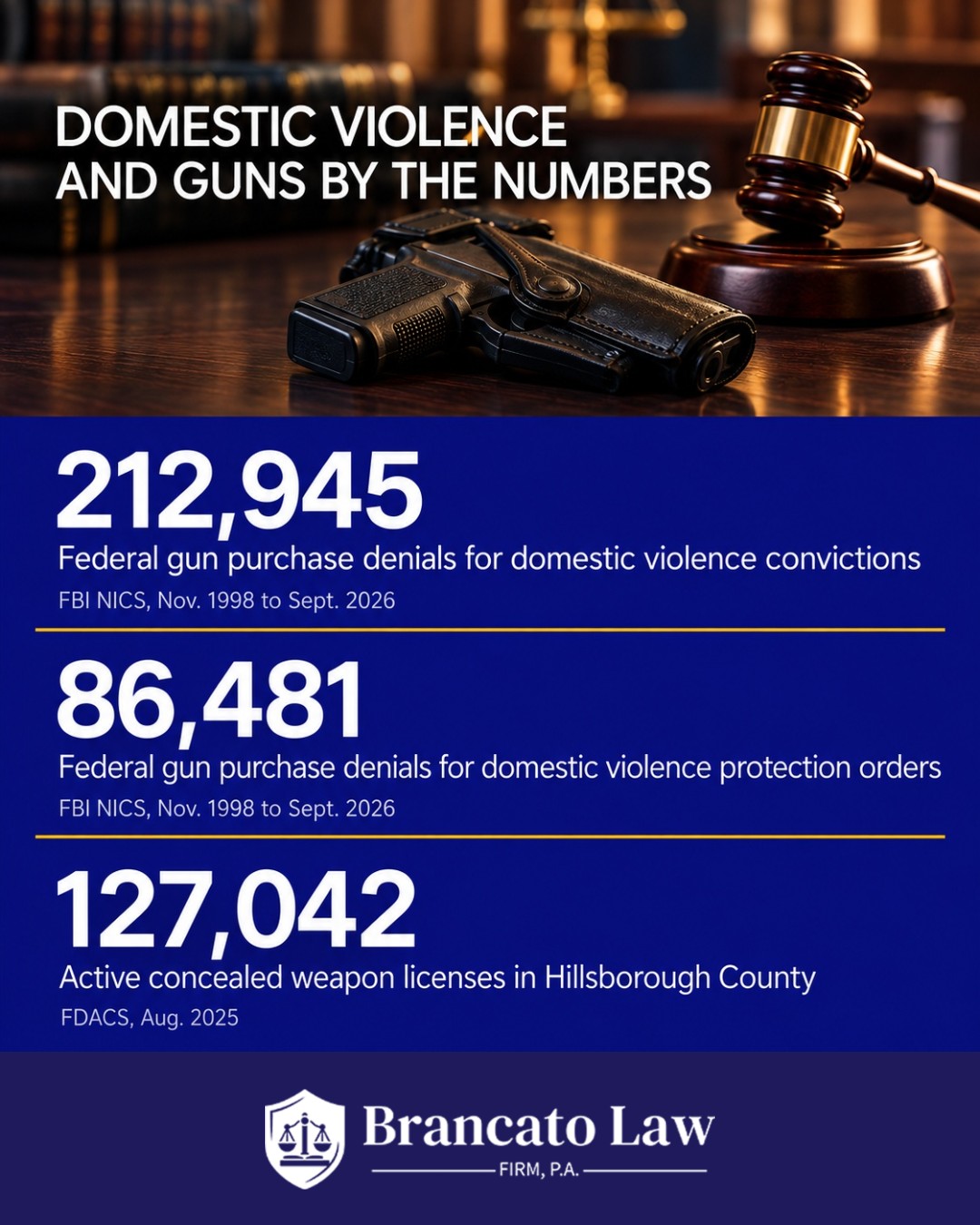
The federal government enforces this ban at every gun counter. From November 30, 1998, through September 30, 2026, the FBI’s background check system issued 212,945 denials for misdemeanor domestic violence convictions and 86,481 more for domestic violence protection orders, according to the FBI’s National Instant Criminal Background Check System federal denials report.
Does a Withhold of Adjudication Count for the Federal Gun Ban?
Whether a Florida withhold of adjudication counts as a conviction for the federal domestic violence gun ban is not settled, which makes any plea a risk. The ATF regulation, 27 C.F.R. § 478.11, says a person is not convicted unless “the person is considered to have been convicted by the jurisdiction in which the proceedings were held.” Florida’s general rule is that a withhold is not a conviction: in Clarke v. United States, 184 So. 3d 1107 (Fla. 2016), the Florida Supreme Court held that a guilty plea with adjudication withheld is not a conviction under the felon-in-possession statute, because that statute does not say otherwise. Florida’s domestic violence laws often do say otherwise. Since July 1, 2026, section 741.2801 counts a withhold or no contest plea as a prior domestic violence conviction, and the sealing bar in section 943.0584 does the same.
In practice, a withhold on a domestic battery case can still lead to a background check denial or a long delay while an examiner researches the record. A 2016 report by the U.S. Government Accountability Office found that domestic violence conviction checks were the slowest category the FBI handled: in fiscal year 2015 the FBI completed 90 percent of those denials within seven business days, because the information needed was often not in the national databases and examiners had to contact state agencies. Our attorneys treat a plea to any force offense against a covered family member as a potential lifetime ban and plan the defense around avoiding one.
Are Police Officers and Soldiers Exempt From the Domestic Violence Gun Ban?
No. Police officers, deputies, corrections officers, and members of the military have no exemption from the misdemeanor domestic violence gun ban, including for a duty weapon. Federal law exempts government-issued firearms from most of the federal gun statutes, but 18 U.S.C. § 925(a)(1) expressly carves out section 922(g)(9). An officer with a qualifying conviction cannot lawfully carry a service weapon, which in most agencies means the officer cannot keep the job.
A domestic violence injunction works differently, and the difference matters. A final injunction issued after a hearing can trigger a separate federal ban under section 922(g)(8), and Florida’s section 790.233 makes it a first-degree misdemeanor to possess a firearm while a final domestic violence injunction is in force. Both rules leave room for an officer’s duty weapon, because the government exemption in section 925(a)(1) still applies to injunction cases and section 790.233 exempts a certified officer carrying a firearm for official duties unless the agency says otherwise. The criminal conviction is the one with no exception.
| Situation | Federal gun ban | Florida gun ban | Duty weapon exception |
|---|---|---|---|
| Arrest or pending charge only | No | No statutory ban, though bond conditions can restrict guns | Depends on the agency |
| Final domestic violence injunction after a hearing | Yes, while it is in force (§ 922(g)(8), if the order meets the federal criteria) | Yes, while it is in force (§ 790.233) | Yes, unless the agency prohibits it |
| Conviction for a misdemeanor force offense against a covered person | Yes, usually for life (§ 922(g)(9)) | Concealed weapon license barred (§ 790.06) | None |
Can a Police Officer Lose Certification Without a Domestic Violence Conviction?
Yes. Florida’s Criminal Justice Standards and Training Commission can discipline a certified officer for conduct that amounts to battery, assault, stalking, or violating an injunction, even if the State never files a charge. Under Florida Administrative Code Rule 11B-27.0011(4)(b), an officer fails the moral character standard by pleading guilty to one of those offenses “notwithstanding any suspension of sentence or withholding of adjudication,” or by “the perpetration by an officer of an act that would constitute” one of them “whether criminally prosecuted or not.” The listed statutes include sections 784.011 (assault), 784.03 (battery), 784.048 (stalking), and 741.31 (injunction violations).
That means an officer’s defense has two tracks: the criminal case and the agency’s internal investigation, which can move on its own schedule. Statements made in one can surface in the other. When a PBA member calls our firm after a domestic arrest, we coordinate the criminal defense with the union representative from the start, and we plan the internal affairs interview before it happens. Our post on criminal defense for law enforcement officers in Tampa covers the broader process.
What Happens to a Florida Concealed Weapon License After a Domestic Violence Arrest?
A Florida concealed weapon license is suspended after an arrest or formal charge for a disqualifying crime until the case is resolved, and a domestic violence plea can block it for years. Under section 790.06, the Department of Agriculture and Consumer Services must deny a license to anyone who had adjudication withheld on a misdemeanor crime of domestic violence until three years after probation ends, to anyone subject to an active domestic violence injunction, and to anyone barred from owning a gun under federal law. The license count shows how many people this reaches: Hillsborough County had 127,042 active concealed weapon licenses as of August 31, 2025, according to the Florida Department of Agriculture and Consumer Services.
Which Outcomes Protect Your Gun Rights in a Domestic Violence Case?
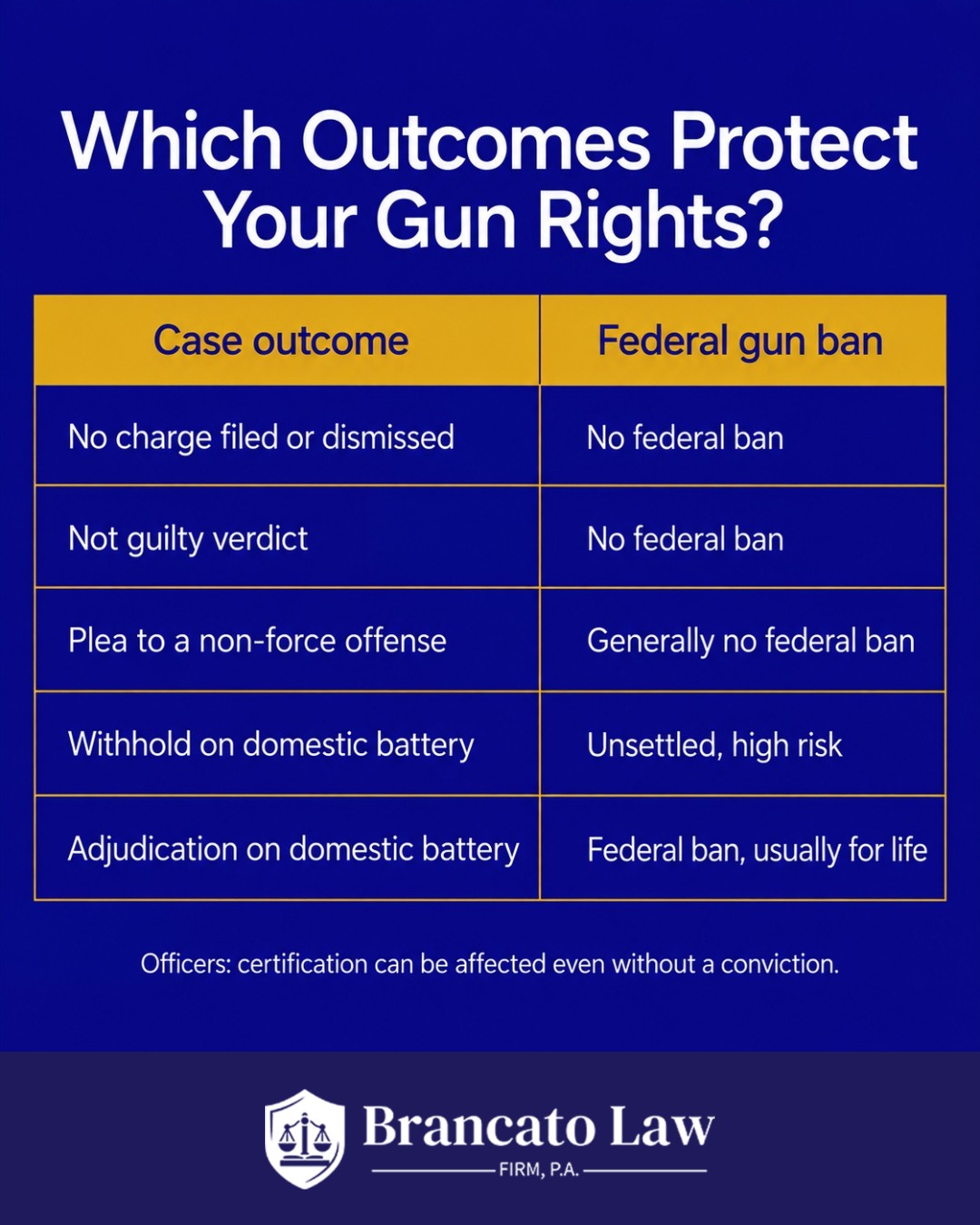
The outcomes that protect gun rights are the ones with no plea to a force offense against a covered family member: no charge filed, a dismissal, an acquittal, or, in some cases, a plea to an offense without a force element. The table shows how each common outcome plays out.
| Outcome | Federal gun ban (§ 922(g)(9)) | Florida concealed weapon license | Officer certification (Rule 11B-27.0011) |
|---|---|---|---|
| No charge filed or charge dismissed | No | Suspension ends when the case closes | Still possible, because the rule reaches conduct “whether criminally prosecuted or not” |
| Not guilty verdict | No | Suspension ends when the case closes | Still possible for the same reason |
| Plea to an offense with no force element, such as disorderly conduct | Generally no | Depends on the offense | Depends on whether the offense is on the rule’s list |
| Withhold of adjudication on battery or assault of a covered person | Unsettled and high risk | Barred until 3 years after probation ends | Yes; a guilty plea counts even with a withhold, and the conduct itself can count either way |
| Adjudication of guilt on battery or assault of a covered person | Yes, usually for life | Barred | Yes |
Every one of these outcomes is decided in negotiation or at trial, and the leverage is greatest before the State files. Our pre-file advocacy work puts the evidence in front of the prosecutor early, and when a plea is on the table, we check the exact statute and wording against the federal definition before a client signs anything. Our Tampa domestic violence defense attorney page and our Tampa gun crimes lawyer page explain how we handle each side of these cases.
What Should Officers and Gun Owners Do After a Domestic Violence Arrest?
The first week after a domestic violence arrest decides most of what happens to a gun owner’s rights and career, so these steps come first:
- Follow every bond and injunction condition on firearms exactly. If a judge orders guns surrendered, surrender them the way the order requires and keep the receipt.
- Do not give a statement to investigators about the incident, and talk to counsel and your union representative before any internal affairs interview.
- Do not contact the alleged victim while a no-contact order is in place, even if they reach out first.
- Save evidence: texts, call logs, photos of your own injuries, and names of witnesses.
- Hire a lawyer before the filing decision. The State has 30 days to file if you are in jail and 60 if you are on bond, and the work that protects a career happens before then.
Domestic Violence and Gun Rights FAQs
Can I own a gun if my domestic violence charge is dropped in Florida?
Yes. A dropped or dismissed domestic violence charge is not a conviction, so it does not trigger the federal ban under section 922(g)(9), though an active injunction or bond condition can still restrict guns while it lasts. The Brancato Law Firm works to get domestic violence cases declined before filing, which is the cleanest result for a gun owner. Learn more about our representation before charges are filed.
Does a withhold of adjudication on domestic battery stop me from buying a gun?
It can. Whether a Florida withhold counts as a conviction under the federal ban is unsettled, and a withhold on a misdemeanor crime of domestic violence bars a Florida concealed weapon license until three years after probation ends under section 790.06. Our attorneys at The Brancato Law Firm review any proposed plea against both the federal definition and the Florida licensing rules before a client accepts it.
Can a police officer carry a duty weapon after a domestic violence conviction?
No. The federal misdemeanor domestic violence ban has no exception for government-issued firearms, so a qualifying conviction bars an officer from carrying a service weapon. The Brancato Law Firm, on call for the Tampa PBA and the Suncoast PBA, defends officers with that consequence in view from the first phone call; see our law enforcement officer defense post.
Can a domestic violence conviction be expunged in Florida to restore gun rights?
No. Under section 943.0584, a domestic assault or battery that ends in a plea or verdict, even with a withhold, cannot be sealed or expunged in Florida, so expunction is not a path back to gun rights. Because the options after a plea are so limited, The Brancato Law Firm focuses on the outcome before any plea is entered.
Does a temporary injunction take away my guns in Florida?
Florida’s possession ban in section 790.233 and the federal ban in section 922(g)(8) apply to final injunctions issued after a hearing, not to a temporary injunction entered without one. The Brancato Law Firm prepares clients for the final hearing, where the injunction, and the gun ban that comes with it, is decided.
Does the 2022 “boyfriend loophole” change apply to me?
It applies only to domestic violence convictions entered on or after June 25, 2022, when federal law added current or recent former dating partners to the ban. Our attorneys at The Brancato Law Firm check the date and the relationship in every case, because a person with one dating-relationship conviction can regain federal gun rights after five years if no other disqualification applies. The statute is 18 U.S.C. § 921(a)(33)(C).
For more about our defense strategies, visit our Domestic Violence page.
A plea offer at arraignment can end a career, so get advice before you answer it. Call The Brancato Law Firm, P.A., founded by Tampa Criminal Defense Attorney Rocky Brancato, at (813) 727-7159, and our attorneys will review the arrest, the firearm consequences, and your job’s rules before the State decides what to file. You can call us at any hour, and our office is two blocks from the courthouse. Our firm has Spanish-speaking staff, and attorney Jean-Luc Adrien speaks Spanish, Haitian Creole, and French.

The Brancato Law Firm, P.A.
620 E. Twiggs Street, Suite 205, Tampa, FL 33602
(813) 727-7159
Serving Hillsborough, Pinellas, and Pasco Counties
The Brancato Law Firm, P.A. is a Tampa-based criminal defense practice. We are not affiliated with any other Brancato-named law firms.
Visit Us

Tampa, FL 33602

Contact Us Now
Free Legal Consultation (813) 727-7159
