

From First DUI to Death Penalty



How to Fight a False Name to Police Charge in Florida? (2026)


Giving a false name or false identification to a police officer in Florida is a first-degree misdemeanor under section 901.36, punishable by up to 1 year in jail, and becomes a third-degree felony punishable by up to 5 years if another person is harmed because their name or identification was used. The law applies only after a person has been arrested or lawfully detained, so a false name given during a consensual encounter or an unlawful stop is not a violation. A separate law, section 837.055, makes it a first-degree misdemeanor to knowingly give false information to an officer conducting a felony or missing person investigation with intent to mislead or impede it.
Prosecutors file false-name charges because they are easy to prove once fingerprints reveal the person’s real identity, and judges often treat the lie as a sign that the person should not be trusted on release. The charge is weaker than it looks, because the State must first prove the stop or arrest was lawful. As founder of The Brancato Law Firm, P.A., a Tampa criminal defense firm, and a former police academy instructor who taught officers the rules for stops and detentions, I have tried more than 150 jury trials to verdict in more than 25 years in Hillsborough County courtrooms. Our attorneys defend these charges by examining the encounter from its first second, because the legality of the stop often decides the case.
What Is the Florida Law Against Giving a False Name to Police?
Section 901.36, Florida Statutes, makes it unlawful for a person who has been arrested or lawfully detained by a law enforcement officer to give a false name, or otherwise falsely identify himself or herself in any way, to the officer or to county jail personnel. That covers a made-up name, a relative’s or friend’s name, a false date of birth, and someone else’s driver license or ID card.
The most common setting is a traffic stop where the driver has a suspended license or an outstanding warrant and gives a sibling’s or cousin’s name to avoid arrest. That is why these cases often travel with charges defended by a Tampa criminal traffic lawyer, such as driving while license suspended. Drivers are already required to present their license on an officer’s demand under section 322.15, and failing to do so is a noncriminal infraction; lying about who you are is a crime.
What Are the Penalties for Giving a False Name or False Information to Police?
A false-name charge is a first-degree misdemeanor in most cases, punishable by up to 1 year in jail under section 775.082 and a fine of up to $1,000 under section 775.083. It becomes a third-degree felony, punishable by up to 5 years in prison and a $5,000 fine, when the false name or identification results in another person being adversely affected. The court may also order restitution and issue orders correcting any public record that contains the false name.
| Offense | Statute | Degree | Maximum jail or prison | Maximum fine |
|---|---|---|---|---|
| Giving a false name or false identification after arrest or lawful detention | 901.36(1) | First-degree misdemeanor | 1 year in county jail | $1,000 |
| False name or identification that adversely affects the person whose name was used | 901.36(2) | Third-degree felony | 5 years in prison | $5,000 |
| False information to an officer conducting a felony or missing person investigation | 837.055(1) | First-degree misdemeanor | 1 year in county jail | $1,000 |
| False information in a missing child investigation (child 16 or younger) when the child suffers great bodily harm, permanent disability or disfigurement, or death | 837.055(2) | Third-degree felony | 5 years in prison | $5,000 |
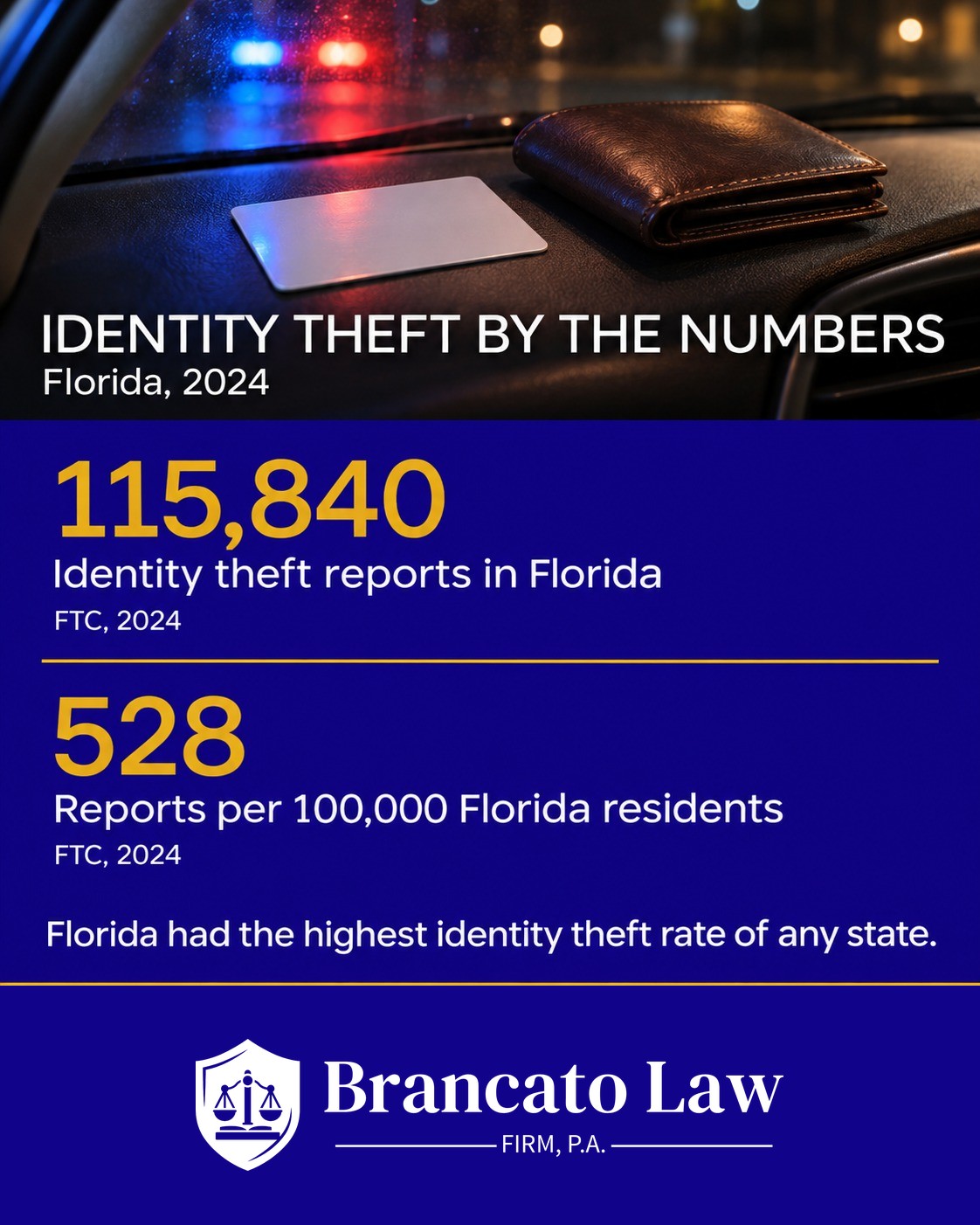
The felony version of the false-name law exists because using a real person’s name puts that person at risk of a criminal record, a license suspension, or a warrant they know nothing about. Florida led the nation in identity theft reports in 2024, with 115,840 reports and 528 reports per 100,000 residents, the highest rate of any state, according to the Federal Trade Commission’s Consumer Sentinel Network Data Book 2024. Nationally, nearly 1 in 10 U.S. residents age 16 or older experienced identity theft in 2021, according to the Bureau of Justice Statistics report Victims of Identity Theft, 2021. When the name given belongs to a real person, prosecutors treat the case as closer to identity theft than to a simple lie.
Is It a Crime to Give a False Name If You Were Not Under Arrest?
No, giving a false name is not a crime under section 901.36 unless you had already been arrested or lawfully detained when you gave it. The Second District, whose decisions bind Hillsborough, Pinellas, and Pasco courts, applied that rule in Whyte v. State, 940 So. 2d 1174 (Fla. 2d DCA 2006). A Haines City officer checking on a man who said he had been drinking asked his name, and the man answered “Marley Marley.” The officer knew him and arrested him on the spot for giving a false name. Because there was no lawful detention before the false name, the court held the arrest was unlawful, ruled the evidence from the search should have been suppressed, and ordered him discharged.
The First District reached the same result in D.K.D. v. State, 92 So. 3d 897 (Fla. 1st DCA 2012), where officers approached a juvenile just to ask questions and he gave a false name. The court held the statute requires the arrest or lawful detention to come first, found the encounter was consensual, and added that even if it became a detention, it was not lawful without a well-founded suspicion of criminal activity. The court reversed the adjudication.
| Type of encounter | What it is | Can a false name be charged? |
|---|---|---|
| Consensual encounter | An officer approaches and asks questions; you are free to leave | No |
| Unlawful detention | A stop without reasonable suspicion or a traffic violation | No, and evidence may be suppressed |
| Lawful detention | A traffic stop or investigative stop based on reasonable suspicion | Yes |
| Arrest | Custody based on probable cause or a warrant | Yes, including false names given to jail staff |
Whether a stop was lawful is a Fourth Amendment question, explained in our post on whether police can stop and frisk you in Florida.
What Is the Crime of Giving False Information to Law Enforcement?
Giving false information to law enforcement is a separate crime under section 837.055, Florida Statutes, and it covers lies about the facts of a case rather than lies about your identity. The State must prove the person knowingly and willfully gave false information to an officer who was conducting a missing person investigation or a felony criminal investigation, with the intent to mislead the officer or impede the investigation. A lie told during a misdemeanor investigation does not fit subsection (1).
The best-known case under this statute is Anthony v. State, 108 So. 3d 1111 (Fla. 5th DCA 2013), the Casey Anthony appeal from Orange County. She was convicted of four misdemeanor counts for false statements to a detective during the investigation into her missing daughter. The Fifth District held that the false statements given in one interview made up a single offense because the statute punishes giving “false information,” and it ordered two of the four convictions vacated. That unit-of-prosecution rule still matters when the State charges one count for every sentence in a single interview.
The Legislature then added subsection (2), creating a felony for false information in a missing child investigation when the child suffers serious harm or death. In Melvin v. State, 246 So. 3d 424 (Fla. 4th DCA 2018), the Fourth District described the felony as enacted in the wake of the Anthony case and upheld the charge under its plain language even though the child had died before the false statements were made.
How Do Our Attorneys Fight a False Name or False Information Charge?
Our attorneys fight these charges by attacking the legal conditions the statutes require, because the lie itself is usually not in dispute. These are the defenses we raise most often:
- No arrest or lawful detention. If the false name came during a consensual encounter, or the stop lacked reasonable suspicion or a valid traffic violation, section 901.36 does not apply, as Whyte and D.K.D. hold.
- Suppression of everything that followed. When the arrest rested only on the false name, a motion to suppress can remove drugs, weapons, or property found in the search incident to that arrest.
- No felony investigation. Section 837.055(1) requires an officer conducting a felony or missing person investigation. A lie during a misdemeanor or traffic investigation does not meet that element.
- No intent to mislead. Confusion, a nickname, a mumbled answer, or a mistaken date of birth is different from a knowing and willful lie.
- No adverse effect. The felony under section 901.36(2) requires proof that another person was actually harmed by the use of their name. We hold the State to that proof.
- One offense, not many. Under Anthony, false statements in a single interview are one offense, which can cut multiple counts down to one.
- Resolving the case without a conviction. For a first offense, we press for dismissal, a reduced charge, or a diversion program, especially when the underlying stop was minor.
False-name charges often come with resisting an officer without violence when the person also pulls away or refuses commands. A false ID card, rather than a spoken false name, can bring a separate charge covered in our post on how to fight a fake ID charge in Florida.
What Happens After a False Name Arrest in Hillsborough County?
A person arrested for giving a false name in Hillsborough County is booked into the county jail and, if not released on a bond schedule, sees a judge at first appearance within 24 hours. The lie usually comes out at booking, when fingerprints are matched to a true identity. In our experience, Hillsborough County does not offer pretrial services supervision as a release option, though some neighboring counties do, and a judge who has just read that the defendant lied about his name is more likely to set a higher bond. Our post on Hillsborough first appearance explains that hearing.
A misdemeanor false-name charge is heard in county court, while the felony versions go to circuit court in the 13th Judicial Circuit. Our guide to the Florida criminal case process covers each stage after arrest, and our Hillsborough County criminal defense attorney page explains local procedure.
What Should You Do If Police Want to Question You About a Felony?
If detectives want to talk to you about a felony or a missing person, the safest course is to say nothing until you have spoken with a lawyer, because silence is not a crime and a false statement can be. Section 837.055 punishes knowing lies, and investigators often record interviews and check every detail. Our attorneys provide representation before charges are filed, which means we can speak to investigators for you and keep a frightened answer from becoming a new charge.
Frequently Asked Questions About False Name and False Information Charges in Florida
Can a false name charge be dropped in Florida?
Yes, false-name charges are often dropped or dismissed when the stop or detention was not lawful, because section 901.36 applies only after an arrest or lawful detention. The Brancato Law Firm reviews the body camera footage and the officer’s stated reason for the stop before anything else, and we file a motion to dismiss or suppress when the encounter was consensual or unlawful.
Do I have to give police my name during a traffic stop in Florida?
A driver must present a driver license on an officer’s demand under section 322.15, and once a traffic stop is lawful, giving a false name is a crime under section 901.36. Our attorneys at The Brancato Law Firm often see a suspended license turn into two charges this way, and we work to resolve both; learn more on our criminal traffic defense page.
Is giving a fake date of birth to police the same as giving a false name?
Yes, section 901.36 covers anyone who gives a false name or otherwise falsely identifies himself or herself in any way, which includes a false date of birth. The Brancato Law Firm looks at whether the answer was a knowing lie or a mistake, since the State must prove the false identification was intentional.
Is using my brother’s name with police a felony in Florida?
It can be a third-degree felony under section 901.36(2) if your brother is adversely affected, such as by a ticket, a warrant, or a license suspension issued in his name. Our attorneys at The Brancato Law Firm press the State for proof of actual harm, because without it the charge is a misdemeanor; our post on identity theft charges in Florida covers the related offenses.
Is lying to police during an investigation a crime if I was not under arrest?
Yes, section 837.055 does not require an arrest; it applies to knowing lies told to an officer conducting a felony or missing person investigation, with intent to mislead. When you learn detectives want to talk, The Brancato Law Firm can step in through pre-file advocacy before any statement is made.
What is the difference between giving false information and filing a false police report?
Giving false information under section 837.055 involves lying during an investigation already underway, while a false report involves telling police a crime happened when it did not, which Florida charges under separate statutes. The Brancato Law Firm defends both, and our post on how to fight a perjury charge in Florida explains the related crime of lying under oath.
Talk to a Tampa Defense Lawyer About a False Name or False Information Charge
Before your first court date, have a lawyer look at how the stop began, because that single question can end a false-name case. Our attorneys will get the body camera and dash camera video, test the officer’s reason for the stop, and move to suppress or dismiss when the law allows. Reach The Brancato Law Firm, P.A., founded by Tampa Criminal Defense Attorney Rocky Brancato, at (813) 727-7159; call us at any hour, and our office is two blocks from the courthouse. Our firm has Spanish-speaking staff, and attorney Jean-Luc Adrien speaks Spanish, Haitian Creole, and French. Learn more about our Spanish and Haitian Creole criminal defense services.
For more about our defense strategies, visit our Tampa Criminal Traffic Defense page.
The Brancato Law Firm, P.A.
620 E. Twiggs Street, Suite 205, Tampa, FL 33602
(813) 727-7159
Serving Hillsborough, Pinellas, and Pasco Counties
The Brancato Law Firm, P.A. is a Tampa-based criminal defense practice. We are not affiliated with any other Brancato-named law firms.
Visit Us

Tampa, FL 33602

Contact Us Now
Free Legal Consultation (813) 727-7159
