- Free Consultation 24/7: (813) 727-7159 Tap Here To Call Us


From First DUI to Death Penalty



Can Police Stop and Frisk You in Florida?



| Key Takeaway: Yes — but only within strict limits. Under Florida’s Stop and Frisk Law, an officer may temporarily detain you when the circumstances reasonably indicate you have committed, are committing, or are about to commit a crime, and may pat you down only with a separate, objective reason to believe you are armed and dangerous. Two Florida appellate decisions issued the same week in August 2026 show exactly where those lines sit — and Florida law contains its own exclusionary rule: evidence from a frisk that breaks the statute’s rules is inadmissible in court. |
I’m Rocky Brancato, founder of The Brancato Law Firm, P.A., a Tampa criminal defense firm. I taught search and seizure to police officers at the police academy — the same rules discussed on this page — and today our attorneys use that insider’s understanding of how stops and frisks are supposed to work to challenge the ones that don’t.
What Is Florida’s Stop and Frisk Law?
Florida’s Stop and Frisk Law, section 901.151, Florida Statutes, is the state’s codified version of the rule from Terry v. Ohio, 392 U.S. 1 (1968) — the landmark U.S. Supreme Court case that first allowed officers to briefly detain and pat down a suspect on less than probable cause. The Florida statute authorizes an officer to temporarily detain any person “under circumstances which reasonably indicate that such person has committed, is committing, or is about to commit” a crime, for the limited purpose of identifying the person and learning the circumstances that aroused the officer’s suspicion.
The statute then draws boundaries that many street encounters blow straight through. The detention may last no longer than reasonably necessary to accomplish that limited purpose, and it may not extend beyond the place where it began or its immediate vicinity. If probable cause to arrest develops, the officer must arrest; if it does not, the officer must let the person go. Every one of those requirements is a potential defense issue, because the statute’s final subsection is a weapon our attorneys use regularly: no evidence seized in a search under the statute is admissible in any Florida court unless the stop and the search complied with the statute’s own rules.
What Does the State Need to Stop You? (Less Than You Think)
The legal standard for the stop itself is reasonable suspicion — specific, articulable facts suggesting criminal activity, judged by the totality of the circumstances. It is far less than probable cause, and far less than proof. But it must be more than a hunch, a feeling, or your mere presence in the “wrong” neighborhood.
Here is a quirk of the statute that surprises even lawyers: section 901.151 uses the words “probable cause” in its frisk provision, but Florida courts have held that in this statute the term actually means reasonable belief or suspicion — the point was repeated just weeks ago in State v. Lyles, No. 3D24-1602 (Fla. 3d DCA Aug. 5, 2026), a decision we discuss in detail below.
Florida courts judging reasonable suspicion look at the whole picture. In Cook v. State, No. 4D2025-1960 (Fla. 4th DCA Aug. 5, 2026), decided the same day as Lyles, the Fourth District repeated the factors courts weigh: the time; the day of the week; the location; the physical appearance of the suspect; the behavior of the suspect; the appearance and manner of operation of any vehicle involved; and anything incongruous or unusual in the situation as interpreted in light of the officer’s experience.
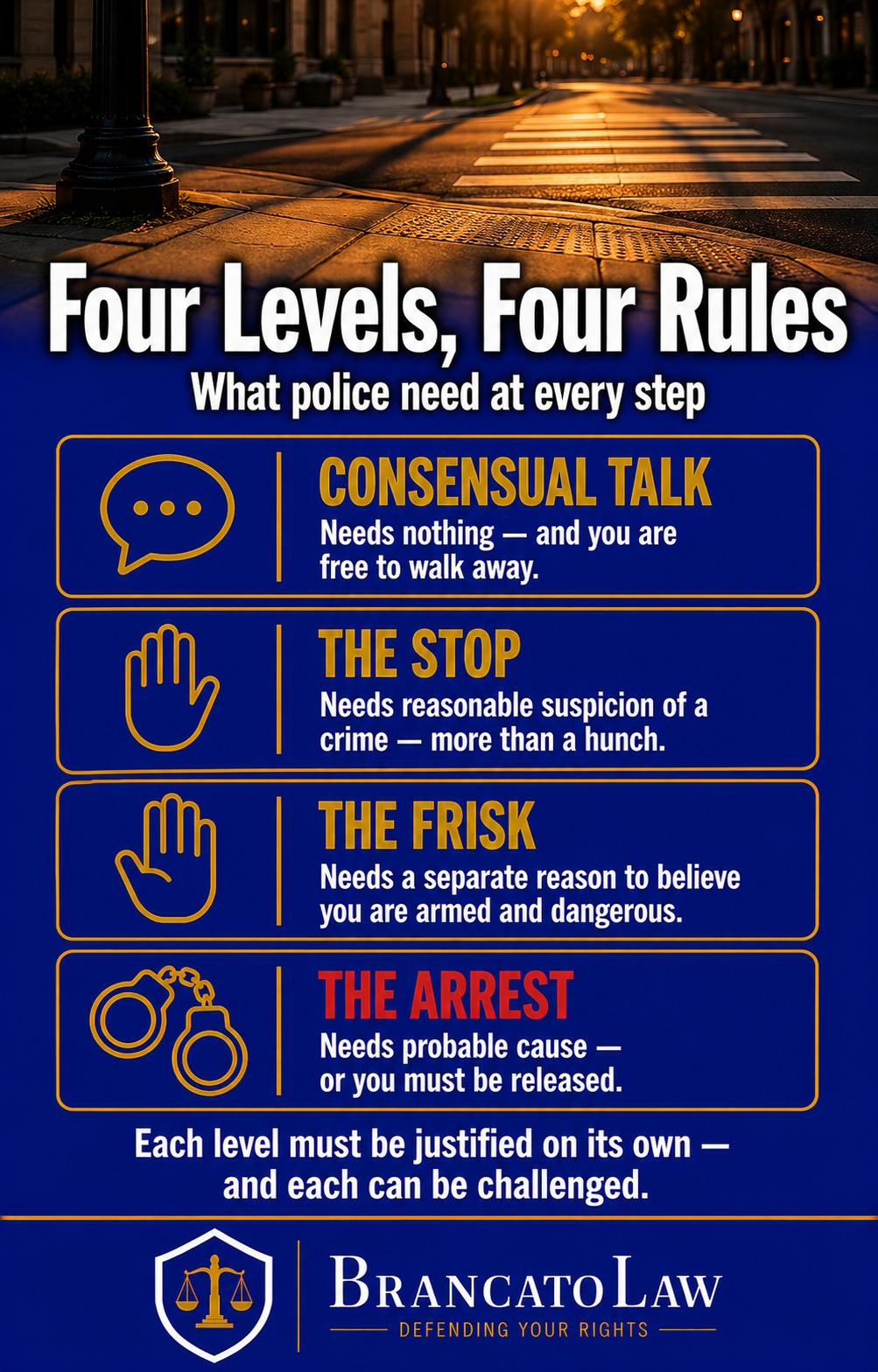
| Encounter level | What the officer needs | What it allows |
|---|---|---|
| Consensual encounter | Nothing | Officer may ask questions; you may walk away |
| Investigatory stop | Reasonable suspicion of a crime | Brief detention, at that location, to confirm or dispel suspicion |
| Frisk (pat-down) | Separate reasonable suspicion you are armed and dangerous | Outer-clothing pat-down limited to finding weapons |
| Arrest | Probable cause | Full custodial arrest and search incident to arrest |
When Can Police Frisk You? The Stop Is Not Enough
A lawful stop does not automatically authorize a frisk — this is the single most misunderstood point in Florida stop-and-frisk law. Under section 901.151(5), the officer must separately have a reasonable belief that you are armed with a dangerous weapon and therefore pose a threat to the officer or someone else, and even then may search “only to the extent necessary to disclose, and for the purpose of disclosing,” the weapon.
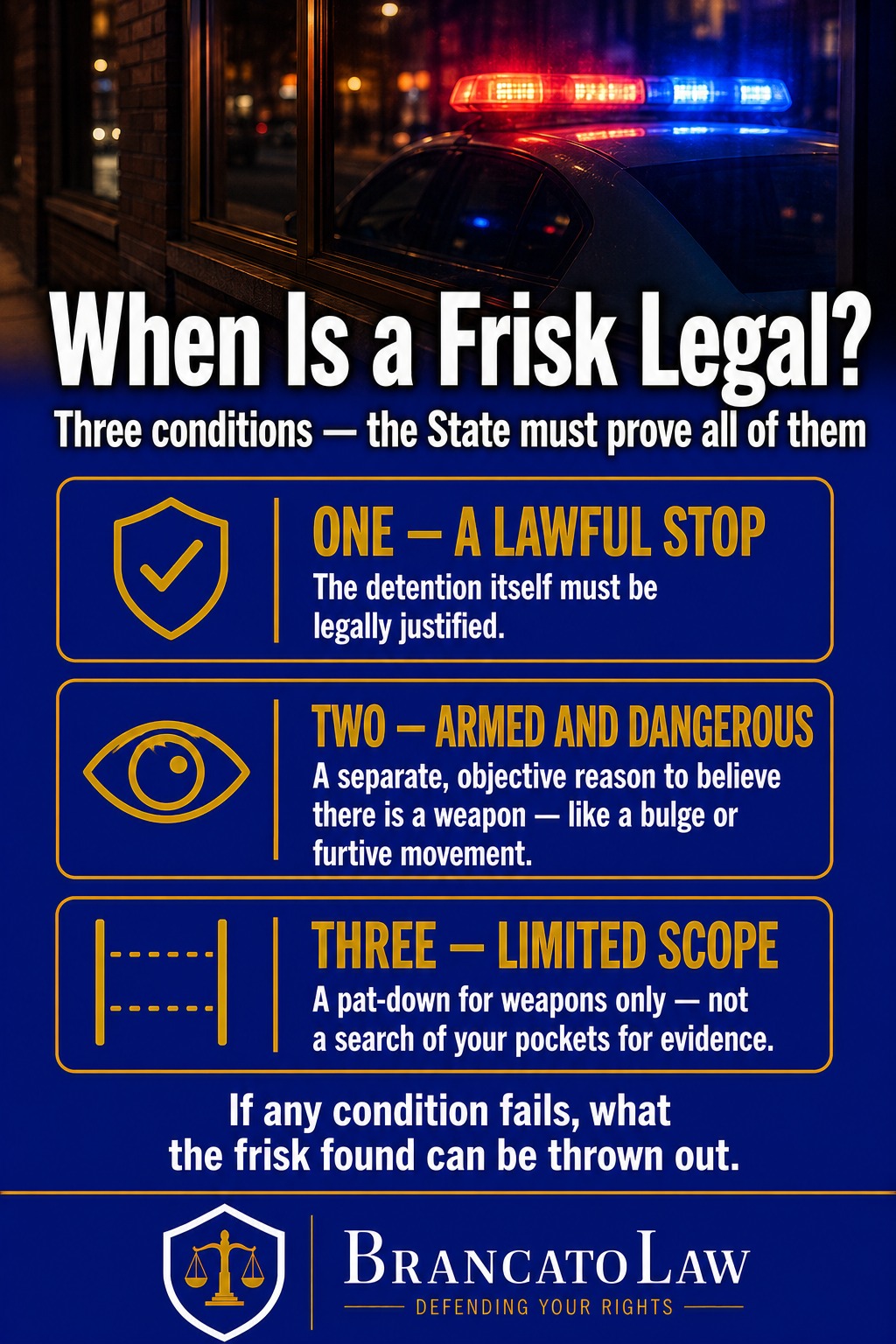
Florida courts distill this into three conditions, each of which the State must satisfy: the detention itself must be lawful; the officer must have a reasonable suspicion that the person is armed; and the pat-down must be strictly limited to finding the weapon. The suspicion that you are armed must rest on some objective basis — courts point to things like aggressive behavior, furtive movements, or a visible bulge in the clothing — and not simply on whatever justified the stop in the first place. A frisk that fails any of the three conditions is unlawful, and what it turns up is subject to suppression under the statute’s exclusionary rule.
What Does the Lyles Decision Mean for Gun Cases?
In State v. Lyles, No. 3D24-1602 (Fla. 3d DCA Aug. 5, 2026), officers responding to a shots-fired report had a fairly detailed BOLO — a “be on the lookout” description — of the suspect. A detective spotted Lyles, who matched the description, and when they made eye contact the detective saw a bulge at Lyles’s waistband and watched him move his hand to adjust it. The detective stopped him and lifted his shirt, revealing a firearm. The trial court suppressed the gun, reasoning in part that the stop and the search happened simultaneously and that the detective never articulated safety concerns.
The Third District reversed. The court held that the totality of the circumstances — a BOLO for a shooting suspect, the matching description, the bulge, and the hand movement toward it — gave the detective reasonable suspicion that Lyles was armed and dangerous, and that nothing in the law forbids the stop and the protective search from happening at the same moment.
The evergreen lessons cut both ways, and our attorneys use each of them. For the State, Lyles confirms that a bulge plus a furtive adjustment, in the context of a shots-fired BOLO, will usually justify a frisk. For the defense, the decision reaffirms the framework that decides these cases: the frisk requires its own objective justification, distinct from the stop. When there is no bulge, no furtive movement, no report of a weapon — just an officer’s routine habit of patting down everyone he stops — the framework Lyles applied is the roadmap to suppression. In the permitless-carry era, when carrying a firearm is often perfectly legal, these stop-and-frisk boundaries have become the central battleground in Tampa Bay gun prosecutions — we cover the substantive gun charges in our guide to Florida’s gun crime laws.
Is Running From the Police a Crime in Florida?
It can be — and the answer traces to one of the most consequential Florida Supreme Court decisions of the modern era. In C.E.L. v. State, 24 So. 3d 1181 (Fla. 2009), a teenager standing in the common area of an apartment complex in a high-crime area took off running the moment officers approached, then kept running after they ordered him to stop. The Florida Supreme Court held that unprovoked, headlong flight from police in a high-crime area itself creates the reasonable suspicion that justifies a stop — and that once the officers’ command to stop was therefore lawful, the continued flight in defiance of it constituted the crime of resisting an officer without violence under section 843.02, Florida Statutes.
The rule has hard edges worth knowing. Mere presence in a high-crime area is not reasonable suspicion, and as a general rule flight alone, without more, does not support a resisting charge — it is the combination of unprovoked flight plus the high-crime setting that changes the analysis. Whether the area actually qualifies as “high-crime,” whether the flight was truly unprovoked, and whether the officer’s command came before or after the legal justification arose are all litigable questions, and they decide real cases. We break down the resisting charge itself in our guide to resisting an officer without violence in Florida.
What Are Your Rights During a Stop and Frisk?
You have more rights during a street stop than most people exercise — and fewer than internet folklore suggests. You are not required to answer questions beyond basic identification during a lawful stop, and you never have to consent to a search: a frisk imposed over your objection must stand on the officer’s own reasonable suspicion that you are armed, or its fruits are suppressible. What you cannot lawfully do is physically resist, run from a lawful command to stop, or give a false name — each of those converts a bad stop into a real charge.
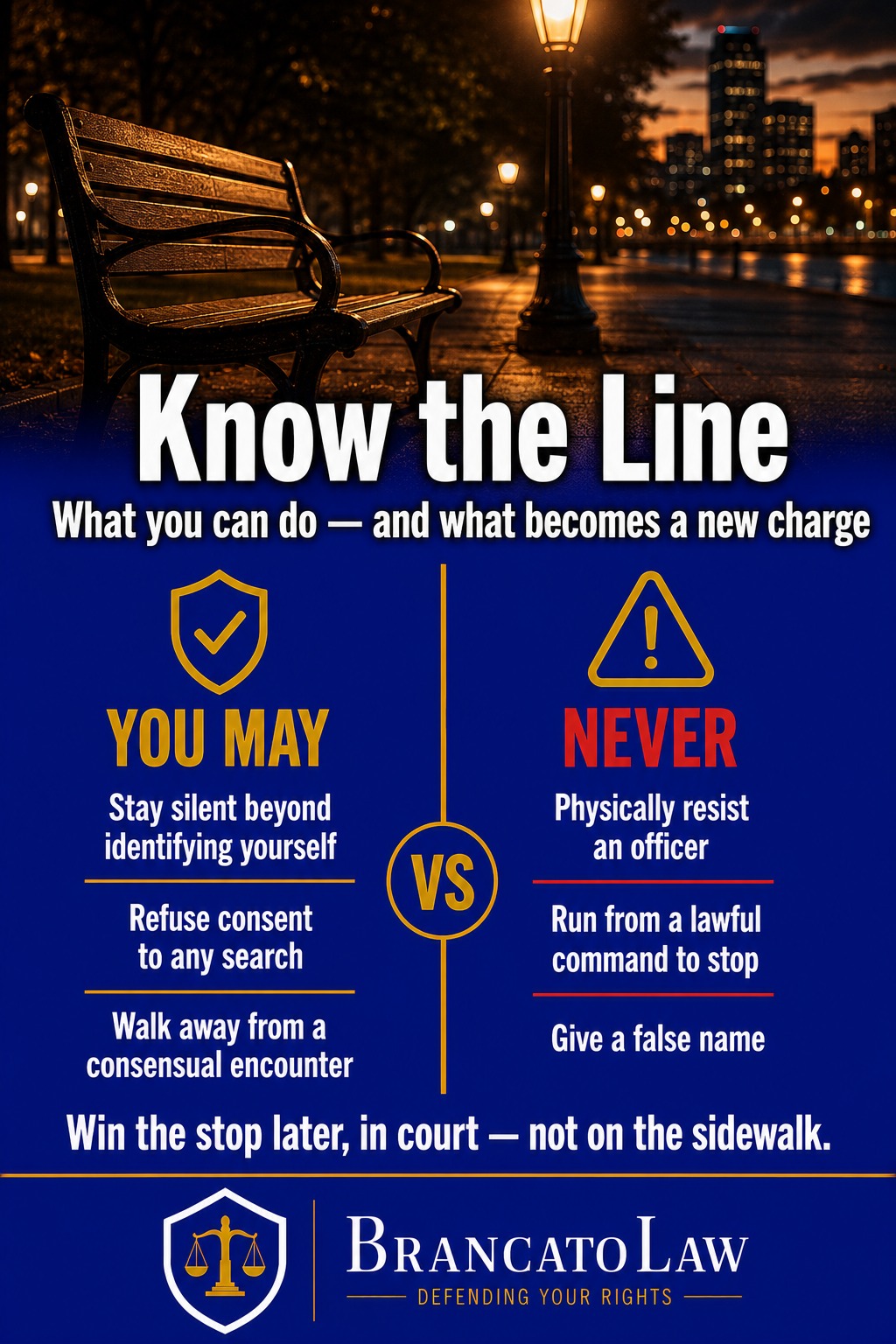
The most valuable thing you can do during a questionable stop is preserve the record rather than win the argument. Note the time and place, what the officer said, what you were doing, and who saw it. The legality of the stop will be decided later, in a courtroom, on a motion to suppress — not on the sidewalk. And because section 901.151(6) makes compliance with the statute a condition of admissibility, the details you remember often become the suppression motion our attorneys file.
| The police may | The police may not |
|---|---|
| Briefly detain you on reasonable suspicion of a crime | Detain you on a hunch, or for being in a “bad” neighborhood |
| Ask who you are and why you are there | Hold you longer than needed to confirm or dispel suspicion |
| Pat down your outer clothing if they reasonably suspect you are armed | Frisk you automatically just because they stopped you |
| Remove an object they reasonably believe is a weapon | Rummage through pockets searching for drugs or evidence |
| Arrest you if probable cause develops | Move you far from the scene while merely “detained” |
How Do We Challenge an Unlawful Stop or Frisk?
We attack the stop and the frisk as separate events, because the law treats them separately. First, the stop: what specific facts did the officer possess before the detention began? Reasonable suspicion is measured only by what the officer knew at that moment — facts learned afterward cannot rescue a bad stop. Second, the frisk: what objective basis suggested you were armed — and if the honest answer is “nothing beyond the stop itself,” the three-condition framework applied in Lyles points toward suppression. Third, the scope: a pat-down that wanders beyond a search for weapons into pockets, bags, or containers has left its legal authority behind.
I taught officers exactly where these lines sit, and our attorneys read every report and every second of body-worn camera footage against that training. In Lyles itself, the body camera showed no visible bulge — the case turned on what the detective testified he saw. Those disputes are where suppression motions are won and lost, and they are why the earliest weeks of a case, while video and witnesses are still available, matter most.
What Should You Do If a Stop and Frisk Led to Charges?
Say nothing about what was found — not whose it is, not why it was there — because possession cases are built on statements far more often than on fingerprints. Then get the stop reviewed quickly. Body-worn camera footage, surveillance video from nearby businesses, dispatch and BOLO records, and CAD logs establishing exactly what the officer knew and when are the raw material of a suppression motion, and they are freshest — and sometimes only preserved — in the first weeks after an arrest. Under the statute’s exclusionary rule, a stop or frisk that violated section 901.151 means the evidence it produced cannot be used against you, and in a possession case that is usually the whole prosecution.
Frequently Asked Questions About Stop and Frisk in Florida
Can police stop me for no reason in Florida?
No. An investigatory detention requires reasonable suspicion — specific facts reasonably indicating you have committed, are committing, or are about to commit a crime, under section 901.151, Florida Statutes. Officers may always attempt a consensual encounter and ask questions, but unless the encounter ripens into a lawful stop, you are free to decline and walk away. Our attorneys review body camera and dispatch records in every case to pin down which kind of encounter it really was.
Do I have to answer police questions during a stop?
Beyond identifying yourself during a lawful stop, you are not required to answer investigative questions, and declining to answer is not a crime. Anything you volunteer, however, can supply the probable cause that turns a detention into an arrest. The safer course is polite silence and an early call to a defense lawyer.
Can police search my pockets during a frisk?
Not as a general search. Section 901.151(5) limits the frisk to what is necessary to find a dangerous weapon — an outer-clothing pat-down, extended only as needed to disclose the weapon. A frisk that becomes a hunt through your pockets for drugs or other evidence exceeds the statute, and what it finds is subject to suppression under section 901.151(6).
Is it illegal to run from the police in Florida?
It can be. Under C.E.L. v. State, 24 So. 3d 1181 (Fla. 2009), unprovoked flight from officers in a high-crime area creates reasonable suspicion for a stop, and continuing to flee after a lawful command to stop is resisting an officer without violence — a first-degree misdemeanor. Whether the area was truly “high-crime” and whether the command was lawful are contested questions our attorneys litigate.
I was carrying my gun legally — can police still frisk me?
The sight of a firearm is no longer automatic evidence of a crime in Florida’s permitless-carry era, which is precisely why the frisk rules matter more than ever. The officer still needs reasonable suspicion of criminal activity for the stop and a reasonable belief you pose a danger for the frisk. If a lawful carry led to charges anyway, The Brancato Law Firm, P.A. examines both the stop and the charging decision — start with our guide to Florida’s gun crime laws.
Can evidence from an illegal stop and frisk be thrown out?
Yes — Florida’s Stop and Frisk Law contains its own exclusionary rule. Section 901.151(6) makes evidence from a search inadmissible unless both the detention and the search complied with the statute. The Brancato Law Firm, P.A. builds suppression motions on exactly that provision; call (813) 727-7159 for a free review of how your stop actually happened.
For more about our defense strategies, visit our Hillsborough County Criminal Defense Attorney page.
Related reading: What Are the Gun Crime Laws in Florida? · What Is Resisting an Officer Without Violence in Florida? · Florida’s Second DCA Limits the “Plain Smell” Cannabis Search Doctrine · What to Do After Being Arrested in Tampa, Florida
The Stop Decided Your Case Before You Ever Saw a Courtroom
If a street stop, a pat-down, or a “routine” detention in Hillsborough, Pinellas, or Pasco County produced the evidence against you, the lawfulness of those first ninety seconds may decide everything that follows. Call the attorneys of The Brancato Law Firm, P.A. — founded by Tampa Criminal Defense Attorney Rocky Brancato, who taught these rules at the police academy — at (813) 727-7159 before the body camera footage and dispatch records that can prove your stop was unlawful disappear into routine retention purges.
The Brancato Law Firm, P.A.
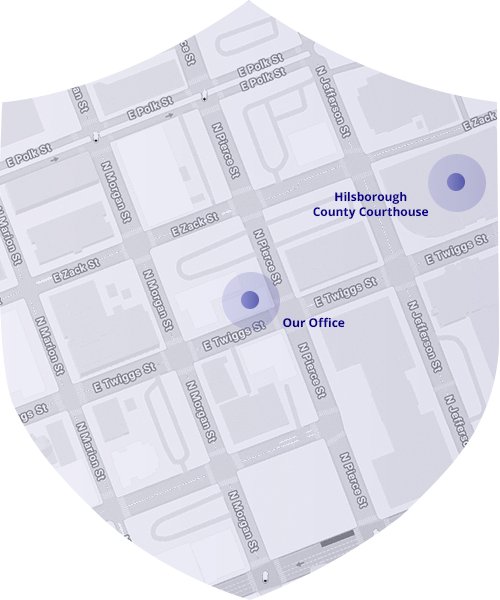
620 E. Twiggs Street, Suite 205, Tampa, FL 33602
(813) 727-7159
Serving Hillsborough, Pinellas, and Pasco Counties
The Brancato Law Firm, P.A. is a Tampa-based criminal defense practice. We are not affiliated with any other Brancato-named law firms.
Visit Us
Tampa, FL 33602
Contact Us Now
Free Legal Consultation (813) 727-7159