- Free Consultation 24/7: (813) 727-7159 Tap Here To Call Us


From First DUI to Death Penalty



What Is Resisting an Officer Without Violence in Florida?


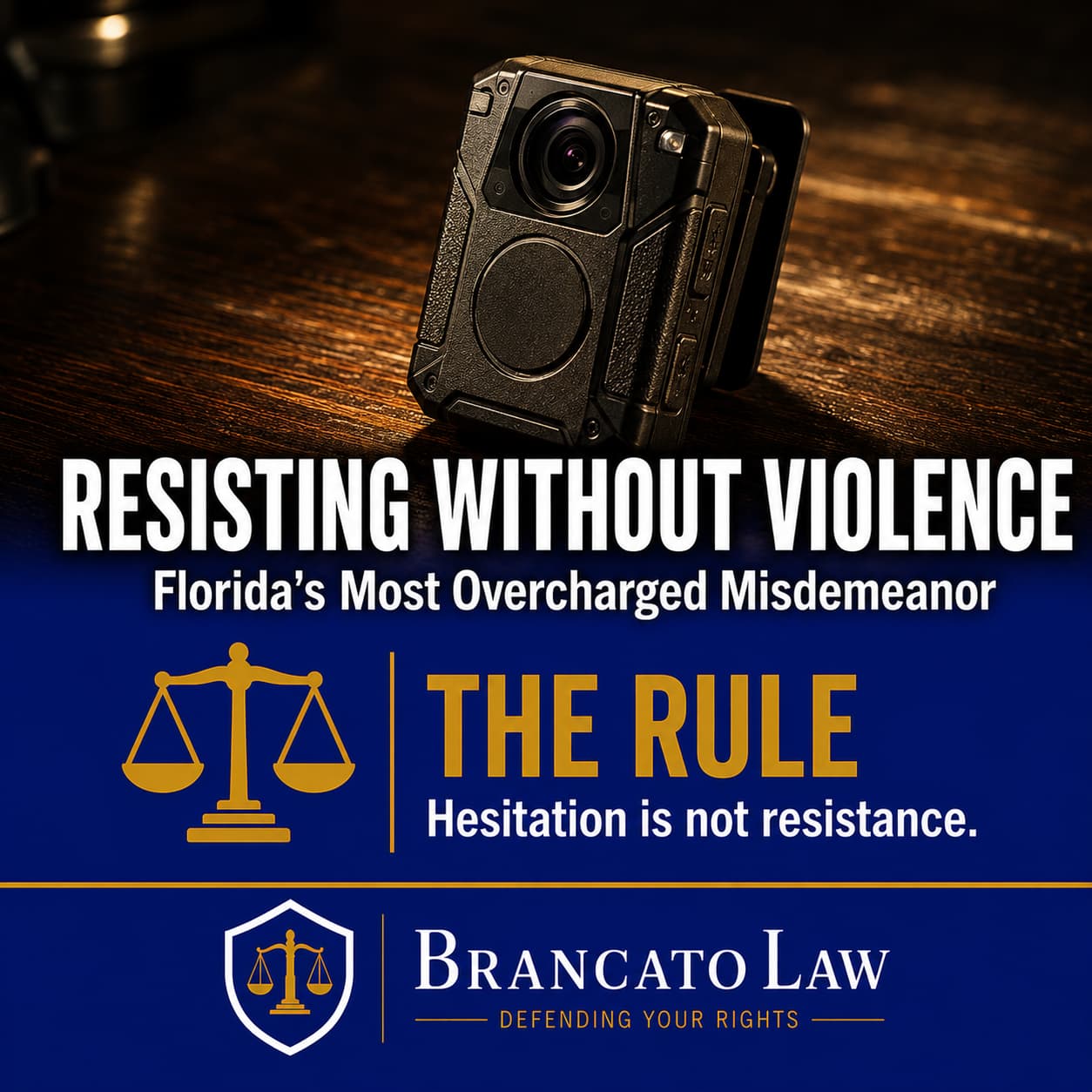
| Key Takeaway: Resisting an officer without violence is a first-degree misdemeanor under Florida law, punishable by up to a year in jail — and it is one of the most overcharged offenses we see. The State must prove the officer was lawfully performing a legal duty AND that you actually obstructed it. In August 2026, Florida appellate courts threw out two juvenile resisting cases in a single week — one because the child’s brief hesitation wasn’t resistance at all, and one because a single episode of resistance can’t be charged twice. |
I’m Rocky Brancato, founder of The Brancato Law Firm, P.A., a Tampa criminal defense firm. I taught criminal procedure at the police academy, so I know exactly what officers are trained to write in a resisting report — and our attorneys use that training every week to take these charges apart.
What Does the State Have to Prove for Resisting Without Violence?
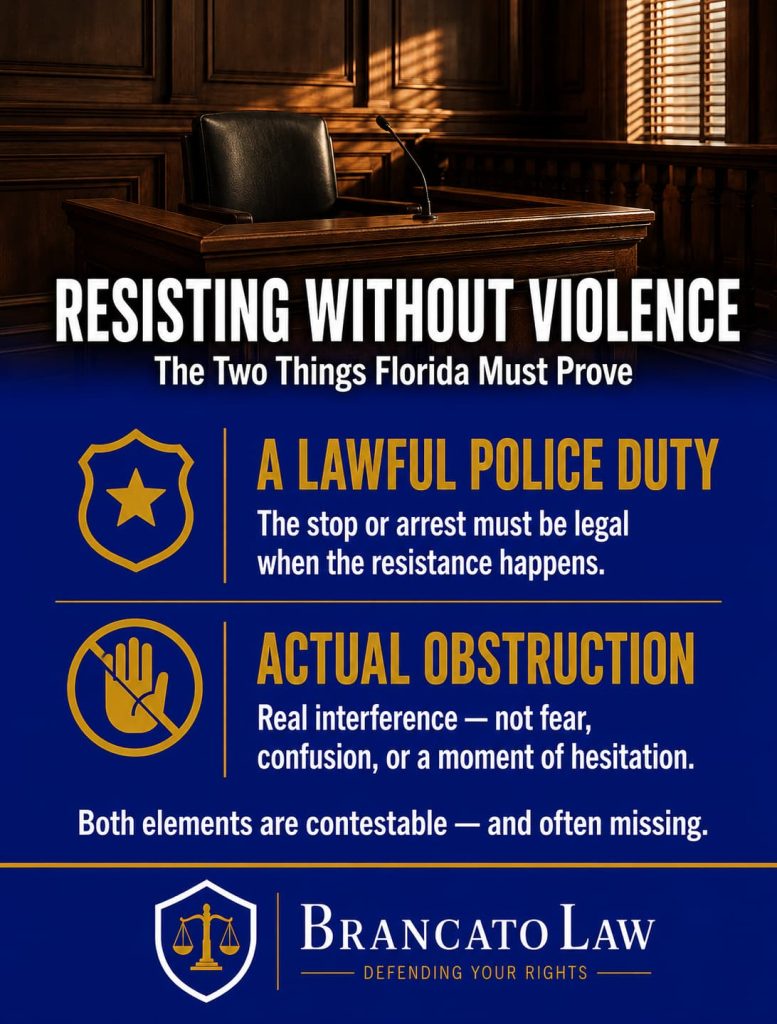
Two things — and both are genuinely contestable. Under Section 843.02, Florida Statutes, and as the Florida Supreme Court framed it in C.E.L. v. State, 24 So. 3d 1181 (Fla. 2009), the State must prove: (1) the officer was engaged in the lawful execution of a legal duty; and (2) the defendant’s action — by words, conduct, or a combination — constituted obstruction or resistance of that lawful duty.
| Fla. Stat. § 843.02: “Whoever shall resist, obstruct, or oppose any officer … in the lawful execution of any legal duty, without offering or doing violence to the person of the officer, shall be guilty of a misdemeanor of the first degree.” |
Both elements have teeth. If the stop or detention wasn’t lawful at the moment the alleged resistance happened, element one fails — and that fight doesn’t end if a pretrial motion to suppress is denied, because the lawfulness of the officer’s duty is an element the State must still prove at trial. Losing the suppression motion means the jury hears the evidence; it does not take the defense away. And not everything that annoys an officer is “obstruction” — element two requires actual resistance, not confusion, fear, or a few seconds of hesitation. Our attorneys attack both in Hillsborough, Pinellas, and Pasco County courtrooms:
| Element | What it means | How we attack it |
| Lawful execution of a legal duty | The officer needed legal justification — for the stop, detention, or arrest — at the moment of the alleged resistance | Suppress the stop: no reasonable suspicion, no lawful command, duty not “legal” when the act occurred |
| Actual obstruction or resistance | Words or conduct that actually impeded the officer | Hesitation, questions, fear, or walking away before a lawful command is not resistance |
The Brancato Law Firm, P.A. — Tampa criminal defense — (813) 727-7159
What Are the Penalties for Resisting Without Violence?
Up to one year in jail, twelve months of probation, and a fine — because it is a first-degree misdemeanor. That’s the same maximum as a battery or possession of 20 grams or less of cannabis, for conduct that is often nothing more than a chaotic few seconds during someone else’s bad night. A conviction also puts a “resisting” offense on a permanent record that employers and licensing boards read as fighting with police — which is exactly why we fight these charges instead of pleading them out by default. And the felony version is always lurking: resisting an officer with violence is a felony, and prosecutors sometimes charge up first and negotiate down later.
What Is the Difference Between Resisting With and Without Violence?
Violence toward the officer — and it is the difference between a misdemeanor and a felony. Under Section 843.01, Florida Statutes, whoever knowingly and willfully resists an officer “by offering or doing violence to the person of such officer” commits a felony of the third degree — up to five years in prison. Without violence, the same resistance is the first-degree misdemeanor discussed in this article.
| Charge | Statute | Level | Maximum penalty |
| Resisting officer without violence | § 843.02 | Misdemeanor (1st degree) | 1 year jail |
| Resisting officer with violence | § 843.01 | Felony (3rd degree) | 5 years prison |
The Brancato Law Firm, P.A. — (813) 727-7159
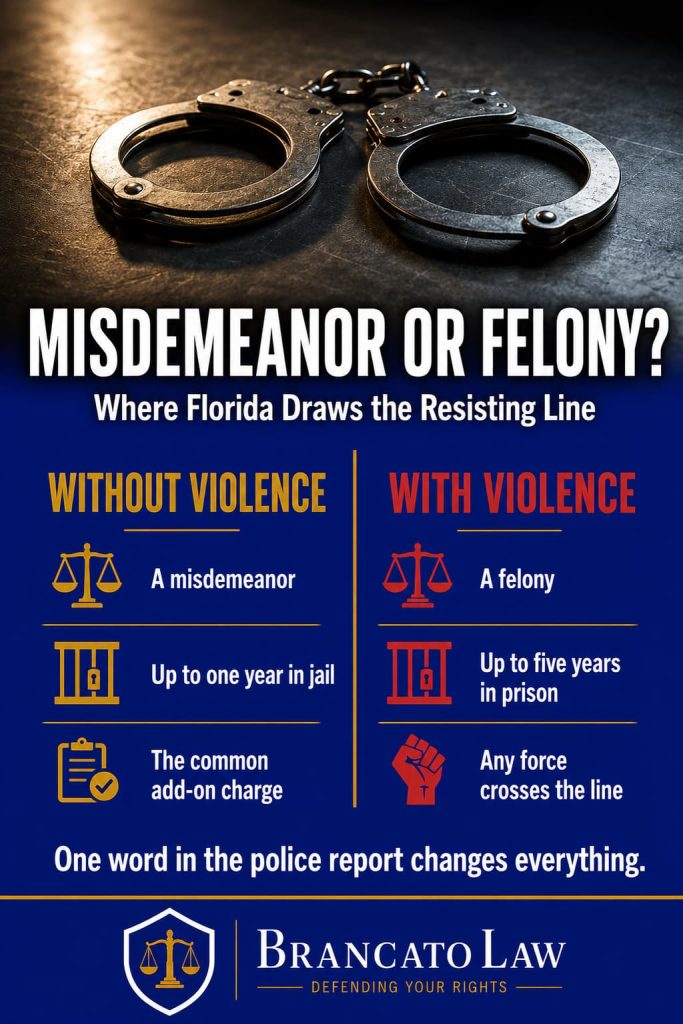
The line between the two is contested in real cases constantly: tensing an arm, pulling away, or stumbling during a chaotic arrest gets written up as “violence” in reports more often than you would think. When our attorneys see a felony resisting charge, the first fight is usually over that word — because reducing § 843.01 to § 843.02 takes a felony off the table entirely.
Why Do Resisting Charges Get Added to Other Charges?
September 2026 update: Resisting without violence is most often paired with disorderly conduct, and the two charges frequently fail together: if the underlying disorderly conduct arrest was unlawful because the officer saw only protected speech or did not witness the conduct, the officer was not engaged in the lawful execution of a legal duty. Our fully rewritten guide, Is Disorderly Conduct a Crime in Florida, and Can You Be Arrested Just for Yelling?, covers the Second District’s Barry v. State decision and the 2024–2026 cases on arrests made outside the officer’s presence.
Because resisting is the easiest charge to write — it requires no victim, no property, and no evidence beyond the officer’s own account of the encounter. In Tampa Bay arrest paperwork, we routinely see it stacked on top of the charge that started the encounter, and sometimes it is the only charge left standing when the original suspicion fizzles: the search comes up empty or the battery call falls apart, but the arrest still happened, so the report says the person “resisted.”
That pattern is also where the defense leverage lives. A resisting count that depends entirely on an unlawful stop collapses with the stop. A count built on a few chaotic seconds collapses against the video. And stacked counts collapse under the double jeopardy rule discussed below. Our firm treats an add-on resisting charge as a signal to scrutinize the whole encounter — because if the resisting count is weak, the rest of the report deserves the same skepticism.
What Counts as Resisting an Officer Without Violence?
Real obstruction of a lawful police duty — classic examples include refusing lawful commands during a valid stop, physically pulling away from a lawful arrest, or giving false identifying information during a lawful detention.
Running from the police can qualify too, and the leading case is worth knowing. In C.E.L. v. State, 24 So. 3d 1181 (Fla. 2009), a teenager in a high-crime area took off running the moment he saw officers, and kept running after they ordered him to stop. The Florida Supreme Court held that his flight was resisting without violence — because his own unprovoked, headlong flight in that setting gave the officers reasonable suspicion to stop him, which made their order to stop a lawful command he then defied. But C.E.L. cuts both ways, and it sets two limits the State must satisfy: the person must know the officer intends to detain them, and the officer must be legally justified in the stop at the moment the command is given. Walking away from an officer who has no lawful basis to detain you is not a crime.
Notice what all of those examples share: a lawful police command plus a real act of defiance. In our experience reviewing Tampa Bay arrest reports, plenty of resisting charges are missing one or both — the “command” was never lawful, or the “resistance” was a scared person freezing.
When Is It NOT Resisting? A 13-Year-Old’s Case Was Just Thrown Out
Hesitating for a few seconds is not a crime — a Florida appellate court said so this month. In E.Y., a Child v. State, No. 4D2025-2551 (Fla. 4th DCA Aug. 19, 2026), officers responding to a call about a girl suspected of battering her mother approached a 13-year-old, and an officer yelled “come here!” The child, within a few seconds, stopped walking and started crying. The appellate court held she was entitled to a judgment of dismissal on the resisting charge — because a momentary pause followed by compliance is not obstruction of a legal duty.
That case is worth sitting with, because it is how these charges actually happen: a tense scene, a shouted command, a frightened kid or adult who doesn’t respond instantly, and a charge that treats fear as defiance. When our attorneys defend a resisting case, the first question is always the same — what exactly did our client do, second by second? The answer, surprisingly often, is: nothing the law recognizes as resistance.
Can You Legally Resist an Unlawful Arrest in Florida?
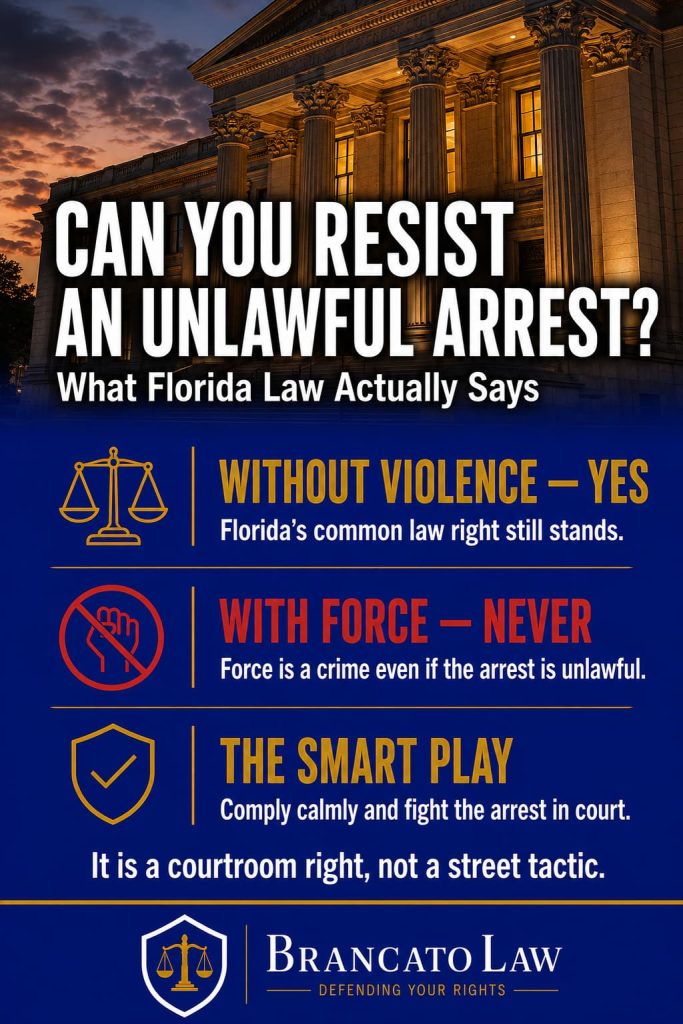
Yes — as long as you use no force or violence at all. This surprises almost everyone, but it has been Florida law for generations: as the Second District — the appellate court for Hillsborough, Pinellas, and Pasco Counties — put it in Lobb v. State, No. 2D18-4137 (Fla. 2d DCA Jan. 31, 2020), “[i]f an arrest is not lawful, then a defendant cannot be guilty of resisting it . . . the common law rule still remains that a person may lawfully resist an illegal arrest without using any force or violence.” In Lobb itself, the court threw out a resisting conviction because the deputy had no lawful basis to detain the defendant in the first place.
The flip side is just as absolute: you may never use force. Under Section 776.051(1), Florida Statutes, a person is not justified in using or threatening force to resist an arrest or detention by a law enforcement officer — even one that turns out to be unlawful. The moment resistance becomes physical force against the officer, the legality of the arrest stops being a defense to that force, and a felony charge is on the table.
Our attorneys give every client the same practical advice: this is a courtroom right, not a street tactic. Comply calmly, say nothing about the incident, and let us litigate the lawfulness of the arrest afterward — where the right actually wins cases, the way it did in Lobb.
Can You Be Charged With Resisting Twice for One Incident?
Not when the resistance was one continuous act — even if several officers were involved. In K.B., a Child v. State, No. 5D2025-1370 (Fla. 5th DCA Aug. 21, 2026), a student resisted two school officers trying to take her vape device, kept resisting after being handcuffed, and was charged with two counts of resisting — one per officer. The Fifth District reversed one of them: her “continuing resistance to an arrest can amount to a single act of resistance, even if several officers are involved in the effort,” and charging it twice violated double jeopardy.
The court applied a five-factor test to decide whether resistance is one act or several:
| Factor | The question the court asks |
| 1. Separate victims | Were different officers actually obstructed by distinct acts? |
| 2. Separate locations | Did the incident move to a genuinely different place? |
| 3. Temporal break | Was there a pause between episodes of resistance? |
| 4. Intervening act | Did something happen between the acts? |
| 5. New criminal intent | Did a fresh decision to resist form? |
The Brancato Law Firm, P.A. — (813) 727-7159
In K.B., the location stayed the same, nothing intervened, and the child’s intent never changed — so it was one act, charged once. The court also confirmed that a double jeopardy violation is fundamental error, meaning it can be raised for the first time on appeal. When our firm reviews a case with stacked resisting counts — and multiple counts are common whenever several officers respond — this test is the first thing we run.
How Our Attorneys Defend a Resisting Without Violence Charge
By litigating it like the constitutional case it usually is, not the throwaway misdemeanor it looks like. The pattern that wins these cases:
- Reconstruct the encounter second by second. Body camera, dash camera, school and business surveillance, and witness phones — matched against the report’s timeline. The E.Y. case turned on a few seconds.
- Test the lawfulness of the duty. Was there reasonable suspicion for the stop, a lawful basis for the detention, a valid arrest? If not, element one fails — and a motion to suppress or dismiss follows.
- Isolate the actual “act” of resistance. Fear, hesitation, questions, and reflexive movement are not obstruction. We make the State name the act — precisely — and then measure it against the video.
- Run the double jeopardy test on stacked counts. One continuous episode is one charge, no matter how many officers responded.
- Protect the record. Where the case resolves, we fight for outcomes that preserve eligibility to seal the record — because “resisting an officer” is a phrase no background check reads charitably.
That last point matters beyond the courtroom: a resisting case handled well ends quietly, and one handled carelessly follows a client for decades. It is also why these cases deserve real defense attention even though they are “only” misdemeanors — in our Hillsborough County practice, the resisting count is often the most winnable charge on the arrest affidavit.
What Should You Do After a Resisting Arrest in Tampa Bay?
Say nothing about the incident, and get the paper fast. Three things matter in the first days:
- Don’t explain yourself to anyone but your lawyer. “I only pulled away because…” is a confession to element two.
- Preserve the video. Body cameras, school cameras, and bystander phones decide these cases — the E.Y. facts were won on what actually happened, second by second. Video gets overwritten; preservation letters need to go out early.
- Have counsel test both elements before any plea. Whether the stop was lawful and whether the conduct was truly resistance are legal questions — the kind our attorneys resolve in motions, not at sentencing.
Call The Brancato Law Firm at (813) 727-7159 — our attorneys answer 24/7.
Frequently Asked Questions: Resisting Without Violence in Florida
Is resisting an officer without violence a felony in Florida?
No — it is a first-degree misdemeanor under § 843.02, Fla. Stat., punishable by up to a year in jail. Resisting an officer with violence is a separate felony offense. In our Tampa Bay cases, we regularly see the line between the two contested — and it matters enormously.
Can I be convicted of resisting if the stop was illegal?
Generally no — the State must prove the officer was in the lawful execution of a legal duty when the alleged resistance occurred. But timing matters: under C.E.L. v. State, flight itself can sometimes create the suspicion that makes a later command lawful. Our attorneys analyze the lawfulness of the encounter moment by moment.
Is running from the police a crime in Florida?
It can be — defying a lawful order to stop is resisting without violence, and unprovoked flight in a high-crime area can itself justify the stop under C.E.L. v. State, 24 So. 3d 1181 (Fla. 2009). But the person must know the officer intends to detain them, and the order must be lawful when given.
Can a resisting without violence charge be dropped?
Yes — these charges get dismissed or reduced regularly, especially where the stop was unlawful, the “resistance” was momentary hesitation, or counts were stacked from a single episode. The Brancato Law Firm challenges both elements and, where the record supports it, moves for dismissal before trial.
My child was arrested at school for resisting — what happens now?
The case goes to juvenile delinquency court, and the recent appellate decisions in E.Y. and K.B. — both juvenile cases — show how vulnerable these charges are to challenge. In our juvenile cases, we also work to keep school-based incidents from becoming lasting records.
Can a resisting without violence case be sealed in Florida?
Often, yes — the outcome of the case controls eligibility, which is exactly why the resolution matters as much as the verdict. A dismissal, a dropped charge, or in many cases a withhold of adjudication can preserve the ability to seal or expunge the record, while a conviction generally cannot. Our firm handles record sealing and expungement, and we negotiate resisting cases with that endgame in view from day one.
Do I need a lawyer for a misdemeanor resisting charge?
Yes — a resisting conviction reads like “fought with police” to every future employer, landlord, and licensing board, and the charge is often the most defensible count on the arrest report. The attorneys of The Brancato Law Firm, P.A. handle these cases throughout Hillsborough, Pinellas, and Pasco Counties. Call (813) 727-7159 for a free, confidential consultation.
For more about our defense strategies, visit our Hillsborough County Criminal Defense page.
Related reading: Teen Takeover Arrests in Tampa Bay: What Every Parent Needs to Know · What to Do After Being Arrested in Tampa, Florida · How Does a Bond Hearing Work in Tampa? · The Criminal Court Process in Hillsborough County
Charged With Resisting in Tampa Bay? The Video Won’t Wait
Body camera and surveillance footage — the evidence that wins these cases — starts disappearing within weeks of an arrest. If you or your child is facing a resisting charge in Hillsborough, Pinellas, or Pasco County, call the attorneys of The Brancato Law Firm, P.A. — founded by Tampa Criminal Defense Attorney Rocky Brancato — at (813) 727-7159 before the recordings are gone.
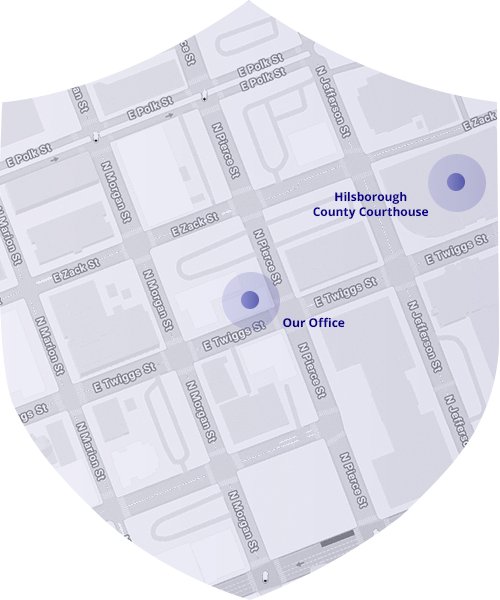
The Brancato Law Firm, P.A. 620 E. Twiggs Street, Suite 205, Tampa, FL 33602 (813) 727-7159 Serving Hillsborough, Pinellas, and Pasco Counties
The Brancato Law Firm, P.A. is a Tampa-based criminal defense practice. We are not affiliated with any other Brancato-named law firms.
Visit Us
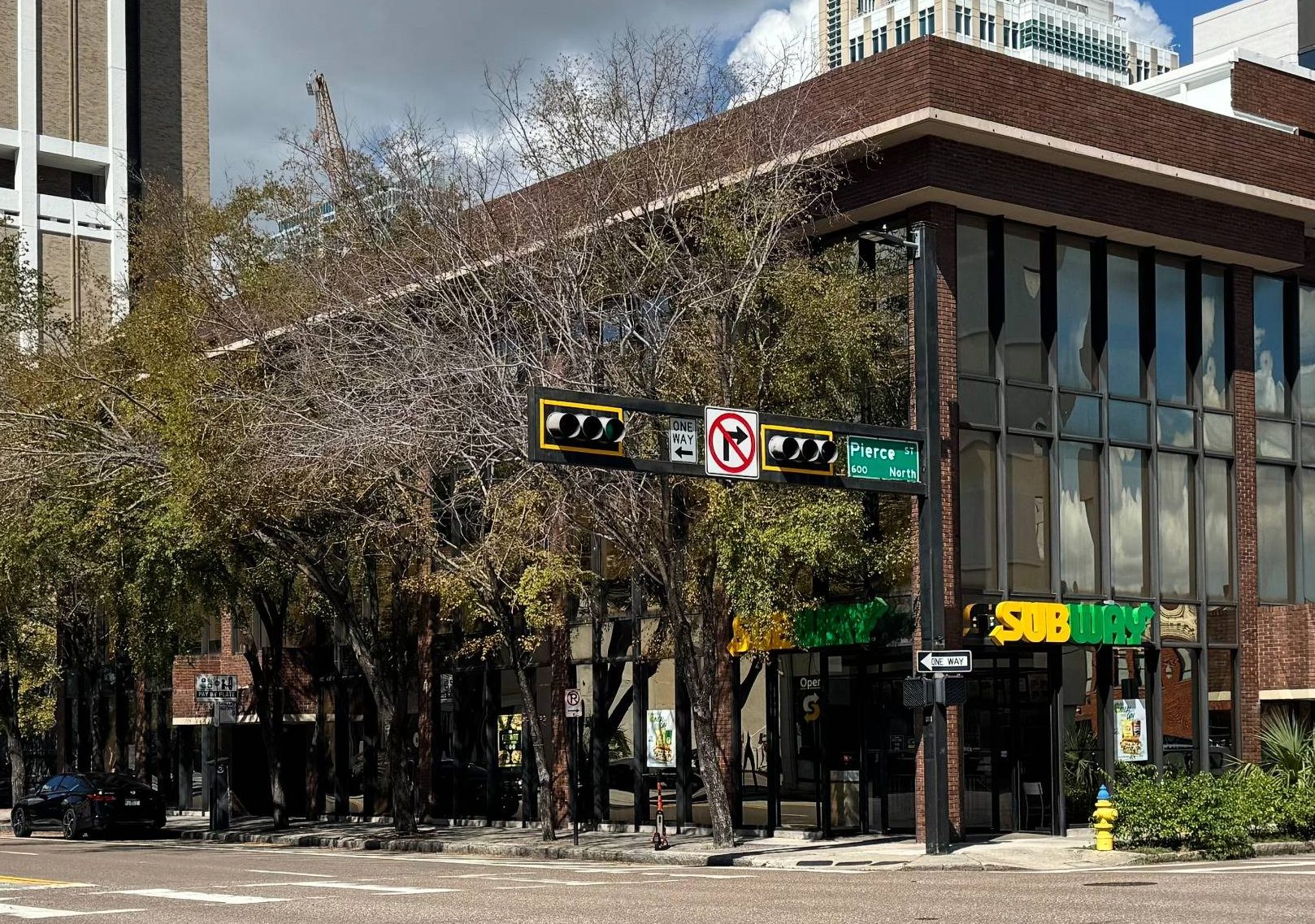
Tampa, FL 33602
Contact Us Now
Free Legal Consultation (813) 727-7159