

From First DUI to Death Penalty



How to Fight a False Imprisonment Charge in Florida? (2026)


To fight a false imprisonment charge in Florida, the defense attacks the elements the State must prove: that the person was actually confined or restrained, that it happened against the person’s will, and that there was no lawful authority for it. False imprisonment under section 787.02 is a third-degree felony punishable by up to 5 years in prison and a $5,000 fine, ranked at Level 6 on Florida’s sentencing chart. Because a brief grab can legally qualify, most of these cases are won or lost on the facts: video, phone records, witness statements, and what the accuser said first.
If you were arrested for false imprisonment after an argument at home, a fight in a parking lot, or a dispute over a child, the charge probably sounds far more serious than what happened. Florida’s definition is broad, and the first decisions in the case often come before you ever speak to a lawyer. I’m Rocky Brancato, founder of The Brancato Law Firm, P.A., a Tampa criminal defense firm, and a former Chief Operations Officer of the Hillsborough County Public Defender’s Office, where I oversaw a staff of over 100 attorneys. I have tried more than 150 jury trials to verdict in more than 25 years in Hillsborough County courtrooms. Our attorneys build false imprisonment defenses from the timeline: who could leave, when, and what the recordings show.
What is false imprisonment in Florida?
False imprisonment is confining or restraining another person against their will without lawful authority. Section 787.02(1)(a), Florida Statutes, defines it as “forcibly, by threat, or secretly confining, abducting, imprisoning, or restraining another person without lawful authority and against her or his will.” It is the same physical act as kidnapping without any of the four intents listed in the kidnapping statute, section 787.01, such as holding someone for ransom or to facilitate another felony. Our firm explains how the two charges compare in our post on kidnapping versus false imprisonment in Florida.
The State must prove each of these elements beyond a reasonable doubt:
- The accused forcibly, by threat, or secretly confined, abducted, imprisoned, or restrained the other person.
- The confinement or restraint was against that person’s will.
- The accused had no lawful authority to do it.
For a child under 13, the statute treats confinement as against the child’s will if it happens without the consent of a parent or legal guardian. That rule matters in custody disputes, where a parent, step-parent, or relative keeps a child longer than agreed and the other parent calls police.
How little restraint does it take to be charged with false imprisonment?
Very little. Florida courts have held that false imprisonment can be complete with a momentary grab. In Conner v. State, 19 So. 3d 1117 (Fla. 2d DCA 2009), a man pushed a 13-year-old girl to the ground at a school bus stop and choked her for a few seconds. The Second District reversed his kidnapping conviction because the restraint was momentary and incidental to the attack, but it held the same facts were enough for false imprisonment, noting that Florida courts have allowed the crime to be “completed by the simple momentary grasping of another person.” The court sent the case back for a false imprisonment conviction instead of kidnapping.
Conner shows both sides of the charge. A brief restraint can be filed as a felony, and false imprisonment is also where an overcharged kidnapping case often lands. In our experience, the most common arrest reports describe blocking a doorway, holding someone’s arm, taking car keys, or refusing to let a partner leave a room during an argument. Those are fact questions, and our attorneys treat them that way.
The breadth of the offense is a known issue in legal scholarship. A 2018 note in the Vanderbilt Law Review, Alexandra M. Ortiz, Invisible Bars, 71 Vand. L. Rev. 681 (2018), proposed adapting the crime of false imprisonment to reach nonphysical domestic abuse, which shows how readily the offense is drawn into relationship conflict.
Can you be convicted of false imprisonment and another crime from the same incident?
Yes. In State v. Smith, 840 So. 2d 987 (Fla. 2003), a man was convicted of burglary of a dwelling, robbery with a weapon, and false imprisonment. The Fifth District threw out the false imprisonment conviction because the confinement was part of the robbery. The Florida Supreme Court reversed that decision and held that “the Faison test is not applicable to the offense of false imprisonment.” The Faison test limits kidnapping charges when the confinement is merely incidental to another crime, but under Smith it does not protect against a separate false imprisonment conviction.
That means false imprisonment is often stacked on top of battery, robbery, or burglary charges from one event. The practical defense is factual: our attorneys show that there was no real restraint at all, or that what the State calls confinement was simply part of a mutual argument in which both people were free to walk away.
What are the penalties for false imprisonment in Florida?
False imprisonment is a third-degree felony punishable by up to 5 years in prison and a $5,000 fine under section 775.082 and section 775.083. The offense severity chart in section 921.0022 ranks it at Level 6, which scores 36 points. A person with no prior record and no other charges usually scores below the 44-point prison threshold, so a judge has discretion to impose probation, but prior convictions and added counts can change that.
The charge becomes a first-degree felony, punishable by up to life, when the person confined is a child under 13 and the accused also commits aggravated child abuse, sexual battery, a lewd or lascivious offense, or certain prostitution, exploitation, or human trafficking offenses in the course of the false imprisonment.
| Charge | Statute | What the State must add | Degree and maximum |
|---|---|---|---|
| False imprisonment | s. 787.02(2) | Confinement or restraint against the person’s will, without lawful authority | Third-degree felony, Level 6; 5 years, $5,000 |
| False imprisonment of a child under 13 with aggravating offense | s. 787.02(3) | Child under 13 plus an enumerated offense such as aggravated child abuse or sexual battery | First-degree felony, Level 9; up to life |
| Kidnapping | s. 787.01 | One of four intents, such as ransom, facilitating a felony, or terrorizing the victim | First-degree felony punishable by life |
| Battery | s. 784.03 | Intentional unwanted touching or striking, with no confinement required | First-degree misdemeanor; 1 year, $1,000 |
Is false imprisonment a domestic violence charge in Florida?
It is when the accused and the alleged victim are family or household members. Section 741.28 lists false imprisonment in the definition of domestic violence, and family or household members include spouses, former spouses, relatives, people who live or lived together as a family, and parents of a child in common. A domestic violence label brings a mandatory hold: under section 741.2901(3), a person arrested for an act of domestic violence “shall be held in custody until brought before the court for admittance to bail.”
Domestic incidents are the main source of these cases. In 2020, law enforcement agencies in Hillsborough County reported 7,083 domestic violence offenses, according to the Florida Department of Law Enforcement’s 2020 county domestic violence report. A false imprisonment count is often added to a domestic battery when the report says one person blocked the other from leaving. Our post on how to fight a domestic violence battery charge in Florida covers the battery side, and our Tampa domestic violence defense attorney page explains how our firm handles both.
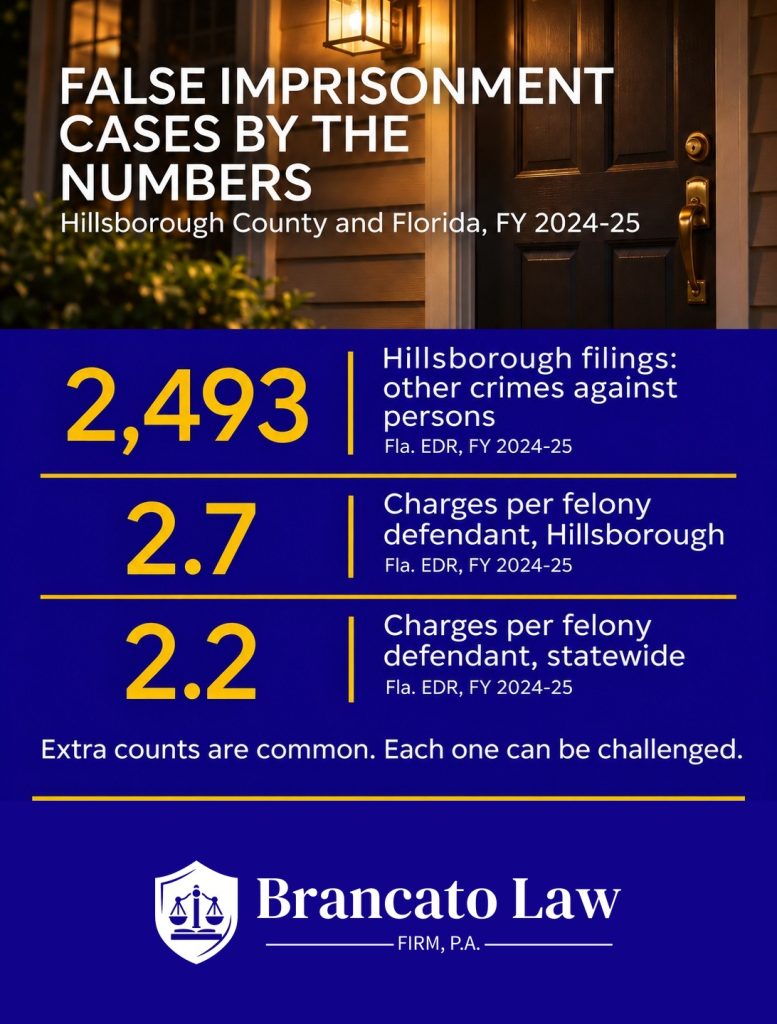
False imprisonment is rarely the only count in a case. In fiscal year 2024-25, felony filings in Hillsborough County covered 12,317 defendants, including 2,493 in the category the Legislature’s economists label other crimes against persons, and Hillsborough cases carried an average of 2.7 charges per defendant compared with 2.2 statewide, according to the Florida Legislature’s Office of Economic and Demographic Research 2025 criminal justice profile of Hillsborough County.
How do our attorneys fight a false imprisonment charge?
Our attorneys fight these charges element by element, starting with the timeline. These are the defenses we raise most often in our Tampa violent crime lawyer practice.
| Element the State must prove | What the State usually relies on | Evidence our attorneys gather |
|---|---|---|
| Confinement or restraint | The accuser’s statement that a door was blocked or an arm was held | Doorbell and body camera video, layout of the home, other exits |
| Against the person’s will | The 911 call and the first statement to deputies | Texts, calls, and location data showing the person moved or communicated freely |
| Without lawful authority | The absence of a court order or parental right | Parenting plans, custody orders, and proof of a parent’s authority |
| Credibility of the accusation | One witness account | Prior inconsistent statements, custody or divorce motives, independent witnesses |
1. Show there was no real confinement
We gather body camera and dash camera video, doorbell and surveillance footage, phone location data, and call logs. If the person called a friend, sent texts, or walked out to a car during the time they say they were held, that evidence goes to the heart of the restraint element.
2. Contest the claim that it was against the person’s will
Arguments that end with both people staying in the same room are not automatically confinement. We compare the 911 call, the first statement to deputies, and later sworn statements, because accounts often grow between the night of the arrest and the deposition.
3. Raise lawful authority where it applies
The statute only covers restraint “without lawful authority.” Parents have legal authority over their own children, and in custody disputes we look at the parenting plan and court orders to show who had the right to keep the child at that moment.
4. Expose a false or exaggerated accusation
False imprisonment allegations sometimes surface during divorces, custody fights, and breakups, where an arrest can change who keeps the house or the children. Our post on interference with child custody in Florida explains a related charge that comes up in those same disputes.
5. Push an overcharged case down
When the State files kidnapping, Conner and the Faison line of cases give us a basis to argue for a judgment of acquittal on the kidnapping count. When the State files false imprisonment, we negotiate toward a misdemeanor such as battery, or a dismissal, when the restraint evidence is thin.
6. Act before the case is filed
The State Attorney’s Office decides whether to file a felony information after reviewing the arrest report. Representation before charges are filed lets our attorneys put video and witness statements in front of the prosecutor before that decision is made.
What happens after a false imprisonment arrest in Hillsborough County?
After a false imprisonment arrest in Hillsborough County, the person is booked into jail and sees a judge at first appearance, usually within 24 hours. In Hillsborough, the judge sits downtown and the arrested person appears by video from the jail. When the case is domestic, the person cannot bond out on a schedule before that hearing. Judges commonly order no contact with the alleged victim as a condition of release, and a violation can lead to a new arrest. Our post on Hillsborough County first appearance explains that hearing, and our Hillsborough County criminal defense page covers the local courts.
One local fact surprises many families: pretrial services supervision, which some nearby counties use as an alternative to a high bond, is not available in Hillsborough County. That puts more weight on the bond argument at first appearance. Our Florida criminal case process page walks through every step after the arrest, from filing to trial.
What should you do after a false imprisonment arrest?
- Do not contact the alleged victim, even to apologize, if a no-contact order is in place.
- Do not discuss the incident on recorded jail calls, texts, or social media.
- Save your own texts, call logs, and location history from the day of the incident.
- Write down every witness, camera, and doorbell you know of near the scene.
- Call a defense lawyer before giving any statement to law enforcement.
Frequently asked questions about false imprisonment charges
Can false imprisonment charges be dropped in Florida?
Yes, prosecutors can drop or reduce a false imprisonment charge when the evidence does not show real restraint, when the accuser’s account changes, or when video contradicts the report. The Brancato Law Firm presents that evidence to the State Attorney early, often through pre-file advocacy before the felony is formally filed.
Is blocking a doorway during an argument false imprisonment in Florida?
It can be charged that way if the report says the other person tried to leave and could not. Our attorneys at The Brancato Law Firm look at how long it lasted, whether there was another exit, and whether the person actually tried to leave, because those details decide whether the restraint element holds up.
Is false imprisonment a felony in Florida?
Yes, false imprisonment is a third-degree felony under section 787.02(2), punishable by up to 5 years in prison. The Brancato Law Firm works to reduce it to a misdemeanor or have it dismissed, and our violent crimes defense page explains how we approach these cases.
Can a parent be charged with false imprisonment of their own child?
A parent acting within lawful authority over their own child generally does not meet the “without lawful authority” element, but a parent who keeps a child in violation of a court order can face charges. Our team at The Brancato Law Firm reviews the parenting plan and every custody order first, and our post on interference with child custody in Florida covers the related offense.
What if the alleged victim does not want to press charges?
The decision belongs to the State Attorney, not the alleged victim, so a case can continue even when the accuser wants it dropped. The Brancato Law Firm explains the process for that situation in our post on whether a victim can drop domestic violence charges in Florida.
Will a false imprisonment conviction stay on my record?
If a judge adjudicates you guilty of false imprisonment, Florida law does not allow that record to be sealed or expunged. Our attorneys at The Brancato Law Firm look for outcomes such as a dismissal or a reduced charge that keep a felony conviction off your record whenever the evidence allows.
For more about our defense strategies, visit our Violent Crimes page.
The recordings that can clear you, from doorbell cameras to phone logs, may be overwritten within days, so the first call matters. The Brancato Law Firm, P.A. was founded by Tampa Criminal Defense Attorney Rocky Brancato, a former Chief Operations Officer of the Hillsborough County Public Defender’s Office, where he oversaw a staff of over 100 attorneys. Call us at any hour at (813) 727-7159, two blocks from the courthouse. Our firm has Spanish-speaking staff, and attorney Jean-Luc Adrien speaks Spanish, Haitian Creole, and French.
The Brancato Law Firm, P.A.
620 E. Twiggs Street, Suite 205, Tampa, FL 33602
(813) 727-7159
Serving Hillsborough, Pinellas, and Pasco Counties
The Brancato Law Firm, P.A. is a Tampa-based criminal defense practice. We are not affiliated with any other Brancato-named law firms.
Visit Us

Tampa, FL 33602

Contact Us Now
Free Legal Consultation (813) 727-7159
