

From First DUI to Death Penalty



How to Fight an Interference With Child Custody Charge in Florida? (2026)



To fight an interference with child custody charge in Florida, the defense starts with which part of section 787.03 applies. When no court order sets custody, a parent or relative with custody can be convicted only if the State proves a malicious intent to deprive another person of custody, and the statute provides complete defenses for a parent who acted to protect the child from danger or to escape domestic violence. Interference with custody is a third-degree felony punishable by up to five years in prison, and the domestic violence exception requires a report to the sheriff or state attorney within 10 days of taking the child.
Prosecutors in a custody interference case have to prove more than a missed exchange or a late return. I have spent more than 25 years in Hillsborough County courtrooms, including time in the Major Crimes Unit handling child abuse cases, and I founded The Brancato Law Firm, P.A., a Tampa criminal defense firm, after serving as former Chief Operations Officer of the Hillsborough County Public Defender’s Office, where I oversaw a staff of over 100 attorneys. Our attorneys look first at the custody paperwork, the timeline, and the reason the parent acted, because those three facts usually decide whether the charge holds.
What Is Interference With Child Custody in Florida?
Interference with child custody is the Florida crime of taking, enticing, concealing, or keeping a minor or incompetent person away from the person or agency lawfully entitled to custody, defined in section 787.03, Florida Statutes. The statute has two main parts. Subsection (1) applies to anyone who, without lawful authority, knowingly or recklessly takes or entices a minor from a parent, guardian, public agency with lawful charge, or other lawful custodian. Subsection (2) applies when there is no court order on custody or visitation, and it reaches a parent, stepparent, legal guardian, or relative with custody who takes, detains, conceals, or entices the child away “with malicious intent to deprive another person of his or her right to custody.”
These cases sit where criminal and family law meet, and our Tampa violent crime lawyer team handles them alongside related charges such as false imprisonment and kidnapping. Our post on the difference between kidnapping and false imprisonment in Florida explains those more serious offenses.
What Must Prosecutors Prove for Interference With Custody?
Prosecutors must prove the elements of the specific subsection charged, and the two subsections work differently. The table below compares them.
| Element | Subsection (1) | Subsection (2) |
|---|---|---|
| Who can commit it | Anyone acting without lawful authority, including a person who aids, hires, or procures someone else | A parent (natural or adoptive), stepparent, legal guardian, or relative who has custody |
| Court order required? | No; it protects any lawful custodian, including a parent, guardian, or public agency | Applies only “In the absence of a court order determining rights to custody or visitation” |
| Act | Takes or entices a minor or incompetent person from the lawful custodian | Takes, detains, conceals, or entices away the minor or incompetent person, inside or outside Florida |
| Mental state | Knowingly or recklessly | Malicious intent to deprive another person of the right to custody |
| Degree | Third-degree felony | Third-degree felony |
Two other rules shape the proof. Under subsection (3), “A subsequently obtained court order for custody or visitation does not affect application of this section,” so a parent cannot cure the charge by winning custody later. Under subsection (5), proof that the child was under 18 creates a presumption that the defendant knew the child’s age or acted in reckless disregard of it.
What Are the Penalties for Interference With Custody in Florida?
Interference with custody is a third-degree felony punishable by up to five years in prison and a $5,000 fine under section 775.082 and section 775.083. The offense severity chart in section 921.0022 ranks section 787.03(1) as a Level 4 offense, and the chart does not list subsection (2) separately, so an unranked third-degree felony defaults to Level 1 under section 921.0023.
| Charge | Statute | Degree | Offense level |
|---|---|---|---|
| Interference with custody (any custodian) | § 787.03(1) | Third-degree felony: up to 5 years and $5,000 | Level 4 |
| Interference with custody (no court order; malicious intent) | § 787.03(2) | Third-degree felony: up to 5 years and $5,000 | Not separately ranked |
| Taking a minor out of Florida or concealing a minor in violation of a court order | § 787.04(1) | Third-degree felony | Level 2 |
| Taking a minor out of Florida or concealing a minor during a pending custody case, with criminal intent | § 787.04(2) | Third-degree felony | Level 4 |
| Taking a minor out of Florida or concealing a minor during a dependency case or abuse or neglect investigation | § 787.04(3) | Third-degree felony | Level 4 |
A Level 4 offense scores 22 points under section 921.0024. With no prior record and no other charges, that falls under the 44-point line, where the lowest permissible sentence is any non-state-prison sanction such as probation. The practical stakes are often higher in family court, where a criminal charge can affect time-sharing, so our attorneys coordinate with the client’s family law counsel from the start.
How Do Our Attorneys Fight an Interference With Child Custody Charge?
Our attorneys fight these charges by testing the custody status on the day of the incident, the intent behind the parent’s actions, and whether a statutory defense applies. These are the defenses that come up most often.
- No malicious intent under subsection (2). When there is no custody order, the State must prove the parent acted “with malicious intent to deprive another person” of custody. A parent who kept the child for a medical appointment, a family emergency, or a misunderstanding about the schedule, and who kept the other parent informed, may not meet that standard. Texts, call logs, and messages showing where the child was are often the best defense evidence.
- Protecting the child from danger. Subsection (4)(a) makes it a defense that the defendant “had reasonable cause to believe that his or her action was necessary to preserve the minor or the incompetent person from danger to his or her welfare.” Our attorneys gather the evidence of that danger, such as medical records, school reports, or prior DCF contacts.
- Escaping domestic violence. Subsection (4)(b) makes it a defense that the defendant was a victim of domestic violence, as defined in section 741.28, or reasonably believed it was about to happen, and reasonably believed the action was necessary to escape it or to protect the child from exposure to it. Subsection (6) also exempts a parent with a legal right to custody who seeks shelter and takes the child, if that parent reports to the sheriff’s office or state attorney’s office within 10 days and starts a custody case within a reasonable time.
- The child left on their own. Subsection (4)(c) is a defense when the minor “was taken away at his or her own instigation without enticement and without purpose to commit a criminal offense,” and it was reasonable to rely on the child’s actions. This comes up with teenagers who run to a relative’s home.
- No proof of participation. In Arroyo v. State, 705 So. 2d 54 (Fla. 4th DCA 1997), a mother rode in the car while her husband drove their three children, who were in foster care, toward Mexico instead of returning them after a court-approved visit. The Fourth District reversed her convictions because the State proved nothing more than her presence in the car, and there were “no words or acts, other than presence, to show participation.” A relative or new partner who was merely present is not automatically guilty.
- The agency did not have lawful charge. When the State claims a child was taken from DCF, the agency’s lawful charge is an element. In Crawford v. State, No. 1D2024-2173 (Fla. 1st DCA July 8, 2026), a Bay County attorney drove away from a Children’s Advocacy Center with a teenage client after DCF said it was sheltering her. The First District held that the trial court erred by blocking evidence that DCF lacked lawful charge, because “this was an element of the offense,” though it found the error harmless on that record and affirmed.
The reach of subsection (1) is broad. In Lindemuth v. State, 247 So. 3d 635 (Fla. 3d DCA 2018), a Monroe County man followed a 14-year-old riding his bicycle home from school and offered him money to get into his car. The Third District affirmed the conviction, holding that the statute “does not require the minor to be physically taken from his parents’ custody.” Enticement alone, by a person with no lawful authority, can complete the crime.
How Common Are Family Abductions?
Family abductions are far more common than stranger abductions, and most are short. An estimated 203,900 children were victims of a family abduction in 1999, according to the U.S. Department of Justice’s NISMART-2 bulletin on children abducted by family members, published by the Office of Juvenile Justice and Delinquency Prevention in 2002. The same study found that 53% were taken by their biological father and 25% by their biological mother, that 46% were gone less than one week, and that 91% had been returned by the time of the survey interview.
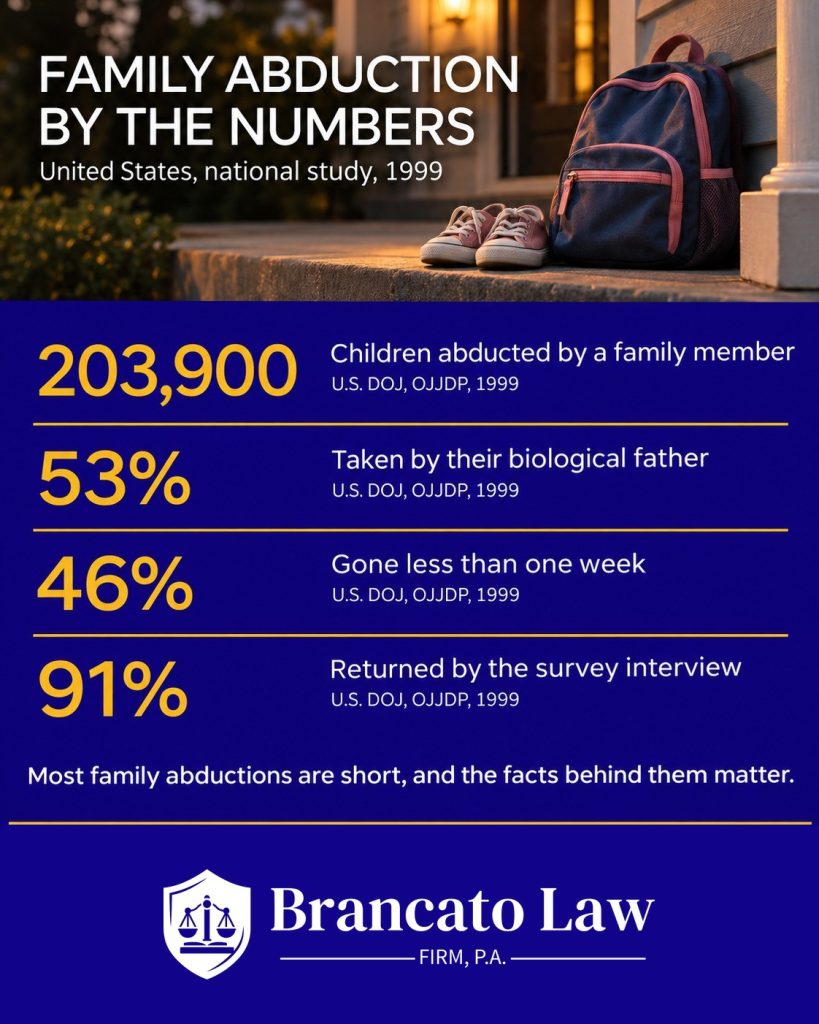
Those numbers match what our attorneys see: most custody interference cases involve parents in conflict, not strangers. Legal scholarship has also documented how often a parent who flees with a child is escaping abuse. Professor Merle H. Weiner’s article “International Child Abduction and the Escape from Domestic Violence,” 69 Fordham Law Review 593 (2000), examined parents who crossed borders with their children to get away from violent partners and then faced abduction claims. Florida’s statute addresses that problem directly through the domestic violence defense and exception.
How Are Custody Interference Cases Handled in Hillsborough County?
In Hillsborough County, an interference with custody case is a felony prosecuted in the 13th Judicial Circuit, and it often runs at the same time as a family court case in the same circuit. A parent who relies on the domestic violence exception must make the 10-day report to the sheriff’s office or state attorney’s office for the county where the child lived, which for a child living in Hillsborough County means the Hillsborough County Sheriff’s Office or the State Attorney’s Office for the 13th Circuit.
A parent arrested on this charge who does not bond out sees a judge at first appearance, which in Hillsborough County is held every day of the year by video from the jail, as our guide to Hillsborough first appearance explains. In our practice, release conditions in these cases can include no-contact provisions that collide with an existing time-sharing schedule, and pretrial services supervision is not available in Hillsborough County, so our Hillsborough County criminal defense attorneys prepare to address those conditions at the first hearing.
What Should You Do If Police Call About Your Child?
You should not explain your reasons to police before speaking with a defense attorney, and you should not hide the child’s location. A statement made in anger, such as “she will never see him again,” is exactly the kind of proof prosecutors use to show malicious intent. Our attorneys provide representation before charges are filed, which can include arranging the child’s safe return or exchange, documenting a domestic violence or danger defense, and making the statutory report on time.
The Florida criminal case process moves quickly once a warrant issues, and the 10-day reporting deadline in subsection (6) cannot be fixed after it passes.
Frequently Asked Questions About Interference With Child Custody in Florida
Can interference with custody charges be dropped in Florida?
Yes. Prosecutors can drop the charge when the evidence shows no malicious intent, when a statutory defense such as danger to the child or domestic violence applies, or when the child is returned safely and the dispute is moved to family court. Our attorneys at The Brancato Law Firm present that evidence to the State Attorney’s Office early, often through pre-file advocacy before a charge is filed.
Can a parent be charged with interference with custody if there is no custody order?
Yes. Section 787.03(2) applies specifically when no court order on custody or visitation exists, but the State must prove the parent acted with malicious intent to deprive the other person of custody. The Brancato Law Firm builds a timeline from texts, calls, and witnesses to show where the child was and why.
Is keeping my child past my time-sharing weekend a crime in Florida?
It can be charged, but a late return alone does not prove the crime; the State still has to prove each element, including the required mental state. Our team at The Brancato Law Firm often sees these disputes handled through family court enforcement instead, and we work with your family law attorney to keep the criminal case from making the custody case worse.
What if I took my children to escape domestic violence?
Florida law gives a defense, and an exception from the statute, to a parent who reasonably believed the action was necessary to escape domestic violence or to protect the child from it. To use the exception, you must report to the sheriff’s office or state attorney’s office within 10 days and start a custody case within a reasonable time, and The Brancato Law Firm helps clients make that report correctly; our domestic violence defense attorneys in Tampa also handle any related charges.
Can a grandparent or other relative be charged with interference with custody?
Yes. A relative who has custody can be charged under subsection (2), and anyone who takes, entices, or helps someone else take a child without lawful authority can be charged under subsection (1). The Brancato Law Firm looks closely at what the relative actually did, because mere presence is not enough to make someone a principal.
Is it a separate crime to take my child out of Florida during a custody case?
Yes. Section 787.04 makes it a third-degree felony to take a child out of Florida or conceal the child in violation of a court order, or with criminal intent during a pending custody case, or during a dependency case or abuse investigation without permission. Our attorneys at The Brancato Law Firm review every order and notice the parent received, because section 787.04 turns on knowledge of the order or notice of the proceeding.
Will an interference with custody charge affect my custody case?
It can, because family judges consider a parent’s conduct when deciding time-sharing, and bond conditions can restrict contact. The Brancato Law Firm coordinates the criminal defense with your family law counsel, and our violent crimes defense team aims for an outcome that does not leave a felony conviction on your record.
For more about our defense strategies, visit our Violent Crimes page.
If a child is involved, the first 10 days can decide which defenses are still available. The Brancato Law Firm, P.A., founded by Tampa Criminal Defense Attorney Rocky Brancato, can be reached at (813) 727-7159 at any hour, and our office is two blocks from the courthouse. Our firm has Spanish-speaking staff, and attorney Jean-Luc Adrien speaks Spanish, Haitian Creole, and French.
The Brancato Law Firm, P.A.
620 E. Twiggs Street, Suite 205, Tampa, FL 33602
(813) 727-7159
Serving Hillsborough, Pinellas, and Pasco Counties
The Brancato Law Firm, P.A. is a Tampa-based criminal defense practice. We are not affiliated with any other Brancato-named law firms.
Visit Us

Tampa, FL 33602

Contact Us Now
Free Legal Consultation (813) 727-7159
