- Free Consultation 24/7: (813) 727-7159 Tap Here To Call Us


From First DUI to Death Penalty



How Do You Fight a Drug Charge in Florida Before It Is Filed? (2026)


| After a drug arrest in Florida, the State Attorney’s Office decides whether to file formal charges, and that decision often waits on the crime lab. A roadside field test is only a presumptive screen, so the lab report, the weight of each package, the hemp-versus-marijuana question, and how the drugs were found are where most drug cases are won or lost. A defense lawyer who reaches the prosecutor before the filing decision can argue for no charges, a lesser charge, or a pretrial diversion program that ends in dismissal. |
A Hillsborough County prosecutor deciding whether to file a drug charge looks at two things first: what the lab says the substance is, and how the police found it. I am Rocky Brancato, founder of The Brancato Law Firm, P.A., a Tampa criminal defense firm, and a former Chief Operations Officer of the Hillsborough County Public Defender’s Office, where I oversaw a staff of over 100 attorneys. In more than 25 years in Hillsborough County courtrooms, I have watched the filing decision shape drug cases long before any trial date is set. Our attorneys use that window to put the weaknesses in the State’s evidence in front of the prosecutor before a charge is ever filed. Our drug case results include a fentanyl trafficking case dismissed three weeks after the arrest and a not guilty verdict in a 200-to-400-gram cocaine trafficking trial.
This guide explains what happens between a drug arrest and a formal charge in Florida, the court rule deadlines that changed in July 2025, and the five places where drug evidence most often breaks down. If you are facing a drug case now, our Tampa drug crimes attorney page explains how our firm defends these charges.
What happens after a drug arrest in Florida before charges are filed?
After a drug arrest in Florida, the arrest report and the seized evidence go to the State Attorney’s Office, and an assistant state attorney decides whether to file formal charges. The arrest itself is not the charge. The formal charge in a felony drug case is an “information” filed by the prosecutor, and until it is filed, the case sits in what lawyers call the pre-file stage. In the 13th Judicial Circuit, that is where our representation before charges are filed does its most useful work.
During the pre-file stage, three things usually happen at once. The suspected drugs are sent to a crime lab for chemical testing. The prosecutor reviews the arrest report, any body camera video, and the search. And the defense, if one is involved yet, gathers its own evidence and asks the prosecutor to file nothing, file less, or offer diversion.
Florida’s court rules put a clock on this stage. Under Florida Rule of Criminal Procedure 3.134, as amended in In re Amendments to Florida Rule of Criminal Procedure 3.191, 411 So. 3d 385 (Fla. 2025), a Florida Supreme Court rules opinion that took effect July 1, 2025, the State must formally charge a jailed defendant within 30 days and a defendant out on bond within 60 days. Missing those deadlines leads to release from jail or from bond conditions. It does not lead to dismissal.
| Stage | What happens | What the defense can do |
|---|---|---|
| Arrest (day 0) | Drugs are seized and logged as evidence. A field test may be done at the scene. | Stay silent about the drugs. Write down who was present and where each item was found. |
| First appearance (usually within 24 hours) | A judge reviews probable cause and sets bond or release conditions. | Argue for reasonable release conditions so the client can work and help with the defense. |
| Lab submission and testing | The evidence goes to the crime lab for identity and weight testing. | Track when the evidence was submitted. Delay by the State can matter at a Rule 3.134 hearing. |
| Day 30 to 40 (in custody) | The State must file charges by day 30. If not, release on day 33, or on day 40 if the State shows good cause. | Move for release under Rule 3.134 the day the deadline passes. |
| Day 60 to 90 (out of custody) | The State must file charges within 60 days. If not, release from bond conditions on day 63, or up to 30 more days on good cause. | Move to be released from all bond requirements and conditions. |
| Filing decision | The prosecutor files an information, files a lesser charge, or declines to file (a “no information”). | Present the defense’s evidence and mitigation to the prosecutor before this decision. |
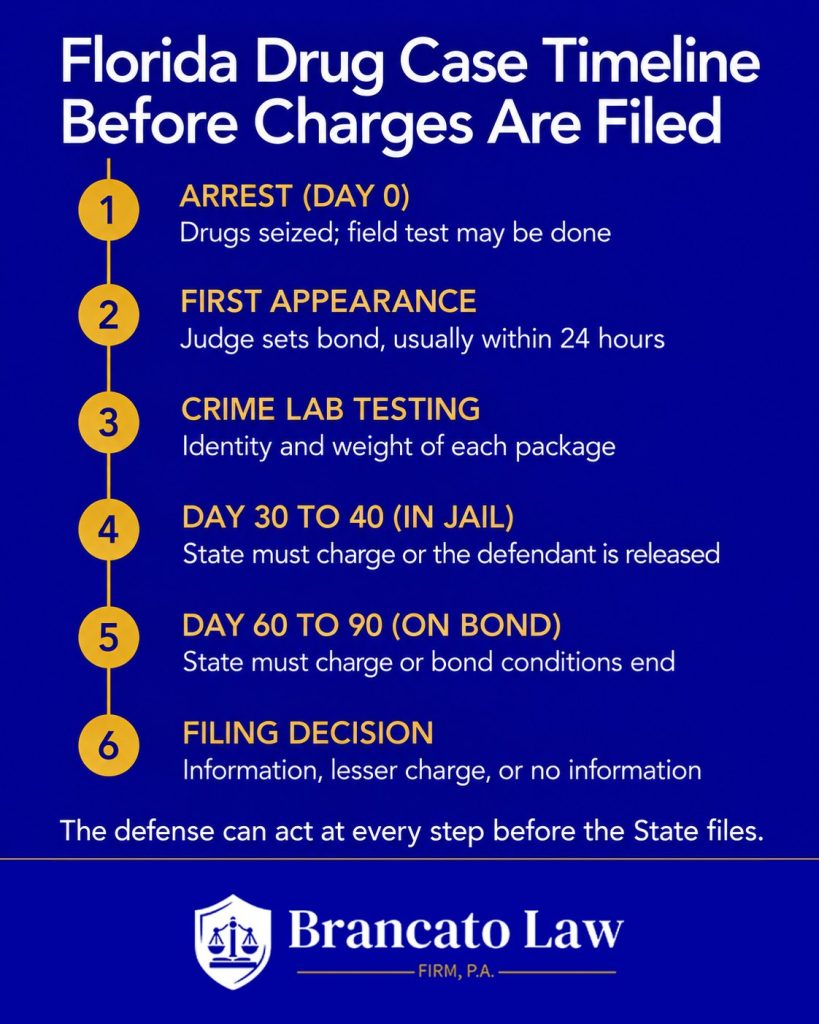
The 2025 amendments also changed Florida’s speedy trial rule. The Florida Supreme Court explained that the speedy trial period “now starts from the date that formal charges are filed rather than from the date of arrest.” The practical effect is that the State faces no speedy trial pressure while it waits for a lab report, so the pre-file stage can run for months when the defendant is not in custody. That is time the defense can use.
How common are drug arrests in Hillsborough, Pinellas, and Pasco Counties?
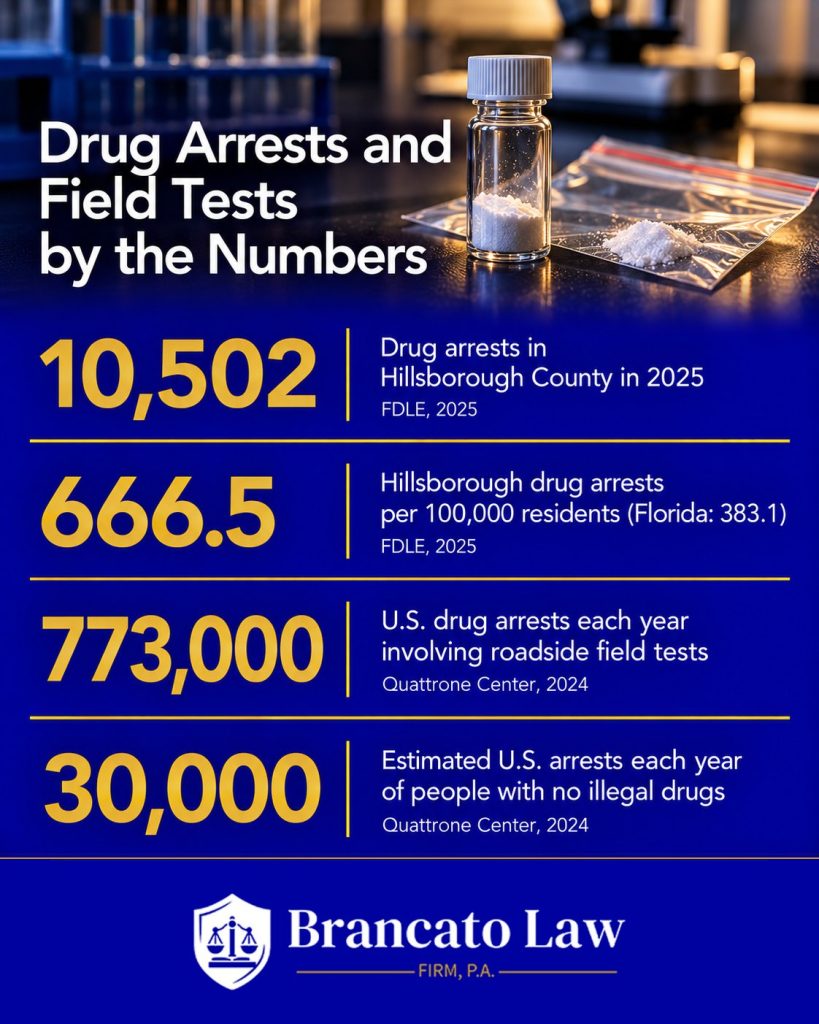
In 2025, Hillsborough County recorded 10,502 drug arrests, a rate of 666.5 per 100,000 residents, compared with 383.1 per 100,000 statewide, according to Florida Department of Law Enforcement arrest data published on the Florida Department of Health’s FLHealthCHARTS site. That puts Hillsborough’s drug arrest rate about 74 percent above the state average. Pinellas County recorded 5,269 drug arrests in 2025 and Pasco County recorded 1,817.
Together, the three Tampa Bay counties our firm serves accounted for 17,588 of Florida’s 89,562 drug arrests in 2025, or about one in five. Each of those arrests goes through the same filing decision described above. FDLE notes that its figures count arrest events and that one arrest can include several charges. Our attorneys handle drug cases in Hillsborough County, Pinellas County, and Pasco County, and the filing practices of each State Attorney’s Office differ.
Is a roadside field test enough to prove a drug charge in Florida?
No. A roadside field test is a presumptive screen that tells an officer a substance might be a drug. It is a color-change kit, and it can react to legal substances. Florida appellate courts have held that a field test alone did not prove what a package contained, which is why the crime lab report carries so much weight in the filing decision.
A 2024 report by the Quattrone Center for the Fair Administration of Justice at the University of Pennsylvania Carey Law School estimated that about 773,000 drug arrests in the United States each year involve these presumptive field tests. The same report estimated that around 30,000 arrests each year involve people who did not possess any illegal substance, and it noted that the true error rate of the tests remains unknown. Our firm treats a positive field test as a claim the lab still has to confirm.
Tampa Bay has its own record with these kits. A 2016 investigation by ProPublica and the Tampa Bay Times found that over the first several months of 2014, the Hillsborough County Sheriff’s Office arrested 15 people on drug charges for substances the Florida state crime lab later determined were not drugs. Other Florida cases reported in the news follow the same pattern: a roadside color change, an arrest, and a lab result that came too late to prevent it.
| Person | Where and when | Field test said | What it really was | What happened |
|---|---|---|---|---|
| Gil Ramirez Martinez | Hillsborough County, 2015 | Methamphetamine | Penicillin for his sick chickens | Spent seven hours in jail; the state lab found it was not meth a month later |
| Rebecca Shaw | Pasco County, 2015 | Oxycodone | Vitamins | Spent five months in jail; the lab cleared her about seven months after arrest and the charges went away |
| Daniel Rushing | Orlando, 2015 | Methamphetamine | Glaze flakes from Krispy Kreme doughnuts | The state lab cleared him weeks later; the City of Orlando paid him a $37,500 settlement in 2017 |
The Martinez case was reported by ProPublica and the Tampa Bay Times, the Shaw case by FOX 13 Tampa Bay, and the Rushing case by CBS News. Each of them was cleared by a lab, but only after an arrest. That is why our attorneys push for the lab result before the State makes its filing decision, and why we challenge any case that rests on a field test alone.
Florida’s Second District Court of Appeal, which hears appeals from Tampa Bay, applied that principle in Smith v. State, 835 So. 2d 387 (Fla. 2d DCA 2003). An officer field-tested two baggies of suspected methamphetamine, then poured them into one bag without weighing either one. The court held that “the field test alone does not make a prima facie case” for trafficking and reduced the conviction to armed possession. The lesson carries forward: when the only proof of what was in a package is a field test, the State has a gap.
Where does the lab evidence in a Florida drug case break down?
Drug evidence in a Florida case usually breaks down in one of five places: the field test, the lab’s testing choices, the weight, the chain of custody, or the analyst who testifies. Our attorneys review each one before we talk to the prosecutor, because a weakness found before filing can change what charge, if any, the State files.
1. The lab tested a sample, not every package
When the total weight of several packages matters, Florida courts have required the State to test each package rather than infer the contents from one. In Campbell v. State, 407 So. 3d 558 (Fla. 2d DCA 2025), a Hillsborough County case, detectives found 50 vacuum-sealed bundles of a green, leafy substance, but the FDLE lab tested only one sample, which weighed 24.47 grams. Every State witness admitted they could not tell legal hemp from illegal cannabis by appearance or smell. The Second District reversed the trafficking conviction and ordered it reduced to felony possession of cannabis, holding that the State “must chemically test each packet” when it relies on multiple packages to reach a trafficking weight.
2. Hemp and marijuana look and smell the same
Since hemp became legal, Florida courts recognize that hemp and marijuana cannot be told apart without testing. The Campbell court explained that a substance with a THC concentration above 0.3% is illegal cannabis, and one below 0.3% is legal hemp. That makes the lab’s THC result central in any marijuana or THC case, including vape and edible cases. Our post on how much weed is a felony in Florida explains the weight thresholds that follow from that result.
3. The weight includes the wrong things
Drug charges in Florida climb with weight, and trafficking under section 893.135, Florida Statutes carries mandatory minimum prison sentences. When officers combine packages before weighing them, weigh drugs in their packaging, or estimate pill counts, the weight that drives the charge may not be the weight of the drug. In Smith, combining two baggies before weighing them cost the State its trafficking conviction. Our post on fentanyl trafficking defenses covers how weight issues play out in the most serious cases.
4. The chain of custody has a gap
Florida admits physical evidence unless there is evidence of probable tampering. In Murray v. State, 3 So. 3d 1108 (Fla. 2009), a murder case involving hair evidence, the Florida Supreme Court held that once the defense produces evidence of probable tampering, the burden shifts to the State to establish a proper chain of custody. In drug cases, our attorneys compare the evidence log, the lab intake form, and the weights recorded at each step. A package that gains or loses weight, or changes description, between the scene and the lab is the kind of discrepancy that meets that burden.
5. The analyst who did the testing does not testify
A defendant has the right to confront the lab analyst whose testimonial findings are used against him. In Smith v. Arizona, 602 U.S. 779 (2024), the State of Arizona replaced the analyst who tested the drugs with a substitute expert who relayed her notes and report to the jury. The U.S. Supreme Court held that when an expert relays an absent analyst’s statements to support his opinion, those statements come in for their truth, and if they are testimonial, the defendant has the right to cross-examine the person who did the lab work. The Court sent the case back to decide whether the absent analyst’s statements were testimonial. When analysts leave crime labs or cases are reassigned, that ruling gives the defense real leverage.
Two more issues sit alongside the lab evidence. The first is how the drugs were found: an illegal stop or search can lead to a motion to suppress that keeps the drugs out of evidence, and our posts on drugs thrown down during a police encounter and confidential informants cover two common search issues. The second is knowledge. Under section 893.101, Florida Statutes, lack of knowledge of the illicit nature of a substance is an affirmative defense, and drugs found in a shared car or home raise the constructive possession questions the State must answer. If the lab identifies a different drug than the one charged, our post on being charged with the wrong drug explains what follows.
What can a defense lawyer do before drug charges are filed in Tampa?
Before charges are filed, a defense lawyer can give the prosecutor reasons not to file, to file less, or to offer diversion, while the prosecutor still has full discretion. Once an information is filed, every change has to be negotiated. In our firm’s pre-file drug work, the steps usually look like this:
- Find the weak points first. We review the arrest report, body camera video, and property receipts for the five evidence problems above.
- Document lawful explanations. A valid prescription is a complete answer to many possession charges under section 893.13(6)(a), Florida Statutes, and a receipt for a lawful hemp product can matter in a THC case.
- Press the timeline. We track when the evidence was submitted to the lab and hold the State to the Rule 3.134 deadlines.
- Present mitigation. Employment, school, treatment, and a clean record give the prosecutor a reason to choose diversion over a felony filing.
- Ask for a specific outcome. We ask for a no information, a misdemeanor instead of a felony, or entry into a pretrial program, depending on what the evidence supports.
Speed matters at this stage. In a January 2025 case, a client was arrested for possession of cocaine and possession of a firearm during the commission of a felony. Rocky argued at first appearance that the facts did not meet the intent of the firearm statute, the judge set low bonds, and his immediate work with the intake prosecutor led to both charges being dismissed within days of the arrest. In a March 2025 fentanyl trafficking case, Rocky defeated the State’s motion for pretrial detention, challenged constructive possession and the vehicle search, and the prosecutor issued a Letter of Release within three weeks of the arrest.
Arrests at the Port Tampa Bay cruise terminals show how this works in practice. In March 2026, a husband and wife who flew to Tampa for a cruise were arrested after the cruise line’s security screening found felony amounts of marijuana in their shared luggage, including vape cartridges, flower, and edibles. Before the State made its filing decision, Rocky presented the facts to the State Attorney’s Office and argued constructive possession: neither spouse could be individually linked to drugs in shared luggage. The State never filed charges against either one. Our post on cruise ship arrests in Tampa covers those cases in more detail.
Can drug charges be dropped in Florida?
Yes. Florida drug charges can be dropped before filing through a no information, or dismissed after filing through a pretrial intervention program. Under section 948.08(6), Florida Statutes, a person charged with a nonviolent felony who has a substance abuse problem and no more than two prior nonviolent felony convictions is eligible for a pretrial drug treatment program, and “the court shall dismiss the charges” on successful completion. Admission is not automatic, and the State can oppose it in some cases.
In Hillsborough County, the 13th Judicial Circuit’s Administrative Order S-2026-002, effective February 2, 2026, governs Adult Drug Treatment Court. Its pretrial program does not require a guilty or no contest plea, and successful completion results in dismissal. The defendant must waive speedy trial for the diversion period. The circuit’s post-adjudicatory drug court is different: it requires a plea and is limited to nonviolent felonies scoring 60 points or fewer on the Criminal Punishment Code scoresheet.
Diversion is often the result of pressure on the evidence. In an August 2025 amphetamine trafficking case, Rocky filed a motion to suppress that exposed serious weaknesses in the State’s case. The trafficking charge was reduced, and the client was accepted into a diversion program under which the case will be dismissed once he completes a drug evaluation and any recommended outpatient treatment. In an October 2026 case, a young man charged with multiple counts of possessing party drugs and pills completed a diversion program Rocky negotiated, the charges were dismissed, and he is now eligible to have his record expunged.
| Outcome | When it happens | Conviction or record? |
|---|---|---|
| No information (no charges filed) | Before filing, when the prosecutor declines the case | No conviction. The arrest record remains and may be eligible for sealing or expunction. |
| Pretrial drug treatment program | After filing, before trial; no plea in Hillsborough’s pretrial program | Charges dismissed on successful completion. |
| Reduced charge | Before or after filing, often after lab or search problems surface | Depends on the plea. A withhold of adjudication may be available. |
| Post-adjudicatory drug court | After a plea, for qualifying nonviolent felonies | A plea is entered and the defendant is sentenced into the program. |
Possession of most controlled substances under section 893.13(6)(a) is a third-degree felony, punishable by up to 5 years in prison and a $5,000 fine. Possession of 20 grams or less of cannabis is a first-degree misdemeanor, punishable by up to 1 year in jail and a $1,000 fine. Those exposures are why the filing decision matters so much: the difference between a felony information and a no information is the difference between a felony record and none.
What should you do if you are arrested or under investigation for drugs in Tampa?
Talk to a defense lawyer before the State files charges, because Florida’s court rules expect a filing decision within 30 days for a jailed defendant and 60 days for one on bond, and the lab result can arrive sooner. Until then, protect the case:
- Do not explain, discuss, or text about the drugs, the car, or the house with anyone, including family. Jail calls are recorded.
- Do not talk to detectives or agree to a “just to clear things up” interview without a lawyer.
- Keep prescriptions, pharmacy records, and receipts for any lawful hemp or CBD products.
- Write down who had access to the car, room, or bag where the drugs were found.
- Save the property receipt and bond paperwork. The dates on them help track the Rule 3.134 deadlines.
If detectives contact you before any arrest, the same rules apply. Our pre-file advocacy page explains how our firm handles investigations before charges.
What results has our firm gotten in Tampa drug cases?
Our attorneys have won drug cases at every stage: before charges were filed, through motions to suppress and diversion, and in front of juries. The results below are drawn from our firm’s published case results and include trafficking dismissals, not guilty verdicts, and reductions that kept clients out of prison.
| Charge | Result | What made the difference |
|---|---|---|
| Fentanyl trafficking (March 2025) | Dismissed by Letter of Release within three weeks of arrest | Defeated pretrial detention; challenged constructive possession and the vehicle search |
| Cocaine trafficking, 200 to 400 grams | Not guilty at trial | Showed the co-defendant was the trafficker and the client was merely present |
| Trafficking in amphetamine (August 2025) | Reduced; diversion, with dismissal on completion | Motion to suppress exposed weaknesses in the State’s case |
| Possession of cocaine and firearm during a felony (January 2025) | Both charges dismissed within days | Low bonds at first appearance and immediate work with the intake prosecutor |
| Felony marijuana possession, husband and wife (March 2026) | No charges filed against either spouse | Pre-file constructive possession argument for drugs in shared luggage |
| Drug possession, multiple counts (October 2026) | Dismissed after diversion; eligible for expungement | Negotiated a diversion program |
| Sale of cocaine near a church (November 2025) | 1,000-foot enhancement dropped; probation instead of prison | The State’s sale video was missing |
| Delivery of cocaine near a church and possession of cocaine | Not guilty on both counts | Mistaken identity defense and poor police work |
| Sale of cocaine near a church and a school | Not guilty on both counts | The State could not prove its case |
| Short-barreled rifle, felony cannabis, and paraphernalia (September 2026) | Diversion; felony conviction and likely deportation avoided | Mitigation report and a motion challenging possession (attorney Jean-Luc Adrien) |
Past results do not guarantee future outcomes. Each result depended on its own facts. You can read the full story behind each one on our case results page.
Frequently asked questions
How long does the State have to file drug charges in Florida?
The State must file formal charges within 30 days if you are in jail and within 60 days if you are out on bond, under Florida Rule of Criminal Procedure 3.134. The Brancato Law Firm tracks those dates from the day of arrest and moves for release the day a deadline passes. Missing the deadline leads to release, and the State can still file later. Our representation before charges are filed page explains that work.
Can a drug lab backlog delay my release from jail in Florida?
Yes, sometimes, because a lab backlog can count as good cause to hold a defendant until day 40. At every Rule 3.134 hearing, our attorneys at The Brancato Law Firm press the State for the date it actually submitted the drugs to the lab. In Roberson v. Reyes, 390 So. 3d 669 (Fla. 3d DCA 2023), a Miami-Dade case involving suspected MDMA and oxycodone, the court said a lab backlog “may constitute good cause” but warned that a generic claim of lab delay may not be enough when the State waited almost two weeks to submit the drugs.
Can I be convicted in Florida if only a field test was done?
A field test alone is weak proof of what a substance is, and Florida appellate courts have reversed convictions that depended on one. When the State’s case rests on a field test, The Brancato Law Firm raises it with the prosecutor before filing and, if needed, at trial. In Smith v. State, the Second District held that a field test alone did not prove the contents of baggies the officer combined before weighing. Our drug crimes defense page explains how we defend these cases.
What can cause a false positive on a police drug field test?
Legal substances can trigger the same color change as an illegal drug, and in Florida, reported false positives include doughnut glaze, vitamins, and penicillin for chickens. The Brancato Law Firm treats any arrest based on a field test as unconfirmed until the crime lab reports, and we raise that gap with the prosecutor before charges are filed. Our pre-file defense page explains how we use that window.
Does the lab analyst have to testify at my Florida drug trial?
Often yes, because under Smith v. Arizona a substitute expert cannot simply relay an absent analyst’s testimonial statements to support his own opinion. Our trial attorneys at The Brancato Law Firm check early whether the analyst who did the testing is still available, since the answer can change how the State proves its case.
Do I have to plead guilty to enter drug court in Hillsborough County?
No, not for the pretrial program, which under the 13th Judicial Circuit’s Administrative Order S-2026-002 requires no plea and ends in dismissal on successful completion. The Brancato Law Firm evaluates whether a client qualifies under section 948.08(6) and argues for admission when the State resists.
Can drug charges be dropped in Florida if the drugs were not mine?
Yes, because the State must prove you knowingly possessed the drugs, and drugs found in a shared space raise constructive possession questions the State often cannot answer. Our attorneys at The Brancato Law Firm present those facts to the prosecutor before filing, when a no information is still on the table, and at trial our firm won a not guilty verdict for a client accused of trafficking 200 to 400 grams of cocaine by showing he was merely present. Florida also treats lack of knowledge of a substance’s illicit nature as an affirmative defense under section 893.101.
For more about our defense strategies, visit our Drug Crimes page.
Florida’s court rules give the State 30 days to charge a jailed defendant and 60 days to charge one on bond, and the lab result that drives that decision can arrive sooner. Call The Brancato Law Firm, P.A., founded by Tampa Criminal Defense Attorney Rocky Brancato, at (813) 727-7159. Our attorneys will review the arrest report and the evidence and contact the prosecutor before charges are filed. You can call us at any hour, and our office is two blocks from the courthouse. Our firm has Spanish-speaking staff, and attorney Jean-Luc Adrien speaks Spanish, Haitian Creole, and French.

The Brancato Law Firm, P.A.
620 E. Twiggs Street, Suite 205, Tampa, FL 33602
(813) 727-7159
Serving Hillsborough, Pinellas, and Pasco Counties
The Brancato Law Firm, P.A. is a Tampa-based criminal defense practice. We are not affiliated with any other Brancato-named law firms.
Visit Us

Tampa, FL 33602

Contact Us Now
Free Legal Consultation (813) 727-7159
