

From First DUI to Death Penalty



How to Fight Domestic Battery by Strangulation in Florida? (2026)


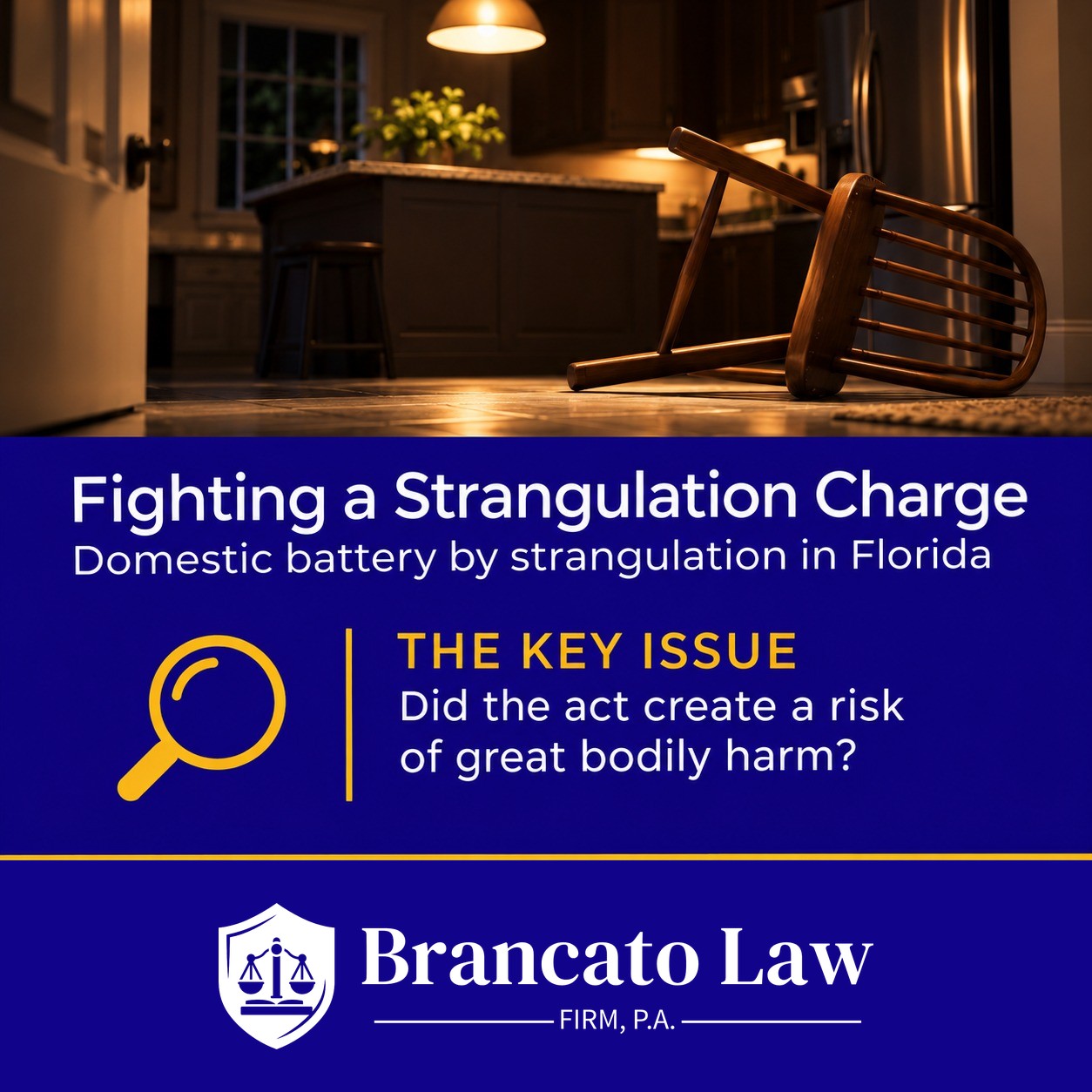
To fight a domestic battery by strangulation charge in Florida, the defense attacks the three elements the State must prove under section 784.041(2): that the accused knowingly and intentionally impeded the other person’s normal breathing or blood circulation by pressure on the throat or neck or by blocking the nose or mouth, that the act created a risk of or caused great bodily harm, and that the two were family or household members or in a dating relationship. Domestic battery by strangulation is a third-degree felony punishable by up to 5 years in prison, and a conviction can never be sealed or expunged, even with a withhold of adjudication. Common defenses include an account that does not describe impeded breathing, missing or inconsistent medical findings, self-defense, a relationship that does not meet the statute, and reduction to simple battery, a misdemeanor.
A prosecutor deciding whether to file a strangulation charge looks for three things: words from the complainant describing trouble breathing, physical or medical findings at the neck, and proof of a qualifying relationship. When one of the three is missing, the felony is in trouble. As founder of The Brancato Law Firm, P.A., a Tampa criminal defense firm, I have spent more than 25 years in Hillsborough County courtrooms, including as former Chief Operations Officer of the Hillsborough County Public Defender’s Office, where I oversaw a staff of over 100 attorneys. Our attorneys defend strangulation charges by getting the 911 call, the body camera footage, and the medical records early, before the State’s filing decision locks in a felony.
What is domestic battery by strangulation in Florida?
Domestic battery by strangulation is knowingly and intentionally impeding another person’s normal breathing or blood circulation, against that person’s will, by applying pressure to the throat or neck or by blocking the nose or mouth, in a way that creates a risk of or causes great bodily harm. The crime is defined in section 784.041(2), Florida Statutes, and it applies only when the two people are family or household members or are in a dating relationship. It does not apply to authorized medical diagnosis or treatment.
| Element | What the State must prove | Where our attorneys look for weakness |
|---|---|---|
| 1. Impeding breathing or circulation | The accused knowingly and intentionally impeded normal breathing or blood circulation, against the person’s will, by pressure on the throat or neck or by blocking the nose or mouth | Whether the first statement, 911 call, or body camera footage describes any trouble breathing at all, or only a push, grab, or contact near the neck |
| 2. Risk of or actual great bodily harm | The act created a risk of great bodily harm or caused great bodily harm | Whether the force, duration, and medical findings support a real risk, or only minor contact |
| 3. Qualifying relationship | Family or household member, or a dating relationship | Whether the relationship was a continuing and significant romantic or intimate one, and whether the State actually proved it |
Family or household member has the meaning in section 741.28: spouses and former spouses, people related by blood or marriage, people who live or have lived together as a family, and parents of a child in common. A dating relationship means “a continuing and significant relationship of a romantic or intimate nature.” A roommate, a coworker, or a first date usually does not qualify. In that situation, the most the State can charge for the same act is ordinary battery or aggravated battery, depending on the facts.
Does the State have to prove an injury for strangulation in Florida?
No. The State does not have to prove an injury or actual great bodily harm, only that the act created a risk of great bodily harm. In Lopez-Macaya v. State, 278 So. 3d 248 (Fla. 3d DCA 2019), a Monroe County man was convicted after the complainant testified that he strangled her with his hands and she could not breathe, and she had trouble breathing and swallowing the next day. The Third District affirmed, holding that the State “need not prove great bodily harm” and can instead prove that the defendant’s actions created a risk of it. The Fourth District followed that rule in Dennis v. State, No. 4D21-1723 (Fla. 4th DCA May 4, 2022), where a St. Lucie County man lifted the complainant off the ground by her neck while she struggled to breathe, and the court held that photographs that did not show a neck injury did not defeat the charge.
Those cases describe what the State can prove, not what it always has. “Great bodily harm” means great as distinguished from slight, trivial, minor, or moderate harm, and it does not include mere bruises, according to the Florida Supreme Court’s standard jury instruction. The risk must be real. A complainant who describes a shove, a hand on the shoulder, or a grab that never affected breathing has not described strangulation, no matter what the arrest affidavit calls it. Our attorneys compare every version of the complainant’s account, from the 911 call to the written statement to the deposition, because the description of breathing is the heart of the charge and it often changes.
What are the penalties for domestic battery by strangulation in Florida?
Domestic battery by strangulation is a third-degree felony punishable by up to 5 years in prison, up to 5 years of probation, and a fine of up to $5,000. It is a Level 6 offense on the Criminal Punishment Code scoresheet under section 921.0022, which scores 36 points as a primary offense. A total of 44 points or less allows the judge to impose any sentence short of state prison, so for a person with no record, prison is not required by the scoresheet. Prior convictions, additional counts, and victim injury points can push the total past 44.
| Charge | Statute | Degree and maximum | Scoresheet level | Sealable after a withhold? |
|---|---|---|---|---|
| Simple battery (domestic) | s. 784.03 | First-degree misdemeanor; up to 1 year and $1,000 | Not scored | Possible with a withhold, if otherwise eligible |
| Domestic battery by strangulation | s. 784.041(2) | Third-degree felony; up to 5 years and $5,000 | Level 6 | No, never |
| Felony battery (great bodily harm) | s. 784.041(1) | Third-degree felony; up to 5 years and $5,000 | Level 6 | No, never |
| Aggravated battery | s. 784.045 | Second-degree felony; up to 15 years and $10,000 | Level 7 | No, never |
Two consequences make this charge heavier than its degree suggests. First, section 943.0584 lists domestic battery by strangulation among the offenses that can never be sealed or expunged, and it defines conviction to include a guilty or no contest plea “regardless of whether adjudication is withheld.” A plea to this charge stays public for life. Second, if the person is adjudicated guilty of any crime of domestic violence that intentionally caused bodily harm, section 741.283 requires at least 10 days in county jail for a first offense, or 15 days if a child under 16 who is a family or household member was present, unless the judge imposes state prison. An adjudication of guilt on a felony also ends the right to possess firearms under Florida law.
How do our attorneys fight a strangulation charge in Florida?
Our attorneys fight a strangulation charge by testing each element against the earliest evidence, then pushing for dismissal, a no-file decision, or a reduction to a misdemeanor. These are the steps The Brancato Law Firm takes most often in Hillsborough, Pinellas, and Pasco County cases.
- Get the first account. We obtain the 911 recording, dispatch logs, and body camera footage. The first description of the event is often the most accurate, and it frequently says nothing about breathing.
- Read the medical record closely. We review EMS reports, hospital records, and any forensic nurse exam, and we consult a medical expert where the findings are thin, absent, or explained by something else.
- Test the risk of great bodily harm. Brief contact, a hand that slipped toward the collarbone, or a push away during a struggle is different from sustained pressure. We hold the State to the “risk of great bodily harm” element and request the battery lesser-included instruction.
- Raise self-defense. Many strangulation arrests come from mutual struggles. When the accused was defending against an attack, Florida’s justifiable use of force law can support a pretrial immunity motion as well as a trial defense.
- Challenge the relationship. In Jennings v. State, 135 So. 3d 581 (Fla. 1st DCA 2014), the State presented no evidence about the relationship between the accused and the complainant, conceded on appeal that the proof was insufficient, and the First District reversed the strangulation conviction. We hold the State to this element in every case.
- Look at motive and timing. Accusations made during a breakup, a divorce, or a custody dispute deserve investigation. We gather texts, prior statements, and witnesses who saw the aftermath.
- Negotiate from the weaknesses. Because a strangulation plea can never be sealed, a reduction to simple battery or a dismissal is often worth more than a lighter sentence on the felony.
Our Tampa domestic violence defense attorney page explains how these defenses fit into the firm’s broader domestic violence practice, and our guide on how to fight a domestic violence battery charge in Florida covers the misdemeanor version of the case.
Why do prosecutors treat strangulation so seriously?
Prosecutors treat strangulation as a felony because research links it to later homicide. In a case-control study published in the Journal of Emergency Medicine, “Non-fatal strangulation is an important risk factor for homicide of women” (Glass et al., 2008), researchers found that prior non-fatal strangulation was reported in 43% of women who were killed and 10% of abused women in a comparison group, and it was associated with more than seven times the odds of becoming a homicide victim (odds ratio 7.48).
That research is why strangulation appears on lethality assessments and why judges set strict release conditions. It does not prove that any particular accusation is true. The study measured women who had already been killed or nearly killed, and it relied heavily on interviews with family members. Our attorneys respect the danger the research describes while insisting that each case be decided on its own evidence, not on a statistic. Our post on the domestic violence lethality assessment in Florida explains how officers use these questions at the scene.
How common are domestic violence arrests in Hillsborough County?
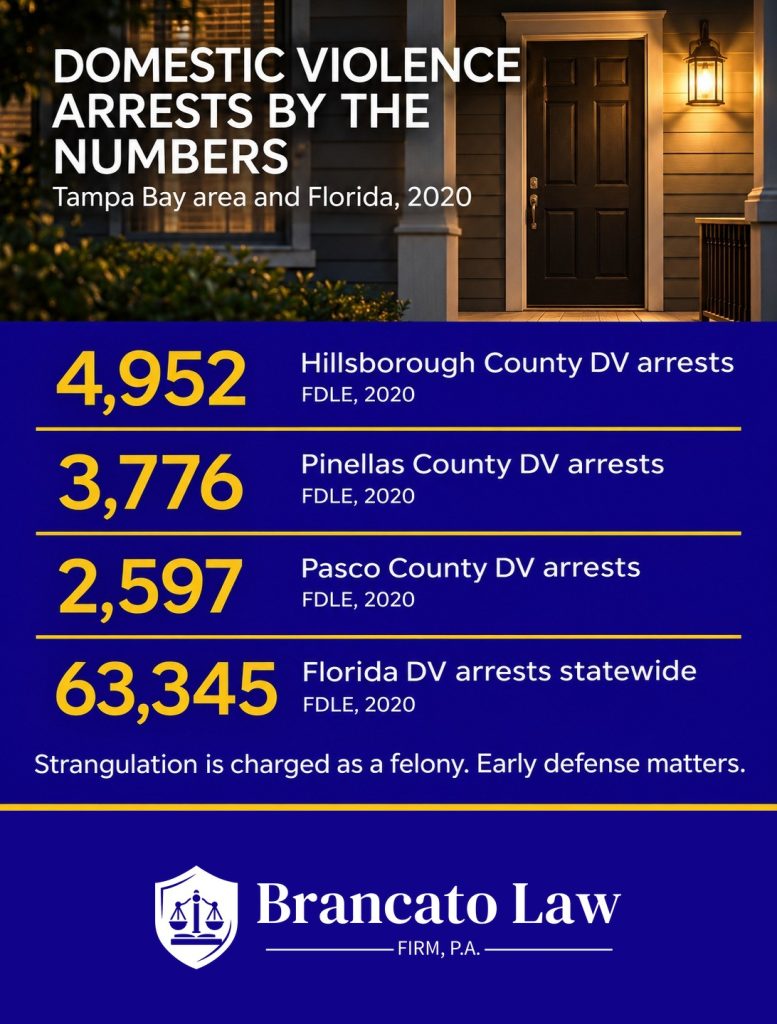
Domestic violence arrests are frequent in Hillsborough County. In 2020, law enforcement agencies in Hillsborough County made 4,952 domestic violence arrests, according to the Florida Department of Law Enforcement’s 2020 Reported Domestic Violence by Florida Jurisdiction, Arrests by Year. The same FDLE report counted 3,776 domestic violence arrests in Pinellas County, 2,597 in Pasco County, and 63,345 statewide in 2020. Strangulation cases are a small share of that total, but they draw more attention from prosecutors than most domestic battery cases because they are felonies.
What happens after a strangulation arrest in Hillsborough County?
A strangulation arrest in Hillsborough County leads to first appearance within 24 hours, where a judge reviews probable cause, sets bond, and almost always orders no contact with the complainant. Our post on Hillsborough first appearance explains that hearing. In our experience, Hillsborough County does not offer pretrial services supervision as a release option, though some neighboring counties do, so the conditions set at first appearance usually stay in place for months. A no-contact order means no calls, texts, or messages through friends, even if the complainant reaches out first.
The State Attorney’s Office for the 13th Judicial Circuit then decides whether to file the felony, reduce it, or decline it. Hillsborough’s Domestic Violence Intervention Program is generally a misdemeanor diversion program, but in our experience the State can reduce a felony domestic violence charge to a misdemeanor for the purpose of entering the program. That makes the filing decision the most important moment in a strangulation case. Our page on representation before charges are filed explains that work, our Hillsborough County criminal defense page covers the local courts, and our guide to the Florida criminal case process maps each stage after arrest.
What results has our firm obtained in strangulation cases?
Strangulation charges can be stopped before they become felony convictions. These results come from our firm’s published case results on our domestic violence defense page.
| Result | What happened |
|---|---|
| Strangulation charge never filed (November 2026) | A custom affidavit stating the alleged victim’s wishes, and direct communication with the State, led the State to decline charges. |
| One count dismissed at first appearance (August 2026) | The client faced felony domestic battery by strangulation and domestic battery. One count was dismissed at first appearance, and the alleged victim’s affidavit ended the rest. |
Past results do not guarantee future outcomes.
What should you do after a strangulation arrest?
Protect the case from the first hour. These steps matter most.
- Follow the no-contact order exactly. A single text can mean a new charge and loss of bond.
- Do not discuss the event with police, the complainant, family, or on social media.
- Write down what happened, who was present, and any injuries you received, while memory is fresh.
- Photograph your own injuries and keep any medical records.
- Save texts and messages from before and after the incident; do not delete anything.
- Call a defense attorney before the State’s filing decision.
Frequently asked questions about strangulation charges in Florida
Can domestic battery by strangulation charges be dropped in Florida?
Yes, but only the State Attorney’s Office can drop them, and the complainant’s wishes alone do not end the case. The Brancato Law Firm works the case before the filing decision, presenting the 911 call, medical records, and any self-defense evidence that shows the felony cannot be proven. Our post on whether a victim can drop domestic violence charges in Florida explains how that process works.
Can a strangulation charge be reduced to simple battery in Florida?
Yes. Simple battery is the lesser-included offense listed in the standard jury instruction, and prosecutors can reduce the charge by agreement when the evidence of impeded breathing or risk of great bodily harm is weak. Our attorneys at The Brancato Law Firm push for that reduction early, because a battery plea can often be sealed while a strangulation plea never can.
Is it strangulation if there are no marks on the neck?
It can be, because Florida law requires only a risk of great bodily harm, not a visible injury. The Brancato Law Firm still treats the lack of marks, the lack of medical findings, and an account that never mentions breathing as powerful evidence, since together they can show the act was not strangulation at all.
Does a strangulation charge apply if we only dated briefly?
Only if the relationship was a continuing and significant one of a romantic or intimate nature, or the two of you are family or household members. Our attorneys at The Brancato Law Firm investigate the relationship history, because without that element the charge cannot stand, as the First District recognized in Jennings v. State.
Can a domestic battery by strangulation conviction be sealed or expunged in Florida?
No. Section 943.0584 makes it permanently ineligible for sealing or expunction, even when adjudication is withheld after a plea. The Brancato Law Firm factors that rule into every plea discussion, and our domestic violence defense lawyers often prioritize a dismissal or reduction over a lighter sentence for this reason.
Can I go to prison for a first strangulation charge?
Prison is possible, up to 5 years, but a Level 6 charge alone scores 36 points, below the 44-point line that requires prison under the scoresheet. Our attorneys at The Brancato Law Firm build a mitigation record from the start, including treatment, employment, and character evidence, to keep a client out of state prison when the case cannot be won outright.
Should I talk to detectives about a strangulation accusation?
No. A statement explaining “what really happened” often confirms the relationship, the contact, and the location, which are three of the facts the State needs. The Brancato Law Firm speaks for clients during the investigation, and our page on pre-file advocacy explains how early work can keep a felony from being filed.
Talk to a Tampa strangulation defense attorney
The days right after a strangulation arrest decide whether the State files a felony, a misdemeanor, or nothing at all. Our attorneys will start by getting the 911 call and medical records before they disappear. Call The Brancato Law Firm, P.A., founded by Tampa Criminal Defense Attorney Rocky Brancato, at (813) 727-7159, at any hour. Our office is two blocks from the courthouse. Our firm has Spanish-speaking staff, and attorney Jean-Luc Adrien speaks Spanish, Haitian Creole, and French. For more about our defense strategies, visit our Domestic Violence Defense page.
The Brancato Law Firm, P.A.
620 E. Twiggs Street, Suite 205, Tampa, FL 33602
(813) 727-7159
Serving Hillsborough, Pinellas, and Pasco Counties
The Brancato Law Firm, P.A. is a Tampa-based criminal defense practice. We are not affiliated with any other Brancato-named law firms.
Visit Us

Tampa, FL 33602

Contact Us Now
Free Legal Consultation (813) 727-7159
