- Free Consultation 24/7: (813) 727-7159 Tap Here To Call Us


From First DUI to Death Penalty



What Is a Domestic Violence Lethality Assessment in Florida?


| A domestic violence lethality assessment is a 12-question checklist that Florida law requires officers to read to the alleged victim at every intimate-partner domestic violence call, whether or not anyone is arrested. One “yes” to any of the first four questions marks the alleged victim as being in a “potentially lethal situation.” The tool was built to refer victims to domestic violence services, and the Florida Department of Law Enforcement’s own workgroup reported that the questions in the statute “are not evidence-based.” A defense attorney can challenge any attempt to use the result as proof of guilt or dangerousness. |
If a Hillsborough County arrest report says the alleged victim is in a “potentially lethal situation,” that line came from a checklist an officer read at the scene, and it is not a finding about what happened. I’m Rocky Brancato, founder of The Brancato Law Firm, P.A., a Tampa criminal defense firm, a former police academy instructor, and a former Chief Operations Officer of the Hillsborough County Public Defender’s Office, where I oversaw a staff of over 100 attorneys. Our attorneys are now seeing this label in Hillsborough County domestic violence reports, including cases where the only alleged contact was a push, and we challenge it at first appearance, at bond, and before trial.
What is Florida’s domestic violence lethality assessment?
Florida’s domestic violence lethality assessment is a mandatory set of 12 questions an officer must ask the alleged victim whenever the domestic violence allegation is against an intimate partner. Section 741.29(1)(c), Florida Statutes, requires the assessment “regardless of whether an arrest is made.” The Legislature added the requirement in 2024, and the Florida Department of Law Enforcement (FDLE) adopted a statewide form titled the State of Florida Domestic Violence Lethality Assessment.
Some people call it a “domestic lethality assessment” or a “DV lethality screen.” The official purpose is narrow. Under section 741.29(2)(f), the officer advises the alleged victim of the result and refers that person to the nearest certified domestic violence center, such as The Spring of Tampa Bay in Hillsborough County.
The statute also requires the officer to note the “score” in the written police report under section 741.29(3)(d). That one line is how a services referral ends up in front of a judge. If you are facing a domestic battery charge, our Tampa domestic violence defense attorney page explains how our firm defends these cases from the first hearing forward.
The scale is large. In 2024, Hillsborough County recorded 6,553 domestic violence offenses, according to FDLE data published on Florida Health CHARTS. Each intimate-partner case among them now requires a lethality assessment, and many reports carry a “potentially lethal” notation.
What questions are on the Florida lethality assessment?
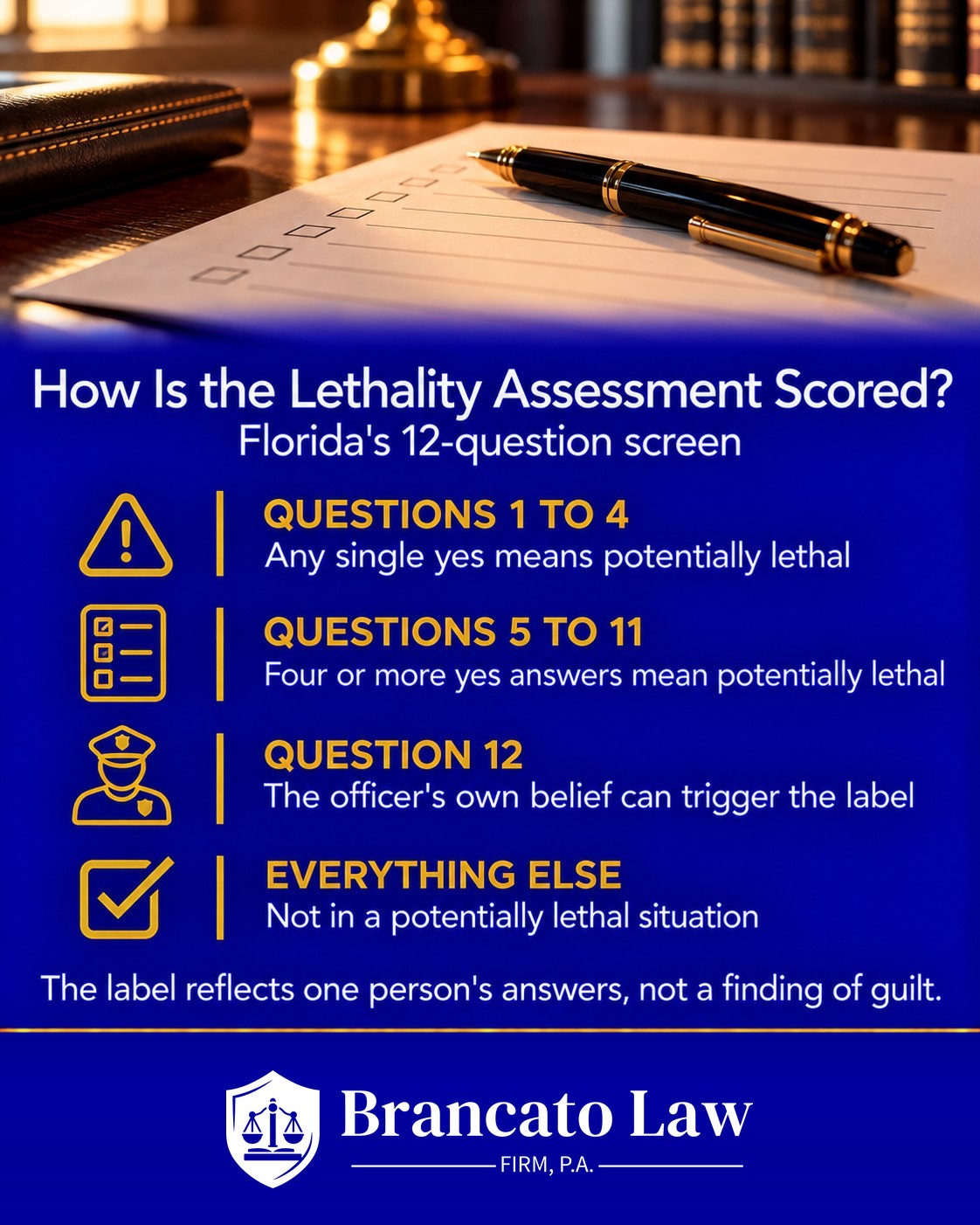
The officer must ask all 12 questions “in the same or similar wording and in the same order,” under section 741.29(2)(e). Every question goes to the alleged victim. The accused person is never asked anything. Here is how the answers drive the result.
| Question (paraphrased from the statute) | Group | Effect of a “yes” |
|---|---|---|
| 1. Did the aggressor ever use or threaten a weapon against you? | High-risk | One “yes” alone means “potentially lethal” |
| 2. Did the aggressor ever threaten to kill you or your children? | High-risk | One “yes” alone means “potentially lethal” |
| 3. Do you believe the aggressor will try to kill you? | High-risk | One “yes” alone means “potentially lethal” |
| 4. Has the aggressor ever choked or tried to choke you? | High-risk | One “yes” alone means “potentially lethal” |
| 5. Does the aggressor have a gun or could easily get one? | Secondary | Four “yes” answers in questions 5 to 11 mean “potentially lethal” |
| 6. Is the aggressor violently or constantly jealous, or controlling? | Secondary | Counts toward four |
| 7. Did you leave or separate after living together or marriage? | Secondary | Counts toward four |
| 8. Is the aggressor unemployed? | Secondary | Counts toward four |
| 9. Has the aggressor ever attempted suicide? | Secondary | Counts toward four |
| 10. Do you have a child the aggressor believes is not theirs? | Secondary | Counts toward four |
| 11. Has the aggressor ever followed, spied on, or left threatening messages for you? | Secondary | Counts toward four |
| 12. Is there anything else that worries you about your safety? | Open-ended | The officer may find “potentially lethal” based on the officer’s own belief |
Notice the word “ever” in most of the questions. The assessment asks about the entire relationship, with no time limit and no requirement that anything be corroborated. Notice also that questions 7 and 8 describe ordinary life events. Someone who moved out and lost a job has already answered two of the four secondary questions.
What does “potentially lethal” mean on a police report?
“Potentially lethal” on a Florida police report means the alleged victim’s answers met the statutory referral trigger, or the officer believed the person was at risk. It does not mean a judge, a doctor, or a scientist found that anyone is dangerous. The FDLE form has no “high,” “medium,” or “low” category. It has five check boxes, and only two of them produce the label:
- The victim is in a potentially lethal situation based on score.
- The victim is in a potentially lethal situation based on the officer’s belief.
The other choices are that the victim declined, the officer could not administer the screen, or the victim is not in a potentially lethal situation. The difference between “based on score” and “based on the officer’s belief” matters. An officer’s belief is opinion, and Florida law limits officer opinion testimony, as explained below.
The narrative and the form do not always agree. In one Hillsborough County Sheriff’s Office report our firm reviewed this fall, involving an allegation of pushing, the deputy’s narrative said the alleged victim was in a “potentially lethal situation.” The attached form, filled out by a different deputy, had the box checked “not in a potentially lethal situation.” In another HCSO report, involving allegations of strangulation and false imprisonment, the answers met the score trigger on three high-risk questions, but the deputy checked the “officer’s belief” box instead. The label is only as accurate as the person filling it out, which is why our attorneys read the form itself and never rely on the narrative’s summary of it.
The same label also covers very different cases. A single “yes” to any of the first four questions produces exactly the same “potentially lethal” result as a case involving binding, strangulation, and hospital treatment. The form has no way to tell a judge which one is in front of them.
The form itself admits the label’s limits. Its closing note on the FDLE statewide lethality assessment form says: “Although most victims who are believed to be in a potentially lethal situation would not be expected to be killed, these victims face a much higher risk than other victims of intimate partner violence.” That sentence, from the government’s own form, belongs in front of any judge who reads the label.
Where did Florida’s lethality assessment come from?
Florida’s lethality assessment comes from victim-advocacy research on intimate partner homicide. The research behind it began with Dr. Jacquelyn Campbell’s Danger Assessment and her study of intimate partner homicides, published as Risk Factors for Femicide in Abusive Relationships: Results From a Multisite Case Control Study (American Journal of Public Health, 2003). In 2005, the Maryland Network Against Domestic Violence condensed that work into an 11-question “Lethality Screen” for police officers.
In Florida, the mandate was first filed in 2024 as Senate Bill 610, which Tampa Bay 28 reported as “the Gabby Petito Act”. It became law through Senate Bill 1224, which passed 40 to 0 in the Senate and 112 to 0 in the House and took effect July 1, 2024, according to the Florida Senate bill summary for CS/CS/CS/SB 1224.
FDLE then convened a workgroup chaired by Joe Petito of the Gabby Petito Foundation. Its members included a Tampa Police Department deputy chief and the Pinellas County Sheriff. The FDLE Lethality Assessment Executive Workgroup Report records three facts every defense lawyer should know:
- The workgroup first voted to use the copyrighted Maryland program, then rescinded that vote 9 to 1 because of copyright, cost of more than $30,000 plus annual fees, and other barriers.
- The Maryland program’s administrator told the workgroup that the screen is evidence-based only when the questions are asked verbatim and in a specific order, and that his organization does not recommend making the assessment mandatory by statute.
- The report states: “It is important to note that these questions in statute are not evidence-based.”
Florida adopted the statutory questions anyway. The statewide form, FDLE-DVLA-001, is incorporated into Florida Administrative Code Rule 11B-27.00212. Officers are trained through a one-hour FDLE online lethality assessment course for law enforcement, which every officer had to complete by October 1, 2026. Under the rule, an officer who misses that deadline has his or her certification placed on inactive status until the agency verifies completion.
How accurate is a lethality assessment?
A lethality screen is good at catching the rare case that turns severe, and poor at telling which flagged cases will. That tradeoff is deliberate. The researchers who studied the Maryland screen designed it to avoid missing anyone, which means it flags many people who never go on to be seriously hurt.
| What researchers measured | Finding | Source |
|---|---|---|
| Sensitivity (catching later severe or near-lethal violence) | 92% to 93% | Messing et al., Journal of Interpersonal Violence (2017) |
| Specificity (correctly clearing people who were not later harmed) | 21% | Messing et al., Journal of Interpersonal Violence (2017) |
| Positive predictive value (flagged cases that turned near-fatal) | 13.27% | National Institute of Justice (2018) |
| False flags for each correct flag | Six to seven | National Institute of Justice (2018) |
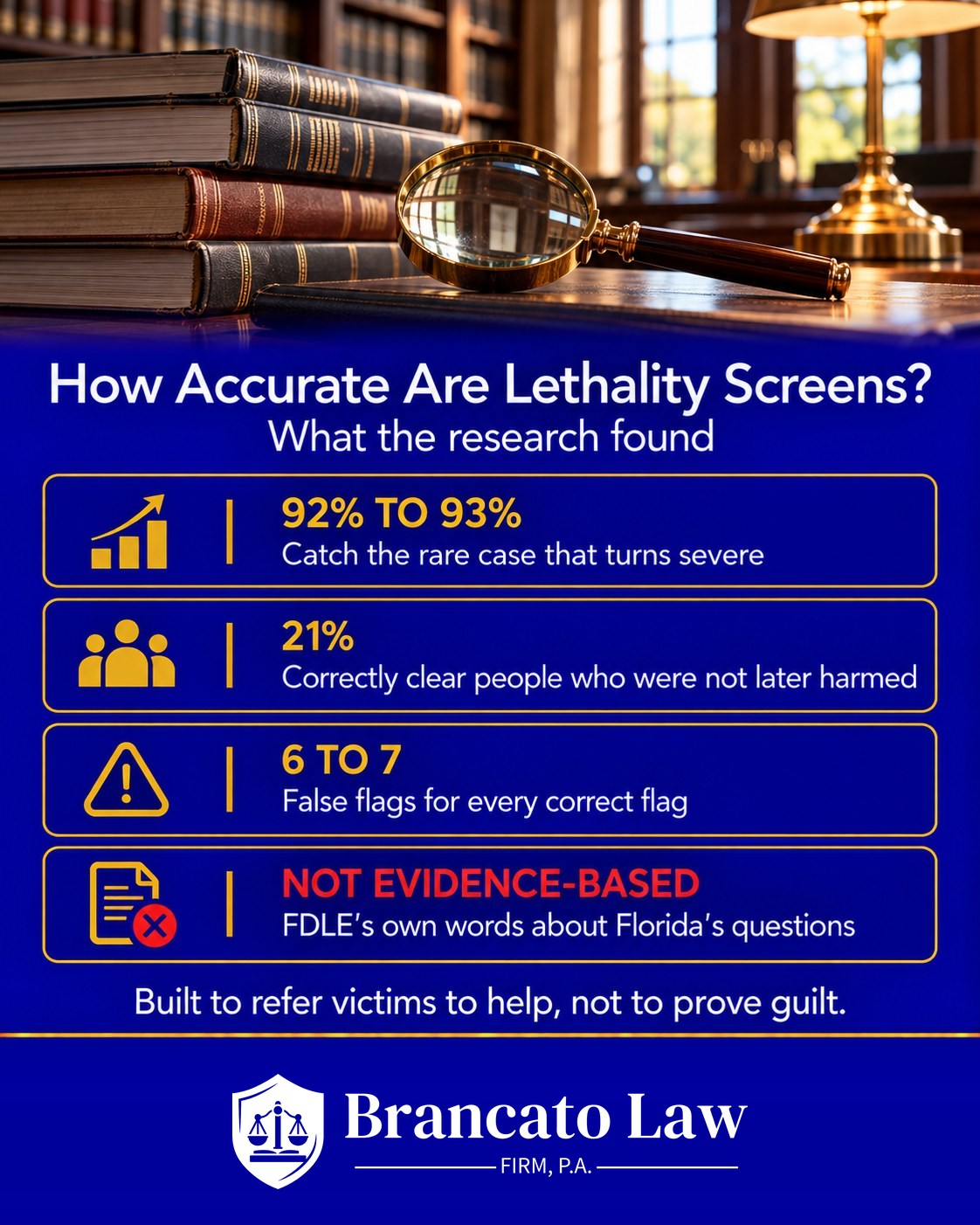
The specificity figure comes from The Lethality Screen: The Predictive Validity of an Intimate Partner Violence Risk Assessment for Use by First Responders (Journal of Interpersonal Violence, 2017), a study of 254 women screened at police calls in a Southwestern state. A specificity of 21% means that roughly four out of five women who did not experience severe or near-lethal violence afterward were still flagged. The National Institute of Justice summary, How Effective Are Lethality Assessment Programs for Addressing Intimate Partner Violence?, reported that six to seven women were incorrectly screened as high risk for every one correctly identified.
Two more points matter in court. Those studies measured the validated Maryland screen, and Florida does not use it. And no study validated any version of the screen as evidence that a charged battery happened. A tool designed to send people to a shelter hotline was never tested as proof of guilt.
Can a lethality assessment affect bond in Hillsborough County?
Yes. The lethality assessment most often hurts an accused person at first appearance, because the “potentially lethal” notation is in the arrest report the judge reads. Florida treats domestic violence as a “dangerous crime” under section 907.041, Florida Statutes, and a person arrested for a dangerous crime cannot receive nonmonetary release at first appearance once the judge finds probable cause.
Under section 741.2901(3), Florida Statutes, a person arrested for domestic violence stays in custody until brought before a judge, and the judge “shall consider the safety of the victim” in setting bail. The same statute lists the history the State Attorney’s Office must gather for first appearance: prior domestic violence arrests, other arrests, prior injunctions, and prior walk-in complaints. The lethality assessment is not on that list.
In Hillsborough County, pretrial services supervision is not available as a release option, though some nearby counties offer it. That makes the bond amount and the no-contact terms the whole fight. Our firm’s guide to how a bond hearing works in Tampa walks through that process. At first appearance or a later bond hearing in Hillsborough County criminal court, our attorneys ask the judge to weigh the facts in the report, not the word “lethal,” and we put FDLE’s “not evidence-based” finding in front of the court.
Can prosecutors use a lethality assessment at trial in Florida?
A Florida prosecutor faces serious legal barriers to using a lethality assessment as evidence of guilt. As of October 2026, our research found no Florida appellate decision ruling on the admissibility of the section 741.29 assessment. Established Florida law points against it on several grounds.
Officer opinion on guilt. In Martinez v. State, 761 So. 2d 1074 (Fla. 2000), the lead detective told the jury he had “no doubt” the defendant committed the murders. The Florida Supreme Court reversed, holding that a witness’s opinion on guilt is inadmissible and that the danger is greatest when it comes from a police officer. A “potentially lethal” box checked “based on the officer’s belief” is officer opinion.
Bolstering the accuser. In Cavaliere v. State, 147 So. 3d 628 (Fla. 2d DCA 2014), a detective told the jury the child complainant “wasn’t a joke” and was acting appropriately. The Second District Court of Appeal, which hears appeals from Hillsborough County, reversed for a new trial because the officer vouched for the complainant’s credibility. An officer’s lethality label puts the State’s stamp on the accuser’s version of events.
Profile evidence. In Flanagan v. State, 625 So. 2d 827 (Fla. 1993), the State used a “sex offender profile” to suggest the defendant fit the type. The Florida Supreme Court held that profile testimony “implies an infallibility not found in pure opinion testimony” and that using it to prove guilt was an improper attack on character. A risk-factor checklist works the same way.
Expert reliability. Section 90.702, Florida Statutes, requires expert testimony to be “the product of reliable principles and methods.” In Petriciolet v. State, 442 S.W.3d 643 (Tex. App. 2014), a Texas appeals court held it was error to admit a social worker’s “lethality assessment” testimony after she could not say whether the tool had been tested and admitted an error rate of “30 or 40 percent.” Another Texas court allowed Danger Assessment testimony in Kingsbury v. State, 625 S.W.3d 686 (Tex. App. 2021), under a separate Texas “soft science” standard that Florida’s statute does not contain.
Uncharged prior acts. Questions 1, 2, 4, and 11 ask about weapons, threats, choking, and stalking at any time in the past. Under section 90.404(2)(a), Florida Statutes, other acts are inadmissible to prove bad character or propensity, and the State must give written notice at least 10 days before trial to use them for another purpose. The assessment cannot be used to slip those allegations in without that process.
Confrontation. The alleged victim’s answers are hearsay. Under Davis v. Washington, 547 U.S. 813 (2006), statements to police are testimonial when the primary purpose is “to establish or prove past events potentially relevant to later criminal prosecution.” Structured questions about the whole history of a relationship, asked after the scene is calm, fit that description.
How do our attorneys challenge a lethality assessment?
Our attorneys challenge a lethality assessment by getting the actual form, testing how it was given, and keeping the label away from the judge and jury. Here is the process we follow in Hillsborough, Pinellas, and Pasco cases:
- Demand the completed form. The form is confidential, but section 741.29(2)(i) allows the State Attorney to release it “to the parties in a pending criminal prosecution as required by law.” We request it in discovery.
- Compare the form to the narrative. If the report says “potentially lethal” but the form says otherwise, the report is wrong on its face, and we put that in front of the prosecutor and the judge.
- Find out which box was checked. “Based on score” and “based on the officer’s belief” call for different attacks.
- Read every answer. A “no” to question 3, meaning the alleged victim does not believe the accused will try to kill her, helps at bond.
- Compare the answers to the evidence. A “yes” to choking with no injury, no strangulation charge, and no mention in the narrative is impeachment.
- Check the officer’s training. Under section 741.29(2)(b), an officer who has not completed the training “may not administer” the assessment.
- Watch the body camera. The statute requires the questions in the same or similar wording and order. Deviations matter.
- File a motion in limine. We move to exclude the result, the word “lethal,” and any testimony interpreting the assessment before the jury is picked.
Our firm’s broader guide on how to fight a domestic violence battery charge in Florida covers the defenses to the underlying charge.
What should you do if your report says “potentially lethal”?
If your report says “potentially lethal,” get a defense attorney involved before first appearance or as soon after it as possible. Under Florida Rule of Criminal Procedure 3.130, first appearance happens within 24 hours of arrest, and the judge sets release conditions using the arrest report.
- Do not contact the alleged victim, even to apologize. A no-contact order is almost always a condition of release.
- Do not discuss the incident on jail phones, texts, or social media. Jail calls are recorded.
- Write down what actually happened while it is fresh, and give it only to your lawyer.
- Ask your lawyer to request the lethality assessment form and the body camera video.
Because officers must give the assessment even when no one is arrested, some people learn about it while the case is still under review. Our firm offers representation before charges are filed, which can shape whether and how the State Attorney’s Office files charges.
Frequently Asked Questions
Can I get a copy of the lethality assessment in my Florida domestic violence case?
Usually yes, through your defense attorney in discovery. The Brancato Law Firm requests the completed form and the body camera footage of the officer asking the questions whenever a report mentions the assessment. The form is exempt from public records, but section 741.29(2)(i) lets the State Attorney release it to the parties in a pending criminal case.
Does the accused person answer any questions on the lethality assessment?
No, all 12 questions are asked of the alleged victim, and the accused person has no input into the result. Our attorneys at The Brancato Law Firm use that one-sided design to show judges that the label reflects one person’s account, not a balanced review.
Can domestic violence charges be dropped if the lethality assessment says “potentially lethal”?
Yes, the lethality assessment does not control the charging decision, and the State Attorney’s Office can still decline or dismiss the case. The Brancato Law Firm regularly works to have domestic violence charges dropped, and our guide on whether a victim can drop domestic violence charges in Florida explains who actually makes that decision.
Does a “potentially lethal” result make a domestic battery a felony?
No, the lethality assessment does not change the charge, which depends on the alleged conduct, any injury, and prior record. When a “potentially lethal” label appears in a misdemeanor battery report, The Brancato Law Firm treats it as a bond and evidence problem to address early, and you can learn more on our Tampa domestic violence lawyer page.
What if the alleged victim’s answers on the lethality assessment were exaggerated?
Exaggerated answers can be exposed, because nothing on the assessment has to be corroborated. Attorneys at The Brancato Law Firm compare every “yes” answer against the officer’s narrative, the photos, and the body camera, and use the conflicts at bond hearings and in cross-examination. The questions cover the whole relationship, so answers about old events are often the easiest to test.
Can an officer give the lethality assessment without training?
No, under section 741.29(2)(b), an officer may not administer the assessment without completing the required training, and every officer had to finish it by October 1, 2026. The Brancato Law Firm requests the officer’s training completion date, and an assessment given before the officer completed the course is a basis to challenge the result.
Talk to a Domestic Violence Defense Attorney Before First Appearance
The label on the report is written in the first hour of a case, and the first appearance judge reads it within a day. The Brancato Law Firm, P.A., founded by Tampa Criminal Defense Attorney Rocky Brancato, gets the lethality assessment form, tests how it was given, and fights to keep it from driving your bond or your trial. Call (813) 727-7159 today, before the next court date. For more about our defense strategies, visit our Domestic Violence Defense page.
The Brancato Law Firm, P.A.
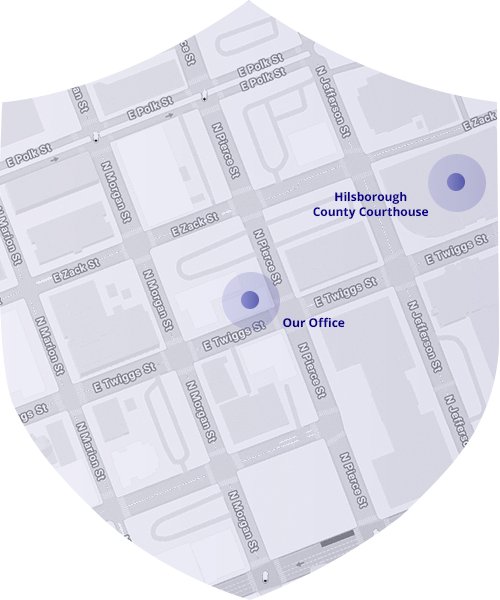
620 E. Twiggs Street, Suite 205, Tampa, FL 33602
(813) 727-7159
Serving Hillsborough, Pinellas, and Pasco Counties
The Brancato Law Firm, P.A. is a Tampa-based criminal defense practice. We are not affiliated with any other Brancato-named law firms.
Visit Us
Tampa, FL 33602
Contact Us Now
Free Legal Consultation (813) 727-7159