

From First DUI to Death Penalty



How to Fight a Culpable Negligence Charge in Florida? (2026)


To fight a culpable negligence charge in Florida, the defense shows that the conduct was ordinary carelessness rather than the gross and flagrant disregard for safety that section 784.05 requires. In the Second District, which covers Hillsborough, Pinellas, and Pasco counties, the State must prove a conscious act that a reasonable person would know is likely to cause death or great bodily harm. Culpable negligence is a second-degree misdemeanor when it exposes someone to injury and a first-degree misdemeanor when it causes injury, but leaving a loaded gun where a child under 16 gets it and causes injury or death is a third-degree felony unless the gun was locked or secured.
Culpable negligence cases are usually won on the difference between a mistake and recklessness, and that difference is a legal line, not a feeling. Florida appeals courts have reversed convictions for a parent who left children home alone for a few hours, a man whose pistol went off while he loaded it, and a 12-year-old who threw a smoke bomb into a house. I am Rocky Brancato, founder of The Brancato Law Firm, P.A., a Tampa criminal defense firm, and I have spent more than 25 years in Hillsborough County courtrooms. Our attorneys build these defenses around the facts that separate an accident from a crime: what the person knew, what precautions they took, and what risk a reasonable person would actually have seen.
What is culpable negligence in Florida?
Culpable negligence is negligence so gross and flagrant that it shows a reckless disregard for human life or the safety of others. Under section 784.05, Florida Statutes, a person who, through culpable negligence, exposes another person to personal injury commits a second-degree misdemeanor, and a person who inflicts actual personal injury that way commits a first-degree misdemeanor. The statute does not define the term, so courts and the standard jury instruction supply the definition.
Ordinary negligence, the kind that supports a lawsuit, is not enough. In Kish v. State, 145 So. 3d 225 (Fla. 1st DCA 2014), the court quoted the jury instruction: culpable negligence “must be gross and flagrant,” committed “with an utter disregard for the safety of others.” Our attorneys defend culpable negligence charges alongside battery and other injury cases, and more about that work is on our Tampa violent crime lawyer page.
What does the State have to prove in Hillsborough, Pinellas, and Pasco counties?
In the Second District, the State must prove a conscious act that a reasonable person would know is likely to result in death or great bodily harm, done with utter disregard for the safety of others. That rule comes from J.C. v. State, 233 So. 3d 519 (Fla. 2d DCA 2018). A 12-year-old in Polk County lit a smoke bomb and threw it toward a friend’s open front door. It landed on the carpet, smoking but not burning, and no one was hurt. The Second District reversed his delinquency finding because the State offered no evidence that a smoke bomb was likely to cause death or great bodily harm.
The same opinion shows the standard is contested. A concurring judge questioned whether the “death or great bodily harm” requirement fits the statute’s text, which speaks of “personal injury.” Until the court revisits the rule, it binds trial courts in the 13th Judicial Circuit and the rest of the Second District, and our attorneys hold the State to it in every motion for judgment of acquittal.
| Level of fault | What it looks like | Criminal under section 784.05? |
|---|---|---|
| Accident | No carelessness; an unforeseeable event | No |
| Ordinary negligence | A lapse a careful person might make, such as failing to double-check arrangements | No; civil liability at most |
| Culpable negligence | A conscious act a reasonable person would know is likely to cause death or great bodily harm, with utter disregard for safety | Yes: second- or first-degree misdemeanor |
| Culpable negligence that causes death | The same conduct, resulting in a death | Charged as manslaughter, a second-degree felony |
What are the penalties for culpable negligence in Florida?
The penalty depends on whether someone was hurt and whether a loaded firearm and a child were involved. Maximum jail terms come from section 775.082 and fines from section 775.083.
| Charge | Statute | Degree | Maximum penalty |
|---|---|---|---|
| Exposing another to personal injury | 784.05(1) | Second-degree misdemeanor | 60 days in jail, $500 fine |
| Inflicting actual personal injury | 784.05(2) | First-degree misdemeanor | 1 year in jail, $1,000 fine |
| Leaving a loaded firearm within reach of a minor who uses it to injure or kill | 784.05(3) | Third-degree felony | 5 years in prison, $5,000 fine |
When culpable negligence causes a death, prosecutors charge manslaughter instead. Our post on second-degree murder vs. manslaughter in Florida explains that charge.
When is leaving a gun around a child a felony in Florida?
Leaving a loaded firearm within the reach or easy access of a minor under 16 is a third-degree felony under section 784.05(3) only if the minor gets the gun and uses it to injure or kill someone, including themselves. The statute does not apply if the gun was in a securely locked box or container, in a place a reasonable person would believe was secure, or secured with a trigger lock. It also does not apply when the minor got the gun through an unlawful entry, or to injuries from target shooting, sport shooting, or hunting accidents.
The statute adds one rule found nowhere else in chapter 784: when a child is accidentally shot by another family member, no arrest may be made under subsection (3) until 7 days after the shooting. Those seven days are the time to retain counsel, preserve the storage evidence, and stay out of interviews.
The research behind the law is strong. A case-control study published in JAMA in 2005, Grossman and colleagues’ “Gun storage practices and risk of youth suicide and unintentional firearm injuries,” found that guns involved in youth shootings were far less likely to have been stored locked (odds ratio 0.27) or unloaded (odds ratio 0.30) than comparison guns. Locally, a Johns Hopkins All Children’s Hospital team in St. Petersburg analyzed Florida hospital discharge data for patients ages 0 to 19 hospitalized with firearm injuries from 2012 to 2021. As Johns Hopkins Medicine reported in 2025, 52% of those patients needed intensive care and 7% died. Because the statute’s exceptions track safe storage, our first question in a 784.05(3) case is where and how the gun was kept, and our Tampa gun crimes attorney page covers related weapons charges.
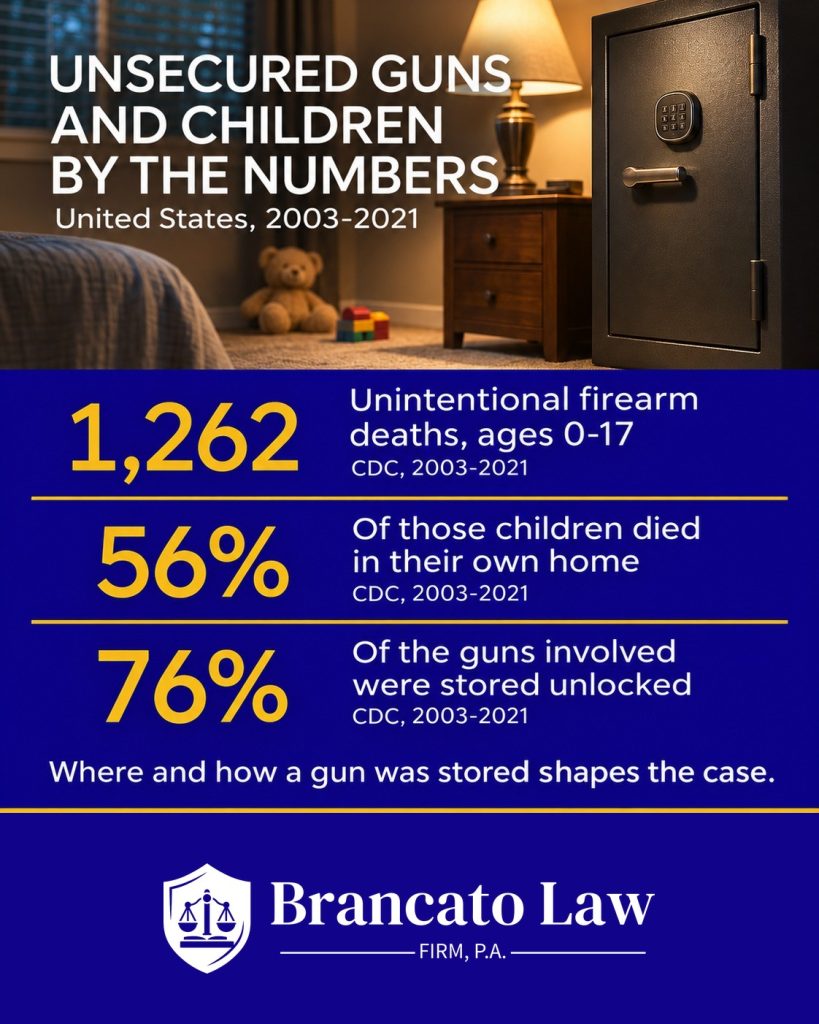
National death data show why storage is the first question in these cases. The CDC’s National Violent Death Reporting System identified 1,262 unintentional firearm deaths of children ages 0 to 17 from 2003 through 2021, and 56% of those children were fatally injured in their own home, according to a December 2023 CDC report in the Morbidity and Mortality Weekly Report. The same report found that the guns involved were often stored loaded (74%) and unlocked (76%).
How do our attorneys fight a culpable negligence charge?
Our attorneys fight culpable negligence by proving the conduct was a lapse, not a reckless disregard for life, and by holding the State to the Second District’s likelihood-of-serious-harm standard.
1. Show the precautions that were taken
In Kish, a mother changed her children’s bus route to a trusted caregiver’s home after a family emergency but did not confirm the caregivers were home. The First District called that a lapse she “should have” avoided, but held it did not show “utter disregard” for her children, and ordered acquittals on all three counts. Our attorneys document every step the client took, because effort toward safety is the strongest evidence against recklessness.
2. Make the State prove the danger
J.C. turned on the State’s failure to present evidence that the act was likely to cause death or great bodily harm. When a case involves an unfamiliar object, a vehicle, a pool, or a substance, we look at whether the State has any expert or factual proof of the danger, and we retain our own expert when it does.
3. Separate an accident from recklessness
In Killingsworth v. State, 584 So. 2d 647 (Fla. 1st DCA 1991), a man was loading a pistol in a car when it discharged, hit the car’s interior, and ricocheted into a child’s leg. No one saw him point the gun at anyone, and even the child’s father testified he saw no danger. The First District held this did not show gross and flagrant negligence and ordered him discharged. Our attorneys reconstruct the event, including how the gun or object was handled, to show the jury the difference between bad luck and recklessness.
4. Use the safe-storage exceptions
In a firearm-and-minor case, proof of a lockbox, a trigger lock, or a location a reasonable person would think secure defeats the felony. We photograph the storage, collect purchase records for locks and safes, and identify how the child actually reached the gun.
5. Work the case early
Many culpable negligence cases begin with a DCF call, a hospital report, or a detective’s visit. Through representation before charges are filed, our attorneys present the context before the State decides what, if anything, to file. Where children are involved, our Tampa child abuse attorney page explains how a parallel child neglect investigation can arise.
What happens after a culpable negligence arrest in Hillsborough County?
A misdemeanor culpable negligence arrest in Hillsborough County may end in a notice to appear or a trip to first appearance, where a judge sets release conditions. Hillsborough County does not offer pretrial services supervision as a release option, so release turns on bond or release on recognizance. The case then proceeds in county court for misdemeanors or circuit court for the felony firearm charge. Our guide to the stages of a Florida criminal case explains each step, and our Hillsborough County criminal defense page covers local courts.
Frequently asked questions about culpable negligence in Florida
Can culpable negligence charges be dropped in Florida?
Yes, culpable negligence charges can be dropped, most often when the evidence shows ordinary carelessness rather than gross and flagrant disregard for safety. The Brancato Law Firm presents the precautions our client took and the facts the arrest report left out, ideally before charges are filed through pre-file advocacy.
Is leaving a child alone at home culpable negligence in Florida?
Not automatically. In Kish, leaving children ages 10, 8, and 7 alone for two to three hours did not prove culpable negligence. Our attorneys at The Brancato Law Firm look at the children’s ages, the length of time, the home, and the arrangements made, because the totality of the circumstances decides these cases. Our post on leaving a child in a hot car in Florida covers a related charge.
What is the difference between culpable negligence and child neglect in Florida?
Culpable negligence under section 784.05 applies to anyone exposed to injury, while child neglect under chapter 827 applies to a caregiver’s failure to provide a child with necessary care or supervision. The Brancato Law Firm reviews which statute the State charged, since child neglect carries felony penalties. Our post on child neglect charges in Tampa explains that charge.
Is an accidental shooting a crime in Florida?
An accidental shooting is not a crime unless the handling of the gun was culpably negligent or another statute applies. Lawyers at The Brancato Law Firm review how the gun was loaded, carried, and stored, because Killingsworth shows that an accidental discharge alone is not culpable negligence.
Does a trigger lock protect me from a charge if a child gets my gun?
A trigger lock, lockbox, or reasonably secure location is an express exception to the felony in section 784.05(3). The Brancato Law Firm documents the lock or storage right away, because proof of how the gun was kept often decides whether the felony applies. The misdemeanor subsections can still apply in some cases, so get advice before speaking with detectives.
Can I get a culpable negligence charge sealed?
Often, yes, if the case is dismissed or ends with a withhold of adjudication and you meet Florida’s eligibility rules. Our team at The Brancato Law Firm aims first for an outcome that keeps sealing or expunction available. Our violent crime defense team in Tampa can review your eligibility.
For more about our defense strategies, visit our Violent Crimes page.
Our attorneys start by documenting what you did to keep people safe, while the scene, the storage, and the witnesses are still available. Call The Brancato Law Firm, P.A., founded by Tampa Criminal Defense Attorney Rocky Brancato, at (813) 727-7159 for a free consultation; we are available 24/7. Our firm has Spanish-speaking staff, and attorney Jean-Luc Adrien speaks Spanish, Haitian Creole, and French.
The Brancato Law Firm, P.A.
620 E. Twiggs Street, Suite 205, Tampa, FL 33602
(813) 727-7159
Serving Hillsborough, Pinellas, and Pasco Counties
The Brancato Law Firm, P.A. is a Tampa-based criminal defense practice. We are not affiliated with any other Brancato-named law firms.
Visit Us

Tampa, FL 33602

Contact Us Now
Free Legal Consultation (813) 727-7159
