

From First DUI to Death Penalty



How to Fight Battery on a Person 65 or Older in Florida (2026)


Battery on a person 65 or older is a third-degree felony in Florida, punishable by up to five years in prison, because section 784.08 reclassifies an ordinary first-degree misdemeanor battery whenever the alleged victim is 65 or older. The State does not have to prove the accused knew the person’s age, and a judge cannot withhold adjudication on the reclassified charge. The defense is fought on the same ground as any battery (whether there was an intentional, unwanted touching, and whether it was self-defense) plus one more element: proof of the alleged victim’s age.
If you were arrested after a shoving match with an older neighbor, a parent, or a resident in a care facility, you may have expected a misdemeanor and found the word “felony” on your booking sheet. I’m Rocky Brancato, founder of The Brancato Law Firm, P.A., a Tampa criminal defense firm. I have tried more than 150 jury trials to verdict over more than 25 years in Hillsborough County courtrooms, and as a former Chief Operations Officer of the Hillsborough County Public Defender’s Office, where I oversaw a staff of over 100 attorneys, I saw how often an age enhancement turns a family argument into a felony file. In these cases our attorneys start by pinning down three facts before the State Attorney’s Office does: exactly what contact happened, who started it, and what evidence the State actually has of the other person’s age.
What is battery on a person 65 or older in Florida?
Battery on a person 65 or older is an ordinary battery with an age-based reclassification attached. Under section 784.03, Florida Statutes, a battery happens when someone “actually and intentionally touches or strikes another person against the will of the other” or “intentionally causes bodily harm to another person.” On its own, that is a first-degree misdemeanor. When the person touched is 65 or older, section 784.08(2) moves the charge up one degree, so a misdemeanor battery becomes a third-degree felony.
The same statute reaches assault and the aggravated offenses too. Florida’s standard jury instructions cover each version separately: instruction 8.14 (aggravated battery), 8.15 (aggravated assault), 8.16 (battery), and 8.17 (assault) on a person 65 years of age or older, all published in Chapter 8 of the Florida Standard Jury Instructions in Criminal Cases. Our Tampa violent crime lawyer page covers the wider family of battery and assault charges our attorneys defend.
How does a victim’s age change the charge and the penalty?
A victim’s age moves every assault and battery charge up one degree, and for the two aggravated offenses it adds a three-year minimum prison term. The reclassification rules are in section 784.08(2), the maximum prison terms are in section 775.082, and the offense severity levels used on the sentencing scoresheet come from section 921.0022.
| Charge | Normal degree and maximum | Victim 65 or older | Scoresheet level (65+) |
|---|---|---|---|
| Assault | Second-degree misdemeanor, 60 days | First-degree misdemeanor, 1 year | None (misdemeanor) |
| Battery | First-degree misdemeanor, 1 year | Third-degree felony, 5 years | Level 4 |
| Aggravated assault | Third-degree felony, 5 years | Second-degree felony, 15 years, 3-year minimum | Level 6 |
| Aggravated battery | Second-degree felony, 15 years | First-degree felony, 30 years, 3-year minimum | Level 7 |
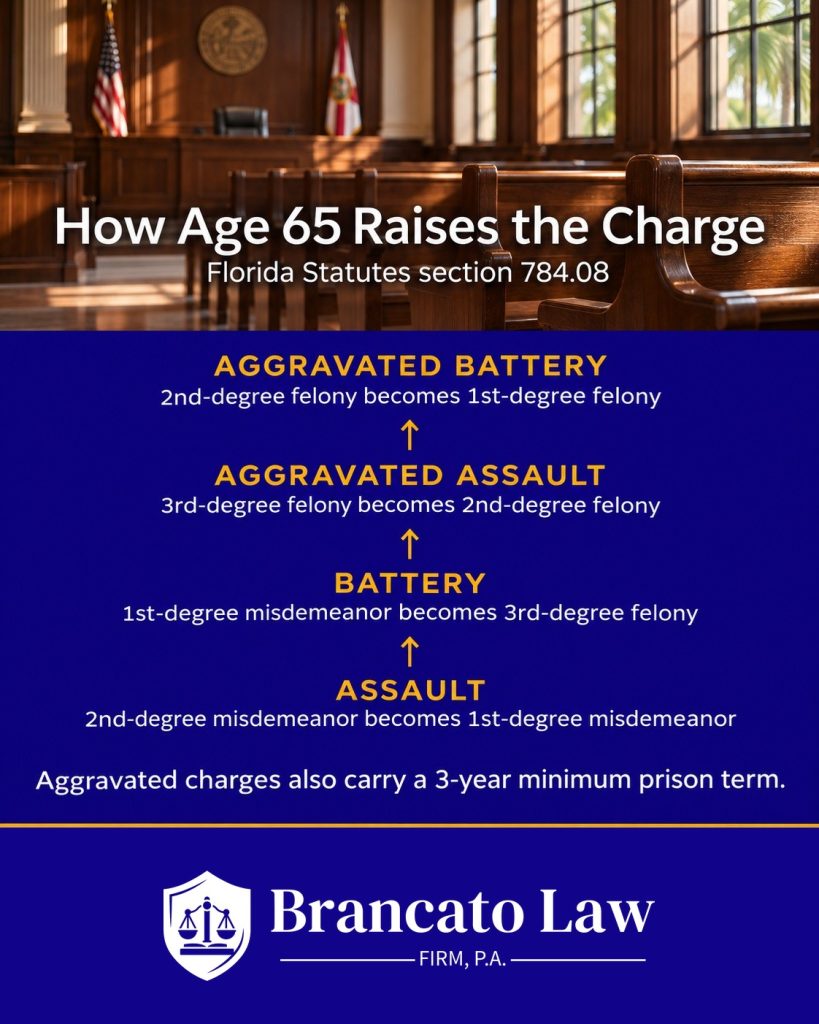
Two other rules make these charges harder than they look. First, section 784.08(1) says a person convicted of aggravated assault or aggravated battery on a person 65 or older “shall be sentenced to a minimum term of imprisonment of 3 years,” fined up to $10,000, and ordered to pay restitution and perform up to 500 hours of community service. Second, section 784.08(3) says adjudication of guilt or imposition of sentence “shall not be suspended, deferred, or withheld.” In plain terms, a plea to the reclassified charge as written means a conviction on your record, even for a first offense.
Does the State have to prove you knew the person was 65?
No. The current statute applies “regardless of whether he or she knows or has reason to know the age of the victim.” That was not always the law. In Cochran v. State, 622 So. 2d 166 (Fla. 2d DCA 1993), a nursing home worker was convicted of felony battery on a resident who was about 80 years old. The Second District reversed because the older version of the statute required the State to prove the worker knew the victim was 65 or older, and no evidence showed that. The court also noted the Legislature had since removed the knowledge requirement, but that the change could not be applied to her case after the fact.
The Florida Supreme Court later updated the jury instruction to match the statute. In In re Standard Jury Instructions in Criminal Cases-Report 2017-11, 260 So. 3d 930 (Fla. 2018), the Court approved instruction 8.16, which tells jurors that “it is not necessary for the State to prove that (defendant) knew or had reason to know the age of (victim).” A defense built on “I didn’t know how old he was” will not beat the felony. It can still matter at sentencing and in negotiations, where our attorneys use it to show the contact was not aimed at an older person because of age.
How do our attorneys fight a battery on a person 65 or older charge?
Our attorneys fight these cases on each element the State must prove, starting with the ones most often overlooked. The table below shows what the State has to prove under instruction 8.16 and where we look for weaknesses.
| What the State must prove | Where the case is often weak | What our attorneys do |
|---|---|---|
| An intentional touching or strike | Accidental contact while helping, steadying, or moving past someone | Reconstruct the contact from video, the 911 call, and neutral witnesses |
| The touching was against the person’s will | Caregiving, physical assistance, or mutual pushing that both people took part in | Gather the history of the relationship and the care arrangement |
| No lawful justification | The older person was the aggressor or threatened force first | Raise self-defense or defense of others and, where it fits, seek immunity |
| The alleged victim was 65 or older at the time | No birth date, ID, or testimony about age in evidence | Hold the State to its proof and move for judgment of acquittal on the reclassification |
1. Hold the State to its proof of age
The alleged victim’s age is an element the jury must find beyond a reasonable doubt. In McMichael v. State, 152 So. 3d 821 (Fla. 2d DCA 2014), a Pasco County case, the defendant was convicted of battery on a person 65 or older. On appeal the State conceded that no evidence at trial showed the victim was at least 65; the trial judge had denied the motion for judgment of acquittal believing the victim had testified about her age. The Second District reversed the felony and sent the case back for a conviction of simple battery, a misdemeanor, and resentencing. The court noted the State can prove age with circumstantial evidence, such as the testifying victim’s appearance or dates like a marriage or children’s ages, so our attorneys look at exactly what the State has, and what it never asked, before trial.
2. Challenge whether the contact was a battery at all
Battery requires an intentional touching against the person’s will or intentional bodily harm. Many of these arrests start in close quarters: an adult child helping a parent out of a chair, a home health aide moving a resident, two neighbors at a condo mailbox. An accidental bump or a touch the person accepted is not a battery. Our firm’s guide to how to fight a battery charge in Florida explains these contact defenses in more detail.
3. Raise self-defense or defense of others
Age does not take away the right to defend yourself. If the older person threatened or used force first, Florida law allows reasonable force in response, and the same self-defense and Stand Your Ground rules apply as in any battery case. Our post on how to claim self-defense in a Florida criminal case walks through the immunity hearing and the jury instruction.
4. Test the account carefully and respectfully
Older witnesses are often honest and still mistaken. Hearing loss, poor lighting, medication, and family conflict over money or caregiving can all shape what an alleged victim reports. Our attorneys question these witnesses with care, because jurors expect respect, and we look for neutral evidence such as doorbell or facility video, medical records, and the first statement given to the deputy, to confirm or contradict the account.
5. Negotiate away the reclassification
When the evidence is strong, the goal often becomes removing the age reclassification. A plea to simple battery under section 784.03 is a first-degree misdemeanor, and the no-withhold rule in section 784.08(3) does not apply to it. For aggravated charges, a resolution that avoids the 784.08 enhancement can avoid the three-year minimum. Whether that is possible depends on the injuries, the alleged victim’s wishes, and your record, which is why we gather mitigation early.
How common are these cases in Tampa Bay?
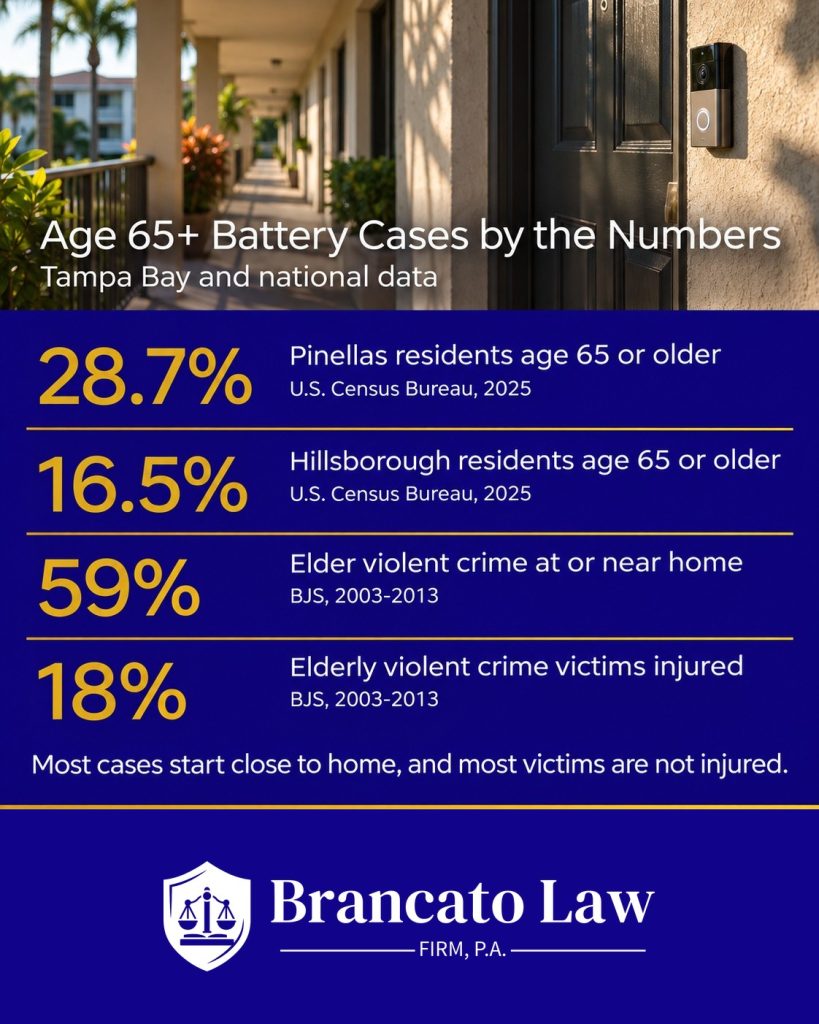
Tampa Bay has a large older population, so age-based reclassification comes up often in local battery cases. According to U.S. Census Bureau QuickFacts 2025 population estimates, 28.7% of Pinellas County residents, 22.4% of Pasco County residents, and 16.5% of Hillsborough County residents are 65 or older. In Pinellas, that is more than one resident in four.
National research shows where these incidents tend to happen. A Bureau of Justice Statistics report, Crimes Against the Elderly, 2003-2013 (Morgan and Mason, November 2014), found that about 59% of nonfatal violent crime against persons 65 or older in 2003 to 2013 occurred at or near the victim’s home, and that 18% of elderly victims of violent crime were injured. Those figures match what our attorneys see in local cases: many arrests come from homes, families, and caregiving relationships, and most involve no serious injury. That context matters when we argue for a misdemeanor resolution.
What does a recent case show about assault on a person 65 or older?
A 2026 appeal shows that the age element is decided by the jury even in misdemeanor cases. In Noel v. State, No. 3D2025-0056 (Fla. 3d DCA Oct. 7, 2026), a man was charged with assault on a 73-year-old woman after threatening her near a bus stop; the charging document alleged he threatened to kill her while holding a box cutter. The State charged a first-degree misdemeanor under section 784.08(2)(d) and section 784.011, and the jury was told it had to find that the woman “was at the time 65 years of age or older.” He was convicted and sentenced to 364 days in jail. On appeal he argued the facts described a felony that the county court could not hear; the Third District affirmed, holding that the information charged only a misdemeanor.
The lesson for anyone charged under section 784.08 is that the charging document controls. How the State words the information decides the degree, the court, and the maximum sentence, and our attorneys read it line by line at the start of every case. Our post on how to fight an assault charge in Florida covers the assault elements in more detail.
Is battery on a person 65 or older the same as elder abuse?
No. Battery on a person 65 or older is charged under chapter 784 and turns only on the person’s age. Elder abuse is a separate crime under chapter 825, and section 825.101 defines an “elderly person” as someone 60 or older who is suffering from the infirmities of aging to the extent that the person’s ability to provide for his or her own care or protection is impaired. A healthy 70-year-old can be the alleged victim of a section 784.08 battery without being an “elderly person” under chapter 825. Our post on whether elder abuse is a felony in Florida explains that statute and its penalties.
What should you do after an arrest or an accusation?
Within 24 hours of an arrest, a judge holds first appearance. There, the judge sets release conditions, which in a family or caregiving case often include no contact with the alleged victim and an order to stay away from the home. Our guide to the Florida criminal case process explains what happens at first appearance and the hearings that follow.
- Do not contact the alleged victim, even to apologize, if a no-contact condition is in place.
- Write down who saw the incident and where cameras were, including doorbell and facility cameras.
- Do not give a statement to a deputy or detective about the incident until you have talked to a lawyer.
- Keep any texts, voicemails, or care records that show the history between you and the alleged victim.
If no charge has been filed yet, there may still be time to change the outcome. Nearly every month, our firm has cases that never get filed because of what our attorneys do before the State Attorney’s Office makes its decision, and we decide case by case what, if anything, to provide to detectives. Learn more about our representation before charges are filed.
Frequently asked questions about battery on a person 65 or older
Can battery on a person 65 or older charges be dropped in Florida?
Yes. Prosecutors can drop or reduce the charge when the evidence of the touching, the intent, or the alleged victim’s age is weak, or when the alleged victim does not want to go forward. The Brancato Law Firm presents that evidence to the assigned prosecutor early, before the case hardens, and our violent crimes defense page explains how we approach these negotiations.
Can I get a withhold of adjudication for battery on an elderly person in Florida?
Not on the reclassified charge. Section 784.08(3) bars a judge from withholding adjudication, so the realistic path to a withhold is a negotiated plea to a charge without the age enhancement, such as simple battery. Our attorneys at The Brancato Law Firm look for that resolution when the facts support it.
Is assault on someone over 65 a felony in Florida?
No, simple assault on a person 65 or older is a first-degree misdemeanor, punishable by up to one year in jail. The Brancato Law Firm defends these misdemeanor cases in county court, where the jury still has to find beyond a reasonable doubt that the person was 65 or older.
Is there a mandatory minimum for aggravated battery on a person over 65?
Yes. Section 784.08(1) requires a minimum of three years in prison for a conviction of aggravated battery or aggravated assault on a person 65 or older, plus restitution and up to 500 hours of community service. Because that minimum is so heavy, our attorneys at The Brancato Law Firm focus early on whether the facts support the aggravating element at all, such as a deadly weapon or great bodily harm. Our guide on how to fight an aggravated battery charge covers those elements.
What if the older person started the fight?
Self-defense applies regardless of the other person’s age. The Brancato Law Firm investigates who was the first aggressor through video, witnesses, and prior incidents, and our post on Stand Your Ground immunity in Florida explains the pretrial hearing that can end a case.
Does it matter that I didn’t know the person was 65?
Not for guilt. Section 784.08(2) applies whether or not the accused knew or had reason to know the alleged victim’s age, and jury instruction 8.16 says so. Our attorneys at The Brancato Law Firm can still use that fact in negotiations and at sentencing to show the incident had nothing to do with the person’s age.
Can a domestic battery against a parent be charged under section 784.08?
Yes, if the parent is 65 or older the battery can be reclassified, and the case can also carry domestic violence conditions such as no-contact orders. The Brancato Law Firm handles both sides of that overlap, and our guide to fighting a domestic violence battery charge explains the family-violence rules.
Talk to a Tampa defense attorney about a battery on a person 65 or older charge
For more about our defense strategies, visit our violent crimes defense practice page.
Before the State Attorney’s Office decides how to file a felony battery charge, our attorneys can collect the video, the witness accounts, and the proof of age it will rely on. Call The Brancato Law Firm, P.A., founded by Tampa Criminal Defense Attorney Rocky Brancato, at (813) 727-7159, especially if a no-contact order is already in place or a first appearance is scheduled. You can call us at any hour, and our office is two blocks from the courthouse. Our firm has Spanish-speaking staff, and attorney Jean-Luc Adrien speaks Spanish, Haitian Creole, and French.
The Brancato Law Firm, P.A.
620 E. Twiggs Street, Suite 205, Tampa, FL 33602
(813) 727-7159
Serving Hillsborough, Pinellas, and Pasco Counties
The Brancato Law Firm, P.A. is a Tampa-based criminal defense practice. We are not affiliated with any other Brancato-named law firms.
Visit Us

Tampa, FL 33602

Contact Us Now
Free Legal Consultation (813) 727-7159
