

From First DUI to Death Penalty



Can Federal Agents Refuse Depositions in Florida? (2026)


The answer: Yes. FBI, DEA, and other federal agents can refuse to sit for a deposition or turn over their files in a Florida state case, because federal regulations let their agency decide, and a state judge cannot hold them in contempt. Florida gives defendants discovery rights federal court does not, including the right to depose the State’s witnesses, and when federal agents the State plans to call refuse, a Florida judge can bar them from testifying. In a 2008 Hillsborough gang case, a judge dismissed the charges outright after the FBI withheld its evidence, and the appeals court affirmed.
If FBI, DEA, or other federal agents helped build the case against you in state court, the people who know the most about it may refuse to answer your lawyer’s questions. I’m Rocky Brancato, founder of The Brancato Law Firm, P.A., a Tampa criminal defense firm, and a former Chief Operations Officer of the Hillsborough County Public Defender’s Office, where I oversaw a staff of over 100 attorneys. After more than 25 years in Hillsborough County courtrooms, I can tell you a federal agent’s refusal to answer a subpoena that every local officer must honor is something our attorneys put on the record and use.
What Discovery Rights Do You Have in a Florida State Case?
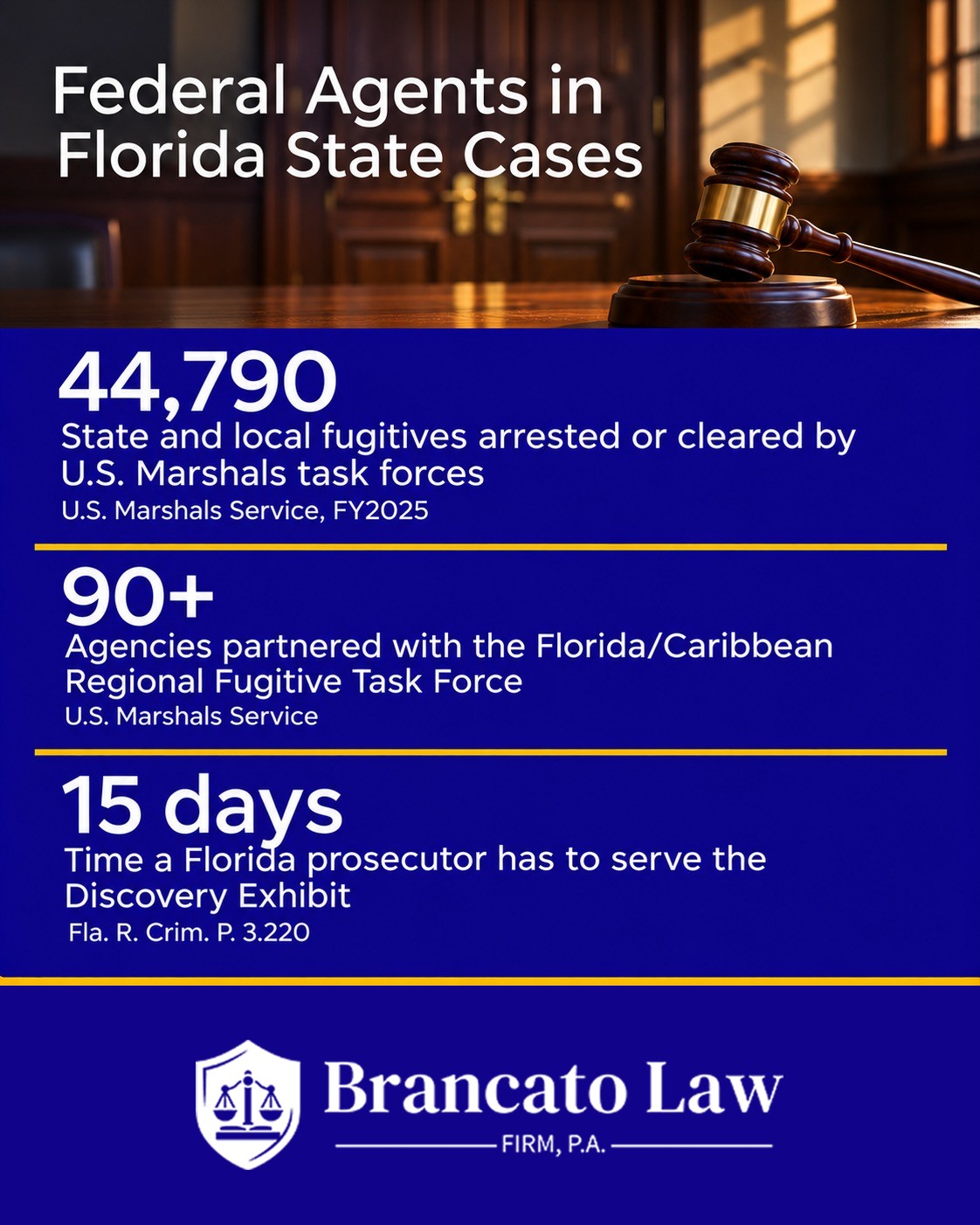
Florida gives criminal defendants far broader discovery than federal court does. Under Florida Rule of Criminal Procedure 3.220, once the defense files a Notice of Discovery, the prosecutor has 15 days to serve a Discovery Exhibit listing the names and addresses of all persons known to have information relevant to the charges, along with their statements and the police and investigative reports in the case. The same rule lets any party take the deposition of any listed witness after the charging document is filed.
That deposition right is the heart of a Florida defense. Our attorneys question detectives, informants, and lab analysts under oath months before trial, so the defense knows what each witness will say and can test it. If the State or its witnesses do not comply, Rule 3.220(n) lets the judge order compliance, grant a continuance or a mistrial, exclude the undisclosed witness or evidence, or enter any other order that is just. Our post on what a Richardson hearing is in Florida explains how judges decide those sanctions, and our guide to the stages of a Florida criminal case shows where discovery fits.
How Is Federal Court Discovery Different?
Federal court gives defendants far less, and much later. Under Federal Rule of Criminal Procedure 15, a deposition in a federal criminal case is the exception: the court may allow one only “because of exceptional circumstances and in the interest of justice,” usually to preserve testimony of a witness who may not be available at trial. There is no general right to depose the agents who investigated you.
Federal rules also hold back what Florida hands over early. Federal Rule of Criminal Procedure 16(a)(2) does not authorize discovery of reports, memoranda, or other internal government documents made by agents investigating the case. And under the Jencks Act, 18 U.S.C. § 3500, the statements of a government witness cannot be obtained by subpoena or discovery until that witness has testified on direct examination at trial.
| Defense right | Florida state court | Federal court |
|---|---|---|
| Witness list | Prosecutor must list all persons known to have relevant information within 15 days of the Notice of Discovery (Rule 3.220) | No general witness-list requirement in Rule 16 |
| Depositions of witnesses | Any listed witness may be deposed after charges are filed (Rule 3.220) | Only in “exceptional circumstances and in the interest of justice” (Rule 15) |
| Witness statements | Disclosed in discovery before trial | Not available until the witness testifies on direct at trial (Jencks Act) |
| Agent and police reports | Police and investigative reports in the State’s possession or control are disclosed | Internal agent reports are not discoverable under Rule 16(a)(2) |
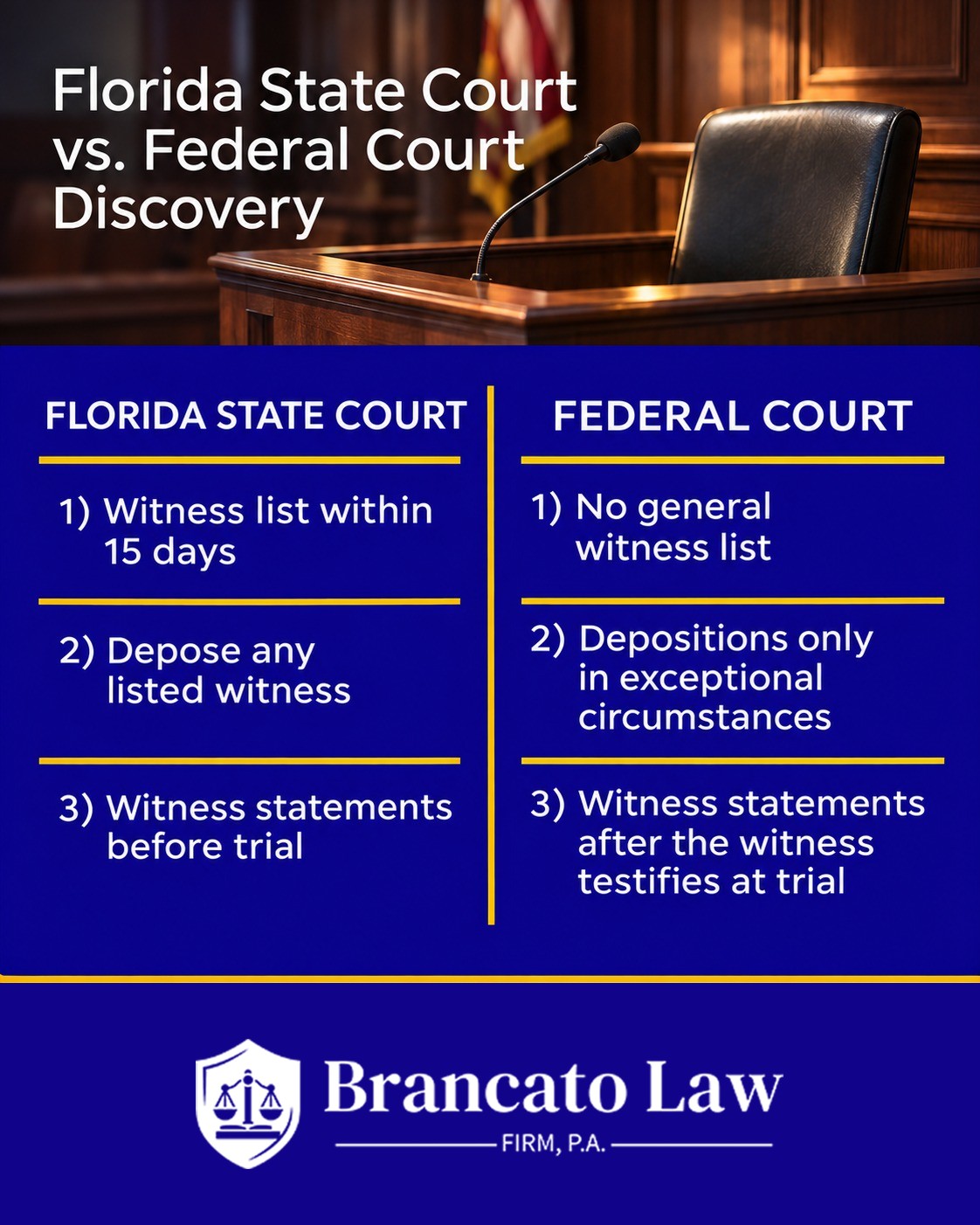
That gap is why it matters which court your case is in. A federal agent who works a joint investigation with Tampa Police is used to the federal rules. When the case lands in a Hillsborough County courtroom instead, Florida’s rules apply to the prosecution, and the agent’s silence becomes the State’s problem.
Why Can Federal Agents Ignore a Florida Subpoena?
Federal agents can refuse because their agencies control what they say, and state courts cannot force a federal agency to comply. In United States ex rel. Touhy v. Ragen, 340 U.S. 462 (1951), the U.S. Supreme Court upheld a Justice Department regulation that barred employees from producing department records in response to a subpoena without permission from their superiors. Those rules, now called Touhy regulations, are in 28 C.F.R. § 16.22, which says no Justice Department employee may produce department files or disclose information acquired in official duties in a state case without prior approval. That covers the FBI, DEA, ATF, and U.S. Marshals.
When a state judge tries to enforce a subpoena anyway, the federal government can move the dispute to federal court under the federal officer removal statute, 28 U.S.C. § 1442. The Fourth Circuit has held that a state court has no power to compel a federal official to comply with its subpoena unless the United States waives sovereign immunity, and that a federal court that receives the case on removal gets no more power than the state court had. It applied that rule to an FBI subpoena in a Maryland murder prosecution in United States v. Williams, 170 F.3d 431 (4th Cir. 1999), while adding that requiring a state defendant to follow the federal regulations does not authorize the FBI to withhold information “where it has participated in the investigation of the alleged crimes at issue.”
Scholars have flagged the problem. In Christine Wong, Derivative Prohibition: Defending Compulsory Process in State Prosecutions, 82 Geo. Wash. L. Rev. 247 (2013), the author describes how federal agencies are taking larger roles in state investigations while sovereign immunity, derivative removal jurisdiction, and the agencies’ own regulations effectively block state defendants from enforcing subpoenas, despite their constitutional right to compulsory process.
What Can a Florida Judge Do When Federal Agents Refuse?
A Florida judge can bar the agents from testifying for the State. In State v. Tascarella, 580 So. 2d 154 (Fla. 1991), DEA agents arrested two people for cocaine trafficking, and the State listed 11 DEA agents as witnesses. On the advice of the U.S. Attorney’s Office, the agents refused to be deposed, even after the trial judge ordered them to respond to subpoenas. The judge found the defense would be prejudiced, recognized that contempt was not an option, and excluded the agents from trial.
The Florida Supreme Court approved. It rejected the State’s argument that the federal regulations override Florida’s discovery rules, holding that states control procedure in their own courts and that a state prosecution for a state crime follows Florida’s rules on depositions. Because the agents’ refusal was intentional, prejudiced the defense, and could not be cured by contempt, excluding them was within the judge’s discretion. Justice Grimes added in a concurrence that a judge could also require defense counsel to cooperate with federal authorities in seeking the depositions before barring the agents.
Excluding the agents often ends the case in practice. If the federal agents were the ones who made the controlled buy, ran the informant, or watched the transaction, the State may have no one left who can prove it.
What Happened in the Hillsborough Latin Kings Case?
A Hillsborough judge dismissed the charges, and the appeals court affirmed. The FBI ran the Latin Kings investigation in Tampa as a joint task force with Tampa Police from 2005 to 2006. According to Circuit Judge Daniel H. Sleet’s order in State v. Lugo, No. 06-CF-010169 (Fla. 13th Jud. Cir. Ct. July 28, 2008), the FBI controlled the confidential informant, paid him $2,400 to $3,500 a month, furnished and paid for his apartment, and ran all of the audio, video, and phone surveillance. Tampa Police received FBI material only “on a selective basis,” and police reports told readers to “see FBI reports for additional information.”
When the defense subpoenaed two FBI agents for depositions in 2007 and Judge Sleet ordered them to appear, the federal government removed his order to show cause to federal court, where it was vacated because a state court cannot compel federal officials without a waiver of sovereign immunity. That ruling is In re May 8, 2007 Order to Show Cause, No. 8:07-cv-850-T-23MAP (M.D. Fla. Sept. 6, 2007). Judge Sleet then ordered the prosecutor and the defense to send the FBI a joint request under its own Touhy regulations. The FBI acknowledged it and said it was under review, but by the time of the July 2008 hearing it had given no substantive answer.
Judge Sleet dismissed all remaining charges against the two defendants still facing trial. He found the FBI had withheld meeting videos, recorded informant phone calls, the informant’s file, and records of payments and benefits to cooperating codefendants, material the court treated as Brady and Giglio information. In our constitutional framework, he wrote, the State “suffers the consequences of the failure of one of its key law enforcement agencies to comply with the law and the rules of discovery, regardless of whether the State has any control over that agency.” The State appealed, and the Second District Court of Appeal affirmed without opinion in State v. Lugo, 68 So. 3d 244 (Fla. 2d DCA 2011) (table).
An affirmance without opinion does not create binding precedent, so the Lugo order shows what a Hillsborough judge was willing to do rather than a rule every court must follow. It is still the clearest local example of federal agents letting a prosecution collapse rather than share what they had. Cases built on informants raise these issues often, and our post on whether the State has to reveal a confidential informant in Florida explains the related disclosure rules.
When Does the State Escape Responsibility for Federal Files?
The State usually escapes responsibility when it never had the federal material and does not plan to use it. In Caplan v. State, 23 So. 3d 1230 (Fla. 4th DCA 2009), DEA and Palm Beach County agents arrested a man for marijuana trafficking, and the defense moved to strike a DEA agent as a witness because the State never produced the DEA’s reports. The Fourth District affirmed the conviction. It held that the State has no duty to produce reports outside its possession or control, and it distinguished Tascarella because there the agents the State intended to call refused depositions, while in Caplan the agent was deposed and never relied on the missing reports.
| Situation | Likely result | Case |
|---|---|---|
| Federal agents the State plans to call refuse to be deposed | Judge may bar them from testifying | Tascarella (Fla. 1991) |
| Federal agency withholds reports the State never had, and the agent testifies without relying on them | No discovery violation; conviction affirmed | Caplan (Fla. 4th DCA 2009) |
| Joint task force; FBI controls the informant and surveillance, ignores court orders and a Touhy request | Charges dismissed; affirmed without opinion | State v. Lugo (Hillsborough 2008; 2d DCA 2011) |
The difference comes down to two questions: did the State build its case on federal work, and did the defense use every available route to get the material? A judge is far more willing to sanction the State when the federal agents are its witnesses and the defense has subpoenaed them, moved to compel, and sent a proper Touhy request.
Where Do Federal Agents Show Up in Florida State Cases?
Federal agents show up most often through joint task forces. In fiscal year 2025, U.S. Marshals-led task forces arrested or cleared 44,790 state and local fugitives, according to the Marshals Service’s 2026 Fugitive Apprehension fact sheet. Florida’s regional unit, the Florida/Caribbean Regional Fugitive Task Force, has partnership agreements with more than 90 federal, state, and local agencies. FBI gang task forces and DEA drug task forces also pair local officers with federal agents.
Federal agencies also guard their tools. Our post on how U.S. Marshals track fugitives in Florida covers the 2014 episode in which the Marshals Service took Sarasota police records about cell phone tracking rather than let the public see them, and our Stingray warrant post explains the FBI nondisclosure agreements that have kept simulator use out of court. A case that started with a federal task force, a federal informant, or federal surveillance equipment is a case where these discovery fights are likely.
How Does Our Firm Handle Federal Agents in a State Case?
Our attorneys build the record a judge needs before asking for exclusion or dismissal. That record is what separated Tascarella and Lugo from Caplan. In a state case with federal agents, we typically:
- Identify every federal agent and agency involved from the Discovery Exhibit, reports that say “see FBI report,” and informant payment records
- Notice the agents for deposition and subpoena them, so their refusal is on the record
- Send a written Touhy request to the agency and the U.S. Attorney’s Office, with the summary of testimony and its relevance that 28 C.F.R. § 16.22(c) requires
- Move to compel and ask the court to order the State to seek the material from its federal partners, especially where they worked as a joint task force
- Ask the court to exclude the agents, and their evidence, under Rule 3.220(n) and Tascarella, or to dismiss when the withheld material is Brady or Giglio evidence the defense cannot get any other way
Timing matters. A record built early, before speedy trial deadlines and trial dates press both sides, gives the judge room to impose a real sanction. When the investigation involves a drug task force, our Tampa drug crimes attorney page explains how we defend trafficking and conspiracy cases, and our post on how to fight a RICO charge in Florida covers gang and enterprise prosecutions like the Latin Kings case. If agents are still investigating and no charges have been filed, our representation before charges are filed can sometimes shape what happens next.
Myths About Federal Agents in State Court
| Myth | Fact |
|---|---|
| If the FBI refuses discovery, the case is automatically dismissed | No. The State usually is not responsible for federal files it never had and does not use (Caplan). Exclusion or dismissal depends on the record the defense builds. |
| A Florida judge can hold an FBI agent in contempt | No. Without a waiver of sovereign immunity, a state court cannot compel a federal official, and the dispute can be removed to federal court (28 U.S.C. § 1442). |
| Federal agents follow the same rules as local officers in state court | No. Local officers must sit for depositions under Rule 3.220. Federal agents answer to their agency’s Touhy regulations first. |
Frequently Asked Questions
Can I depose an FBI agent in my Florida criminal case?
No, not without Justice Department approval under its Touhy regulations, even if you serve a subpoena. The Brancato Law Firm sends the required written request early so that a refusal becomes part of the record the judge can act on, as described on our drug crimes defense page for task force cases.
What happens if a DEA agent refuses to testify at my deposition in Florida?
The judge can bar that agent from testifying for the State at trial. In State v. Tascarella, the Florida Supreme Court approved excluding 11 DEA agents who refused depositions, and our attorneys at The Brancato Law Firm cite that decision when federal witnesses will not cooperate.
Is the State responsible for evidence the FBI will not share?
Sometimes. When the federal agents are the State’s witnesses or the agencies worked as a joint task force, judges have held the State accountable, but in Caplan v. State the Fourth District found no violation where the State never had the reports and did not use them. Which side of that line a case falls on is the first thing The Brancato Law Firm’s attorneys sort out.
Do I get more discovery in state court or federal court?
Usually state court. Florida lets the defense depose the State’s witnesses and get their statements before trial, while federal court allows depositions only in exceptional circumstances and withholds witness statements until the witness testifies, which is why The Brancato Law Firm explains early in a case which court’s rules will govern.
Can my case be dismissed because the FBI withheld evidence?
Yes, but dismissal is a last resort. A Hillsborough judge dismissed charges in the 2008 Latin Kings case after the FBI ignored court orders and a joint Touhy request, and the appeals court affirmed without opinion; at The Brancato Law Firm, our attorneys build the same kind of record before asking for that remedy, as our post on prosecutorial misconduct in Florida explains.
Sources
- Florida Rule of Criminal Procedure 3.220 (Discovery)
- Federal Rule of Criminal Procedure 15 (Depositions)
- Federal Rule of Criminal Procedure 16 (Discovery and Inspection)
- 18 U.S.C. § 3500 (Jencks Act)
- 28 C.F.R. § 16.22 (Justice Department Touhy regulation)
- 28 U.S.C. § 1442 (federal officer removal)
- United States ex rel. Touhy v. Ragen, 340 U.S. 462 (1951)
- State v. Tascarella, 580 So. 2d 154 (Fla. 1991)
- Caplan v. State, 23 So. 3d 1230 (Fla. 4th DCA 2009)
- United States v. Williams, 170 F.3d 431 (4th Cir. 1999)
- State v. Lugo, No. 06-CF-010169 (Fla. 13th Jud. Cir. Ct. July 28, 2008) (order dismissing information for discovery violations), aff’d, 68 So. 3d 244 (Fla. 2d DCA 2011) (table)
- In re May 8, 2007 Order to Show Cause, No. 8:07-cv-850-T-23MAP (M.D. Fla. Sept. 6, 2007)
- Christine Wong, Derivative Prohibition: Defending Compulsory Process in State Prosecutions, 82 Geo. Wash. L. Rev. 247 (2013)
- U.S. Marshals Service, Fugitive Apprehension fact sheet (FY2025 data, 2026)
- U.S. Marshals Service, Florida/Caribbean Regional Fugitive Task Force
Talk to a Tampa Defense Lawyer About Federal Agents in Your Case
Depositions, Touhy requests, and motions to compel all take time, and the record has to exist before trial. Our attorneys can start building it this week. Call The Brancato Law Firm, P.A., founded by Tampa Criminal Defense Attorney Rocky Brancato, at (813) 727-7159. You can call us at any hour, and our office is two blocks from the courthouse. Our firm has Spanish-speaking staff, and attorney Jean-Luc Adrien speaks Spanish, Haitian Creole, and French.
The Brancato Law Firm, P.A.
620 E. Twiggs Street, Suite 205, Tampa, FL 33602
(813) 727-7159
Serving Hillsborough, Pinellas, and Pasco Counties
The Brancato Law Firm, P.A. is a Tampa-based criminal defense practice. We are not affiliated with any other Brancato-named law firms.
Visit Us

Tampa, FL 33602

Contact Us Now
Free Legal Consultation (813) 727-7159
