- Free Consultation 24/7: (813) 727-7159 Tap Here To Call Us


From First DUI to Death Penalty



What Is a Richardson Hearing in Florida? (2026)


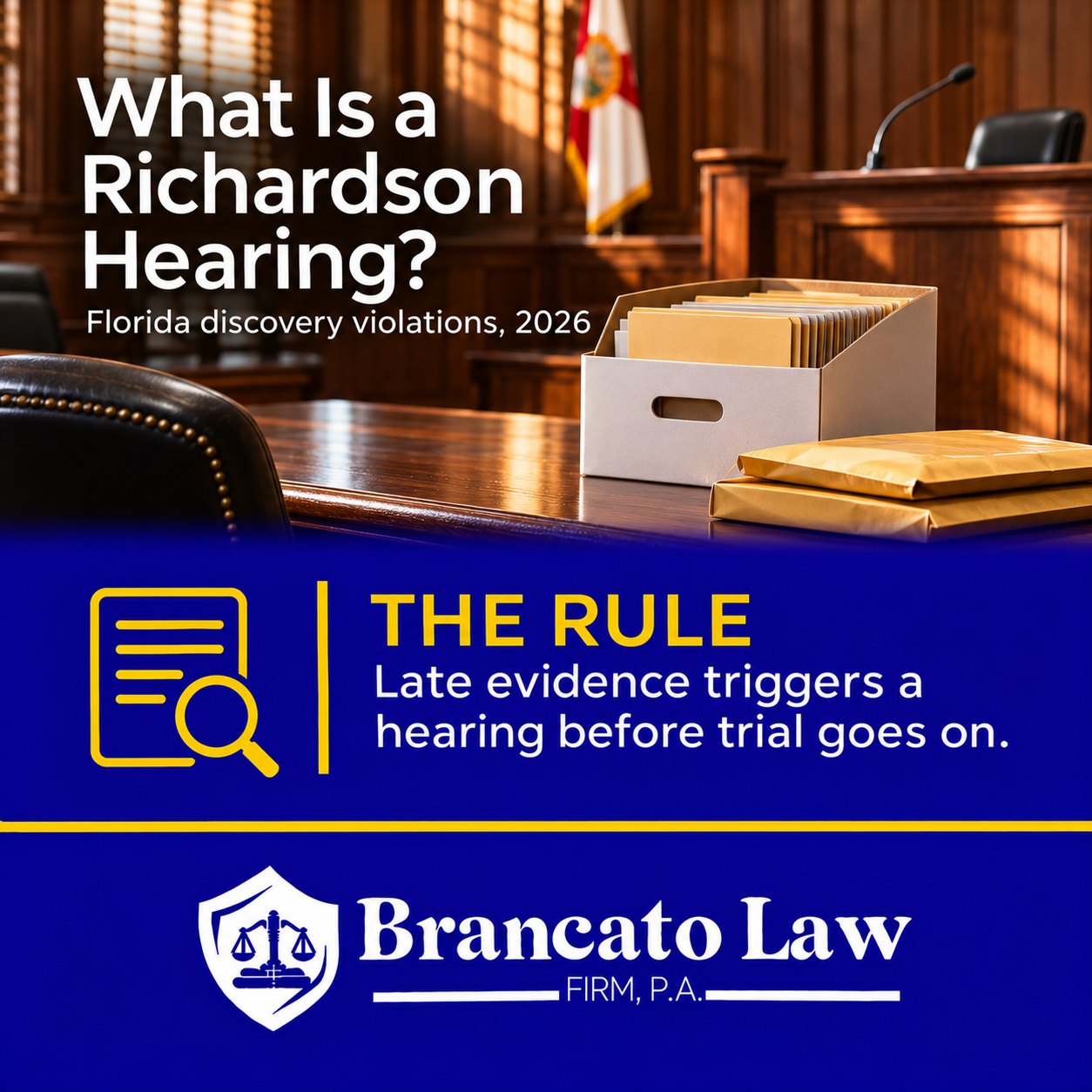
Short answer: A Richardson hearing is the inquiry a Florida trial judge must hold when a party may have violated the criminal discovery rule, Florida Rule of Criminal Procedure 3.220, for example by revealing a witness, a statement, or a lab result late or not at all. The judge must decide whether a violation occurred and, if so, whether it was willful or inadvertent, trivial or substantial, and whether it hurt the other side’s ability to prepare for trial. The judge then picks a remedy, such as a continuance, exclusion of the evidence, or a mistrial. If the judge skips the hearing, the conviction can be reversed unless the State proves the violation caused no prejudice to the defense’s preparation.
Trials in Florida are rarely lost on the evidence the defense saw coming. They are lost on the statement, the lab finding, or the witness that shows up on the first day of trial. I learned that as a former Chief Operations Officer of the Hillsborough County Public Defender’s Office, where I oversaw a staff of over 100 attorneys, and through more than 150 jury trials to verdict. As founder of The Brancato Law Firm, P.A., a Tampa criminal defense firm, I make sure our attorneys know the Richardson procedure cold, because it is the tool that turns a late surprise into a remedy instead of a conviction.
What is a Richardson hearing in Florida?
A Richardson hearing is a hearing the trial judge holds, often in the middle of trial, to sort out a possible discovery violation. It takes its name from Richardson v. State, 246 So. 2d 771 (Fla. 1971). In that case, the State did not tell the defense until the day before trial that a co-defendant would testify against Mr. Richardson. The Florida Supreme Court held that a judge may decide whether the late disclosure caused harm “only after the court has made an adequate inquiry into all of the surrounding circumstances,” and it ordered a new trial.
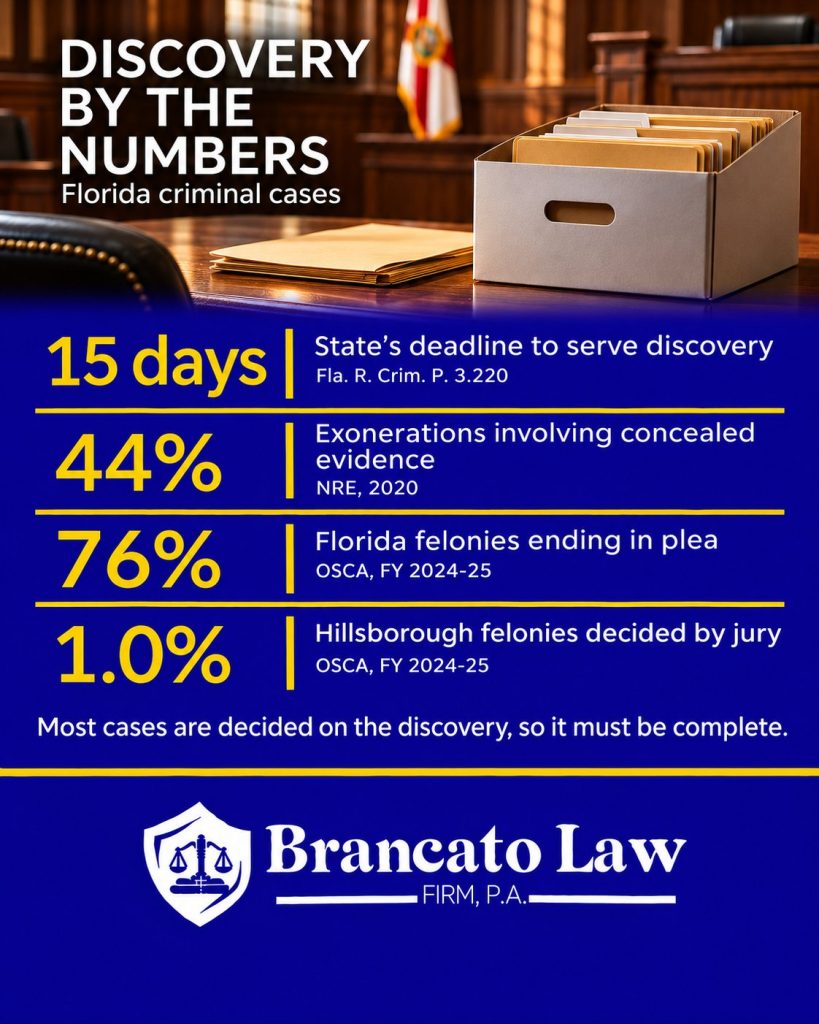
The hearing protects Florida’s discovery system, which is broader than in most states. Under Rule 3.220, once the defense files a notice of discovery, the State must serve its discovery within 15 days, including witness names, written and recorded statements, police reports, the defendant’s own statements, expert reports, and tangible evidence. The State must also disclose information that tends to negate guilt, a duty that overlaps with the constitutional rule of Brady v. Maryland, 373 U.S. 83 (1963). Both sides have a continuing duty to “promptly disclose” new material as it surfaces. The full rule is in the Florida Rules of Criminal Procedure published by The Florida Bar.
When does the judge have to hold a Richardson hearing?
The judge must hold a Richardson hearing whenever someone tells the court that a discovery violation may have happened. The judge does not need to be sure a violation occurred first, and Florida appellate courts have said the duty applies even when the defense lawyer does not use the word “Richardson.” Common triggers include:
- A State witness testifies to a statement by the defendant that was never disclosed.
- A lab analyst gives a result that is not in the report the defense received.
- The State calls a witness who was never listed, or a listed witness gives materially new testimony.
- A video, phone extraction, or body camera recording appears for the first time at trial.
- The State learns new evidence before trial and holds it instead of disclosing it promptly.
A recent appellate decision shows how much this matters. In Macias v. State, No. 4D2024-1360 (Fla. 4th DCA Dec. 19, 2025), a St. Lucie County lewd or lascivious molestation case, the State’s DNA analyst left out of her written report that male DNA had been found on the alleged victim’s shorts. The prosecutor learned of the finding the week before trial and did not disclose it, then announced it in opening statement. The trial judge found no violation and held no Richardson hearing. The Fourth District Court of Appeal reversed and ordered a new trial, explaining that the defense lost the chance to depose the analyst properly, hire its own DNA expert, or advise the client on a plea.
What does the judge decide at a Richardson hearing?
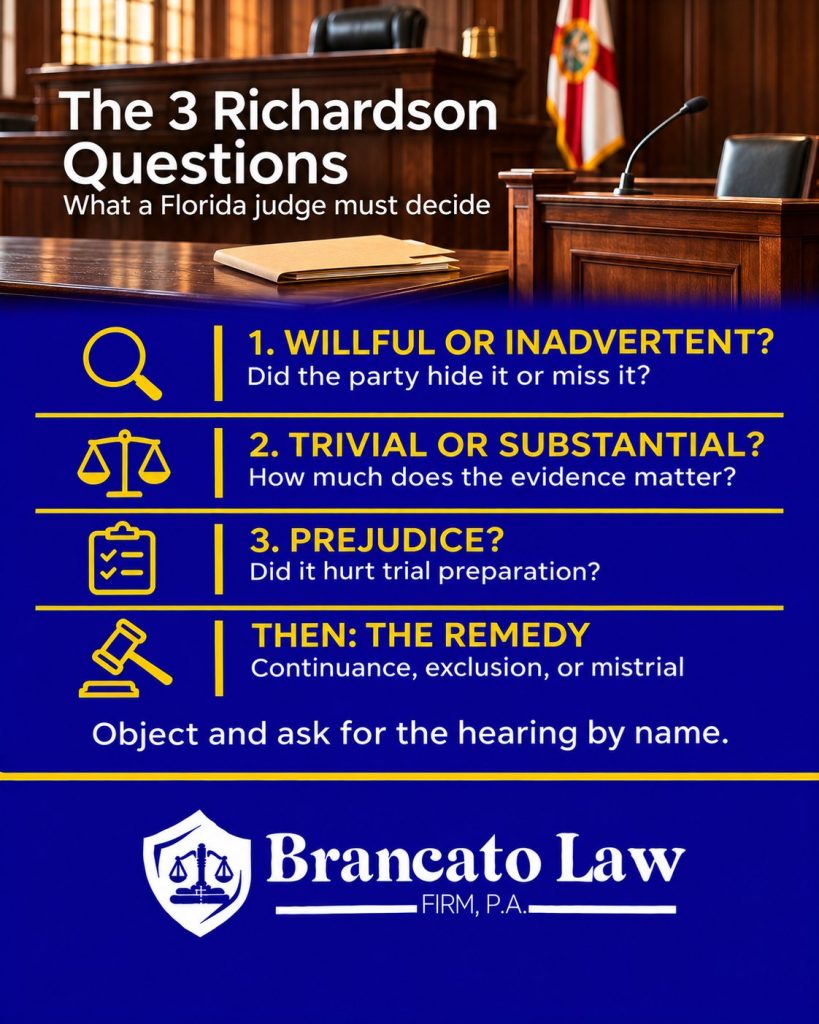
At a Richardson hearing, the judge first decides whether a discovery violation happened at all. If it did, the judge must answer three questions on the record:
| Question | What the judge looks at | Why it matters |
|---|---|---|
| 1. Was the violation willful or inadvertent? | Whether the party knew about the evidence and chose not to disclose it, or simply missed it | Willful violations support stronger sanctions, including contempt and costs under Rule 3.220(n)(2) |
| 2. Was it trivial or substantial? | How important the late evidence is to the issues at trial | A minor detail may need no remedy; key evidence usually does |
| 3. Did it hurt the other side’s trial preparation? | Whether the party would have prepared or tried the case differently with timely disclosure | This is the most important question and drives the remedy |
The third question is about preparation, not the verdict. The judge asks how the defense might have responded if it had the evidence on time: a different deposition, a defense expert, a different theory, a motion to suppress, or a decision to accept a plea offer. Our attorneys answer that question for the judge in specific terms, because a vague claim of surprise rarely earns a remedy.
What remedies can the judge order for a discovery violation?
Under Rule 3.220(n), the judge can order compliance, grant a continuance or a mistrial, prohibit a party from calling an undisclosed witness or using undisclosed material, or enter any other order the judge considers just. The right remedy depends on the answers to the three Richardson questions.
| Remedy | When courts tend to use it |
|---|---|
| Order immediate disclosure or a recess | The late material is small and the defense can review it quickly |
| Deposition during trial | A late witness or analyst can be questioned under oath before testifying |
| Continuance | The defense needs time to investigate, consult an expert, or rethink strategy |
| Exclusion of the evidence or witness | The violation is serious and no lesser remedy can cure the prejudice |
| Mistrial | The jury has already heard the undisclosed evidence and an instruction cannot cure it |
| Contempt or costs against counsel | The violation was willful (Rule 3.220(n)(2)) |
Exclusion is the remedy of last resort. In State v. Sullivan, 173 So. 3d 1133 (Fla. 2d DCA 2015), a Hillsborough County felony battery case, the trial judge found that the State had willfully misrepresented an alleged victim’s address and failed to disclose that she lived out of state. The judge excluded her testimony and dismissed the case. The Second District Court of Appeal reversed, holding that excluding a witness is the “most severe sanction” and should be “a last resort,” and that the judge should have first considered an immediate deposition or a continuance. Our Hillsborough County criminal defense attorneys build their requests for relief with that ruling in mind.
Does the Richardson rule apply when the defense discloses something late?
Yes. The Richardson procedure applies to both sides, and the State often invokes it when the defense lists a witness late. Excluding a defense witness is treated as an extreme remedy because it also affects the defendant’s constitutional right to present a defense. In Tomengo v. State, 864 So. 2d 525 (Fla. 5th DCA 2004), a sexual battery case, the defense disclosed a witness the day before trial whose testimony supported the defense that the allegation was fabricated. The trial judge excluded him without making the Richardson findings or considering a continuance. The Fifth District Court of Appeal reversed for a new trial, noting that relevant evidence “should not be excluded from the jury unless no other remedy suffices.”
The practical lesson for clients is that our attorneys list defense witnesses on time, supplement the list the moment a new witness surfaces, and offer the witness for deposition. That protects the defense case from the same sanctions we ask the court to impose on the State.
What happens on appeal if the judge skipped the Richardson hearing?
If the trial judge fails to hold an adequate Richardson hearing, the conviction is reversed unless the State proves the error harmless beyond a reasonable doubt. That rule comes from State v. Schopp, 653 So. 2d 1016 (Fla. 1995). Before Schopp, Florida courts reversed automatically whenever the hearing was skipped. In Schopp, the Florida Supreme Court adopted harmless-error review, consistent with section 924.33, Florida Statutes, which bars reversal unless an error injuriously affected the defendant’s substantial rights.
The Schopp test still favors the defense. The question is whether there is a reasonable possibility that the defense’s trial preparation or strategy would have been materially different without the violation. The State carries the burden, and if the record is too thin to rule out prejudice, the error is harmful. In Schopp itself, the error was harmless because the late-listed officer’s testimony matched the police report the defense already had and the defendant was convicted only of lesser offenses. In Macias, the error was harmful because the undisclosed DNA finding went to the heart of the case.
That is why the record made in the trial court decides the appeal. Our attorneys object immediately, ask for a Richardson hearing by name, state on the record what we would have done differently, and ask for a specific remedy. If the judge declines, the record shows exactly what was lost.
How common are discovery problems in Florida criminal cases?
No Florida agency publishes a count of discovery violations, but the stakes are clear from the data that does exist. The National Registry of Exonerations’ 2020 report, Government Misconduct and Convicting the Innocent, studied the first 2,400 exonerations in its database and found concealment of exculpatory evidence in 44% of them. Hidden or late evidence is one of the most common threads in proven wrongful convictions.
Most defendants decide their cases on the discovery they receive. In fiscal year 2024-25, about 76% of the felony cases resolved in Florida circuit courts, 118,636 of 155,206, ended in a plea before trial, according to the Florida Office of the State Courts Administrator’s Statistical Reference Guide (pages 20 to 22). In Hillsborough County’s Thirteenth Judicial Circuit, only 108 of 10,862 felony dispositions, about 1.0%, came after a jury trial. A Richardson hearing usually arises at trial, but the same discovery rules shape every plea decision before it.
How do our attorneys use discovery to protect clients?
Our attorneys treat discovery as an active investigation, not a waiting period. In every felony case, our process includes these steps:
- File the notice of discovery early and calendar the State’s 15-day deadline.
- Compare the discovery against the police reports for missing items, such as body camera files, lab bench notes, and phone extractions the reports mention.
- Depose key State witnesses, including lab analysts, so changes in testimony surface before trial.
- Send written demands for missing material and for anything that tends to negate guilt.
- Object and ask for a Richardson hearing by name the moment undisclosed evidence appears at trial, and state specifically how preparation would have changed.
- Ask for the least drastic remedy that fully cures the harm, and preserve the request for appeal.
Lab reports and forensic testing are a frequent source of late disclosures. Our Tampa criminal forensic science attorney page explains how we review DNA, toxicology, and digital evidence. For the broader picture of a prosecutor’s disclosure duties, read our guide to what prosecutorial misconduct is in Florida.
Frequently asked questions about Richardson hearings in Florida
Is a Richardson hearing the same as a Brady claim?
No. A Richardson hearing enforces Florida’s discovery rule and focuses on whether late disclosure hurt trial preparation, while a Brady claim enforces the constitutional duty to disclose favorable evidence and asks whether the evidence could have changed the outcome. The Brancato Law Firm raises both when the facts support them, because the standards and remedies differ, as explained in our guide to prosecutorial misconduct in Florida.
Can a case be dismissed because of a discovery violation?
Dismissal is rare and is usually reserved for violations that cannot be cured any other way. The Brancato Law Firm asks for the strongest remedy the record supports, but we also prepare the case so that a continuance, a deposition, or exclusion of the evidence leaves the State unable to prove its case.
Does a Richardson hearing happen in front of the jury?
No. The judge holds the hearing outside the jury’s presence, often during a recess, and may take testimony from the witness or the lawyers. Our attorneys at The Brancato Law Firm ask the court to excuse the jury before the hearing begins so jurors do not hear argument about evidence that may be excluded.
What if the defense lawyer never asked for a Richardson hearing?
Florida courts have held that the trial judge must hold the hearing once a possible discovery violation is raised, even if the lawyer does not use the word “Richardson.” The Brancato Law Firm still asks for the hearing by name and makes a full record, because a clear objection is the best protection on appeal.
Do Richardson hearings apply in misdemeanor cases?
Yes. The Richardson procedure applies wherever Rule 3.220 discovery applies, though Rule 3.220 generally limits depositions in misdemeanor and criminal traffic cases unless good cause is shown. Our Tampa DUI lawyer team uses the hearing when breath test records, video, or officer notes are disclosed late.
How long does the defense have to list its own witnesses?
Once the defense elects to participate in discovery, it generally must list its trial witnesses within 15 days after receiving the State’s discovery exhibit, and it must supplement promptly when new witnesses surface. The Brancato Law Firm files supplemental witness lists the same day a new witness is identified so the defense case is not exposed to exclusion.
Facing late or missing evidence in your case?
If the State’s evidence keeps changing, or something appeared that you never saw in discovery, the time to act is before trial, not after the verdict. Our attorneys at The Brancato Law Firm, P.A., founded by Tampa Criminal Defense Attorney Rocky Brancato, will review the discovery, identify what is missing, and make the record a judge has to address. Call (813) 727-7159; you can call us at any hour, and our office is two blocks from the courthouse. Our firm has Spanish-speaking staff, and attorney Jean-Luc Adrien speaks Spanish, Haitian Creole, and French. For more about our defense strategies, visit our Forensic Science page.
The Brancato Law Firm, P.A.
620 E. Twiggs Street, Suite 205, Tampa, FL 33602
(813) 727-7159
Serving Hillsborough, Pinellas, and Pasco Counties
The Brancato Law Firm, P.A. is a Tampa-based criminal defense practice. We are not affiliated with any other Brancato-named law firms.
Visit Us

Tampa, FL 33602

Contact Us Now
Free Legal Consultation (813) 727-7159
