- Free Consultation 24/7: (813) 727-7159 Tap Here To Call Us


From First DUI to Death Penalty



What Is Prosecutorial Misconduct in Florida? (2026)


Short answer: Prosecutorial misconduct is conduct by a prosecutor that breaks the legal or ethical rules that keep a criminal case fair. The most common forms are hiding evidence that helps the defense, letting a witness testify falsely, making improper arguments to the jury, bringing charges to punish a defendant for using his rights, and keeping back information the defense needs to pick a fair jury. In Florida, misconduct can lead to a mistrial, a new trial, a reversed conviction, or Florida Bar discipline, but courts usually grant relief only when the misconduct could have affected the outcome and the defense raised it on time.
A Florida judge will not undo a verdict just because a prosecutor broke a rule. The defense has to prove the violation mattered, and it has to raise the issue at the right moment. I have spent more than 25 years in Hillsborough County courtrooms, including years as former Chief Operations Officer of the Hillsborough County Public Defender’s Office, where I oversaw a staff of over 100 attorneys. Today, as founder of The Brancato Law Firm, P.A., a Tampa criminal defense firm, I lead a team that tracks the State’s disclosure duties from the first discovery exchange to the verdict, because the remedy for misconduct depends on catching it early and building a record.
What counts as prosecutorial misconduct in Florida?
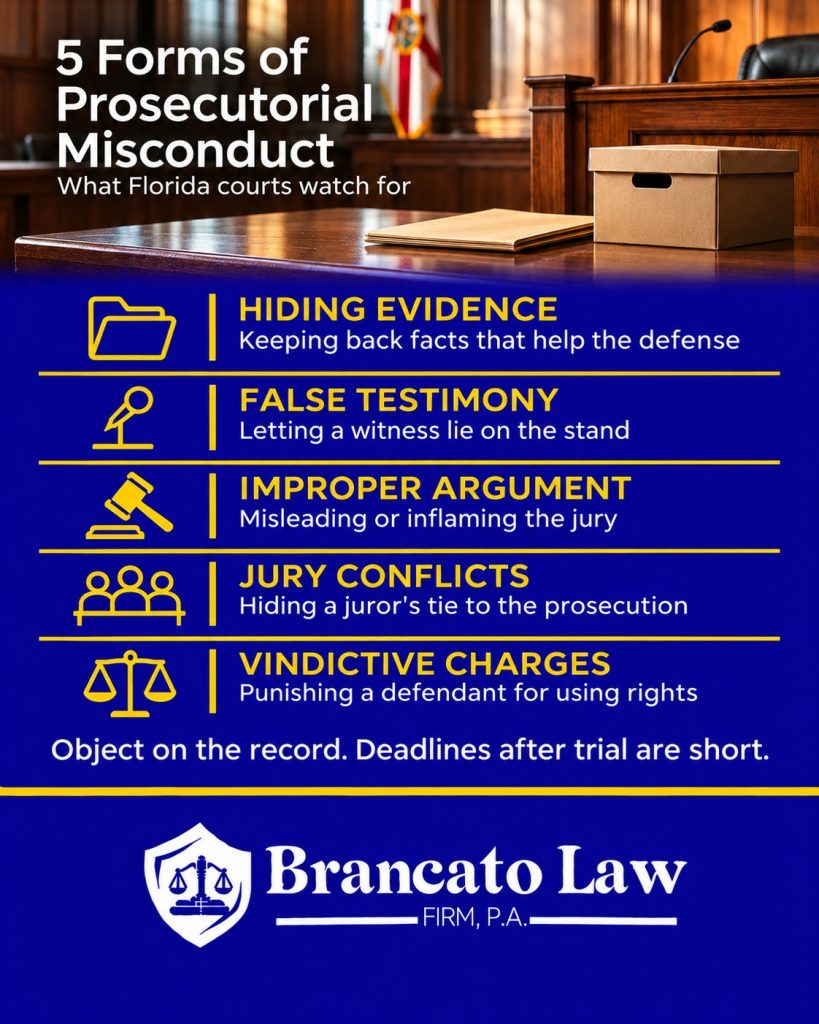
Prosecutorial misconduct is any act or omission by a prosecutor that violates a defendant’s constitutional rights, the rules of criminal procedure, or the prosecutor’s ethical duties. Florida courts and the Rules Regulating The Florida Bar recognize several recurring types. The table below lists the forms our attorneys see most often and the rule each one breaks.
| Type of misconduct | What it looks like | Main rule it breaks |
|---|---|---|
| Hiding favorable evidence (a “Brady violation”) | The State keeps back a statement, report, or deal that helps the defense or hurts a State witness | Due process under Brady v. Maryland; Fla. R. Crim. P. 3.220; Bar Rule 4-3.8(c) |
| Using false testimony (a “Giglio violation”) | A prosecutor lets a witness lie, or fails to correct testimony the prosecutor knows is false | Due process under Giglio v. United States |
| Discovery violations | The State discloses a witness, a report, or a recording late or not at all | Fla. R. Crim. P. 3.220; a Richardson hearing |
| Improper argument | Vouching for a witness, attacking the defendant for not testifying, inflaming the jury, misstating the law | Fair-trial guarantees; see our post on overturning convictions for misconduct |
| Jury-selection misconduct | Striking jurors because of race, or failing to disclose a known connection between a juror and the prosecution | Equal protection under Batson v. Kentucky; the right to a fair and impartial jury |
| Vindictive charging | Adding heavier charges to punish a defendant for appealing or demanding a new trial | Due process under Blackledge v. Perry |
| Charging without probable cause | Pursuing a charge the prosecutor knows is not supported | Bar Rule 4-3.8(a) |
Improper closing argument is the type most people have heard of. We cover it in depth, with a full case study, in our post Can a Conviction Be Overturned for Prosecutorial Misconduct in Florida? This guide covers the other forms, which often do more damage because the defense may never see them.
Why are prosecutors held to a higher standard than other lawyers?
Prosecutors are held to a higher standard because they represent the government, and the government’s goal in a criminal case is a fair result, not a win. The U.S. Supreme Court said so in Berger v. United States, 295 U.S. 78 (1935), a counterfeiting case in which the Court reversed a conviction because of a federal prosecutor’s repeated misconduct at trial. The Court wrote that a prosecutor “may strike hard blows” but “is not at liberty to strike foul ones.”
Florida’s ethics rules say the same thing. Rule 4-3.8 of the Rules Regulating The Florida Bar requires a prosecutor to drop charges the prosecutor knows lack probable cause and to promptly disclose evidence that tends to negate guilt or mitigate the offense. The comment to that rule says a prosecutor has “the responsibility of a minister of justice and not simply that of an advocate.” Our firm holds the State to that standard in every case we handle.
What is a Brady violation?
A Brady violation happens when the State fails to disclose evidence that is favorable to the defense and material to the outcome. The rule comes from Brady v. Maryland, 373 U.S. 83 (1963), where the Supreme Court held that suppressing favorable evidence violates due process “irrespective of the good faith or bad faith of the prosecution.” In Strickler v. Greene, 527 U.S. 263 (1999), a Virginia capital case, the Court spelled out the three parts of a true Brady violation:
- Favorable evidence. The evidence helps the defense, either because it points to innocence or because it impeaches a State witness.
- Suppression. The State kept it back, either on purpose or by accident.
- Prejudice. There is a reasonable probability the result would have been different if the defense had the evidence.
Two points surprise most clients. First, the prosecutor’s good faith is no defense. Second, the duty reaches evidence held only by the police. Under Strickler, the individual prosecutor “has a duty to learn of any favorable evidence known to the others acting on the government’s behalf in this case, including the police.” A detective’s notes in a drawer at Tampa Police headquarters count as the State’s evidence.
Florida courts enforce this. In State v. Huggins, 788 So. 2d 238 (Fla. 2001), an Orange County murder case tried in Duval County after a change of venue, a witness called the State Attorney’s Office during trial and gave a recorded statement that conflicted with a key State witness. The trial prosecutor decided the statement had little value and did not disclose it. The Florida Supreme Court affirmed an order vacating the murder conviction and death sentence and granting a new trial.
What happens when a prosecutor lets a witness lie?
When a prosecutor knowingly presents false testimony, or fails to correct testimony the prosecutor knows is false, the conviction is in serious jeopardy. This rule comes from Giglio v. United States, 405 U.S. 150 (1972). Florida applies it through a three-part test: the testimony was false, the prosecutor knew it was false, and the testimony was material.
The materiality standard in a Giglio claim is more favorable to the defense than in a Brady claim. In Guzman v. State, 868 So. 2d 498 (Fla. 2003), a murder case, a State witness and the lead detective both testified that the witness received no benefit for her testimony other than being taken to a motel instead of jail. In fact, the State had paid her $500. The Florida Supreme Court held that the detective’s knowledge was imputed to the prosecutor and that, once a defendant shows knowing use of false testimony, the State must prove the falsehood harmless beyond a reasonable doubt. The Court sent the case back for the trial court to apply that standard.
Undisclosed deals with cooperating witnesses are one of the most common sources of Giglio problems. Our post on fighting jailhouse informant testimony in Florida explains how our attorneys dig out those benefits before trial.
What happens when the State breaks Florida’s discovery rules?
When the State violates Florida’s discovery rule, Florida Rule of Criminal Procedure 3.220, the trial judge must hold a hearing before deciding what to do. This is called a Richardson hearing, after Richardson v. State, 246 So. 2d 771 (Fla. 1971). In that case, the State did not reveal a co-defendant as a witness until the day before trial, and the Florida Supreme Court reversed and ordered a new trial.
At a Richardson hearing, the judge must decide whether the violation was willful or inadvertent, whether it was trivial or substantial, and, most important, whether it hurt the defense’s ability to prepare for trial. The judge can then exclude the evidence, grant a continuance, or order other relief. Our attorneys ask for this hearing on the record every time late discovery appears, because an appellate court will ask whether the issue was raised. Our guide to what a Richardson hearing is in Florida covers the procedure, remedies, and appeals in detail.
Can a prosecutor’s conduct during jury selection be misconduct?
Yes. A prosecutor can commit misconduct during jury selection by striking jurors because of their race or by failing to disclose information the defense needs to pick a fair jury. A recent case involving a Hillsborough County assistant state attorney shows how the second problem plays out. The facts below come from the Tampa Bay Times report published November 13, 2026.
The Hillsborough foreperson case
According to the Times, on the morning jury selection began in a September 2026 sexual battery trial in Tampa, another prosecutor in the same office texted the trial prosecutor that her sister was on the jury panel. The trial prosecutor replied, in part, “Would she be a good juror? Haha.” The sister was seated and became the jury’s foreperson. The six-person jury convicted the defendant on September 30.
The trial prosecutor did not tell the defense about the relationship until October 5, several days after the verdict. The juror had not disclosed it during questioning, even though another prospective juror who had once worked with the prosecutor did speak up and was kept off the jury. The Hillsborough Public Defender’s Office moved for a new trial, alleged misconduct by the prosecutor and the juror, and obtained the prosecutors’ text messages through a public records request.
On November 2, the State conceded that a new trial was warranted under “the totality of the circumstances,” while denying that the prosecutor or the juror committed misconduct. The circuit judge ordered a new trial, finding the circumstances raised a sufficient concern about the fairness of the trial, but made no finding of misconduct. The prosecutor resigned three days later. In a statement, the State Attorney’s Office said that disclosing the relationship during jury selection was “the proper and required step.”
What the case teaches
Florida law gives both sides a right to know about connections like this. Under section 913.03, Florida Statutes, a juror can be removed for cause if related within the third degree to “the attorneys of either party,” or if the juror has a state of mind that would prevent impartial service. A juror related to a colleague of the trial prosecutor may not fall within the first ground, which is exactly why disclosure matters: the defense decides whether to use a challenge only if it knows the facts. With only six jurors under section 913.10, Florida Statutes, a single juror can carry great weight, and a foreperson leads the deliberations.
The legal test for a new trial based on a juror’s nondisclosure comes from De La Rosa v. Zequeira, 659 So. 2d 239 (Fla. 1995). The defense must show the information was relevant and material to jury service, the juror concealed it during questioning, and the defense’s failure to learn it was not caused by a lack of diligence. A prosecutor who knows the hidden fact and stays silent strengthens every part of that showing. Our guide to how jury selection works in a Florida criminal trial explains the questioning process and the challenges in detail.
The case also shows why our attorneys ask every panel direct questions about family and friends who work for the State Attorney’s Office, law enforcement, and the courts. Sex crime trials, like this one, often turn on credibility, and a single juror’s loyalties can decide the case. Our Tampa sex crimes attorney page explains how we prepare those cases for trial.
Can a prosecutor add charges to punish you for using your rights?
No. Due process forbids vindictive prosecution, meaning heavier charges brought to punish a defendant for exercising a legal right. In Blackledge v. Perry, 417 U.S. 21 (1974), a North Carolina defendant convicted of a misdemeanor used his right to a new trial in a higher court, and the prosecutor responded by indicting him for a felony based on the same conduct. The Supreme Court held that the risk of vindictiveness was too great and that the felony charge could not stand.
Plea bargaining is treated differently. In Bordenkircher v. Hayes, 434 U.S. 357 (1978), the Court held that a prosecutor may openly warn a defendant during plea talks that the State will file a more serious charge the defendant is plainly subject to, and then file it if the defendant goes to trial. The practical lesson is that the best time to influence charging decisions is before the information is filed. Our firm’s representation before charges are filed focuses on that window.
How often does prosecutorial misconduct lead to wrongful convictions?
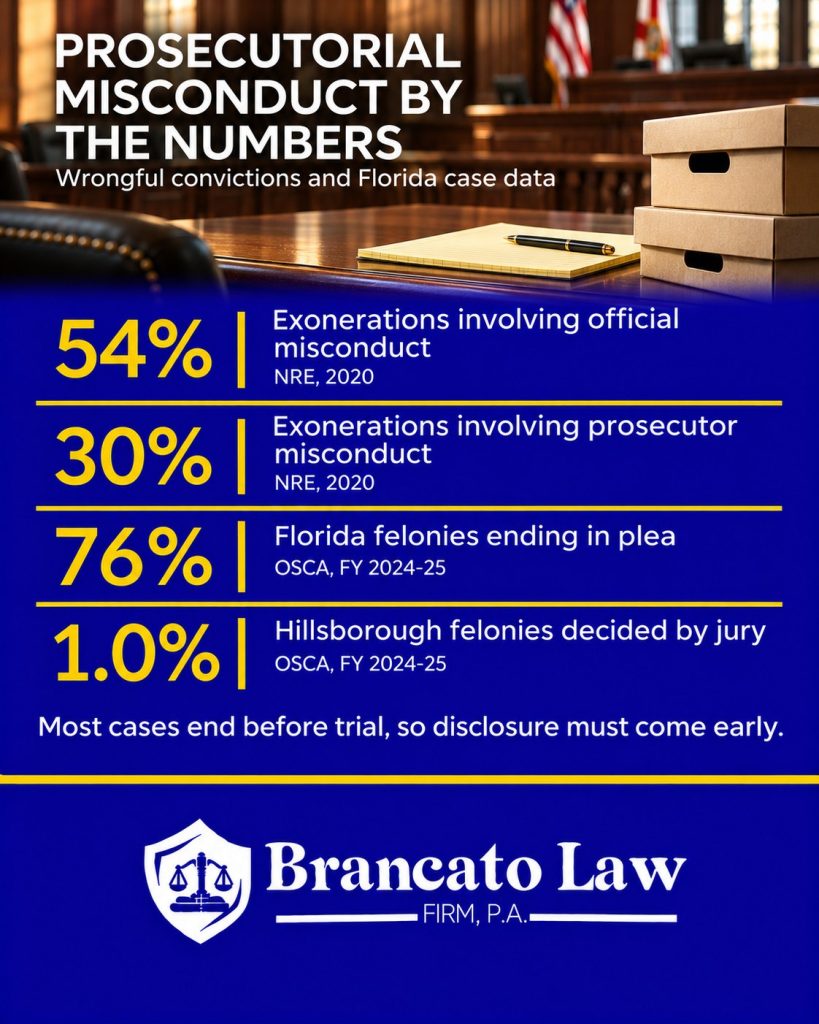
Misconduct by government officials is the most common contributing factor in proven wrongful convictions. The National Registry of Exonerations studied the first 2,400 exonerations in its database in its 2020 report, Government Misconduct and Convicting the Innocent. The report found official misconduct in 54% of those cases, misconduct by prosecutors in 30%, and concealment of exculpatory evidence in 44%.
Most criminal cases never reach the trial stage, where many of these problems surface. In fiscal year 2024-25, 118,636 of the 155,206 felony cases resolved in Florida circuit courts, about 76%, ended in a plea before trial, according to the Florida Office of the State Courts Administrator’s Statistical Reference Guide (pages 20 to 22). In Hillsborough County’s Thirteenth Judicial Circuit, only 108 of 10,862 felony dispositions, about 1.0%, came after a jury trial.
Those numbers matter because the Constitution requires less disclosure before a plea than before a trial. In United States v. Ruiz, 536 U.S. 622 (2002), the Supreme Court held that the Constitution does not require prosecutors to disclose impeachment evidence before a plea agreement. Florida’s discovery rule gives defendants who elect to participate in discovery a broader right to the State’s evidence, and our attorneys use it fully before advising any client on a plea. Our post on what happens if you reject a plea deal in Florida explains how that decision is made.
What can a Florida court do about prosecutorial misconduct?
A Florida court can respond to misconduct with remedies ranging from a jury instruction to a reversed conviction. Which remedy is available depends on when the misconduct is discovered and whether the defense objected. The table below shows the main options at each stage.
| Stage | Possible remedy | What the defense usually must show |
|---|---|---|
| During trial | Objection sustained, curative instruction, exclusion of evidence, or mistrial | A timely objection; for a mistrial, that the error cannot be cured by an instruction |
| Within 10 days after the verdict | New trial under Fla. R. Crim. P. 3.600(b), which lists misconduct by the prosecuting attorney and by a juror as grounds | The misconduct prejudiced the defendant’s substantial rights |
| Direct appeal | Reversal and a new trial | A preserved objection and harmful error, or fundamental error if no objection was made |
| Postconviction (Fla. R. Crim. P. 3.850) | New trial based on Brady, Giglio, or newly discovered evidence | The Brady or Giglio elements; for juror concealment claims, actual bias under Martin v. State |
| Any time | Florida Bar grievance against the prosecutor | A violation of the Rules of Professional Conduct; discipline does not by itself change the case outcome |
Timing changes the legal test. A juror-nondisclosure claim raised in a motion for new trial is judged under De La Rosa. The same claim raised years later in a postconviction motion is harder to win. In Martin v. State, 322 So. 3d 25 (Fla. 2021), a Clay County murder case, the Florida Supreme Court held that a postconviction claim of juror concealment requires proof that the juror was dishonest and actually biased against the defendant. That is why our attorneys act within days of a verdict when something looks wrong.
How do our attorneys protect clients from prosecutorial misconduct?
Our attorneys build safeguards into every case so that misconduct is caught early, objected to on the record, and preserved for appeal. Our process includes these steps:
- A written demand for Brady and Giglio material early in the case, naming specific categories such as witness benefits, prior statements, and police internal records.
- Discovery depositions of State witnesses, which Florida’s rules allow, so changes in a story come out before trial.
- Public records requests for police and agency records when discovery comes back thin. The Hillsborough case above turned on texts obtained this way.
- Targeted jury questioning about relationships with the State Attorney’s Office, law enforcement, and the courthouse.
- Contemporaneous objections with a request for a ruling, a curative instruction, or a mistrial, so the issue survives on appeal.
- A motion for new trial and, when needed, a motion to interview jurors filed within 10 days of the verdict.
While I led training at the Public Defender’s Office, I trained hundreds of Tampa Bay attorneys who now practice in every area of law, including some who now sit as judges. Preservation was always the first lesson: an error no one objected to is far harder to fix. Our post on why you need a trial lawyer, not just a negotiator explains why that trial-ready approach matters.
What should you do if you think a prosecutor crossed the line in your case?
If you believe a prosecutor committed misconduct, talk to a defense lawyer immediately, because several deadlines are short and some cannot be extended. Write down what you saw or learned, keep any documents, and do not contact jurors or witnesses yourself. The deadlines below control most misconduct claims after a trial.
| Deadline | What must be filed | Rule |
|---|---|---|
| 10 days after the verdict | Motion for new trial | Fla. R. Crim. P. 3.590 |
| 10 days after the verdict | Motion to interview a juror | Fla. R. Crim. P. 3.575 |
| 30 days after sentencing | Notice of appeal | Fla. R. App. P. 9.140 |
| 2 years after the conviction becomes final (non-capital cases) | Motion for postconviction relief | Fla. R. Crim. P. 3.850 |
The full text of these rules is in the Florida Rules of Criminal Procedure published by The Florida Bar. Some postconviction claims based on newly discovered evidence follow different timing rules, so have a lawyer review the dates in your case.
Frequently asked questions about prosecutorial misconduct in Florida
Is a Brady violation the same as prosecutorial misconduct?
A Brady violation is one type of prosecutorial misconduct, but it does not require bad intent; an accidental failure to disclose favorable, material evidence still violates due process. Our attorneys at The Brancato Law Firm treat a missing report or recording as a potential Brady issue from the day we notice it and demand it in writing, as Strickler v. Greene, 527 U.S. 263 (1999) allows.
Can charges be dismissed because of prosecutorial misconduct in Florida?
Dismissal is possible but rare; Florida courts usually prefer lesser remedies such as excluding evidence, granting a mistrial, or ordering a new trial. When misconduct is severe, The Brancato Law Firm asks for the strongest remedy the record supports and preserves the request for appeal. Our Hillsborough County criminal defense attorneys handle these motions in the Thirteenth Judicial Circuit.
Does a new trial mean the defendant goes free?
No. A new trial means the case starts over with a new jury, and the State can try the defendant again on the same charges. The Brancato Law Firm uses the time before a retrial to reinvestigate the case, because the first trial reveals the State’s evidence and witnesses in detail.
Can I file a Florida Bar complaint against a prosecutor?
Yes. Anyone can file a grievance with The Florida Bar, which enforces Rule 4-3.8 and the other Rules Regulating The Florida Bar, but a Bar case does not reverse a conviction. The Brancato Law Firm focuses first on the remedies that change the outcome of your case, such as a motion for new trial or an appeal.
What if a juror knew the prosecutor and never said anything?
A juror’s failure to disclose a material relationship during questioning can justify a new trial if the defense raises it promptly and meets the three-part test in De La Rosa v. Zequeira, 659 So. 2d 239 (Fla. 1995). The Brancato Law Firm moves quickly in these situations, because a claim filed within days of the verdict is judged under a far easier standard than one raised in postconviction.
How do I know if the prosecutor is hiding evidence in my case?
You usually will not know unless your lawyer looks for it, which is why depositions, public records requests, and written Brady demands matter. Our attorneys at The Brancato Law Firm compare police reports, body camera timelines, and witness statements for gaps that suggest something is missing. If you are not yet charged, our pre-file advocacy can address those issues before the case is filed.
Talk to a Tampa defense attorney about misconduct in your case
The days right after a verdict, or right after you learn something was hidden, decide which remedies are still available. Call The Brancato Law Firm, P.A., founded by Tampa Criminal Defense Attorney Rocky Brancato, at (813) 727-7159 so our attorneys can review the record and the deadlines that apply to you. You can call us at any hour, and our office is two blocks from the courthouse. Our firm has Spanish-speaking staff, and attorney Jean-Luc Adrien speaks Spanish, Haitian Creole, and French. For more about our defense strategies, visit our Sex Crimes page.
The Brancato Law Firm, P.A.
620 E. Twiggs Street, Suite 205, Tampa, FL 33602
(813) 727-7159
Serving Hillsborough, Pinellas, and Pasco Counties
The Brancato Law Firm, P.A. is a Tampa-based criminal defense practice. We are not affiliated with any other Brancato-named law firms.
Visit Us

Tampa, FL 33602

Contact Us Now
Free Legal Consultation (813) 727-7159
