- Free Consultation 24/7: (813) 727-7159 Tap Here To Call Us


From First DUI to Death Penalty



Falsely Accused of a Sex Crime in Florida: What to Do and What Not to Say (2026)


If you have been falsely accused of a sex crime in Florida, stop talking about the allegation with anyone except a criminal defense attorney. Do not contact the person who made the accusation, directly or through anyone else. Preserve every text, photo, and account exactly as it is. Get a defense attorney involved before you answer a single question from a detective.
Those steps matter because in many Florida sex crime investigations, the accused person’s own words are the evidence the State is missing. Detectives collect those words through interviews pitched as a chance to “clear things up,” through recorded calls placed by the accuser, and through texts, apologies, and conversations with family. The weeks before charges are filed are also when a defense team can do the most.
At The Brancato Law Firm, sex crime cases are a core part of our major crimes practice. Rocky Brancato spent years in the Major Crimes Unit of the Hillsborough County Public Defender’s Office, where he handled only sex offense and child abuse cases, and later oversaw a staff of over 100 attorneys as the office’s Chief Operations Officer. This guide covers what we tell people in the first hours after an allegation: what to do, what not to say, and what a defense team does while the State is still deciding whether to file charges.
What Counts as Being “Falsely Accused” of a Sex Crime?
People use “falsely accused” to describe three different situations:
- A fabricated allegation. The event described never happened.
- Mistaken identity. Something happened to the accuser, but you were not the person involved.
- A consensual encounter later described as nonconsensual. You and the other person agree something happened, but not on whether it was consensual.
The steps in this guide are the same in all three. You do not need to prove your innocence to anyone right now. Trying to prove it on your own is where a lot of the damage gets done. If you were drinking and are unsure about parts of the night, the same steps apply, and that uncertainty is one more reason to describe the night to no one but your lawyer.
Each situation calls for a different defense once a case is underway. Our guide to sex crime defenses in Florida walks through them, and our article on the consent defense covers disputes over consent specifically.
What to Do If You’re Accused of a Sex Crime in Florida
The urge to explain yourself will be strong, especially if you know you did nothing wrong. Almost every step below comes down to holding off on that explanation until you have a lawyer.
- Stop discussing the allegation. That includes the accuser, friends, family, coworkers, a new partner, and anyone online. Your conversations with your defense attorney are privileged. Most other conversations are not.
- Invoke your rights out loud if police contact you. Use the exact words in the next section, then stop talking. Staying quiet without saying the words is not enough.
- Hire a criminal defense attorney before any interview. Your attorney becomes the detective’s point of contact. If a detective left a card or a voicemail, give it to your lawyer instead of calling back yourself.
- Do not contact the accuser. Do not apologize, explain, or ask why. Do not send a message through a friend, a relative, or social media. If the accuser contacts you, do not engage, and tell your attorney.
- Preserve everything. Keep every text, DM, photo, call log, dating app conversation, and account. Do not delete anything, reset your phone, or replace it. Messages that look bad out of context are often the same ones that show the context.
- Write down what you remember, for your attorney only. Note dates, places, who was present, and anything that shows where you were, such as receipts, rideshare records, or location history. Address the notes to your lawyer and share them with no one else.
- Leave the witnesses to your defense team. Make a list of people who may know something. Do not interview them yourself or ask anyone to back up your version of events. Your defense team can interview them independently.
- Follow every release condition exactly. If you were arrested and released, a no-contact order or other condition applies until a judge changes it.
- Stay off social media about the allegation. No posts, no vague status updates, and no deleted content.
What to Say to a Detective, Word for Word
If a detective calls, knocks on your door, or asks you to come to the station, say this:
“I am going to remain silent. I want a lawyer, and I will not answer any questions without my lawyer present.”
Then stop talking. Do not add an explanation, a denial, or small talk. Take the detective’s contact information and give it to your attorney.
The exact words matter because the law on silence and counsel is narrower than most people assume. In State v. Horwitz, the Florida Supreme Court held that the State cannot use a defendant’s pre-arrest, pre-Miranda silence as substantive evidence of guilt when the defendant does not testify. That protection has limits. Silence can still be used to challenge your credibility if you testify, and under federal law, the Fifth Amendment generally protects silence only when you expressly invoke it.
A vague request for a lawyer can fail too. Under Davis v. United States, a suspect who has already waived Miranda rights must clearly ask for an attorney before police are required to stop. Florida adopted that rule in State v. Owen and applied it to any equivocal assertion of a Miranda right. “Maybe I should talk to a lawyer” is not enough. Say it plainly, and do not keep the conversation going after you say it.
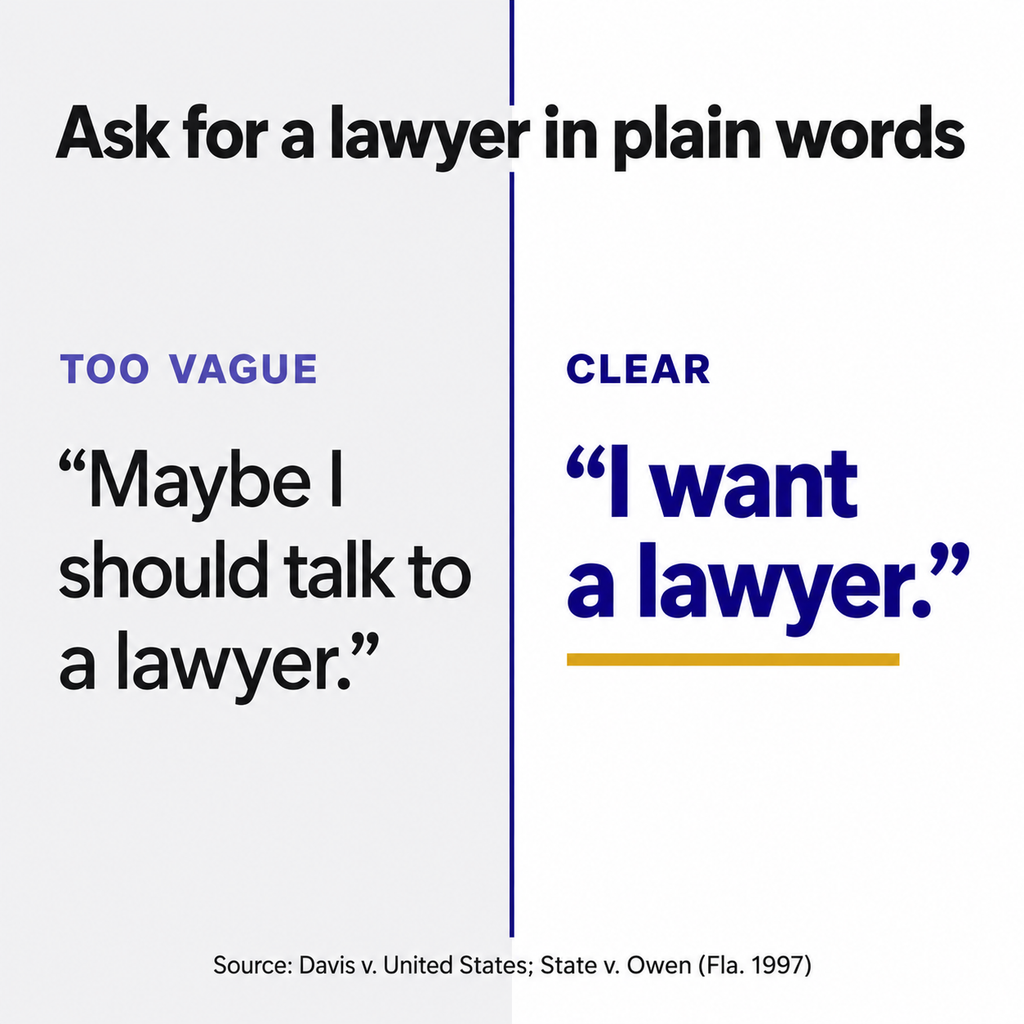
The same script applies to a phone call and to a detective who says you are “not under arrest” and just has “a few questions.”
What Not to Say When You’re Accused of a Sex Crime
Innocent people say things that sound harmless in the moment and read very differently in a police report or on a recorded call. These are some of the most common:
| What people say | How it can be read |
| “I’m sorry.” | An apology for doing what was alleged |
| “I’m sorry you feel that way.” | An acknowledgment that something happened that caused harm |
| “I didn’t think it was a big deal.” | An admission that the act happened, disputing only how serious it was |
| “I thought you wanted to.” | An admission of sexual contact, leaving consent as the only question |
| “I was drunk and don’t remember everything.” | A denial turned into a “maybe,” and an invitation to ask what you do remember |
| “Can we just forget this happened?” | Consciousness of guilt, or pressure on a witness |
What Not to Say to the Detective
Do not accept the invitation to “come in and clear it up.” An interview is how a detective gathers statements, and any statement you give to explain yourself is one the State can use.
Detectives are also allowed to say things that are not true. In Florida, an officer can tell you that your DNA was found or that a friend already gave a statement when neither is true. In State v. Cayward, a case from the Second District Court of Appeal, which covers Hillsborough, Pinellas, and Pasco Counties, the court upheld the suppression of a confession police obtained after fabricating lab reports in a child sexual assault and homicide investigation. The court drew the line at manufactured documents, though. Verbal deception counts as one factor in whether a confession was voluntary. It does not make a confession inadmissible on its own.
Rocky Brancato is a former police academy instructor who trained officers on criminal procedure and courtroom testimony. We know how officers are taught to question suspects, and we have seen how often innocent people talk themselves into trouble. Research on police-induced confessions points the same way. A 2010 white paper in Law and Human Behavior identified innocence itself as a risk factor, because innocent people tend to waive their rights on the belief that the truth will protect them. A 2025 update from the same researchers documents how rarely Miranda warnings work as a safeguard in practice.

What Not to Say to the Accuser (Including Controlled Calls and Texts)
Assume that any call, text, or message from the accuser after an allegation is being recorded, and that a detective may be in the room. Florida is an all-party consent state for recordings, but § 934.03(2)(c) makes an exception for recordings made by police or by a person acting at their direction. That is how a controlled call works. The accuser places the call, the detective records it, and you do not know.
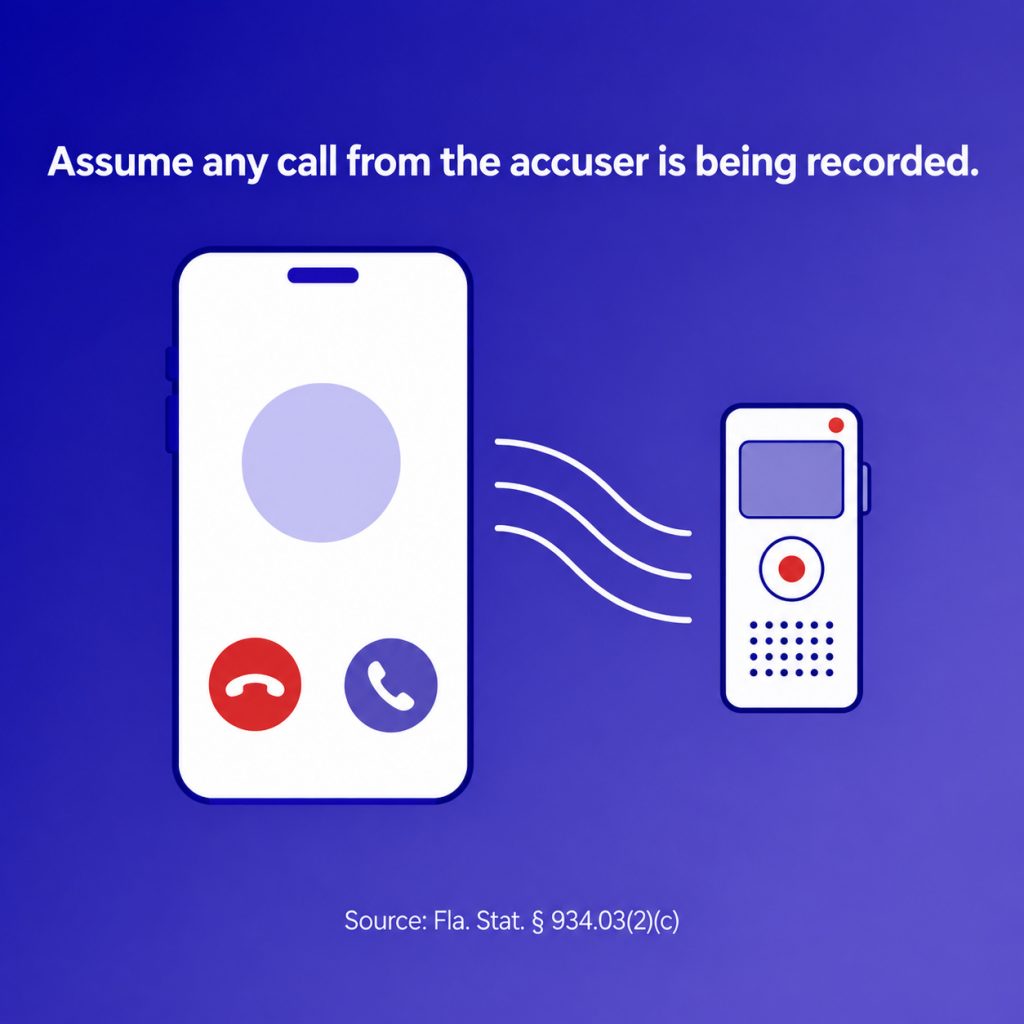
Controlled calls often open with a line that invites you to acknowledge something. In Carter v. State, a Florida appellate case, the recorded call opened with the complainant saying they could not get over what had happened between them. That call was played for the jury. The defendant’s later denials to police were not, because the court held the rule of completeness did not require it. One apology or vague answer on a call like that can outweigh everything you say afterward.
Defense attorneys can sometimes limit what a jury hears. In Woolman v. State, the Second District reversed convictions in part because most of a recorded controlled call was highly prejudicial and had little relevance to the charges. That challenge comes after the call exists, though. The better outcome is a call that contains nothing useful.
If the accuser calls or texts, do not respond. If you have already picked up, do not discuss the allegation. End the conversation and tell your attorney.
What Not to Say to Friends, Family, and Coworkers
Anyone you talk to about the allegation can be interviewed by a detective and called as a witness. Conversations with parents, friends, coworkers, and new partners generally are not privileged the way your conversations with your lawyer are.
Do not ask anyone to contact the accuser for you, pass along a message, or find out what the accuser is saying. That can violate a no-contact order and can look like an attempt to influence a witness. If people ask, a short answer is enough: “I’ve been told not to discuss it, and my attorney is handling it.”
What Not to Say to Your Employer or Licensing Board
Some licensed professionals have to report, and the rules differ by license.
- Teachers and educators. Rule 6A-10.081 of the Florida Administrative Code, as posted by the Florida Department of Education, requires educators to self-report an arrest for certain offenses within 48 hours.
- Nurses and other health care licensees. Under § 456.072(1)(x), the duty to report is triggered by a conviction, finding of guilt, or no contest plea, not by an arrest. The report is due within 30 days.
- CDL holders and other licensed workers. Reporting duties depend on the license and the employer. Check the requirement with your attorney before saying anything.
In every case, report exactly what the rule requires, in wording your attorney drafts, and nothing more. The report should be a bare notice. It is not the place to explain what happened, and neither is a conversation with HR.
What Not to Say on Social Media
Posts, stories, comments, and DMs are all statements, and screenshots outlast the accounts they came from. Do not post about the allegation, the accuser, or your side of the story, even in vague terms. Do not delete old content either, for the reasons covered in the next section.
What Not to Say at an Injunction Hearing or in Family Court
An accuser can petition for a sexual violence injunction under § 784.046 whether or not criminal charges were filed, reduced, or dismissed. The injunction case is civil, and a civil injunction by itself does not mean you will be charged. Many of these petitions grow out of the same incident as a criminal investigation, though, and anything you say at the hearing is sworn and recorded. That testimony can surface in the criminal case.
The same is true of testimony in a divorce, a custody case, or a dependency case. Do not walk into any of these hearings without your defense attorney helping decide whether and how you testify.
What Not to Do: Actions That Can Create New Charges
Some of the most natural reactions to a false accusation are separate crimes in Florida. Each one gives the State a new case, often an easier one to prove than the original allegation.
| What people do | Florida law | What can happen |
| Secretly record the accuser to “catch the lie” | § 934.03(4)(a) | A third-degree felony, and the recording is generally barred from evidence under § 934.06 |
| Delete texts, photos, or accounts, or wipe a phone | § 918.13 | Tampering with evidence, a third-degree felony, or a second-degree felony when the investigation involves a capital felony |
| Contact the accuser through a friend, relative, or social media while a no-contact order is in place | § 903.047(1)(b) | A violation of pretrial release, because indirect contact counts the same as direct contact |
| Ask the accuser to “tell them it was a misunderstanding” | § 914.22 | Witness tampering, a first-degree felony punishable by up to life when the investigation involves a first-degree felony |
People often assume they can record a call because it is legal in other states. Florida requires the consent of every party. A secret recording can lead to a felony charge against you while producing evidence a court will not hear.
A no-contact order has one exception that matters here. The statute allows the defendant’s attorney to communicate with the protected person for lawful purposes. Every other channel, including a mutual friend, is off limits.
Should You Take a Polygraph or Go In to “Give Your Side”?
In Florida, polygraph results are inadmissible unless both sides sign a written stipulation, under Davis v. State (Fla. 1988) and related cases. The real risk in a police polygraph offer is the questioning that comes with it. The exam includes interviews before and after the test, and those conversations are where people explain, elaborate, and say things a detective can use.
The invitation to “come in and give your side” works the same way. The detective sets the time, the room, and the questions. If presenting your side ever makes strategic sense, your attorney can do it through a controlled submission to the prosecutor, which is covered below.
A request for a voluntary DNA swab deserves the same caution. Under § 943.325, anyone arrested for a felony in Florida gives a DNA sample at booking. Whether to provide one voluntarily before that point is a decision to make with your lawyer.
What If You Already Talked to the Police?
It is never too late to stop. You can invoke your rights at any point, including in the middle of an interview or after one is over. Do not call the detective back to correct or add to what you said.
An attorney can review what you already said and how the interview was conducted. That review looks at whether Miranda warnings were given and honored, whether a clear request for a lawyer was ignored, and whether the tactics used crossed a legal line. Our article on false confessions in sex crime cases explains how those statements are challenged.
What a Defense Attorney Does Before Charges Are Filed
The period between an allegation and the State Attorney’s filing decision is often the most important stage of a sex crime case. We call the work done in this window pre-file advocacy. In a sex crime investigation, it typically includes:
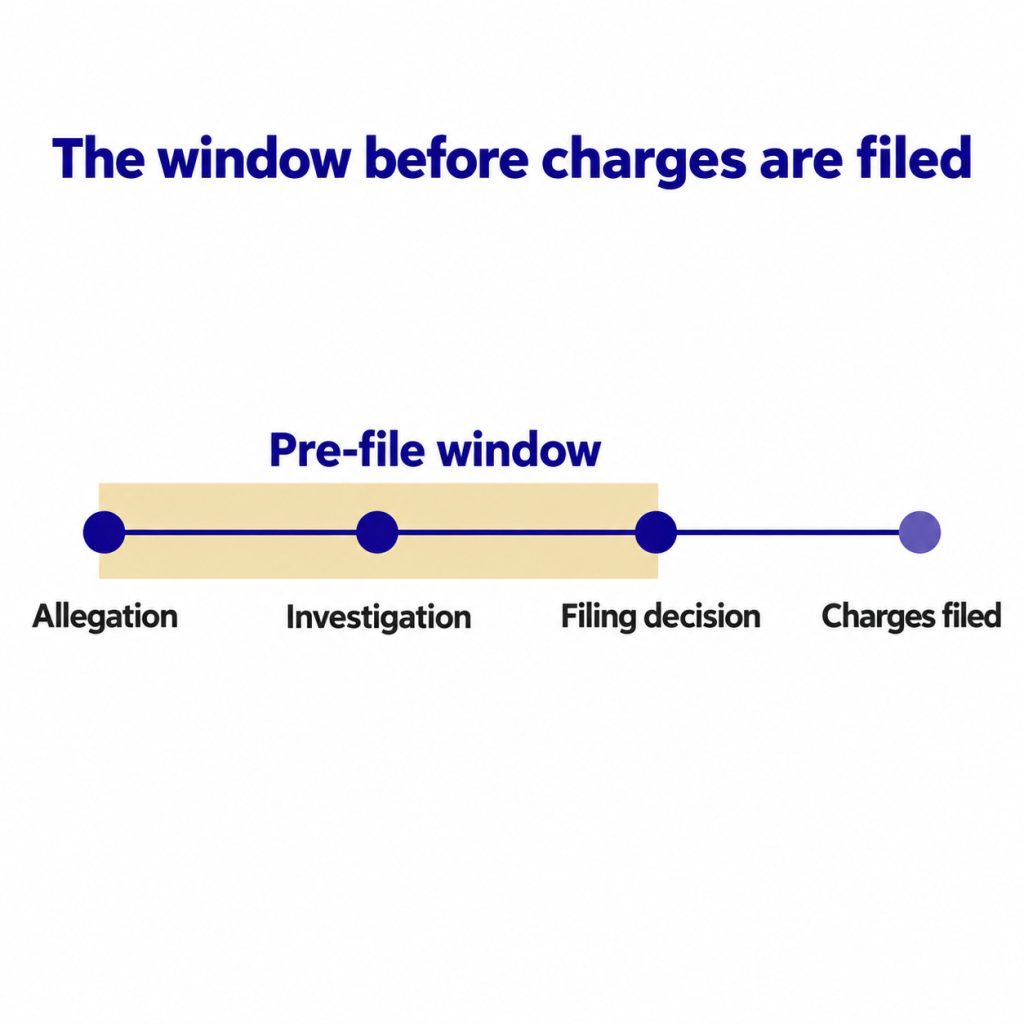
- Acting as the point of contact with the detective, so you are never alone in an interview room
- Interviewing witnesses independently, before memories fade or stories shift
- Preserving favorable evidence, such as location data, messages, receipts, and video that may be overwritten
- Retaining forensic experts early when the evidence calls for it, including DNA analysts, forensic pathologists, digital forensic examiners, and psychologists
- Presenting evidence, witness statements, and context to the detective and the prosecutor before a charging decision is made
Rocky Brancato described this work in his book, How to Choose a Major Crimes Attorney:
“And often, the best outcomes happen quietly. In many cases, experienced attorneys can meet with prosecutors early and present the flaws in the case before charges are even filed. That kind of outcome never makes the news, but it changes lives.”
Early forensic scrutiny can also change a case that looks settled. In a cold-hit DNA case, the State presented a CODIS match in a sexual battery case from eight years earlier. Our defense team subpoenaed the lab’s bench notes, obtained the raw electronic data, and retained an independent geneticist, who found that the State’s analyst had misread an allele at a critical location. The DNA did not match at the required threshold, and the prosecutor dismissed the case. Each case is unique. Past results do not guarantee future outcomes.
Why a Detective May Call Years Later
Many sex crime allegations have no filing deadline in Florida, so there is often nothing pushing the State to decide quickly. The time limits under § 775.15 include:
| Allegation | Time limit to prosecute |
| Capital or life felony sexual battery | None |
| Any sexual battery under § 794.011 with a victim under 18, for offenses on or after July 1, 2020 | None |
| First- or second-degree sexual battery, victim 16 or older, reported to police within 72 hours | None |
| First- or second-degree sexual battery, victim 16 or older, not reported within 72 hours | 8 years |
| Sexual battery or lewd offense where identity is later established by DNA | Any time, if the evidence was preserved |
A call from a detective about an event from years ago deserves the same response as one about last weekend.
When the Allegation Involves DCF, a School, or a Licensing Board
Sex crime allegations often come with a second proceeding that runs alongside the criminal investigation. That can be a DCF investigation, a school disciplinary or Title IX process, a licensing board inquiry, or the injunction and family court hearings covered above. Sworn or recorded statements in any of them can reach the criminal case. One defense attorney should coordinate all of them, so nothing you say in one setting undercuts your defense in another.
Allegations Involving a Child: DCF and Child Protection Teams
When an allegation involves a child, a DCF investigation is effectively a law enforcement investigation. Under § 39.301, DCF must forward allegations of criminal conduct, including suspected sexual abuse, to local law enforcement, with narrow exceptions, and the two agencies can respond jointly. DCF investigators must tell you that you have the right to your own attorney and how the information you give may be used. Take that warning at face value.
Every report alleging sexual abuse goes to a Child Protection Team, which may conduct a forensic interview of the child. Those teams can include law enforcement representatives, and their records can be shared with the State Attorney. A child’s recorded interview may be played at trial under the child hearsay exception, but only after a reliability hearing and specific findings by the judge. Our guide to child hearsay explains how that hearing works.
How a child is questioned shapes what the child says. Rocky Brancato has presented to Hillsborough County Public Schools on police interrogation of children, and our defense team examines how each forensic interview was conducted, starting with the first question.
Allegations involving a child sometimes arise in the middle of a divorce or custody dispute. If you are a parent in that situation, do not question your child about the allegation or discuss it with them. Do not respond to the other parent about it except through counsel.
College Students Facing a School Process
A student accused of sexual misconduct may face a school investigation and a criminal investigation at the same time. Written statements and hearing testimony in the school process can be obtained by prosecutors. Have a criminal defense attorney review anything before you submit it or testify.
Can You Sue the Accuser or Press Charges for a False Report?
That question comes later, if at all. While the criminal investigation is open, any step against the accuser can look like retaliation, and contact aimed at discouraging cooperation can itself be charged under Florida’s witness harassment law.
Florida does criminalize false reports. Under § 837.05, knowingly giving police false information about a crime is a first-degree misdemeanor, and a false report of a capital felony is a third-degree felony. The State decides whether to bring that charge, not the person who was accused. Florida’s sexual battery statute also has a narrow false-report provision, but it covers only accusations against certain authority figures, such as law enforcement and correctional officers. It is not a general false-report crime.
Our firm handles criminal defense only. Civil claims such as defamation belong with a civil attorney, and that conversation makes the most sense after the criminal case is resolved.
What’s at Stake in a Florida Sex Crime Case
The penalties are serious enough that your first decisions carry real weight:
- Sexual battery on an adult without consent, without force likely to cause serious injury, is a second-degree felony under § 794.011(5)(b). Aggravating circumstances or a younger complainant raise the charge to a first-degree, life, or capital felony.
- Lewd or lascivious molestation by an adult of a child under 12 is a life felony under § 800.04(5)(b). The child’s consent is not a defense to any offense in that statute.
- Registration. Every sexual battery offense in § 794.011 carries sex offender registration, and for an adult conviction that registration is for life. Florida’s 25-year removal petition under § 943.0435(11) is not available to a person convicted as an adult under § 794.011. A no contest plea counts as a conviction for registration purposes even when adjudication is withheld.

Registration cannot be undone after the fact, which is why the time to act is while the case is still open. For more detail, see our articles on sexual battery in Florida and sex offender registration.
Frequently Asked Questions
Will I be arrested if someone accuses me of a sex crime?
Not always, and not always right away. Many investigations begin with a phone call, a business card at your door, or a request to come in, and the arrest decision comes later. Some allegations lead to an arrest quickly. Either way, the steps in this guide are the same.
What if the detective only wants to talk on the phone?
A phone call with a detective is an interview, and you should assume it is recorded. Use the same words you would use in person, then give the detective your attorney’s contact information.
Can I talk to my accuser to clear things up?
No. Any contact can be recorded as a controlled call, can violate a no-contact order, and can be charged as witness tampering if it looks like an attempt to change the accuser’s account. Your attorney is the only person who should communicate with the accuser’s side.
Can I record my accuser to prove they’re lying?
No. Florida requires the consent of everyone on the call, and secretly recording a conversation is a third-degree felony. The recording is also generally inadmissible, so it cannot help your case.
Should I take a polygraph if police offer one?
Not without your attorney’s advice. Polygraph results are inadmissible in Florida without a written stipulation from both sides, and the questioning before and after the test is where the real risk lies.
How long can police wait before charging me?
For many sex offenses, there is no deadline. Sexual battery involving a victim 16 or older that was not reported within 72 hours generally must be prosecuted within 8 years, while allegations involving minors often have no limit.
Do I need a lawyer if I haven’t been charged yet?
Yes. The period before charges are filed is when a defense team can interview witnesses, preserve evidence, and present information to the prosecutor before a decision is made. Waiting until after an arrest gives up that window.
Talk to a Tampa Sex Crimes Defense Team
If a detective has contacted you, left a card, or asked you to come in, or you have learned that an allegation has been made, call us before you respond. We offer free, confidential consultations and are available 24/7 for arrest emergencies. Our Tampa sex crimes defense team defends clients across Hillsborough, Pinellas, and Pasco Counties, and every defense is built to the standards Rocky Brancato developed over more than 150 jury trials to verdict. Rocky holds an AV Preeminent rating and is death-qualified, a certification under Florida Supreme Court rules that reflects the training required for the most serious criminal cases.
Call (813) 727-7159 or contact us online for a confidential consultation.
The Brancato Law Firm, P.A.
620 E. Twiggs Street, Suite 205, Tampa, FL 33602
(813) 727-7159
Serving Hillsborough, Pinellas, and Pasco Counties
The Brancato Law Firm, P.A. is a Tampa-based criminal defense practice. We are not affiliated with any other Brancato-named law firms.
Visit Us

Tampa, FL 33602

Contact Us Now
Free Legal Consultation (813) 727-7159
