

From First DUI to Death Penalty



Can a Sex Offender on Probation Have Internet at Home in Florida? (2026)



Short answer: Usually, yes. Florida’s sex offender probation statute, section 948.30(1)(h), prohibits the person on supervision from accessing the internet until a qualified treatment practitioner completes a risk assessment and approves a safety plan. The statute does not require the home to be offline, and family members who are not on supervision may keep their own internet service and devices. The danger is in shared devices and in the probation officer’s instructions: Florida courts have upheld revocations for streaming movies on a relative’s laptop and for keeping an internet-capable phone after an officer said not to.
A sex offender probation order tells the person on supervision what he cannot do. It says almost nothing to the spouse, parent, or adult child who shares the home and pays for the Wi-Fi. As founder of The Brancato Law Firm, P.A., a Tampa criminal defense firm, and a former Chief Operations Officer of the Hillsborough County Public Defender’s Office, where I oversaw a staff of over 100 attorneys, I have spent more than 25 years in Hillsborough County courtrooms watching probation cases turn on small facts, like who owned a device and what an officer actually said. Our attorneys defend violation hearings built on internet allegations, and we push for the risk assessment and safety plan that let a client get back online lawfully.
What does Florida’s internet condition for sex offender probation say?
The condition bars the probationer from accessing the internet until his treatment program approves a safety plan. For offenses committed on or after July 1, 2005, section 948.30(1)(h), Florida Statutes, requires “a prohibition on accessing the Internet or other computer services until a qualified practitioner in the offender’s sex offender treatment program, after a risk assessment is completed, approves and implements a safety plan for the offender’s accessing or using the Internet or other computer services.”
The condition is mandatory for people placed on probation or community control for the offenses section 948.30 lists. Those include sexual battery under chapter 794, lewd or lascivious offenses under section 800.04, offenses under section 827.071, and offenses under sections 847.0135(5) and 847.0145, along with certain human trafficking offenses committed on or after July 1, 2021. The statute treats these as standard conditions that do not have to be announced at sentencing. A judge can also impose them on people convicted of other crimes. In Levandoski v. State, 245 So. 3d 643 (Fla. 2018), a man who pleaded to computer solicitation and traveling charges asked for sex offender probation and received an internet ban. The Florida Supreme Court upheld it and explained that section 948.30 conditions may be imposed on other offenders as special conditions when they reasonably relate to rehabilitation.
People released from prison on conditional release face the same rule. Section 947.1405(7)(a)8., Florida Statutes, imposes an identical internet prohibition for releasees whose crime was committed on or after July 1, 2005. The Florida Commission on Offender Review sets those conditions instead of a judge, and the Department of Corrections supervises them.
| Condition | What it requires | Source |
|---|---|---|
| Internet access | No accessing the internet or other computer services until treatment approves and implements a safety plan (offenses on or after July 1, 2005) | § 948.30(1)(h); § 947.1405(7)(a)8. |
| Sexual material | No viewing, accessing, owning, or possessing obscene, pornographic, or sexually stimulating material, including through electronic media or computer services, unless the treatment plan allows it | § 948.30(1)(g), (5); § 947.1405(7)(a)7., (14) |
| Warrantless search | Submission to a warrantless search of the probationer’s person, residence, or vehicle by the probation officer | § 948.30(1)(k); § 947.1405(7)(a)11. |
| Electronic monitoring | Mandatory for certain offenses involving victims 15 or younger, for sexual predators, and for some repeat offenders; for others, ordered by the court on the Department of Corrections’ recommendation | § 948.30(2), (3) |
| Changes to the order | The court may rescind or modify the conditions it imposed at any time | § 948.03 |
The sexual material condition has a wrinkle that matters at hearings. Section 948.30(1)(g) limits the ban to material “relevant to the offender’s deviant behavior pattern.” Section 948.30(5), which applies to offenses committed on or after October 1, 2014, drops that limit. Under the older language, the Fourth District reversed a violation in Bauer v. State, 96 So. 3d 1063 (Fla. 4th DCA 2012), where officers found adult DVDs and the State offered no proof the material related to the probationer’s offense pattern. The offense date on the judgment decides which version applies.
Does the internet ban mean you cannot have Wi-Fi in the house?
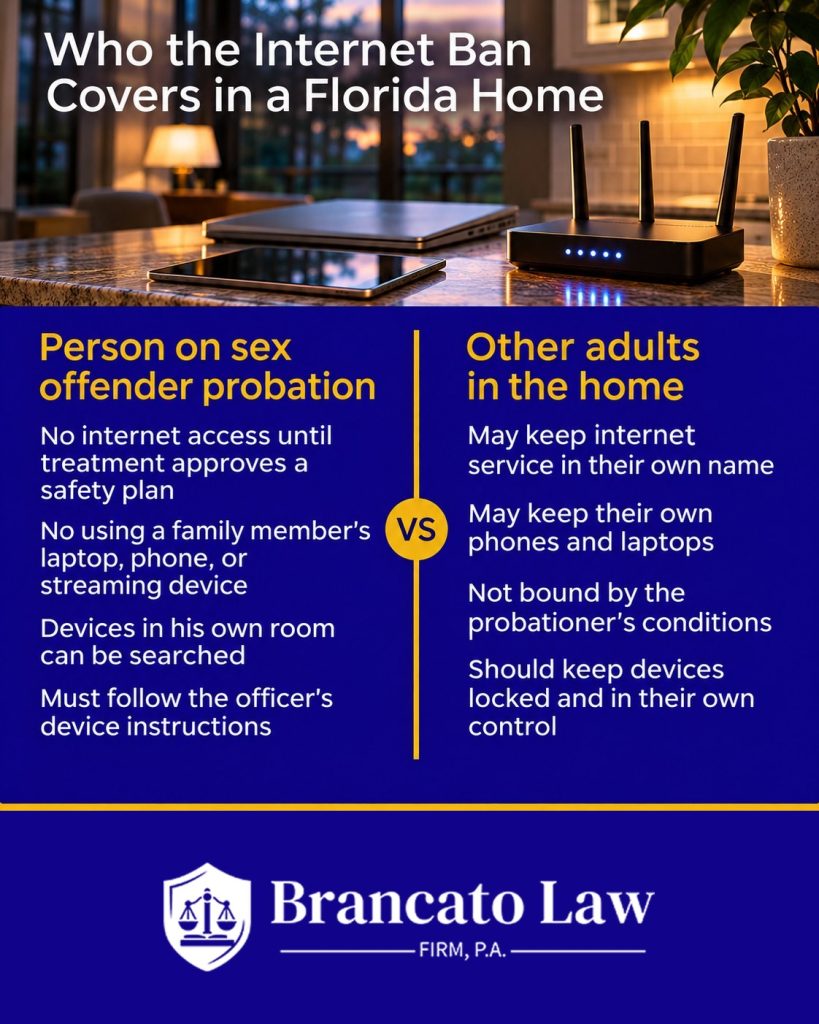
No Florida statute requires a household to go offline because one member is on sex offender probation. Section 948.30(1)(h) prohibits accessing the internet, and it is directed at the probationer. Nothing in the statute restricts what the other adults in the home may use or pay for.
Two documents can change that answer, so read both. The first is the written order of probation, because judges sometimes write broader conditions than the statute. In Levandoski, the sentencing judge barred the defendant from “possessing a computer or any electronic device that can access the internet.” In Alford v. State, 279 So. 3d 752 (Fla. 2d DCA 2019), a Hillsborough County case, the order allowed internet use for work and shopping but banned social media, and the Second District rejected a First Amendment challenge to those conditions.
The second is the probation officer’s instructions. An officer cannot create a new condition of probation, but an officer can give routine instructions that carry out the conditions the judge imposed, and ignoring one can be a violation. In Pinnock v. State, 236 So. 3d 488 (Fla. 2d DCA 2018), the Second District held that an instruction not to possess a phone with internet access was reasonably related to the internet ban, and it affirmed a revocation for ignoring that instruction.
If an officer says the router has to go, or that no smart TV can stay in the house, ask for the instruction in writing and talk to a lawyer before assuming it is enforceable. Our Tampa violation of probation attorney team reviews whether an instruction carries out the judge’s order or adds a condition the judge never imposed.
Can family members keep their own phones, computers, and internet accounts?
Yes. A spouse, parent, roommate, or adult child who is not on supervision is not bound by the probationer’s conditions and may keep a smartphone, a laptop, and an internet account in his or her own name.
The harder question is what a probation officer can look at during a home visit. Section 948.30(1)(k) authorizes a warrantless search of the probationer’s “person, residence, or vehicle.” In State v. Yule, 905 So. 2d 251 (Fla. 2d DCA 2005), the Second District held that officers lawfully entered to conduct a probation search of a home the probationer shared with a man who was not on probation. A concurring opinion explained that the search reaches the parts of the home over which the residents have “joint dominion.” That idea traces to United States v. Matlock, 415 U.S. 164 (1974), where the U.S. Supreme Court tied one occupant’s authority over shared property to “mutual use” by people who generally have joint access or control.
A family member’s own phone, locked and kept in that person’s control, is on different footing. We found no Florida appellate decision holding that a probationer’s search condition lets an officer search a non-probationer’s personal phone. Phones carry heightened privacy protection: in Riley v. California, 573 U.S. 373 (2014), the U.S. Supreme Court held that police generally need a warrant to search the data on a phone seized at an arrest. A household member may decline to hand over his or her own phone, but no one should hide or destroy a device.
Simple habits protect both the family’s privacy and the probationer:
- Lock every household phone, tablet, and laptop with a code the probationer does not know.
- Keep internet-capable devices out of the probationer’s bedroom and other spaces he controls.
- Put internet service and streaming accounts in the name of the person who uses them.
- Never let the probationer borrow a device “just to check something,” even with a family member watching.
Do smart TVs, streaming sticks, and game consoles count as internet access?
Yes. Streaming a movie or playing a game online is accessing the internet, and Florida courts have revoked probation for it. In Morrow v. State, 397 So. 3d 1205 (Fla. 1st DCA 2024), an Alachua County man on sex offender supervision admitted using his brother’s laptop to watch movies on Netflix and his brother’s PlayStation for online gaming. He argued that internet use should count as a substantial violation only if it involved pornography or contact with minors. The First District called that argument an effort to rewrite the probation statute and affirmed the revocation.
Under Morrow, the content is irrelevant: without a safety plan, watching a movie online violates section 948.30(1)(h) the same way any other internet use does. Who owns the device is irrelevant too. The devices belonged to the brother, and the laptop was found in Morrow’s bedroom.
| Device | Risk to the probationer | Why |
|---|---|---|
| Smartphone with data or Wi-Fi | High | It can reach the internet, and an officer may instruct the probationer not to have one, as in Pinnock |
| Basic phone with data turned off | Lower | Owning a phone is not proof of internet use, but the officer can still inspect it |
| Smart TV or streaming stick | High if the probationer uses it | Streaming is internet access under Morrow |
| Game console | High if played online | Online gaming was part of the record in Morrow |
| A family member’s locked phone or laptop | Lower | It is not the probationer’s device if it stays locked and in that person’s control |
| Router or internet account in another person’s name | Lower | The statute bars the probationer’s access, not the presence of service in the home |
Is it a violation to own a smartphone if you never go online?
Owning an internet-capable phone is not the same as accessing the internet, but it can still lead to a violation. In Pinnock, the officer found a Samsung Galaxy phone with apps such as Gmail and Hangouts, admitted there was no proof Mr. Pinnock ever used it to go online, and he testified that he never did. The Second District held there was no competent, substantial evidence that he violated the internet condition. The court still affirmed the revocation because he had ignored his officer’s instruction not to possess a phone with internet access.
The safer course is a basic phone, or a phone with data and Wi-Fi disabled and no internet apps, and only after asking the officer, in writing, whether the device is acceptable.
Can a probation officer search your phone or computer without a warrant?
Often, yes, for use in the violation case. Section 948.30(1)(k) names the person, residence, and vehicle, and it does not mention phones. In State v. Phillips, 266 So. 3d 873 (Fla. 5th DCA 2019), a probation officer forensically downloaded a registered sex offender’s phones with no warrant and no suspicion, even though his probation terms did not expressly allow a phone search. The Fifth District held the search reasonable because he was on probation for sex offenses against a child and the results were used only in probation proceedings. The court certified the question to the Florida Supreme Court, and we found no decision from that court answering it.
The evidence has limits outside the violation case. Under Grubbs v. State, 373 So. 2d 905 (Fla. 1979) and Soca v. State, 673 So. 2d 24 (Fla. 1996), evidence from a warrantless probation search can be used at a violation hearing, but it cannot be used to prove a new crime unless the search met ordinary search-and-seizure standards. If a device search turns up material that could support a new charge, the case can become a new prosecution, and that is the time for representation before charges are filed. Our guide to Florida sex offender probation rules covers searches, polygraphs, and officer questioning in more detail.
What does the State have to prove at a violation hearing for internet use?
The State must prove by the greater weight of the evidence that the probationer willfully and substantially violated a condition of probation. Hearsay is admissible at the hearing, but a revocation cannot rest on hearsay alone, as the Second District held in Garcia v. State, 701 So. 2d 607 (Fla. 2d DCA 1997), where it reversed a revocation built on secondhand reports and a single missed home visit.
In internet cases, that standard turns on proof of who was online. Activity on a household account shows that someone used the internet, but not who. The evidence that usually ties use to the probationer is an admission, a forensic examination of a device he used, a witness who saw him use it, or an account login in his name. Our attorneys test each of those links before a client admits anything.
| Case | What happened | Result |
|---|---|---|
| Morrow (1st DCA 2024) | Probationer admitted streaming movies and online gaming on his brother’s devices | Revocation affirmed |
| Pinnock (2d DCA 2018) | Internet-capable phone with apps, no proof it was used online | Internet violation not proven; revocation affirmed for ignoring the officer’s instruction |
| Ford (2d DCA 2020), Hillsborough County | Admitted internet use led the judge to add a ban on any internet access; a later violation followed | Revocation affirmed; remanded to list the conditions violated |
| Bauer (4th DCA 2012) | Adult DVDs under the older material condition | Violation reversed; no proof the material related to his offense pattern |
| Phillips (5th DCA 2019) | Suspicionless forensic download of a probationer’s phones | Search upheld for use in probation proceedings; question certified |
How do you get permission to use the internet on sex offender probation?
The statute sets the path: a qualified practitioner in the sex offender treatment program completes a risk assessment, then approves and implements a safety plan for internet use. Until that happens, the ban stays in place. Section 948.30(1)(c) requires the treatment itself to be completed at the probationer’s own expense. The statute does not prescribe what a safety plan contains, so the practitioner decides its terms.
Pushing for the assessment early is worth the effort, because job applications, training, banking, and medical portals have all moved online. The Colorado Sex Offender Management Board’s October 2025 guidance on internet access reviewed the research and stated that “There is no empirical support for blanket internet restrictions,” citing Morgan and Klein (2024), and recommended limits that are proportionate to risk and responsive to treatment progress. Florida’s statute takes the same approach by tying internet access to an individual safety plan.
Constitutional challenges have not fared well. In Alford, the Second District distinguished Packingham v. North Carolina, 582 U.S. 98 (2017), where the U.S. Supreme Court struck down a North Carolina law barring registered sex offenders from social media, because that law punished people who had finished their sentences, while a probation condition is part of the sentence. When a written order goes beyond the statute, such as a total ban on owning devices, section 948.03 allows the court to “rescind or modify at any time” the conditions it imposed, and our attorneys can ask the sentencing judge to narrow them.
How closely are people on sex offender probation monitored in Hillsborough County?
Very closely. As of October 2024, the Florida Department of Corrections supervised 6,079 sex offenders living in Florida communities, and as of November 2024, 67% of sex offenders on its community supervision were on active electronic monitoring, according to the Florida Legislature’s OPPAGA Report 24-11. The same report counted 1,999 registered sex offenders living in Hillsborough County communities in 2024.
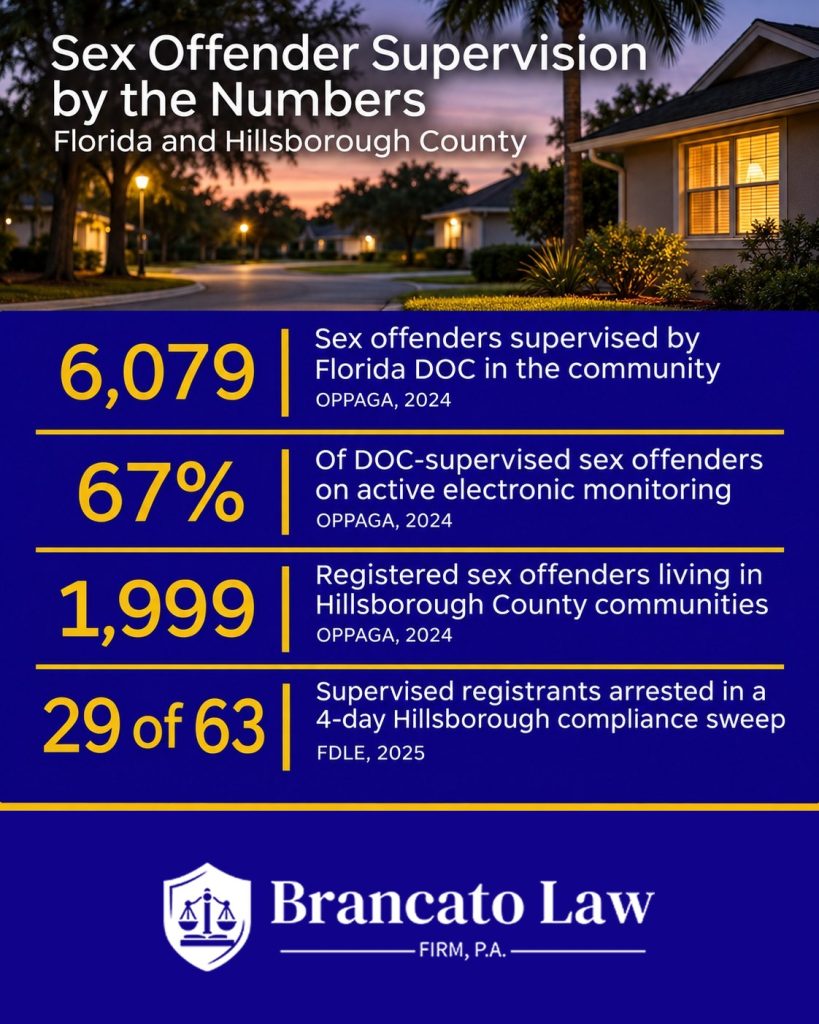
Joint compliance sweeps add to routine home visits. In November 2025, FDLE, the Hillsborough County Sheriff’s Office, and the Department of Corrections announced Operation Lights Out, a four-day operation that contacted 63 registrants on active supervision in Hillsborough County and arrested 29 of them. The violations FDLE listed included unauthorized internet access and unauthorized use of social media accounts.
Electronic monitoring is mandatory for some offenders under section 948.30(3) and available for others under section 948.30(2). A GPS monitor reports where a person is. It does not show who in the house used the internet, so an internet allegation still needs proof of use. Our posts on ankle monitor tampering charges, failure to register as a sex offender, and Florida sex offender registration cover the related supervision issues, and our post on probation curfew violations explains how technical violations are handled.
What happens after an arrest for an internet violation in Hillsborough County?
Expect to stay in jail until a judge hears the case. Under the 13th Judicial Circuit’s 2026 bond schedule, Administrative Order S-2025-063, a person designated a sexual offender or sexual predator may not be released before first appearance, and when a violation of probation warrant is silent on bond, there is no bond until the person appears before the judge assigned to the violation. Under Administrative Order S-2024-062, violations that do not involve a new felony are heard in Circuit Criminal Division “K.”
A first internet violation can also make the conditions stricter. In Ford v. State, 293 So. 3d 553 (Fla. 2d DCA 2020), a Hillsborough County man admitted accessing the internet before completing his risk assessment and safety plan, and at the violation sentencing the judge added a new condition barring any internet access at all. When probation is revoked, Florida law lets the judge impose any sentence that could have been imposed originally.
Statements made to the officer or at the jail in the first days become evidence at the hearing, and devices taken from the home may be examined. Our attorneys request a prompt hearing, read the affidavit for allegations the State cannot prove, and document who owned and used each device. Our guide to the Florida criminal case process shows where a violation case fits, and our Hillsborough County criminal defense page covers local court procedure.
Frequently asked questions about internet use on Florida sex offender probation
Can my spouse have a smartphone if I am on sex offender probation in Florida?
Yes. The internet condition binds only the person on supervision, so a spouse may keep a smartphone, laptop, and internet account. The Brancato Law Firm advises families to keep those devices locked and in the spouse’s own control so the State cannot claim the probationer used them, a point that turns on the shared-access reasoning in United States v. Matlock.
Is watching Netflix a violation of sex offender probation in Florida?
It can be. In Morrow v. State, the First District affirmed a revocation for a probationer who streamed movies on his brother’s laptop without a safety plan, and it held that the content did not matter. Our attorneys at The Brancato Law Firm test whether the State can prove the probationer, and not someone else in the home, did the streaming, which is the core of our work defending probation violation cases.
Can I use the internet for work while on sex offender probation?
Only if your written order or an approved safety plan allows it. Some orders carve out work and shopping, as the Hillsborough County order in Alford v. State did, but the statute itself has no work exception. The Brancato Law Firm reviews the order and works with the treatment provider to get the risk assessment done, as part of our Tampa sex crimes defense practice.
Does the internet ban apply on conditional release from prison in Florida?
Yes. Section 947.1405(7)(a)8. imposes the same internet prohibition on conditional releasees whose crime was committed on or after July 1, 2005, and the Florida Commission on Offender Review sets those terms. Our team at The Brancato Law Firm reads the release certificate line by line to confirm which conditions actually apply.
Can a probation violation for internet use be dismissed in Florida?
Yes, when the State cannot prove willful and substantial use. In Pinnock v. State, the Second District held that owning an internet-capable phone, without proof it was used to go online, did not establish an internet violation. At The Brancato Law Firm, our attorneys hold the State to that proof before any admission, as our guide to Florida sex offender probation rules explains.
Who pays for the treatment that leads to an internet safety plan?
The probationer does. Section 948.30(1)(c) requires sex offender treatment “at the probationer’s or community controllee’s own expense.” When a client cannot afford it, The Brancato Law Firm raises that with the court before it becomes a violation, because a failure caused by inability to pay is not willful, as the Second District recognized in Garcia v. State.
Much of a violation case is shaped in the weeks between the arrest and the hearing. Call The Brancato Law Firm, P.A., founded by Tampa Criminal Defense Attorney Rocky Brancato, at (813) 727-7159 as soon as a violation is alleged. You can call us at any hour, and our office is two blocks from the courthouse. Our firm has Spanish-speaking staff, and attorney Jean-Luc Adrien speaks Spanish, Haitian Creole, and French.
For more about our defense strategies, visit our Violation of Probation page.
The Brancato Law Firm, P.A.
620 E. Twiggs Street, Suite 205, Tampa, FL 33602
(813) 727-7159
Serving Hillsborough, Pinellas, and Pasco Counties
The Brancato Law Firm, P.A. is a Tampa-based criminal defense practice. We are not affiliated with any other Brancato-named law firms.
Visit Us

Tampa, FL 33602

Contact Us Now
Free Legal Consultation (813) 727-7159
