- Free Consultation 24/7: (813) 727-7159 Tap Here To Call Us


From First DUI to Death Penalty



The Complete Guide to Homicide Charges in Florida (2026)



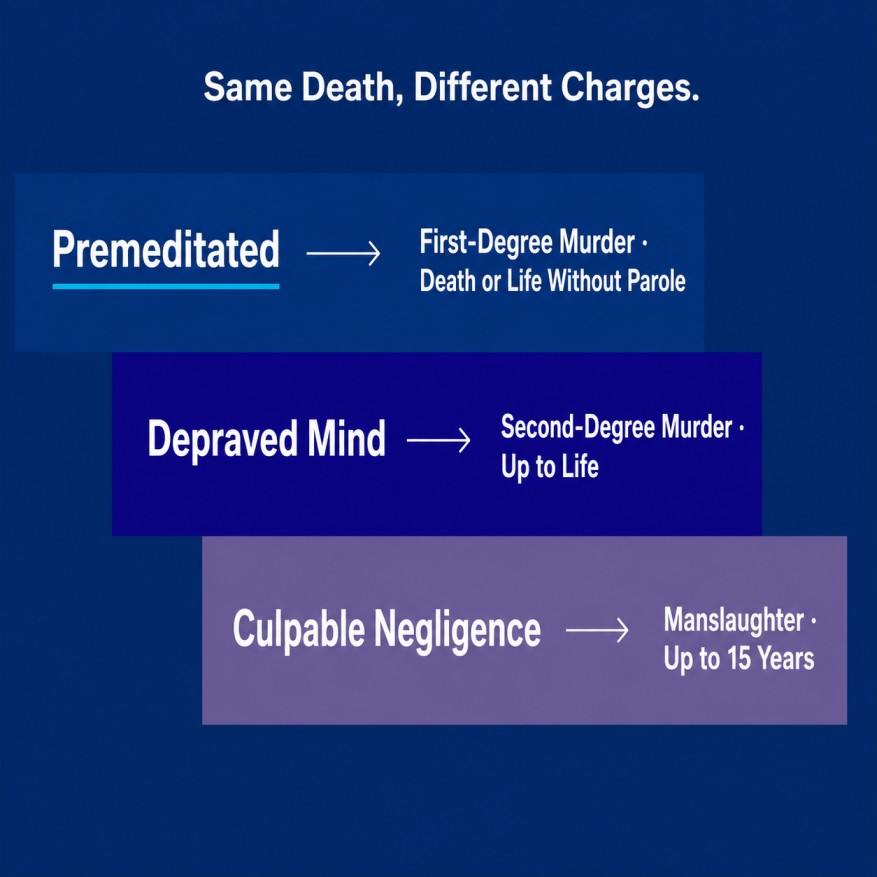
Florida’s homicide laws sort killings into degrees and categories that produce dramatically different outcomes. The same death can be charged as first-degree murder (death or life without parole) or as manslaughter (15 years maximum) depending on what the prosecution can prove about intent, circumstance, and the defendant’s role. The gap between the worst and best outcome is decades of liberty.
This guide maps every Florida homicide charge, the elements the State has to prove, the penalties on the table, the defenses that are available, and how the death penalty actually works in 2026 after the state’s recent legal changes. At The Brancato Law Firm, we defend clients across the full homicide spectrum, from vehicular homicide through capital murder, and the firm’s lead attorney has tried 150+ jury trials to verdict. We built this resource so families pulled into a homicide case can understand the legal landscape before they make decisions they cannot undo.
How Florida classifies homicide charges
Florida codifies its homicide offenses primarily in Chapter 782 of the Florida Statutes, with DUI-related killings handled separately under Chapter 316. The chapter creates a hierarchy graded by mental state, circumstance, and victim class. Here is the full landscape at a glance.
| Charge | Statute | Classification | Maximum Sentence |
| First-degree murder (premeditated or felony murder) | § 782.04(1) | Capital felony | Death or life without parole |
| Second-degree murder (depraved mind) | § 782.04(2) | First-degree felony | Term of years up to life |
| Second-degree felony murder | § 782.04(3) | First-degree felony | Term of years up to life |
| Third-degree murder (felony murder) | § 782.04(4) | Second-degree felony | 15 years |
| Aggravated manslaughter (child, elderly, officer) | § 782.07(2)–(4) | First-degree felony | 30 years |
| Manslaughter (general) | § 782.07(1) | Second-degree felony | 15 years |
| Vehicular homicide | § 782.071 | Second-degree felony (1st if leaving scene) | 15–30 years |
| Vessel homicide | § 782.072 | Second-degree felony (1st if leaving scene) | 15–30 years |
| DUI manslaughter | § 316.193(3) | Second-degree felony (1st if leaving scene) | 15–30 years (4-year mandatory minimum) |
Two structural points are worth absorbing before going deeper. First, Florida has effectively abolished parole. The legislature eliminated parole for almost all offenses in 1983 and for capital felonies in 1995, so a life sentence today means life without the possibility of release. Second, there is no statute of limitations on any homicide. Under Fla. Stat. § 775.15, prosecution for any felony that resulted in a death may be commenced at any time, which is why decades-old cold cases continue to be charged.
First-degree murder in Florida
First-degree murder is the most serious charge in Florida law. It is a capital felony, meaning the State can seek the death penalty or life without parole as the only two possible sentences. Conviction does not require the jury to find that the defendant pulled the trigger or held the weapon. Two separate paths lead to a first-degree murder conviction.
Premeditated murder
The premeditation theory under § 782.04(1)(a)1. requires the State to prove three elements beyond a reasonable doubt: that the victim is dead, that the death was caused by the defendant’s criminal act, and that the killing was premeditated. Per the Florida Standard Jury Instructions in Criminal Cases, premeditation means “killing after consciously deciding to do so.” The decision must exist in the mind at the moment of the killing.
A common misconception is that premeditation requires extended planning. The jury instruction is explicit on this point: the law does not fix any minimum period of time between forming the intent and the killing. The interval only has to be long enough to allow reflection. This is one reason prosecutors often charge first-degree murder in cases that, on the facts, look more like a sudden confrontation. Whether premeditation actually existed becomes a contested question for the jury and a primary battleground at trial.
Florida also recognizes transferred intent. A premeditated design to kill one person that results in killing a different person still qualifies as premeditated murder.
The felony murder rule
The felony murder doctrine under § 782.04(1)(a)2. is the provision that sweeps in defendants who never intended to kill anyone. If a person dies during the commission, attempted commission, or flight from one of the felonies enumerated in the statute, every participant in the underlying felony can be charged with first-degree murder, regardless of who actually caused the death and regardless of whether anyone intended a death to occur.
The list of qualifying felonies is long and includes:
- Drug trafficking
- Robbery, burglary, kidnapping, carjacking, home-invasion robbery
- Sexual battery
- Arson
- Aggravated child abuse and aggravated abuse of an elderly or disabled adult
- Aggravated stalking, aggravated fleeing causing serious bodily injury or death
- Resisting an officer with violence
- Human trafficking
- Acts of terrorism
- Unlawful distribution of fentanyl or fentanyl analogs causing death (when the defendant is 18 or older)
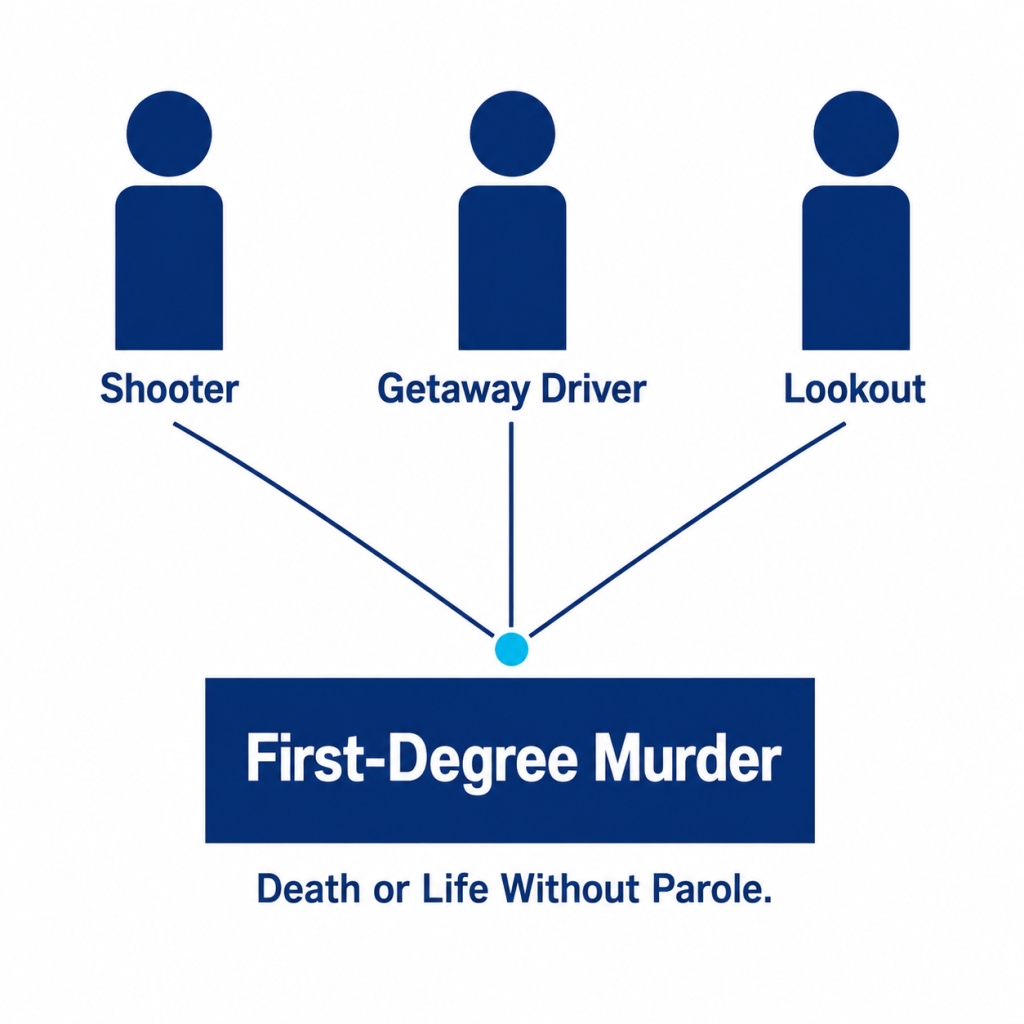
The practical effect is severe. A getaway driver in a robbery gone wrong, a co-defendant in a burglary where a homeowner has a heart attack, or a lookout in a drug trafficking operation can face the same first-degree murder charge as the person who fired the fatal shot. Felony murder cases turn on whether the underlying felony actually qualifies, whether the defendant was truly a participant, and whether the death actually occurred during the commission or flight.
Death penalty eligibility
Because first-degree murder is a capital felony, the State can pursue the death penalty. To preserve that option, the prosecutor must file a notice within 45 days of arraignment under § 782.04(1)(b), and the notice must list the aggravating factors the State intends to prove.
We cover Florida’s capital sentencing process in detail below, including the 2023 statutory change that lowered the jury threshold for a death recommendation. The first-degree murder phase, the guilt phase, must be completed before any death-penalty proceeding begins. A defendant convicted of first-degree murder where the State has not filed a death-penalty notice receives a mandatory life sentence without parole.
Second-degree murder
September 2026 update: The line between second-degree murder and manslaughter was just redrawn in the defense’s favor. In Peoples v. State, No. 1D2025-2335 (Fla. 1st DCA Sept. 2, 2026), the First District reversed a second-degree murder conviction and ordered a manslaughter judgment where the defendant shot an unarmed, intoxicated aggressor who charged him with balled fists, holding that “an impulsive overreaction to an attack or a perceived threat” is not a depraved mind. We break down the element-by-element difference in second-degree murder vs. manslaughter in Florida.
Second-degree murder under § 782.04(2) is a first-degree felony punishable by a term of years not exceeding life. It does not require premeditation. The State must prove that the defendant unlawfully killed another person by an act “imminently dangerous to another and evincing a depraved mind regardless of human life.”
The “depraved mind” language is the heart of the offense. Per the Florida Standard Jury Instructions, an act is “imminently dangerous” and shows a “depraved mind” only when it meets three conditions:
- A person of ordinary judgment would know the act is reasonably certain to kill or cause serious bodily injury.
- The act is done from ill will, hatred, spite, or evil intent.
- The act itself indicates indifference to human life.
This is a deliberately high bar. Plain recklessness or negligence is not enough. Without ill will or evil intent toward another, the State’s case usually collapses to manslaughter. That distinction is one of the most heavily litigated questions in Florida homicide trials.
Second-degree felony murder
Under § 782.04(3), a separate variant of second-degree murder applies when a death occurs during one of the enumerated felonies but is caused by someone who is not a participant in the felony, such as a victim or a responding officer. The participating felon is still guilty, but at the second-degree level rather than first-degree. This provision is what some practitioners call the “agency” line in Florida felony murder doctrine: when the killer is a co-felon, it is first-degree felony murder; when the killer is a non-participant, it drops to second-degree.
Third-degree murder
Third-degree murder under § 782.04(4) is a second-degree felony with a 15-year maximum. It applies when a death occurs during the perpetration or attempted perpetration of any felony other than the felonies enumerated for first-degree felony murder, and the killing was committed without any design to effect death.
This is the catch-all for non-violent felony deaths. If a person dies during the commission of, for example, a property crime that is not on the first-degree list, third-degree murder is available to the prosecution. A separate provision under § 782.04(5)(b) creates a third-degree murder offense for fentanyl distribution by a person under 18 that causes the user’s death.
Manslaughter in Florida
Manslaughter under Fla. Stat. § 782.07 is the residual homicide charge. It covers any unlawful killing that is not justified, not excusable, and not murder. The general offense is a second-degree felony with a 15-year maximum. Aggravated forms become first-degree felonies with 30-year maximums when the victim falls into a protected class.
Florida’s statute does not formally separate “voluntary” and “involuntary” manslaughter, but Florida case law and pattern jury instructions distinguish two practical paths to a manslaughter conviction.
Manslaughter by act
This is sometimes called “voluntary” manslaughter. It applies to an intentional act that causes death where the defendant did not intend to kill. The classic example is a heat-of-passion confrontation that escalates into a fatal blow. The State does not have to prove premeditation. The defendant’s intent to commit a violent act, combined with a death, is enough.
Manslaughter by culpable negligence
The “involuntary” form applies when death results from culpable negligence, a standard that goes well beyond ordinary carelessness. The jury instruction defines culpable negligence as “a course of conduct showing reckless disregard of human life,” “an entire want of care,” or “a grossly careless disregard of the safety and welfare of the public.” The negligent act must have been one the defendant knew or reasonably should have known was likely to cause death or great bodily injury.
Real-world examples include leaving a child in a hot car, mishandling a firearm in close quarters, or failing to secure dangerous machinery in a way that produces a foreseeable fatality.
Aggravated manslaughter
When the victim falls into a protected class, the charge upgrades to a first-degree felony with a 30-year maximum:
- Aggravated manslaughter of a child (§ 782.07(3)). Death of a child under 18 by culpable negligence
- Aggravated manslaughter of an elderly person or disabled adult (§ 782.07(2)). Death by culpable negligence under the elder abuse statute
- Aggravated manslaughter of an officer, firefighter, EMT, or paramedic (§ 782.07(4)). Death of an on-duty first responder by culpable negligence
The factual pattern is often the same as general manslaughter. The victim’s status, child, elder, first responder, is what triples the maximum sentence.
Vehicular homicide
Vehicular homicide under § 782.071 is the killing of a human being caused by the operation of a motor vehicle “in a reckless manner likely to cause the death of, or great bodily harm to, another.” It is a second-degree felony.
The crucial element is recklessness, not mere negligence. Speeding alone is generally not enough. The State has to prove a course of driving that was so dangerous it created a foreseeable risk of death. Drag racing, evading police at high speed, or driving the wrong way on a divided highway are typical fact patterns. Single momentary errors, even fatal ones, more often produce traffic citations or manslaughter charges than vehicular homicide convictions.
When the driver knew or should have known a crash had occurred and failed to stop and render aid as required by § 316.062, vehicular homicide upgrades to a first-degree felony with a 30-year maximum.
DUI manslaughter
DUI manslaughter under Fla. Stat. § 316.193(3) sits separately from the homicide chapter but is functionally one of Florida’s most prosecuted death-related charges. It applies when a death results from impaired driving. It is a second-degree felony, with a 15-year maximum, but the statute imposes a 4-year mandatory minimum prison sentence on every DUI manslaughter conviction. That mandatory minimum is what separates DUI manslaughter from most other manslaughter cases at sentencing.
If the impaired driver knew or should have known a crash had occurred and failed to render aid, the charge becomes a first-degree felony with a 30-year maximum, with the same 4-year mandatory minimum.
DUI manslaughter cases turn on causation as much as impairment. The State has to prove not only that the driver was impaired but that impairment was a cause of the death. Cases involving multiple vehicles, intervening factors, or contested toxicology often produce real defenses on the causation question. Our work on these cases is connected to the broader DUI defense practice, and challenges to breath-test calibration, blood-draw procedure, and retrograde extrapolation can be decisive.
Penalties for Florida homicide convictions
The sentence for a Florida homicide depends on the felony classification under Florida. Stat. § 775.082. Here is the framework that controls every homicide sentence below the death penalty:
| Classification | Maximum Penalty |
| Capital felony | Death or life without parole |
| Life felony | Life or term of years up to life |
| First-degree felony | 30 years (or up to life when specifically authorized) |
| Second-degree felony | 15 years |
| Third-degree felony | 5 years |
Three additional sentencing realities compound those maximums in homicide cases.
Florida has effectively abolished parole
Per OPPAGA, Florida is one of 16 states that eliminated parole between 1976 and 2000. The legislature abolished parole for most offenses in 1983 and for capital felonies in 1995. Only inmates whose offenses predate those cutoff dates remain eligible for parole consideration through the Florida Commission on Offender Review. For any homicide committed today, a life sentence is a life sentence.
The 10-20-Life law
Fla. Stat. § 775.087, commonly called the 10-20-Life law, imposes mandatory minimum sentences when a firearm is used in a qualifying felony. The qualifying felonies include murder, manslaughter, attempted murder, and a long list of other offenses.
| Conduct With a Firearm | Mandatory Minimum |
| Possessed during the felony | 10 years |
| Discharged | 20 years |
| Discharged causing death or great bodily harm | 25 years to life |
Enhanced minimums (15, 20, and 25 years to life) apply when semiautomatic weapons with high-capacity magazines or machine guns are used. We cover the firearm-enhancement framework in greater depth on our violent crimes defense page, which addresses the broader 10-20-Life landscape.
No statute of limitations
Under § 775.15(1), there is no time limit on prosecuting any homicide that constitutes a capital felony, life felony, or first-degree felony. That covers every form of murder, every form of manslaughter, vehicular homicide, and DUI manslaughter. Florida prosecutors have charged decades-old homicides based on cold-case DNA hits, witnesses who finally come forward, or new forensic technology applied to preserved evidence.
Florida’s death penalty in 2026
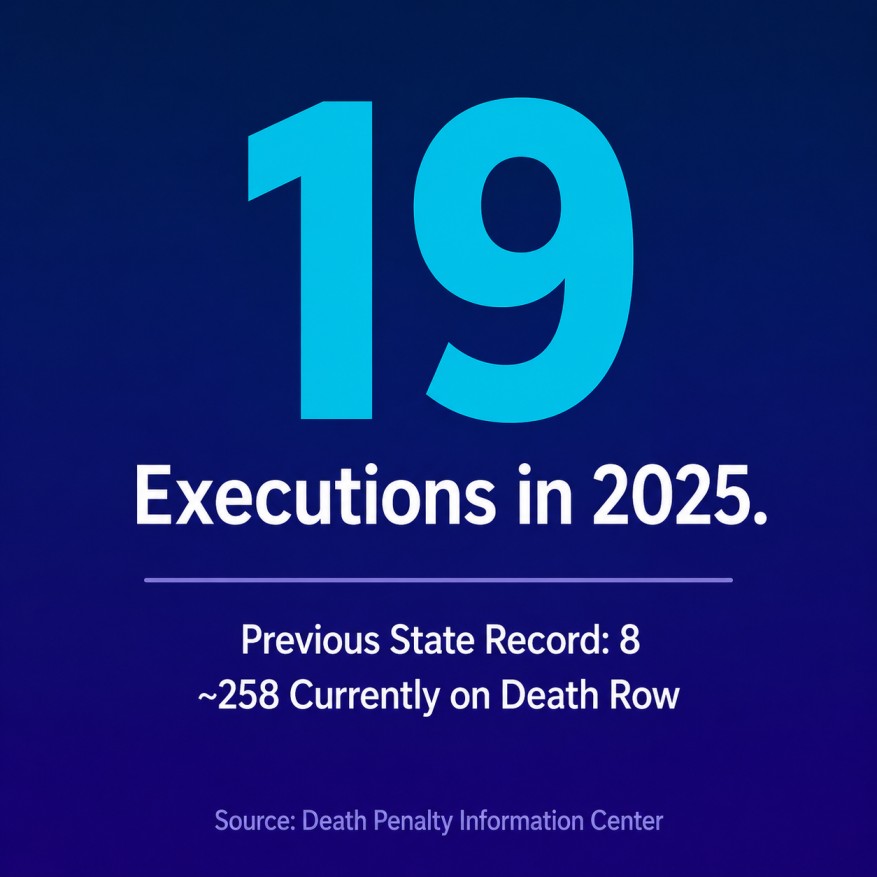
Florida is now the most aggressive death-penalty state in the country. According to the Death Penalty Information Center, the state carried out 19 executions in 2025, the highest annual total of any state since the modern death penalty era began. The previous Florida record was 8 executions in a single year. As of early 2026, the state’s death row held approximately 258 inmates.
Florida is also the state with the most death-row exonerations in the modern era, at 30 since 1973. That gap, between aggressive execution practice and the highest exoneration rate in the country, is part of what makes capital defense such a serious undertaking.
How the 8-of-12 jury rule works
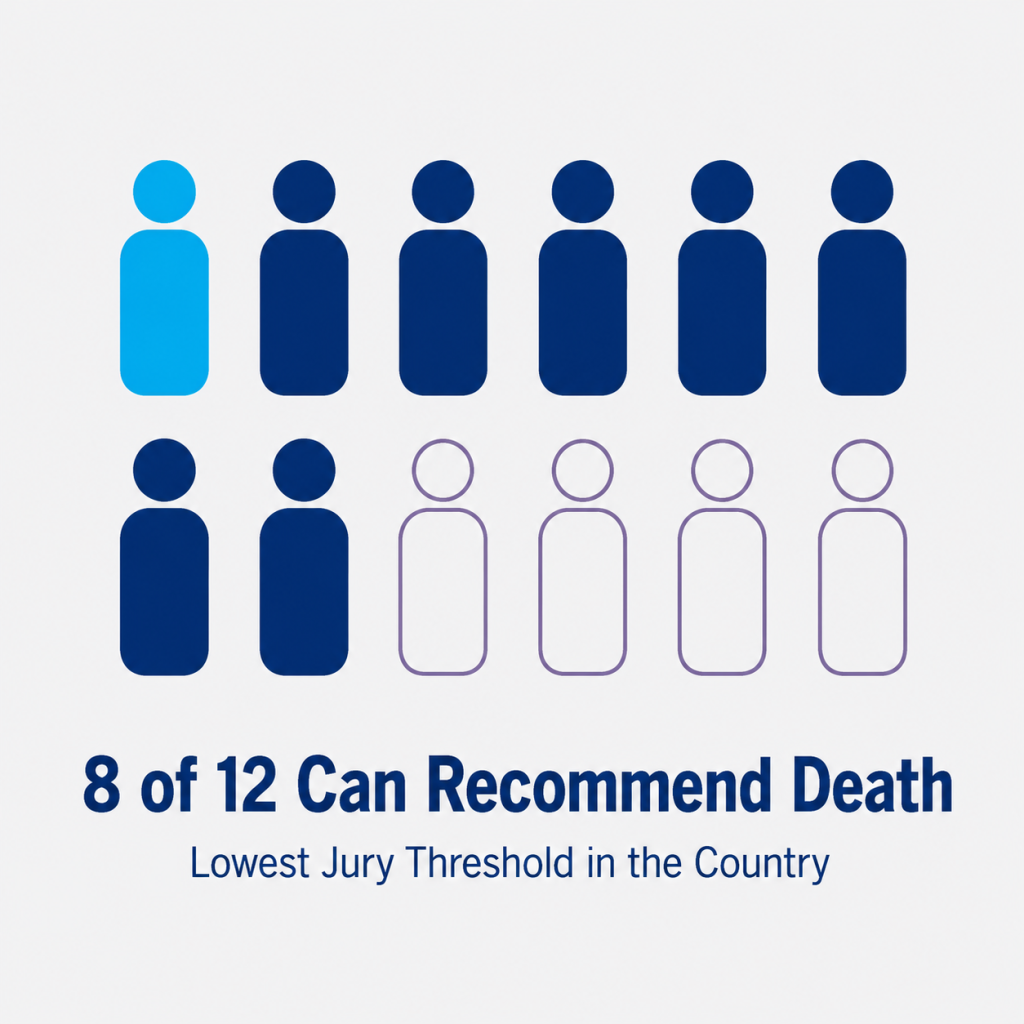
In April 2023, Florida amended Fla. Stat. § 921.141 to eliminate the longstanding requirement of jury unanimity for a death recommendation. Under the current statute, only 8 of 12 jurors must vote for death for a judge to impose a death sentence. This is the lowest threshold in the country. Every other death-penalty state except Alabama still requires unanimity.
The current procedure works in stages:
- Eligibility. The jury must unanimously find at least one statutory aggravating factor beyond a reasonable doubt before the defendant becomes eligible for death.
- Weighing. If at least one aggravator is unanimously found, the jury weighs aggravating factors against mitigating circumstances.
- Recommendation. If at least 8 jurors recommend death, the judge may impose either life without parole or death. If fewer than 8 recommend death, the court must impose life without parole.
- Sentence. Death sentences are subject to automatic review by the Florida Supreme Court.
In December 2025, the Florida Supreme Court upheld the 8-of-12 statute against constitutional challenge in Jackson v. State, No. SC2023-1298, holding that the recommendation is a “selection finding” rather than a fact for Sixth Amendment purposes. The 8-of-12 rule is now settled Florida law.
Aggravating factors
Section 921.141(6) lists the only aggravating factors the State can rely on. The State must prove at least one of them unanimously and beyond a reasonable doubt. The factors include, among others:
- Defendant was under sentence of imprisonment, on community control, or on felony probation
- Defendant has a prior conviction for a capital felony or violent felony
- Defendant knowingly created a great risk of death to many people
- The killing occurred during a robbery, sexual battery, kidnapping, arson, burglary, aggravated child abuse, abuse of an elderly or disabled adult, or other enumerated felony
- The killing was committed to avoid arrest, for pecuniary gain, or to disrupt a governmental function
- The killing was especially heinous, atrocious, or cruel (“HAC”)
- The killing was committed in a cold, calculated, and premeditated manner without pretense of moral or legal justification (“CCP”)
- The victim was a law enforcement officer, public official, child under 12, or particularly vulnerable due to age or disability
- The defendant is a designated sexual predator, gang member, or was subject to a no-contact order
Effective July 1, 2025, the legislature added a new aggravator for capital felonies committed against victims engaged in school, religious, or government public activities (HB 693).
Mitigating circumstances
Section 921.141(7) lists mitigating circumstances the defense can present, but unlike aggravators, mitigators do not need to be found unanimously. Any single juror may give weight to any mitigating circumstance. The statutory mitigators include:
- No significant history of prior criminal activity
- Extreme mental or emotional disturbance at the time of the offense
- Victim consent or participation
- Minor role as an accomplice
- Substantial domination by another person
- Substantially impaired capacity to appreciate criminality or conform conduct to law
- Age of the defendant at the time of the crime
- Any other factor in the defendant’s background that mitigates against the death penalty
The catch-all final factor is critical. It opens the door to comprehensive mitigation investigation: childhood trauma, neurological deficits, military service, addiction, abuse history, intellectual functioning, and any other circumstance that bears on the defendant’s life. Per the U.S. Supreme Court’s decision in Wiggins v. Smith, 539 U.S. 510 (2003), failure to investigate mitigation can itself constitute ineffective assistance of counsel.
The lead attorney at our firm holds death-qualified status, meaning he is certified under Rules of the Florida Supreme Court to serve as lead counsel in capital cases. This is a credential reflecting training and capability under the highest standards Florida applies to criminal defense work.
Common defenses to homicide charges
Florida homicide cases are won at trial, before trial, and in some cases before charges are even filed. The defenses that follow are not theoretical. They are the actual mechanisms that produce dismissals, acquittals, and reductions in real Florida cases.
Self-defense and Stand Your Ground
Florida’s Stand Your Ground framework is set out in Fla. Stat. §§ 776.012, 776.013, and 776.032. Under § 776.012(2), a person is justified in using deadly force if they reasonably believe it is necessary to prevent imminent death or great bodily harm, or to prevent the imminent commission of a forcible felony. There is no duty to retreat, provided the person was not engaged in criminal activity and was in a place where they had a right to be.
Stand Your Ground is more than a trial defense. Section 776.032 creates pretrial immunity from criminal prosecution. A defendant can file a motion for a pretrial immunity hearing where, if the motion succeeds, the case is dismissed before trial.
The 2017 amendment to § 776.032 changed the burden in a significant way. Once the defendant raises a prima facie claim of self-defense immunity at the pretrial hearing, the burden shifts to the State to overcome the immunity by clear and convincing evidence. Before 2017, the defense had to prove entitlement by a preponderance of the evidence. The current rule is one of the most defendant-favorable burden allocations in any state.
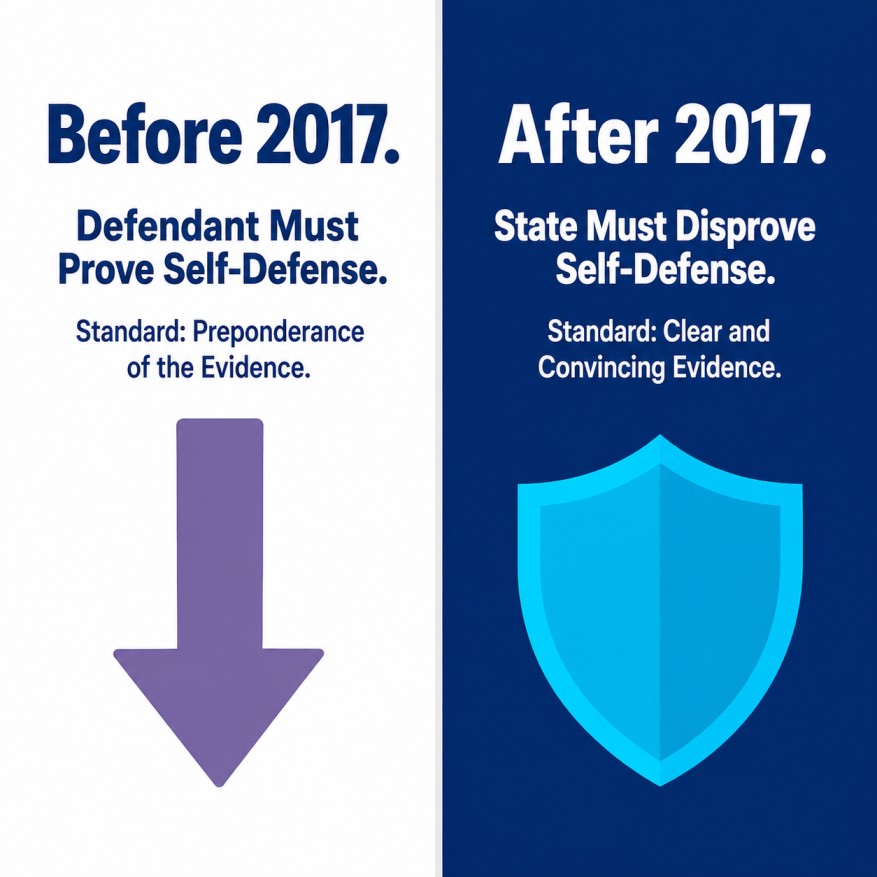
Our firm pursues Stand Your Ground immunity hearings aggressively in homicide cases where the facts support self-defense. The pretrial immunity hearing is a discrete procedural opportunity to end a homicide case before a jury ever sees the evidence.
The Castle Doctrine
Florida’s Castle Doctrine, codified at § 776.013, creates a rebuttable presumption that a person had reasonable fear of imminent death or great bodily harm when force was used against an intruder unlawfully entering or who had entered a dwelling, residence, or occupied vehicle. The presumption is powerful. The State has to rebut it beyond a reasonable doubt at trial, and the defender has no duty to retreat from their own home or vehicle.
Insanity defense
Florida codifies the insanity defense at Fla. Stat. § 775.027, adopting the M’Naghten standard. Insanity is established when the defendant had a mental infirmity, disease, or defect, and because of that condition either did not know what they were doing or its consequences, or did not know that what they were doing was wrong.
The defendant carries the burden of proving insanity by clear and convincing evidence. A successful insanity defense produces a verdict of “Not Guilty by Reason of Insanity” (NGRI), which leads to a commitment hearing rather than imprisonment. Insanity is rarely raised and even more rarely successful, but in cases where mental illness is documented and severe, it can be the right defense.
Lack of intent or premeditation
Many homicide trials are fought on the question of mental state rather than physical conduct. The State may have to prove premeditation for first-degree murder, or “depraved mind” for second-degree, or “culpable negligence” for manslaughter. When the State cannot meet the higher mental-state standard, the offense drops to a lesser-included charge with substantially lower penalties. A first-degree murder charge can resolve as second-degree murder, manslaughter, or even acquittal depending on what the State actually proves at trial.
This is one reason prosecutors so often charge the most serious offense the facts arguably support. The opening charge is a starting position, not an ending position.
Suppression of evidence
Florida criminal cases routinely turn on motions to suppress evidence under Fla. R. Crim. P. 3.190. Unlawful searches and seizures, un-Mirandized statements, coerced confessions, and chain-of-custody failures can all result in evidence being excluded. In a homicide case where the prosecution depends on a single confession, a single weapon, or a single forensic match, a successful suppression motion can collapse the case.
Other defenses
A defenses comparison helps clarify the procedural mechanics across the most common Florida homicide defenses:
| Defense | Burden | Standard | Effect |
| Stand Your Ground (pretrial immunity) | Defendant raises prima facie; State must overcome | Clear and convincing (State) | Pretrial dismissal and civil immunity |
| Self-defense at trial | State must disprove once raised | Beyond a reasonable doubt (State) | Acquittal |
| Castle Doctrine presumption | Defendant invokes; State must rebut | Beyond a reasonable doubt (State) | Acquittal |
| Insanity | Defendant | Clear and convincing | NGRI verdict; commitment hearing |
| Alibi | Defendant raises; State disproves | Beyond a reasonable doubt (State) | Acquittal |
| Mistaken identity | Reasonable doubt | Beyond a reasonable doubt (State) | Acquittal |
| Suppression of evidence | Defendant moves; State justifies | Preponderance | Evidence excluded |
How a Florida homicide case moves through the system
A Florida homicide case follows a structured procedural path. Understanding the sequence helps families know what to expect and where the critical decision points are.
- Arrest. Arrest occurs with or without a warrant. For warrantless arrests, a probable-cause affidavit is required.
- First appearance. Within 24 hours of arrest, the defendant must be brought before a judicial officer under Fla. R. Crim. P. 3.130. The judge confirms probable cause, advises the defendant of charges and rights, and addresses pretrial release.
- Bond status. First-degree murder defendants are held without bond unless they obtain an Arthur hearing under State v. Arthur, 390 So. 2d 717 (Fla. 1980), at which the State must show the proof of guilt is evident or the presumption great. As of January 1, 2024, Fla. Stat. § 907.041 requires the State to move for pretrial detention on capital, life, and first-degree felony arrests.
- Charging. Capital cases must be charged by grand jury indictment under Fla. R. Crim. P. 3.140 and Article I, § 15 of the Florida Constitution. Non-capital homicides may be charged by State Attorney’s information.
- Arraignment. The defendant enters a plea.
- Death-penalty notice. If the State intends to seek death, notice and the list of aggravators must be filed within 45 days of arraignment under § 782.04(1)(b).
- Discovery. Florida is one of the few states that permits routine discovery depositions in felony cases, which gives the defense substantial pretrial access to State witnesses.
- Pretrial motions. Motions to suppress, motions to dismiss, Stand Your Ground immunity hearings, motions in limine, and motions to compel.
- Speedy trial. Florida felonies carry a 175-day speedy trial period under Fla. R. Crim. P. 3.191.
- Trial. Guilt phase, with full jury trial rights.
- Penalty phase. In capital cases, a separate proceeding under § 921.141 follows the guilt verdict.
- Appeal. Death sentences are subject to automatic review by the Florida Supreme Court. Non-death felony convictions go to the district court of appeal.
- Postconviction. Collateral attacks under Fla. R. Crim. P. 3.850 (general) or 3.851 (capital).
Charged is not convicted
One reality of Florida homicide practice deserves direct attention: the charge filed at the start of the case is often not the conviction at the end. Prosecutors charge to the highest defensible offense the facts can support. They keep the death-penalty notice on the table as a negotiation lever. They use the breadth of the felony murder rule to add defendants who never intended a death.
What sticks at the end depends on what the defense can do during the months and years between arrest and resolution. First-degree murder charges resolve as second-degree, as manslaughter, as not guilty, and sometimes never make it past pretrial dismissal. Aggravated charges drop to lesser-included offenses. Death-penalty notices get withdrawn during plea negotiation. Stand Your Ground immunity gets granted. Suppression motions remove the evidence the case was built on.
The headline charge is the prosecutor’s opening offer. It is not the system’s final answer, and it should not be treated as such by anyone making decisions about defense.
Why early defense counsel matters in homicide cases
Florida homicide cases produce their best outcomes when defense work begins early, ideally before charges are filed and certainly before the State’s death-penalty notice deadline. The Sixth Amendment right to counsel attaches at critical stages, and the highest-stakes pretrial decisions, whether to speak with detectives, whether to consent to searches, whether to participate in lineups, often happen before formal charges and before many defendants have retained counsel.
A homicide defense built from day one looks different from one built after months of default investigation:
- Independent investigation. Defense investigators interview witnesses, examine the scene, and preserve evidence the State may not have collected.
- Forensic experts. Forensic pathologists, accident reconstruction specialists, DNA experts, toxicologists, and ballistics analysts identify weaknesses in the State’s case before they become trial assumptions.
- Pre-file advocacy. In some cases, presenting evidence and context to the State Attorney’s Office before charges are filed can result in charges that more accurately reflect the facts, or no charges at all.
- Mitigation, from day one. In cases where the death penalty is possible, mitigation investigation begins immediately, as the American Bar Association Guidelines for capital defense require.
- Stand Your Ground analysis. If the facts support self-defense, an immunity motion under § 776.032 can end the case before trial.
At The Brancato Law Firm, our homicide defense practice covers the full range of Florida charges, from manslaughter through capital murder, across Hillsborough, Pinellas, and Pasco Counties. The firm maintains a network of forensic experts, including forensic pathologists, accident reconstruction specialists, and former medical examiners. The lead attorney brought 25 years of defense-only experience to the firm’s founding, including a tenure as Chief Operations Officer of the Hillsborough County Public Defender’s Office, where he ran the largest criminal defense operation in Tampa Bay. That system-level institutional knowledge informs how we approach charging decisions, plea negotiations, and trial strategy.
We have produced not-guilty verdicts in second-degree murder cases involving self-defense, and have obtained dismissals of first-degree murder and aggravated child abuse charges after retaining medical experts who identified accidental causes the State had missed. Each case is unique. Past results do not guarantee future outcomes.
Get clarity on the charges your family is facing
If you or a family member is facing any homicide charge in Florida, the first conversation with a defense attorney is the most important one. Understanding what the State has actually charged, what they have to prove, what defenses are available, and what realistic outcomes look like is the foundation for every decision that follows.
The Brancato Law Firm offers free, confidential consultations on every homicide matter. We are available 24/7 for arrest emergencies. Call (813) 727-7159 to speak with our team about the charges, the evidence, and the defenses that may apply to your case.
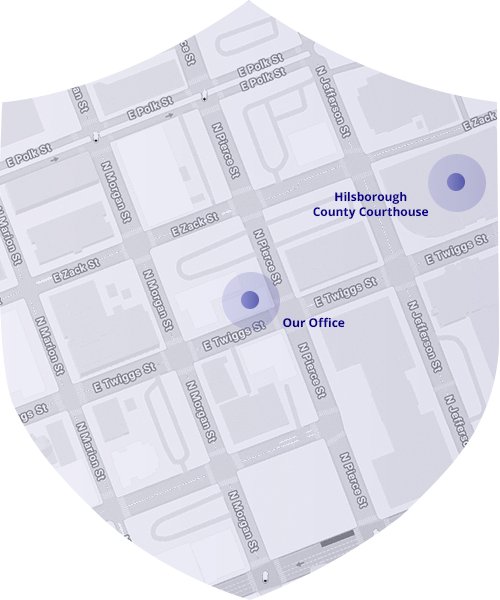
Visit Us
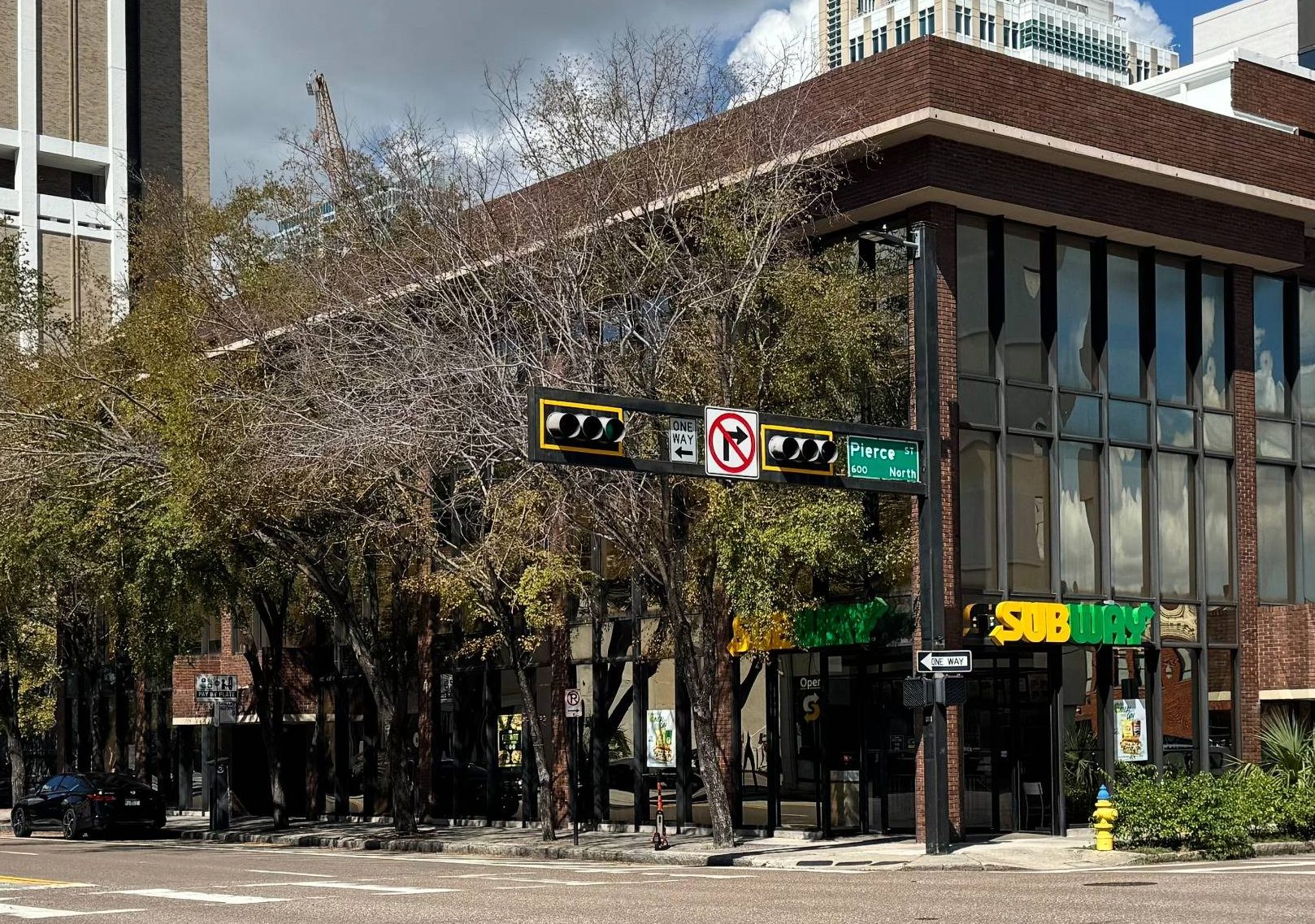
Tampa, FL 33602
Contact Us Now
Free Legal Consultation (813) 727-7159