- Free Consultation 24/7: (813) 727-7159 Tap Here To Call Us


From First DUI to Death Penalty


Can You Fight Jailhouse Informant Testimony in Florida?


Rewrite/update date: October 13, 2026. Originally published in February 2026.
| Yes — jailhouse informant testimony can be attacked at trial and even decades after a conviction. At trial, the defense can expose the informant’s deals, criminal record, and motives to lie. After trial, a Giglio violation — the State presenting testimony it knew was false — can undo a conviction. In 2026 alone, the U.S. Supreme Court reinstated a Florida death-row inmate’s challenge built on a lying jailhouse snitch, and a Florida appellate court ordered a hearing for a defendant who alleged the State’s key witness lied about his plea deal. The tools are real, but the deadlines and standards are strict. |
I’m Rocky Brancato, founder of The Brancato Law Firm, P.A., a Tampa criminal defense firm. I tried more than 150 jury trials to verdict and led the Major Crimes Unit at the Hillsborough County Public Defender’s Office, where jailhouse informants surfaced in the most serious cases we handled — homicides, sex crimes, and anything with a reward attached. Our attorneys treat every incarcerated witness as a case within the case, because the incentives to lie are enormous and the law provides ways to prove it.
Why Is Jailhouse Informant Testimony So Unreliable?
Because the witness has something to gain and little to lose. A jailhouse informant — an inmate who claims another inmate confessed to him — typically hopes for a reduced sentence, dropped charges, returned property, or simple goodwill from the prosecutors who control his fate. The testimony is easy to manufacture (crime details circulate in jails through news coverage and paperwork), difficult to disprove, and delivered by someone with practice persuading people. Wrongful-conviction litigation across the country has repeatedly traced convictions to informants who later admitted inventing confessions.
Florida law gives the defense trial tools to expose all of it. Under Fla. Stat. § 90.608, any party may attack a witness’s credibility by showing bias — which includes every benefit the informant hopes to receive — along with inconsistent statements and contradicting evidence, and under Fla. Stat. § 90.610, the informant’s prior convictions come in to impeach him. The State must also disclose deals and benefits, and when it hides them — or lets the informant lie about them — the Constitution takes over.
Exposing the deal carries a risk the defense has to plan for. In Nixon v. State, No. 1D2024-2412 (Fla. 1st DCA July 29, 2026), a Leon County felony murder case, the defense got a cooperating witness to admit he faced life, had no promises, and hoped for a better deal by helping convict the defendant. The First District held that this cross-examination implied the witness made up his story to earn a deal, which opened the door for the State to call a detective to repeat the witness’s earlier, consistent account under Fla. Stat. § 90.801(2)(b). The court added that an arrest alone does not prove the motive to lie already existed when the earlier statement was made. Before our attorneys cross-examine an informant about a deal, we pin down when every prior statement was made and what the witness stood to gain at that moment, so the jury does not hear the State’s story twice.
What Is a Giglio Violation?
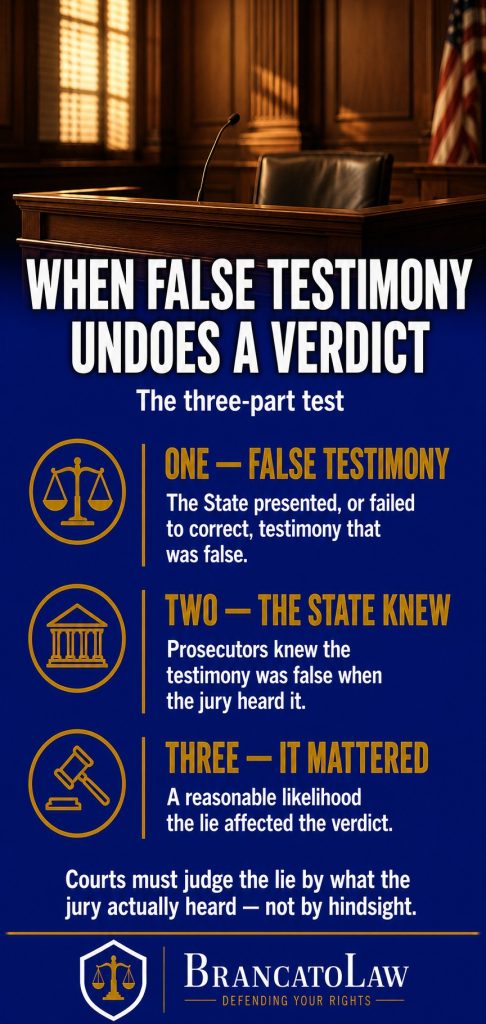
A Giglio violation occurs when the State presents or fails to correct testimony it knows is false, and the lie matters. The doctrine comes from Giglio v. United States, 405 U.S. 150 (1972), where the government’s key witness falsely denied being promised immunity. As the Florida Supreme Court restated the test this summer, the defense must prove that (1) the State presented or failed to correct false testimony, (2) the State knew the testimony was false, and (3) the false evidence was material. The classic jailhouse-informant Giglio claim involves exactly what its namesake case involved: the snitch tells the jury he was promised nothing, and the prosecutor — who knows better — stays silent.
| Attack route | What must be shown | When it happens |
|---|---|---|
| Impeachment at trial (§§ 90.608, 90.610) | Bias, deals, benefits, prior convictions, inconsistent statements | During trial, through cross-examination and defense evidence |
| Giglio claim | State presented/failed to correct testimony it knew was false; reasonable likelihood it affected the verdict | Motion for new trial, direct appeal, or postconviction (Rule 3.850) |
| Massiah / Sixth Amendment claim | After the right to counsel attached on the charged offense, the State deliberately used an informant to elicit statements | Motion to suppress the statements |
What Did the U.S. Supreme Court Decide in Whitton v. Dixon?
In Whitton v. Dixon, No. 25-580 (U.S. June 1, 2026), the Supreme Court revived a Florida prisoner’s jailhouse-informant challenge — and tightened the rules courts must follow when they decide whether a snitch’s lie “mattered.” The informant, Jake Ozio, was a high-school student jailed after a spring-break arrest who testified that he overheard Whitton confess to a murder. Ozio also told the jury he had no prior criminal history. That was false — his juvenile records, which the State possessed at trial, showed prior charges including assault and burglary — and the jury never learned who was actually testifying against Whitton.
The federal appeals court had brushed the lie aside as immaterial, partly by pointing to DNA evidence developed after trial. The Supreme Court vacated that decision: materiality asks whether the false testimony influenced the jury’s verdict, and evidence the jury never saw — evidence that did not even exist at trial — “sheds no light” on that question. The case went back down to be decided on the record the jury actually heard. For defendants, Whitton is a meaningful win: courts cannot launder a Giglio violation through hindsight, propping up a tainted verdict with material the jurors never considered.
How Do Florida Courts Handle Informant Lies About Plea Deals?
Florida’s appellate courts are actively policing this — including a decision just days ago. In Mensah v. State, No. 6D2023-3105 (Fla. 6th DCA Aug. 28, 2026), a defendant alleged in a postconviction motion that the State’s key witness was promised a lenient plea deal and then testified, falsely, that he had been promised nothing — a textbook Giglio allegation. The trial court denied the claim without a hearing. The Sixth District reversed: unless the record conclusively refutes the allegation, the defendant is entitled to an evidentiary hearing. The court sent the case back for the State to either produce record proof that no deal existed or face a hearing where the deal question gets litigated.
Mensah matters for a practical reason: defendants rarely have documents proving a secret deal when they file. The decision confirms that at the pleading stage, the burden runs the other way — the record must disprove the claim, not the defendant prove it — which keeps the courthouse door open long enough for discovery and testimony to do their work.
Why Did the Florida Supreme Court Reject the Informant Claims in Rhodes?
Because the informants’ new stories were not believed — and Rhodes is the honest counterweight every defendant should understand. In Rhodes v. State, No. SC2024-1099 (Fla. July 2, 2026), a death-row prisoner presented recantations from two jailhouse witnesses who now claimed law enforcement coached their testimony and rewarded them with benefits — including, one claimed, the return of seized property such as dozens of ounces of gold and silver. The postconviction court heard the witnesses, found them not credible, and the Florida Supreme Court affirmed, repeating its long-standing view that recantation testimony is “as a general matter, ‘exceedingly unreliable’” — especially where the witnesses could not explain waiting nearly forty years to come forward.
Rhodes also answered a question our clients ask constantly: can police plant an informant near me at the jail? The Sixth Amendment bars the State from deliberately using an informant to draw statements out of you — but only for offenses on which your right to counsel has attached, because that right is offense-specific. An inmate awaiting trial on one charge can lawfully be worked by an informant about a different, uncharged crime. That is exactly why the safest rule in custody is absolute: discuss your case with no one but your lawyer — not cellmates, not friends on recorded jail phones, no one.
What Did 2026’s Informant Decisions Change?
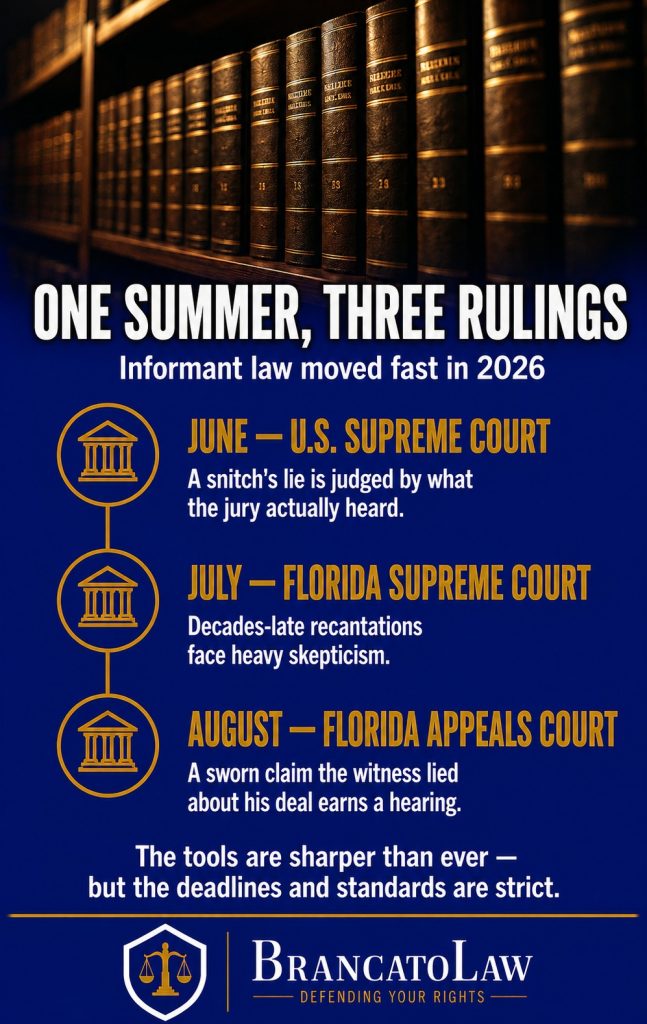
Three courts, three months, three lessons — together they map where informant challenges now stand.
| Case | Court and date | What it means for defendants |
|---|---|---|
| Whitton v. Dixon | U.S. Supreme Court, June 1, 2026 | Whether an informant’s lie “mattered” is judged on what the jury actually heard — courts cannot excuse the lie using evidence the jury never saw |
| Rhodes v. State | Florida Supreme Court, July 2, 2026 | Decades-late recantations face heavy skepticism; the Sixth Amendment bars informant questioning only on charged offenses |
| Mensah v. State | Fla. 6th DCA, Aug. 28, 2026 | A sworn allegation that the State’s witness lied about his plea deal earns an evidentiary hearing unless the record conclusively refutes it |
What Should You Do If an Informant Is Part of Your Case?
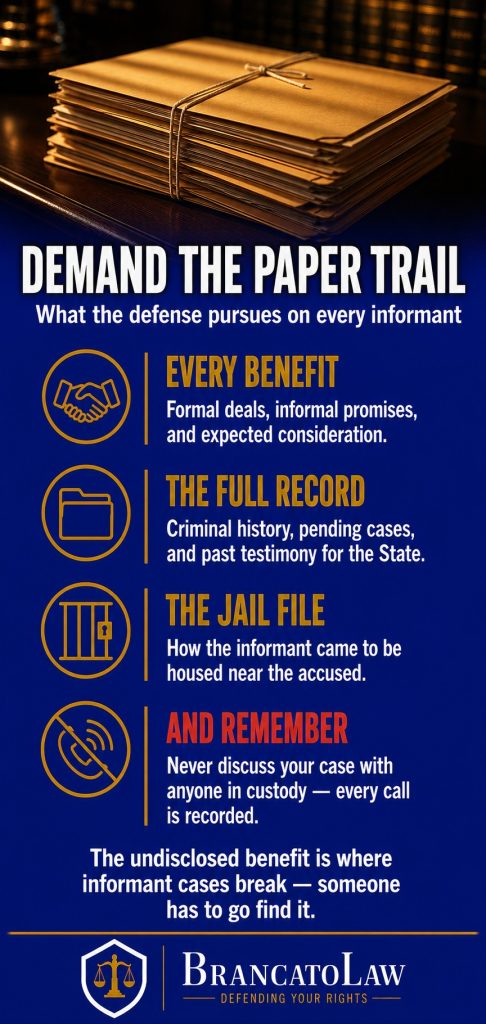
Demand everything, immediately — the benefits paper trail is where these witnesses fall apart. When a jailhouse informant appears on the State’s witness list in a Tampa Bay case, our attorneys move for disclosure of every promise, understanding, or benefit (formal or informal), the informant’s complete criminal history including juvenile records, his other cases and pending charges, every prior occasion he has testified or offered information for the State, and the jail records showing how he came to be housed near our client. We depose the informant — Florida allows depositions in felony cases — and lock him into a story before trial. And if the case is already over, Whitton and Mensah show the fight is not: a lie about a record or a deal, known to the State, supports a Rule 3.850 motion, and the standards applied to it were just clarified in the defense’s favor. Timing matters at both ends — disclosure fights are won before trial, and postconviction deadlines are unforgiving — so if a snitch built or is building the case against you or a family member, our guide to what to do after being arrested in Tampa covers the first hours, and this issue is one to raise with counsel in the first meeting. Informant testimony is most common in the most serious cases — see our complete guide to homicide charges in Florida for how these trials are actually defended.
For more about our defense strategies, visit our Hillsborough County criminal defense page.
Frequently Asked Questions
Do jailhouse informants get deals for testifying?
Frequently, yes — reduced charges, sentencing consideration, or other benefits — and the State is constitutionally required to disclose them. Some deals are informal (“we’ll make your cooperation known”), which are still benefits the jury is entitled to hear about. Our attorneys pursue the paper trail behind every incarcerated witness because the undisclosed benefit is often the case’s breaking point.
What happens if a prosecution witness lied at my trial?
If the State knew the testimony was false and there is a reasonable likelihood the lie affected the verdict, that is a Giglio violation and grounds for a new trial. In Whitton v. Dixon (U.S. 2026), the Supreme Court held courts must judge that question on the evidence the jury actually heard. These claims are raised on appeal or by postconviction motion, and The Brancato Law Firm, P.A. handles both.
What is the difference between a Brady violation and a Giglio violation?
Brady is about suppression: the State hid favorable evidence from the defense. Giglio is about false testimony: the State presented or failed to correct testimony it knew was false. A hidden deal with an informant can violate both at once — the deal was concealed (Brady) and the informant denied it on the stand (Giglio).
Can police put an informant in my cell to get me to talk?
Once you are charged and your right to counsel has attached, the State cannot deliberately use an informant to elicit statements about that offense. But as Rhodes v. State (Fla. 2026) confirms, the right is offense-specific — an informant can lawfully gather statements about uncharged crimes. Never discuss your case with anyone in custody; assume every cellmate conversation and jail call is evidence.
Can an old conviction be overturned because an informant recanted?
It is possible but hard: Florida courts treat recantations as “exceedingly unreliable,” and a decades-late change of story faces heavy skepticism, as Rhodes shows. The stronger paths pair the recantation with objective proof — records showing undisclosed benefits, or documents proving the trial testimony false. The Brancato Law Firm, P.A. evaluates postconviction informant claims with exactly that evidence-first approach.
Does the jury get told that a witness is a jailhouse informant?
The jury hears it if the defense puts it in front of them — through cross-examination on bias under Fla. Stat. § 90.608, prior convictions under § 90.610, and the informant’s expectations of benefit. That is why the pretrial disclosure fight matters: you cannot cross-examine on a deal you never learned about.
The summer of 2026 was the most active season for informant law in years — Whitton in June, Rhodes in July, Mensah in August — and each one changes how these witnesses are fought in Florida courtrooms. If a jailhouse informant is part of the case against you or someone you love, call the attorneys of The Brancato Law Firm, P.A. — founded by Tampa Criminal Defense Attorney Rocky Brancato — at (813) 727-7159 now, before the disclosure deadlines pass and the informant’s story hardens in front of a jury.
The Brancato Law Firm, P.A.
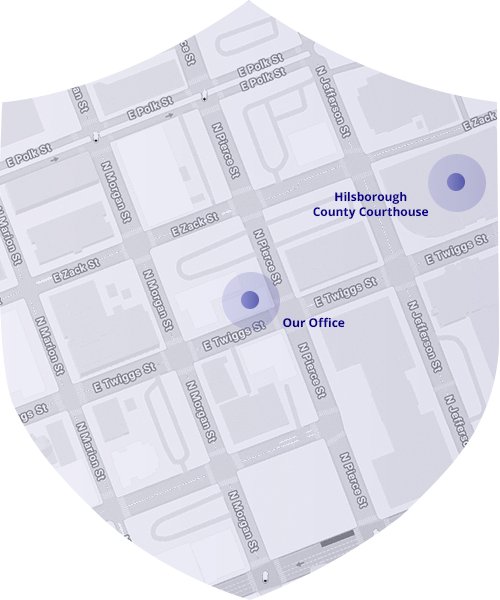
620 E. Twiggs Street, Suite 205, Tampa, FL 33602
(813) 727-7159
Serving Hillsborough, Pinellas, and Pasco Counties
The Brancato Law Firm, P.A. is a Tampa-based criminal defense practice. We are not affiliated with any other Brancato-named law firms.
Visit Us
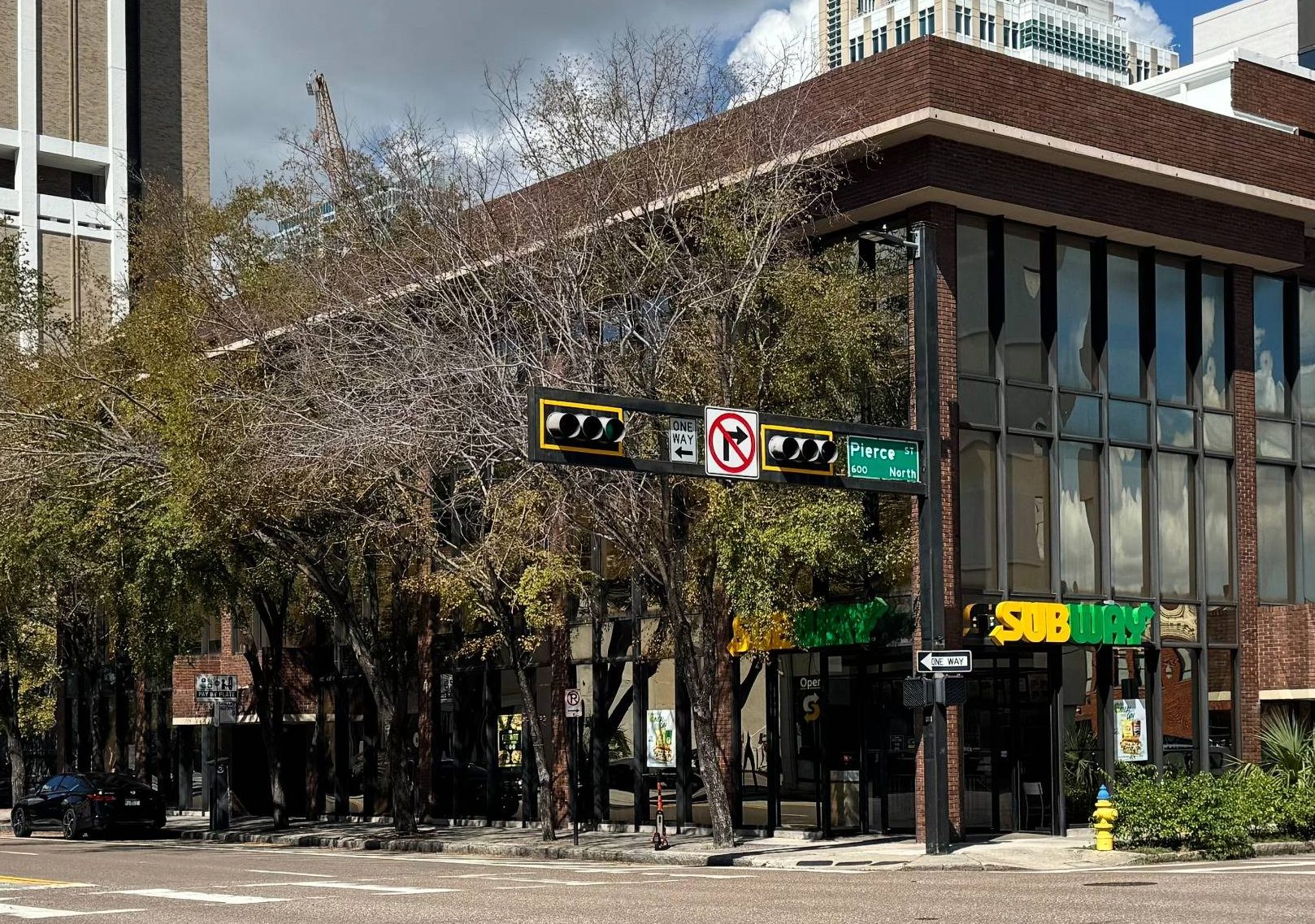
Tampa, FL 33602
Contact Us Now
Free Legal Consultation (813) 727-7159