- Free Consultation 24/7: (813) 727-7159 Tap Here To Call Us


From First DUI to Death Penalty



Can a Conviction Be Overturned for Prosecutorial Misconduct in Florida?


Published September 8, 2026.
| Yes — even when your trial lawyer never objected. The usual rule is that an unobjected-to error is waived on appeal. The exception is “fundamental error”: an error so serious that “a verdict of guilty could not have been obtained without” it. On September 4, 2026, the Second District Court of Appeal — the appellate court for Hillsborough, Pinellas, and Pasco — applied that exception in Green v. State and reversed a Pinellas County sexual battery conviction because the State put a steak knife and two unused condoms in front of the jury that had nothing to do with the charged crime, then built a closing argument on them, expressed personal opinions of guilt, and made comments that implicated the defendant’s right not to testify and shifted the burden of proof. No objection was made to any of it. The convictions were reversed anyway. |
I’m Rocky Brancato, founder of The Brancato Law Firm, P.A., a Tampa criminal defense firm. I have tried cases in Tampa Bay courtrooms for more than 25 years, and the hardest conversations I have are with families whose loved one was convicted at a trial where the defense lawyer sat silent through a closing argument that should have drawn five objections. Green is a reminder that silence is not always fatal — and a warning about how much has to go wrong before an appellate court will step in without it.
What Counts as Prosecutorial Misconduct in a Florida Trial?
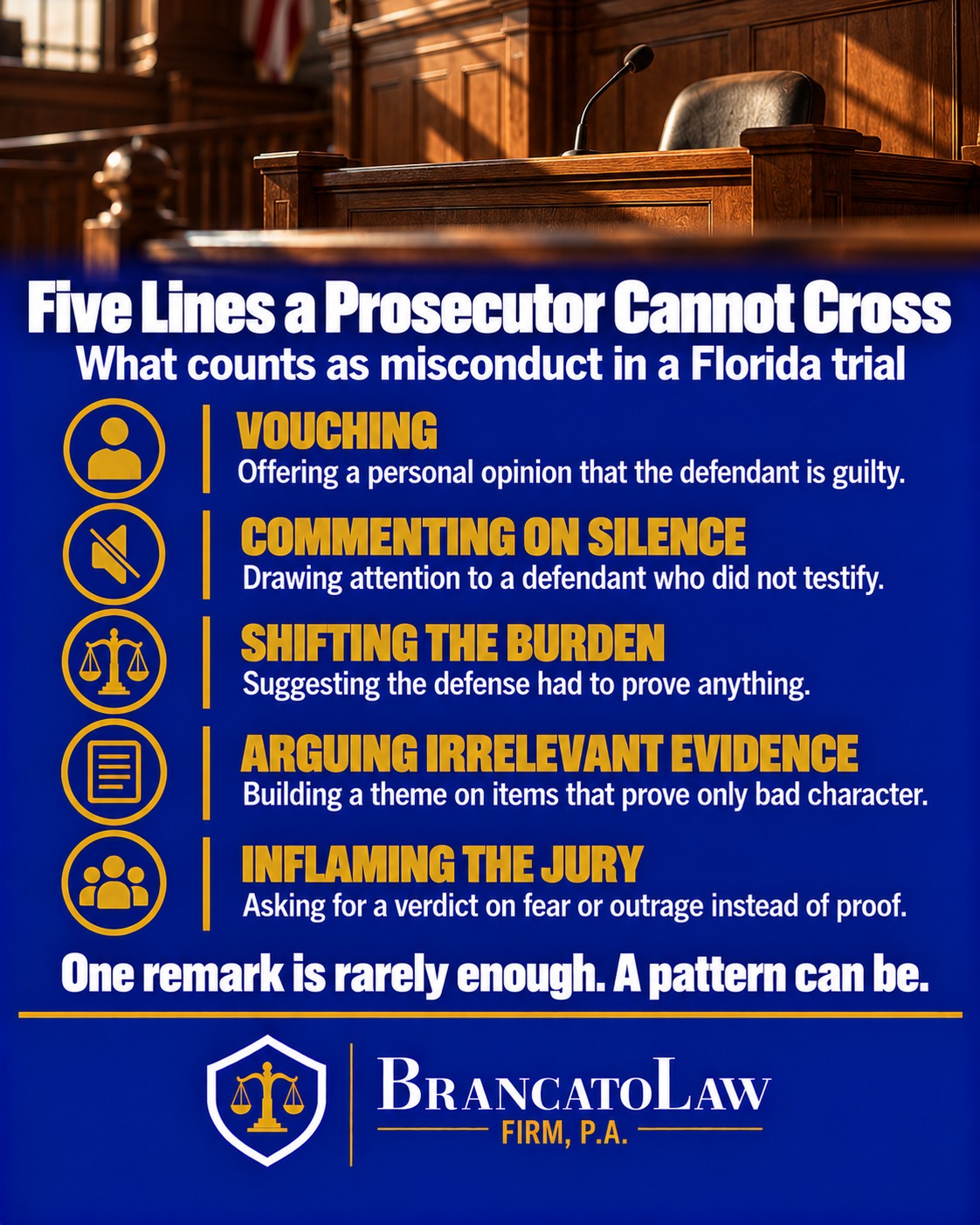
Argument or evidence that asks the jury to convict for a reason other than proof of the charged crime beyond a reasonable doubt. A prosecutor is an advocate, and closing argument is supposed to be forceful; the line is crossed when the argument does one of the things Florida courts have long held improper:
| Category | What it looks like | Why it is improper |
|---|---|---|
| Personal opinion of guilt or vouching | “I submit to you he knew exactly what he was doing”; telling the jury the prosecutor believes the witness | Substitutes the prosecutor’s credibility for the evidence |
| Comment on the right not to testify | Any remark that draws attention to the defendant’s silence or invites the jury to wonder why he did not explain | Penalizes a constitutional right |
| Burden shifting | Suggesting the defense had to produce evidence, call witnesses, or disprove the State’s theory | The burden never leaves the State |
| Arguing irrelevant or inflammatory evidence | Building a theme around items that prove nothing about the charged act — a knife no one saw, condoms no one mentioned | Invites conviction on character, not conduct |
| Inflaming the jury | “He preyed on her”; appeals to fear, sympathy, or community outrage | Asks for a verdict on emotion |
A single stray remark rarely reverses a conviction. What reverses convictions is a pattern — and, when no one objected, a pattern severe enough to meet the fundamental-error standard.
Why Does It Matter Whether Your Lawyer Objected?
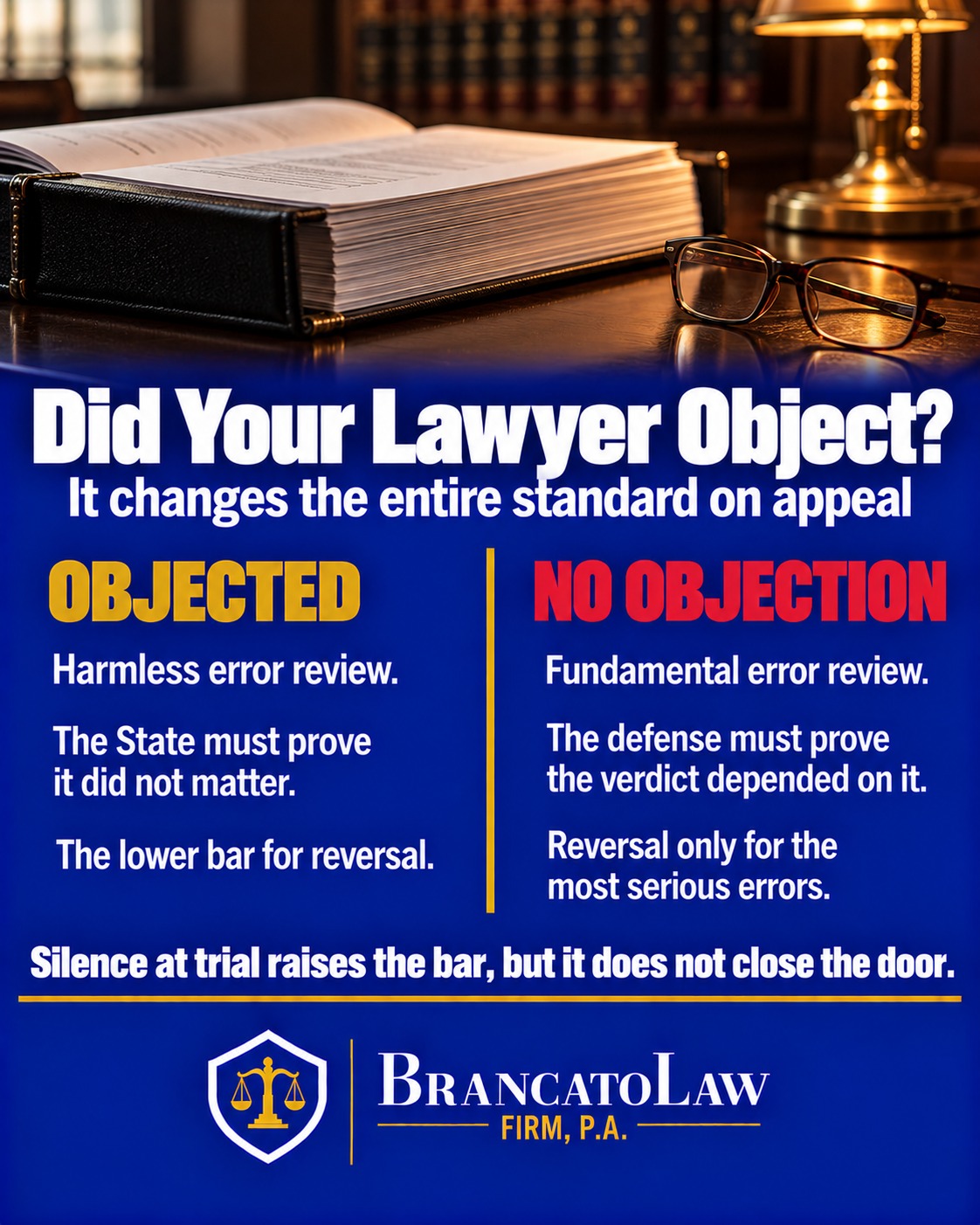
Because Florida’s contemporaneous objection rule ordinarily means that an error no one raised at trial cannot be raised on appeal. The theory is that the trial judge should have the chance to fix the problem — strike the comment, instruct the jury, or grant a mistrial — while it is happening. An appellate court will not reverse a conviction for a mistake the defense never asked the judge to correct.
The one exception is fundamental error. Green states the standard in the terms Florida courts have used for decades: fundamental error is “the type of error which reaches down into the validity of the trial itself to the extent that a verdict of guilty could not have been obtained without the alleged error.” As the court put it, “the sole exception to the general rule is where the unobjected-to comments rise to the level of fundamental error.” That is a deliberately high bar. It is not enough that the prosecutor said something improper; the improper conduct has to be so pervasive or so damaging that the trial itself cannot be trusted.
| Objected to at trial | Not objected to | |
|---|---|---|
| Standard on appeal | Harmless error — the State must show the error did not contribute to the verdict | Fundamental error — the defense must show a guilty verdict could not have been obtained without it |
| Who bears the burden | The State | The defendant |
| Trial-level remedies available | Curative instruction, mistrial, ruling on the record | None — the judge was never asked |
| Typical outcome | Reversal if the error was prejudicial | Reversal only for pervasive or verdict-determinative error, as in Green |
What Happened in Green v. State?
A credibility contest was decided with evidence that had no bearing on credibility. In Green v. State, No. 2D2024-1803 (Fla. 2d DCA Sept. 4, 2026), Gregory Green was tried in Pinellas County on sexual battery and incest charges arising from an encounter with his biological niece in his van. (Read the opinion.) The State’s theory was force; the defense’s theory was that the sexual contact was consensual — a theory that conceded the incest count, to which the defense stipulated, and put the sexual battery counts squarely on the question of consent.
Into that trial the State introduced two things recovered from the van: a steak knife found in a recessed compartment, and two sealed, unused condoms. The niece never testified that Green used a weapon, threatened her with one, or that she ever saw one. She said nothing about condoms. Defense counsel did not object to either exhibit. In closing, the prosecutor made the items a theme — “Had two condoms in it. It’s a strange thing to find, I would submit to you folks. Two condoms in the back of his van, a knife in plain view[,] which is — it’s odd things” — and told the jury: “When he took [the victim] in that van, I submit to you he knew exactly what he was doing. It was thought out. He preyed on her.” The State argued the jury should consider the knife as evidence of guilt and relied on the knife and condoms to show Green’s “state of mind and intent.”
The Second District reversed the sexual battery and battery convictions and remanded for a new trial. It held that admitting the knife and the condoms was error because “the only possible relevance of the [items] would be to demonstrate [Green’s] bad character or propensity” — no link to the charged crimes was ever established, and intent is not an element of sexual battery. It further held that the prosecutor “made improper statements that amounted to personal opinions of guilt” and “improper statements implicating Green’s right to not testify and shifting the burden of proof.” And it concluded that “the improper statements taken together with the State’s use and emphasis on irrelevant evidence … lead to the conclusion that their cumulative effect constitutes fundamental error requiring reversal.” The incest conviction, which the defense had conceded, was affirmed. Judges Silberman, Morris, and Black sat on the panel.
Why Were the Knife and the Condoms Inadmissible?
Because Florida’s evidence code forbids exactly the inference the State wanted the jury to draw. Section 90.404(1), Florida Statutes, provides that “evidence of a person’s character or a trait of character is inadmissible to prove action in conformity with it on a particular occasion.” Subsection (2)(a) allows evidence of other acts when it is “relevant to prove a material fact in issue” such as motive, intent, plan, or identity, “but it is inadmissible when the evidence is relevant solely to prove bad character or propensity.” And even relevant evidence goes out under section 90.403 when “its probative value is substantially outweighed by the danger of unfair prejudice.”
Run the knife and the condoms through that framework and they fail at the first step. A knife in a compartment that the alleged victim never saw does not prove force; it proves that the defendant owned a knife. Sealed condoms do not prove a sexual battery; they prove, at most, that the defendant anticipated consensual sex — which was the defense. The State’s only real use for them was the one the prosecutor made explicit: they were “odd things,” they showed “he knew exactly what he was doing,” and therefore he was the kind of man who would do this. That is a propensity argument, and the code prohibits it. The court’s related point about intent is technical but important: sexual battery is defined by the act and the absence of consent, so “state of mind and intent” was not a material fact the knife could have been offered to prove.
The same body of law governs the State’s use of prior bad acts in sex-crime prosecutions more broadly — our article on the Williams rule in Florida sex crimes cases covers the procedural requirements the State must meet before that evidence comes in.
How Does Cumulative Error Work?
By adding up errors that might each be survivable alone. Green did not rest on the knife alone, or the condoms alone, or any single sentence of the closing. It rested on all of it together: irrelevant physical evidence admitted without objection, a closing argument that made that evidence its centerpiece, personal opinions of guilt, and comments touching the right to remain silent and the burden of proof — in a trial that came down to whether the jury believed the complainant or the defendant’s account of consent. In a case like that, the court reasoned, the cumulative effect of the errors was such that a guilty verdict could not be trusted to have been obtained without them.
For appellate counsel, cumulative error is the argument that turns a list of individually “harmless” mistakes into a reversal. For trial counsel, it is a reason to put every one of those mistakes on the record as it happens, because a preserved error is reviewed under a far more forgiving standard than an unpreserved one.
What Does This Mean If You or a Family Member Has Already Been Convicted?
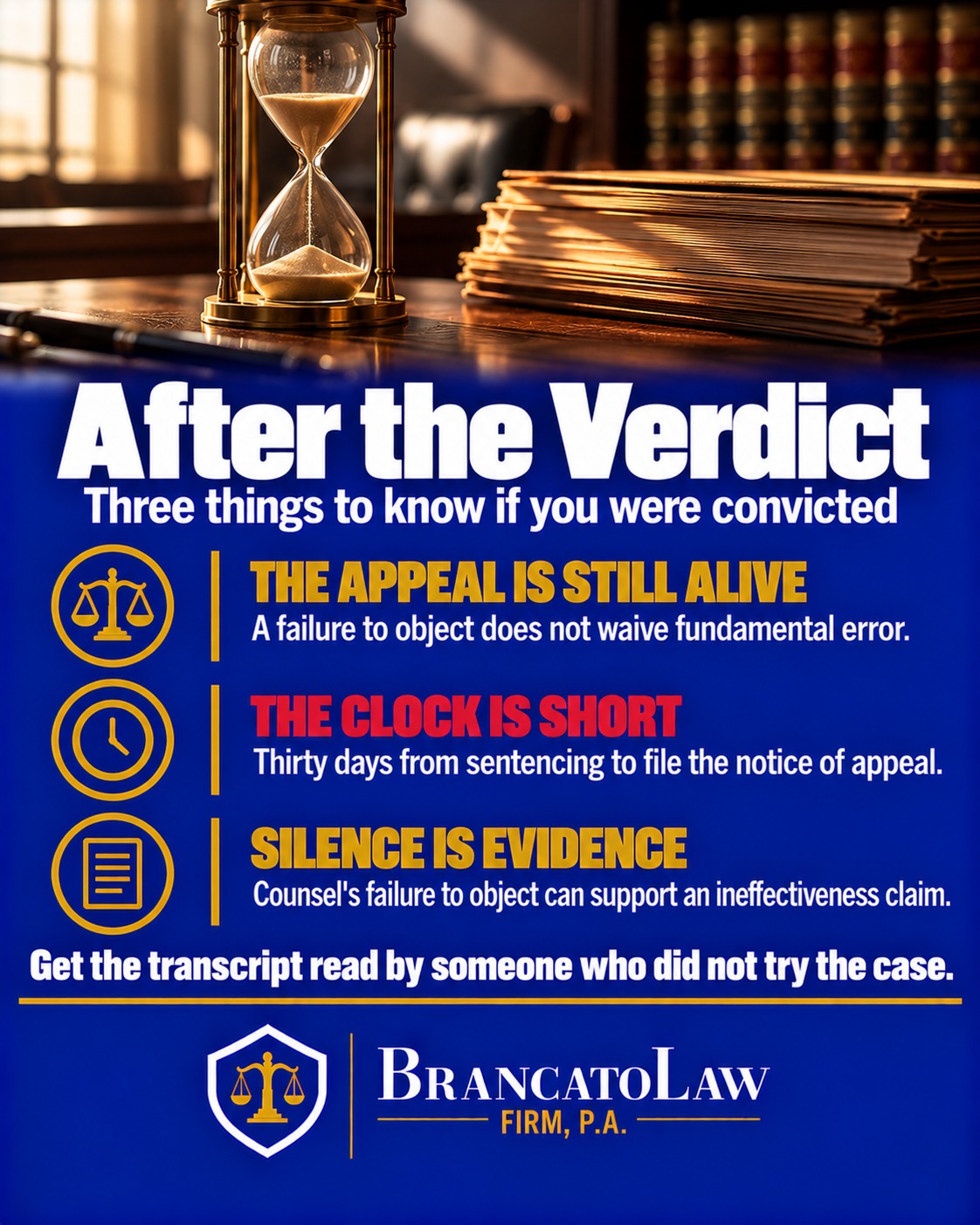
That the transcript is worth reading closely, and quickly. Three things follow from Green:
- A failure to object is not the end of the appeal. If the trial record shows improper evidence and a pattern of improper argument, fundamental error is a live claim on direct appeal even though trial counsel stayed silent.
- The clock is short. A notice of appeal in a Florida criminal case must be filed within thirty days of the sentence. If that window is missed, the fundamental-error argument may have to be repackaged as an ineffective-assistance claim in a postconviction motion, which is a different and harder path.
- The trial lawyer’s silence is itself evidence. Where the record shows errors that should have drawn objections, the failure to object can support a claim that counsel was ineffective — a separate route to a new trial if the direct-appeal route is unavailable.
Our attorneys review trial transcripts for exactly these patterns, and Green gives that review a fresh Second District precedent to anchor it. For a related look at how appellate courts treat trial-level errors, see our discussion of jury instruction error on appeal.
How Do Our Attorneys Guard Against This at Trial?
By treating every physical exhibit and every sentence of closing as something that has to be earned. Concretely:
- Motions in limine on physical evidence. Before the jury is seated, we force the State to articulate the link between each exhibit and an element of the charged crime. A knife no witness will mention and condoms no witness will discuss do not survive that hearing.
- Objection, every time. A single objection to a pattern of improper argument is not enough; each improper comment is objected to, the objection is ruled on, and where warranted a mistrial is requested. That preserves the issue under the ordinary harmless-error standard rather than leaving the client to hope for a fundamental-error finding later.
- Curative instructions on the record. When the judge sustains an objection, we ask for the instruction — and note for the record when it cannot cure the harm.
- Protecting the silence. Any argument that edges toward what the defendant “did not explain” or what the defense “did not show” draws an immediate objection on both constitutional and burden grounds.
For more about our defense strategies, visit our Hillsborough County criminal defense page.
What Should You Do If You Suspect Misconduct in Your Trial?
Get the transcript ordered and reviewed by counsel who did not try the case, before the appeal deadline runs. Write down every moment of the trial that felt wrong — an exhibit that seemed to come from nowhere, a comment about you not taking the stand, a closing that talked about what kind of person you are rather than what happened. Those impressions often point straight to the pages an appellate lawyer needs to read first.
Frequently Asked Questions About Prosecutorial Misconduct in Florida
Is prosecutorial misconduct the same as fundamental error?
No. Misconduct is the improper conduct; fundamental error is the standard an appellate court applies when deciding whether unobjected-to misconduct requires reversal. Most misconduct that is objected to at trial is reviewed for harmless error, a lower bar. Unobjected-to misconduct must reach the fundamental-error level — an error without which “a verdict of guilty could not have been obtained.”
What is “vouching,” and why is it improper?
Vouching is a prosecutor personally endorsing a witness’s truthfulness or the defendant’s guilt — “I believe her,” “I submit to you he knew exactly what he was doing.” It is improper because it asks the jury to rely on the prosecutor’s judgment instead of the evidence, and because the prosecutor’s office carries an authority a witness does not.
Can the prosecutor comment on the defendant not testifying?
No. Any comment that is fairly susceptible of being interpreted as a reference to the defendant’s silence is improper, and arguments about what the defense failed to explain or disprove risk crossing the same line by shifting the burden of proof. Green identified both kinds of comment among the errors that required reversal.
Does a reversal mean the charges are dismissed?
Usually not. Green was remanded for a new trial on the sexual battery and battery counts, which the State may retry without the improper evidence and argument. A reversal for insufficient evidence would bar retrial, but a reversal for trial error does not.
Why was the incest conviction affirmed?
Because the defense conceded it. The theory of the case was consent, and a consensual sexual relationship with a biological niece is still incest under Florida law. The court reversed only the counts on which the improper evidence and argument could have affected the verdict.
My lawyer didn’t object to anything. Do I still have an appeal?
Potentially yes, on a fundamental-error theory — and Green is a September 2026 example of exactly that. Whether the errors in your trial reach that level depends on the record, which is why the transcript has to be reviewed by appellate counsel promptly.
If you or a family member was convicted after a trial in Hillsborough, Pinellas, or Pasco County and something about the evidence or the prosecutor’s closing argument did not sit right, the attorneys of The Brancato Law Firm, P.A. — founded by Tampa Criminal Defense Attorney Rocky Brancato — can review the transcript and tell you whether Green applies. Call (813) 727-7159 before the thirty-day appeal window closes.
The Brancato Law Firm, P.A.
620 E. Twiggs Street, Suite 205, Tampa, FL 33602
(813) 727-7159
Serving Hillsborough, Pinellas, and Pasco Counties
The Brancato Law Firm, P.A. is a Tampa-based criminal defense practice. We are not affiliated with any other Brancato-named law firms.
Visit Us

Tampa, FL 33602

Contact Us Now
Free Legal Consultation (813) 727-7159
