

From First DUI to Death Penalty



Is an Under 21 DUI in Florida a Crime? The 0.02 Zero Tolerance Law (2026)


A driver under 21 in Florida faces a 6-month license suspension for driving with a breath- or blood-alcohol level of 0.02 or higher, under section 322.2616, Florida Statutes. That zero tolerance violation is not a crime, but it does not protect the driver from a DUI charge: at 0.08 or higher, or when alcohol impairs the driver’s normal faculties, the State can file a full DUI case under section 316.193. Refusing the breath test brings a 1-year suspension, and the driver has only 10 days to challenge either suspension.
If your son or daughter called from the side of the road after blowing a 0.03, the paperwork in their hand is probably a notice of suspension, not a criminal charge, and the next 10 days decide whether that suspension holds. As founder of The Brancato Law Firm, P.A., a Tampa criminal defense firm, I have spent more than 25 years in Hillsborough County courtrooms, and as a former police academy instructor and a member of the National College for DUI Defense, I have seen these stops from the officer’s side and the defense side. When a client under 21 comes to us, our attorneys first sort out which case they actually have: a zero tolerance suspension, a DUI, or both.
What is Florida’s zero tolerance law for drivers under 21?
Florida’s zero tolerance law makes it unlawful for a person under 21 to drive or be in actual physical control of a vehicle with a blood- or breath-alcohol level of 0.02 or higher. The rule is in section 322.2616, Florida Statutes, and it applies “notwithstanding” the regular DUI statute. For most people, 0.02 means a single drink, so the law reaches drivers who would never be charged with DUI as adults.
Every state has a version of this rule because federal law pays for it. Under 23 U.S.C. § 161, a state must enact and enforce a law treating an under-21 driver at 0.02 or above as driving under the influence, or the federal government withholds 8 percent of certain highway funds. Florida meets that requirement through an administrative license suspension rather than a criminal charge.
The statute has three levels, and the level decides what follows:
| Breath or blood alcohol level | What happens | Law |
|---|---|---|
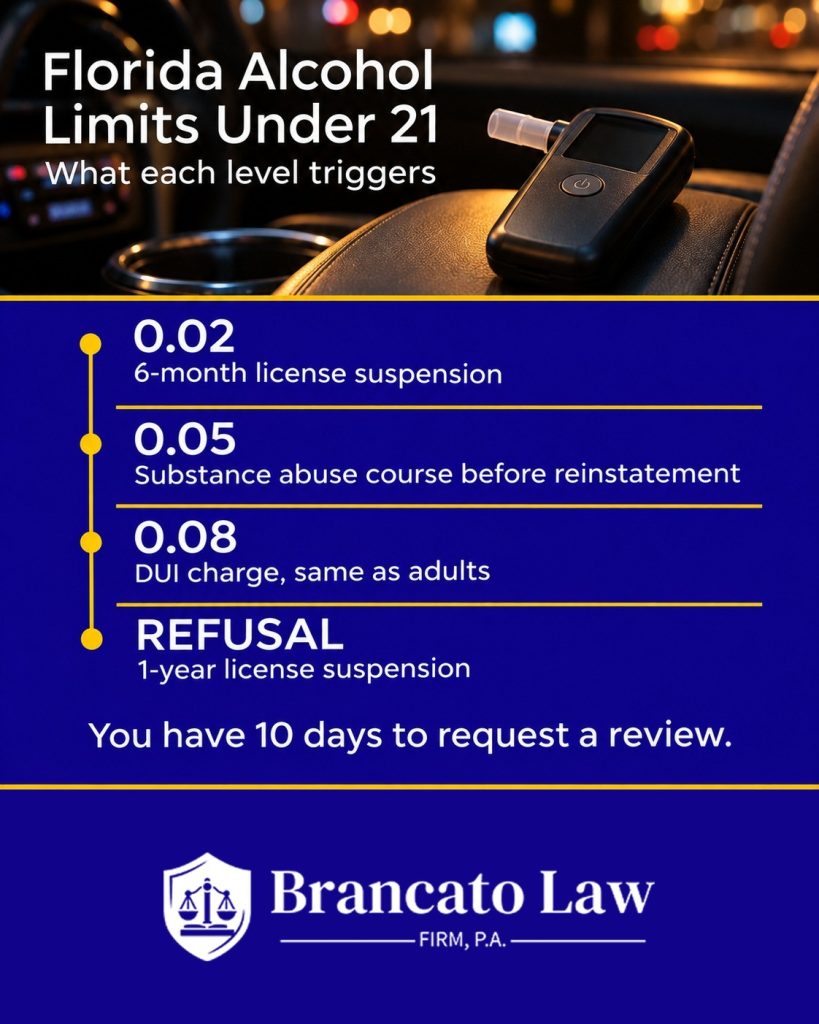
| 0.02 to 0.049 | Administrative suspension: 6 months for a first violation, 1 year if a prior zero tolerance suspension exists | s. 322.2616(2) |
| 0.05 or higher | Same suspension, and the license stays suspended until the driver completes a DUI program substance abuse course and evaluation | s. 322.2616(2)(c) |
| 0.08 or higher, or normal faculties impaired | DUI arrest and criminal charge, same as an adult, with a separate DUI suspension | s. 316.193 and s. 322.2615 |
| Refused breath test | Suspension of 1 year for a first refusal, 18 months after a prior refusal suspension | s. 322.2616(2) |
Is a 0.02 violation a crime in Florida?
No. Section 322.2616(19) says a zero tolerance violation “is neither a traffic infraction nor a criminal offense,” and being detained under the statute is not an arrest. There is no court date, no fine, and no criminal record from the 0.02 violation itself. The Department of Highway Safety and Motor Vehicles handles it entirely through its administrative process, and our attorneys at The Brancato Law Firm treat that administrative hearing as the main event in these cases.
The statute also keeps the two systems apart. The department’s decision on a zero tolerance suspension cannot be used in a DUI trial, and a written statement the driver submits when asking for review is not admissible against the driver in that trial. If the department suspends the license under the adult DUI statute, section 322.2615, it cannot also suspend it under the zero tolerance statute for the same episode. The flip side matters too: the outcome of a related criminal case does not undo a zero tolerance suspension.
When does an under-21 driver get charged with DUI instead?
A driver under 21 is charged with DUI on the same terms as anyone else: a breath or blood alcohol level of 0.08 or higher, or alcohol or drugs impairing the driver’s normal faculties, under section 316.193. Nothing in the DUI statute gives younger drivers a separate standard. The zero tolerance law adds a lower line for under-21 drivers; it does not replace the adult one. Our Tampa DUI lawyer page explains how our attorneys defend the criminal case when the stop goes that far.
A DUI conviction carries a fine of $500 to $1,000 and up to 6 months in jail for a first offense, up to 1 year of probation, at least 50 hours of community service, a 10-day vehicle impoundment, and DUI school. The court also revokes the license for at least 180 days and up to 1 year under section 322.28. At 0.15 or higher, the fine range rises to $1,000 to $2,000 and the maximum jail term to 9 months. Our post on DUI penalties in Hillsborough County walks through each one.
| Zero tolerance (s. 322.2616) | DUI (s. 316.193) | |
|---|---|---|
| Trigger | 0.02 or higher | 0.08 or higher, or normal faculties impaired |
| Criminal charge | No | Yes, a misdemeanor for a first offense |
| Arrest | No; the statute calls it a detention | Yes |
| First suspension | 6 months (1 year for refusal) | 6 months administrative (1 year for refusal), then 180 days to 1 year revocation on conviction |
| Who decides | FLHSMV hearing officer | County court judge or jury |
| Record | Driving record only | Criminal record and driving record |
What happens if a driver under 21 refuses the breath test?
Refusing a breath test requested under the zero tolerance law brings a 1-year suspension for a first refusal and 18 months if the driver’s license was previously suspended for a refusal. By applying for and using a license, a driver under 21 is deemed to have consented to the zero tolerance test, and the officer needs probable cause to believe the driver is under 21 and has been drinking before asking for it. Our attorneys at The Brancato Law Firm check whether the officer’s report actually supports both parts of that probable cause.
The criminal refusal law works differently. Section 316.1939, amended by the Legislature in 2025, makes a first refusal a second-degree misdemeanor, but only for a person placed under lawful arrest for DUI and warned about the consequences. A zero tolerance detention is not an arrest under the statute. If the officer arrests the young driver for DUI and then asks for the test, a refusal brings the adult 1-year suspension and can bring the misdemeanor charge as well. Our post on refusing a breath test after a Tampa DUI arrest covers that path in detail.
How long is the license suspended, and is a hardship license available?
A first zero tolerance violation suspends the license for 6 months, and a second suspends it for 1 year. A refusal brings 1 year, or 18 months after a prior refusal. At 0.05 or higher, the suspension does not end on the calendar date alone: the department will not reinstate the license until the driver completes a substance abuse course from a licensed DUI program, which includes an evaluation, and the program must send the evaluation results to the parents or guardians of a driver under 19.
Limited driving is possible. A driver who requests a formal or informal review gets a temporary permit for business purposes only, if otherwise eligible, that lasts until the review or hearing date. After that, the driver can apply for a business or employment purposes license under section 322.271, but the statute bars issuing it until 30 days have passed after the last temporary permit expired. Our guide to how long a Florida hardship license takes explains the application steps at the Tampa office.
What is the 10-day deadline after an under-21 stop?
The driver has 10 days from the date the notice of suspension is issued to request a formal or informal review with the Department of Highway Safety and Motor Vehicles. The department must hold an informal review within 30 days of the request and must schedule a formal hearing within 30 days. Missing the 10 days means the suspension simply runs.
Those hearings are a high-volume system. From July 1, 2023 through June 30, 2024, the department’s Bureau of Administrative Reviews conducted 26,052 hearings and reviews from eight offices statewide, according to a December 2024 FLHSMV Inspector General audit. In Tampa, these reviews go through the bureau’s office on East Hillsborough Avenue, and in Hillsborough County a Sheriff’s Office or Tampa Police breath test is usually given at Central Breath Testing, the Sheriff’s Office breath-testing site, so the breath records our attorneys request come from that location.
The review is narrow. In Department of Highway Safety & Motor Vehicles v. Colling, 178 So. 3d 2 (Fla. 5th DCA 2014), a University of Central Florida police officer found a student under 21 in the driver’s seat of her car in a campus parking garage and gave her two breath tests. The officer’s paperwork listed the first result as .0154 on one form and .154 on others, and the second result was .028. The Fifth District held that the hearing officer reviews only probable cause on three things, age, control of the vehicle, and alcohol level, and does not decide whether the detention was legal. But it upheld the circuit court’s order setting aside the suspension, because picking one conflicting document over another was “nothing more than a ‘flip of a coin,'” and the department had not proved a level of .02 or higher. In a zero tolerance hearing the department’s own paperwork is usually the only evidence, so an error in it can end the case.
How common is drinking and driving among young drivers?
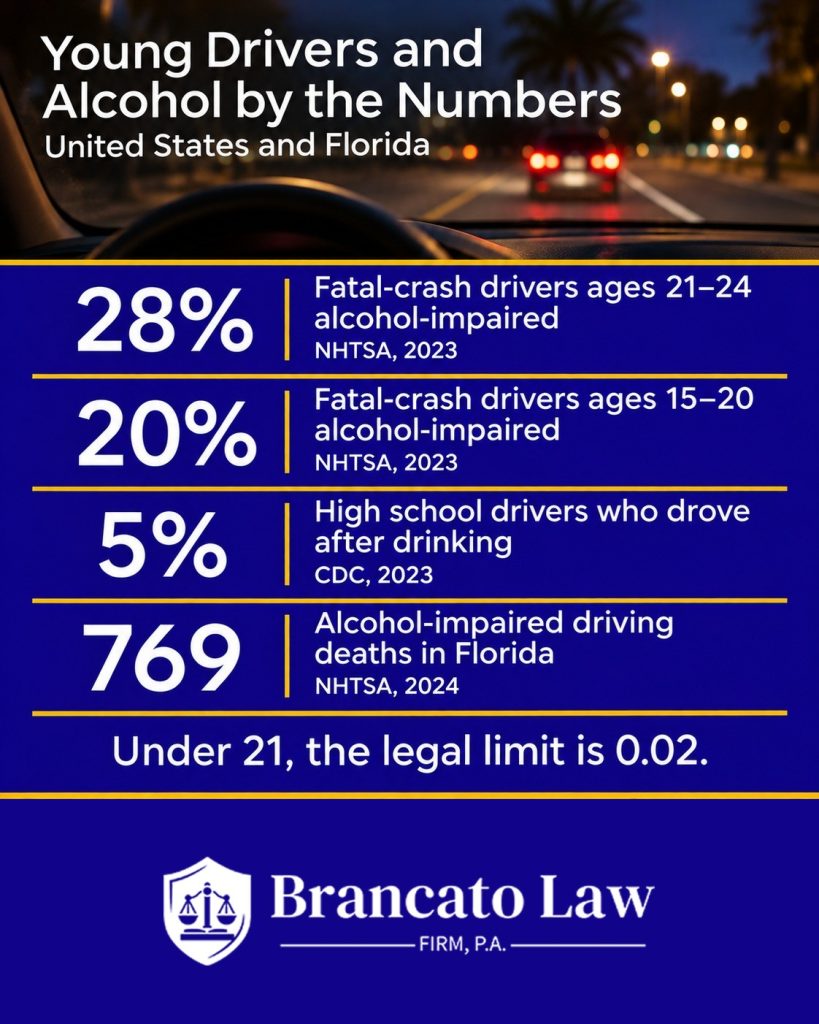
Young drivers are overrepresented in alcohol-impaired crashes. In 2023, drivers ages 21 to 24 had the highest share of alcohol-impaired drivers in fatal crashes of any age group, 28%, and 20% of drivers ages 15 to 20 in fatal crashes were alcohol-impaired, according to the National Highway Traffic Safety Administration’s Alcohol-Impaired Driving: 2023 Data. Among U.S. high school students who drove in 2023, about 5% reported driving after drinking, according to the Centers for Disease Control and Prevention. In Florida, NHTSA’s State Alcohol-Impaired-Driving Estimates: 2024 Data counted 769 alcohol-impaired-driving deaths in 2024, 24% of all traffic deaths in the state.
NHTSA’s Countermeasures That Work guide reports strong evidence that zero tolerance laws reduce alcohol-related crashes and injuries and cites an estimate that they save 159 lives each year. The same guide notes that enforcement and publicity for these laws appear to be rare, which is one reason many families first learn about the 0.02 line after a stop. The Brancato Law Firm uses that gap to explain the law to clients and parents before any decisions are made.
How does an under-21 stop affect college students?
A college student can face three separate cases from one stop: the zero tolerance suspension, a possible criminal charge, and a school conduct case. Possession of alcohol by a person under 21 is a second-degree misdemeanor under section 562.111, so a stop with an open bottle in the car can add a criminal charge even when the breath result is below 0.08. Campus police can make these stops too; the Colling case began in a University of Central Florida parking garage.
Schools run their own process, with their own deadlines, and a statement given in a student conduct meeting can follow the student into the other cases. Our guides to the USF student conduct hearing, the University of Tampa conduct process, and the Hillsborough College conduct process explain how each school handles a case. When the stop leads to an arrest, the criminal side follows the stages in our Florida criminal case process guide, and our Hillsborough County criminal defense page covers how those cases move through the 13th Judicial Circuit.
How do our attorneys defend an under-21 alcohol case?
Our attorneys work the license case and any criminal case together, because the same officer, the same report, and the same breath records drive both. In a typical zero tolerance case, we:
- Request the formal review within the 10 days, which keeps a business purposes permit available and preserves the right to question the officer.
- Subpoena the officer and the breath records, and compare every form for conflicting numbers, times, and signatures, the same kind of error that decided Colling.
- Test the probable cause for age, control of the vehicle, and alcohol, the three issues the hearing officer must find.
- Check the breath instrument and procedure; our posts on the Intoxilyzer 8000 and 9000 and on requesting a blood test instead of a breath test explain what those records show.
- Coordinate with any school conduct case so that nothing the student says there undermines the license or criminal case.
What should a young driver do in the first 10 days?
The first 10 days decide the license case. Keep the notice of suspension and any citations, write down the timeline of the stop while it is fresh, do not discuss the night with police or school officials before getting advice, and talk to a lawyer before the deadline. If the stop turned into a DUI arrest, the criminal case moves on its own schedule, starting with first appearance or an arraignment date on the citation.
Frequently asked questions
Can a 20-year-old get a DUI in Florida at 0.05?
Not on the alcohol level alone; 0.05 is below the 0.08 DUI line, so it brings a zero tolerance suspension and a required substance abuse course before reinstatement. The Brancato Law Firm reviews the officer’s report for signs of impairment, because a DUI charge can still rest on impaired normal faculties at any level.
Does a zero tolerance suspension show up on a criminal background check?
No; a 0.02 violation is not a criminal offense under section 322.2616(19), so it appears on the driving record, not a criminal record. Our attorneys at The Brancato Law Firm still treat it seriously, because the suspension stays on the driving record and counts if a second violation follows.
Can an under-21 driver be charged with both zero tolerance and DUI?
The department cannot suspend the license under both statutes for the same episode, but the zero tolerance law does not bar a DUI prosecution. The Brancato Law Firm looks at which suspension the officer actually issued, since it controls the hearing issues and the DUI defense strategy that follows.
Do parents find out about an under-21 alcohol suspension in Florida?
For a driver under 19 with a level of 0.05 or higher, the DUI program must notify the parents or legal guardians of the evaluation results. Our firm talks with families about that notice early, so the course and evaluation do not delay reinstatement.
Can a college student keep driving after a 0.02 suspension?
Often, yes, on a restricted basis: a temporary business purposes permit during the review period and then a business or employment license after the 30-day wait. The Brancato Law Firm helps students line up the paperwork; see our guide to what a Florida hardship license allows.
Can a zero tolerance suspension be thrown out?
Yes, if the department cannot prove probable cause on age, control, and alcohol level, or if its documents conflict, as in Colling. Our attorneys at The Brancato Law Firm request the formal hearing so the officer’s paperwork can be tested under oath.
Talk to our attorneys about an under-21 alcohol stop
The 10-day clock started when the officer handed over the notice of suspension, and our attorneys can request the review and the breath records as soon as you call. The Brancato Law Firm, P.A., founded by Tampa Criminal Defense Attorney Rocky Brancato, defends young drivers and college students in Hillsborough, Pinellas, and Pasco Counties from an office two blocks from the courthouse. Call us at any hour at (813) 727-7159. Our firm has Spanish-speaking staff, and attorney Jean-Luc Adrien speaks Spanish, Haitian Creole, and French. For more about our defense strategies, visit our Tampa DUI defense page.
The Brancato Law Firm, P.A.
620 E. Twiggs Street, Suite 205, Tampa, FL 33602
(813) 727-7159
Serving Hillsborough, Pinellas, and Pasco Counties
The Brancato Law Firm, P.A. is a Tampa-based criminal defense practice. We are not affiliated with any other Brancato-named law firms.
Visit Us

Tampa, FL 33602

Contact Us Now
Free Legal Consultation (813) 727-7159
