

From First DUI to Death Penalty



Can You Request a Blood Test Instead of a Breath Test in Florida? (2026)


Short answer: No. In Florida the arresting officer chooses the test, and a driver who refuses the breath test while demanding a blood test is treated as refusing, under Department of Highway Safety & Motor Vehicles v. Green, 702 So. 2d 584 (Fla. 2d DCA 1997). What Florida law does give you is the right to an independent test, including a blood draw, after you take the officer’s test. You pay for it, and under Unruh v. State, 669 So. 2d 242 (Fla. 1996), police must give reasonable help when you ask. If they block it, a court can throw out the breath result.
Most people who ask about a blood test are sitting across from a breath machine, worried that the machine is wrong. Rocky Brancato, founder of The Brancato Law Firm, P.A., taught criminal procedure to recruits as a police academy instructor, is a member of the National College for DUI Defense, and has spent more than 25 years in Hillsborough County courtrooms. Our Tampa criminal defense attorneys review every DUI arrest for how the test was chosen, what the driver asked for, and how officers responded, because those few minutes can decide whether the breath result ever reaches a jury.
Who decides which test you take after a Florida DUI arrest?
The officer decides. Under Florida’s implied consent law, section 316.1932, Florida Statutes, a driver lawfully arrested for DUI is deemed to have agreed to a breath test for alcohol, or a urine test when the officer suspects drugs, given “at the request of a law enforcement officer.” The statute does not give the driver a menu.
A blood test is the exception. Section 316.1932(1)(c) allows one under implied consent only when the driver appears for treatment at a hospital, clinic, or other medical facility (including an ambulance) and a breath or urine test is impractical or impossible. A separate statute, section 316.1933, requires a blood draw, with reasonable force if necessary, when an officer has probable cause that an impaired driver caused a death or serious bodily injury.
| Test | When police can require it | Statute |
|---|---|---|
| Breath (Intoxilyzer 8000) | After a lawful DUI arrest, when the officer suspects alcohol | § 316.1932(1)(a)1.a. |
| Urine | After a lawful DUI arrest, when the officer suspects drugs or chemical substances | § 316.1932(1)(a)1.b. |
| Blood (implied consent) | The driver is at a hospital, clinic, or ambulance for treatment and breath or urine testing is impractical or impossible | § 316.1932(1)(c) |
| Blood (forced draw) | Probable cause that an impaired driver caused death or serious bodily injury | § 316.1933(1)(a) |
| Independent test (your choice, including blood) | After you submit to the officer’s test, at your own expense | § 316.1932(1)(f)3. |
What happens if you refuse the breath test and ask for blood instead?
Florida treats it as a refusal. In Department of Highway Safety & Motor Vehicles v. Green, 702 So. 2d 584 (Fla. 2d DCA 1997), a driver declined a deputy’s breath test and offered to take a blood test instead. The deputy suspended his license for refusal. The Second District Court of Appeal upheld the suspension: “It is the officer who ‘requests’ the test, not the driver who selects it.” The court added that the independent-test right belongs to a driver who first complies with the officer’s request.
The cost of that refusal went up in 2025. Under Trenton’s Law (CS/HB 687, effective October 1, 2025), a first refusal of a lawful breath or urine test is now a second-degree misdemeanor under section 316.1939, and a second refusal is a first-degree misdemeanor. The refusal also brings a one-year license suspension for a first refusal, or 18 months with a prior refusal suspension. Our posts on whether refusing a breathalyzer is a crime in Florida and what happens after a Tampa breath test refusal cover that charge in depth.
A request for blood does not always end the analysis, though. Officers sometimes cut a driver off mid-question, give a garbled warning, or record a “refusal” when the driver was asking a question and never said no. Our attorneys compare the officer’s report with the video from the scene and the breath testing room, because the exact words matter in both the criminal case and the license hearing.
When can police require a blood draw in Florida?
Police can require blood in three situations: a hospital or ambulance case under section 316.1932(1)(c), a death or serious bodily injury case under section 316.1933, or with a search warrant or your voluntary consent. Outside those, officers default to breath because the law makes it easier for them.
The U.S. Supreme Court explained the difference in Birchfield v. North Dakota, 579 U.S. 438 (2016), which reviewed three drunk driving arrests from North Dakota and Minnesota. The Court held that police may require a breath test without a warrant as part of a lawful DUI arrest, but not a blood test, because “breath tests are significantly less intrusive than blood tests.” That is why Florida can make breath test refusal a crime while blood draws usually need a warrant. Our guide to when police can take your blood without a warrant covers the warrant rules and the 2026 Marlin decision.
What is the right to an independent blood test in Florida?
Section 316.1932(1)(f)3. lets a person who has taken the officer’s test get a second test of their own choosing. The independent test can be blood, urine, or breath, drawn or given by a physician, registered nurse, hospital-authorized blood drawer, licensed clinical laboratory technologist or technician, or another person you choose. Four rules control it:
- It comes after the officer’s test. The statute calls it a test “in addition to” the one the officer directs, and Green holds it does not replace that test.
- You pay for it, and the burden to arrange it is on you.
- The officer “shall not interfere” with your opportunity to get it and must give you “timely telephone access” to set it up.
- If you never get one, the officer’s test is still admissible. That changes when the State is the reason you did not get one.
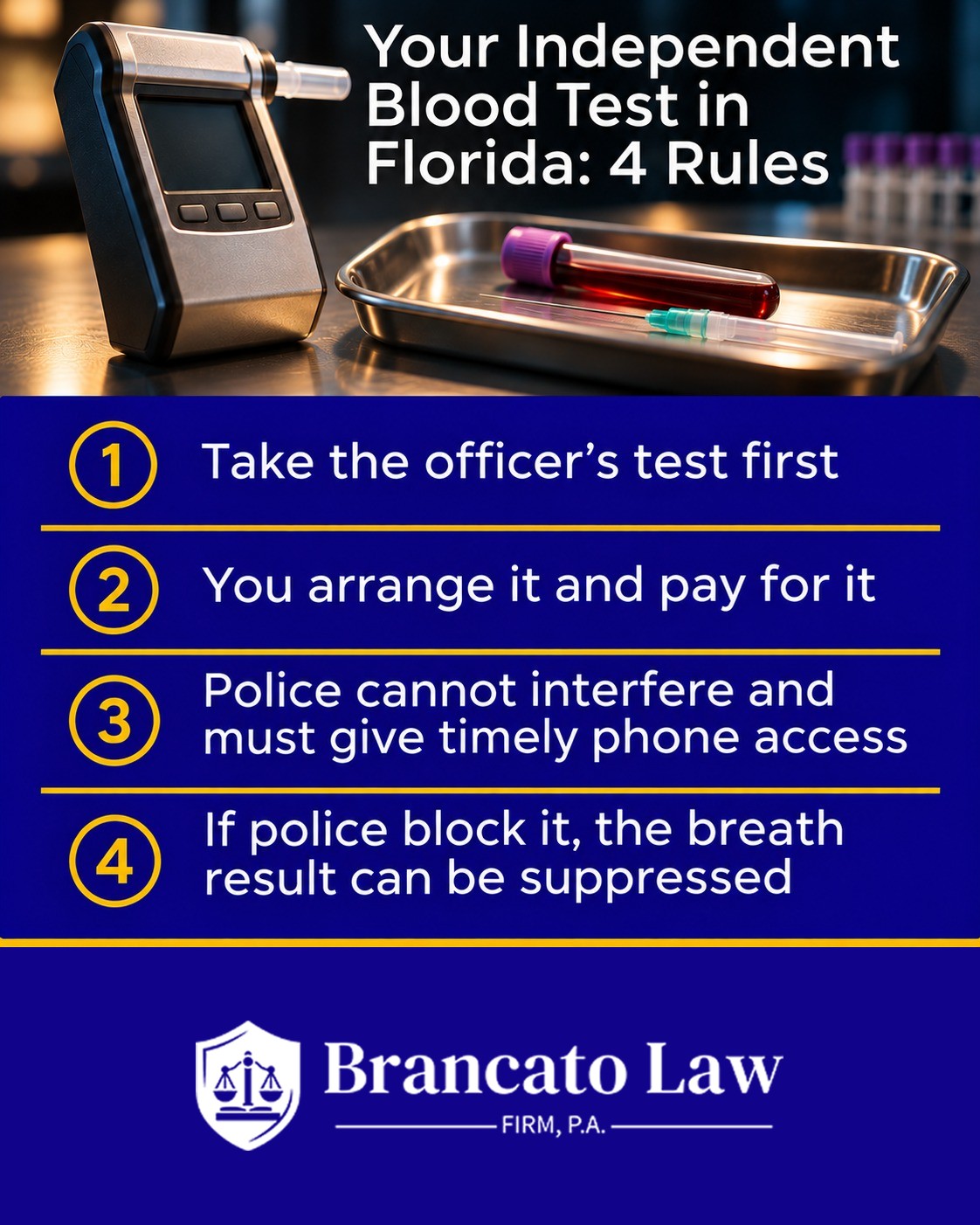
Police do not have to tell you about this right. The Florida Supreme Court noted in Unruh that no Florida statute requires officers to advise an arrestee of it, which is why most drivers never use it.
What did the Florida Supreme Court decide in Unruh v. State?
The Court held that when a DUI arrestee asks for an independent blood test, law enforcement “must render reasonable assistance” in getting it. In Unruh v. State, 669 So. 2d 242 (Fla. 1996), Ronald Unruh was arrested for DUI and taken to the Ormond Beach Police Department. He said he preferred a blood test. The officer told him the department did not offer one, that his choice was to take the breathalyzer or refuse, and that he could arrange a blood test after booking at the Volusia County jail. He took the breath test and later moved to suppress it.
The Court explained that reasonable assistance depends on the facts. Sometimes a telephone and a directory are enough; sometimes officers must take the arrestee to a testing facility. Where an arrestee’s right “effectively has been denied” by police failure to help, suppression of the State’s breath result is a proper sanction. The Court sent Unruh’s case back to the trial court to apply that standard.
The Court cited with approval an earlier case where suppression stuck. In State v. Durkee, 584 So. 2d 1080 (Fla. 5th DCA 1991), Richard Durkee repeatedly asked for a blood test after hearing the implied consent warning, told officers he would take the breath test if he could also get blood drawn, and asked to be taken to a hospital. The arresting officer and the Intoxilyzer operator refused each time. The Fifth District reinstated the county court’s order suppressing his breath result, holding that the statute’s “failure or inability” language does not cover a test the State itself prevented.
The same lesson runs through both cases: ask clearly, and ask more than once. In Smallridge v. State, 904 So. 2d 601 (Fla. 1st DCA 2005), a DUI manslaughter case, the First District refused to suppress because the driver never asked for an independent test and had other chances to get one.
Is an independent blood test worth getting?
It can be, mainly as a check on the breath machine. Breath machines estimate alcohol by assuming a fixed blood-to-breath ratio of 2,100 to 1, and real people vary. In a 1996 Journal of Forensic Sciences study by A.W. Jones and L. Andersson of 799 drunk driving suspects in Sweden, the average ratio was 2,407 to 1, which means breath usually reads lower than blood. But after correcting for alcohol burned off between samples, 4.3 percent of drivers had a ratio below 2,100, so their breath readings overstated their blood alcohol. A blood sample is the only way to show you are one of those people.
Florida law limits how far that argument goes. Section 316.193(1)(c) makes a breath-alcohol level of 0.08 grams per 210 liters of breath its own way to commit DUI, separate from the 0.08 blood standard in section 316.193(1)(b). So a lower blood number does not automatically defeat a breath reading. Where the independent test earns its cost is in exposing a malfunctioning or badly maintained Intoxilyzer, supporting a defense that the driver was not impaired, and, in drug DUI cases, showing that no drug was present.
Timing is the catch. Your body eliminates alcohol every hour, so a blood sample drawn after booking will usually read lower than your level at the time of driving, and the State will say so. A forensic toxicologist has to interpret the result, often with the retrograde extrapolation math both sides use.
| Officer’s breath test | Independent blood test | |
|---|---|---|
| Who chooses it | The officer | You |
| Who pays | The State | You |
| What it measures | Breath alcohol only | Blood alcohol, and drugs if the lab tests for them |
| Can you refuse it? | Yes, but refusal is now a crime and suspends your license | It is optional |
| If police block it | Not applicable | The breath result can be suppressed (Unruh, Durkee) |
| Main weakness | Assumes a 2,100 to 1 blood-to-breath ratio; machine maintenance issues | Drawn later, so alcohol has dropped; needs expert interpretation |
How often does this come up in Tampa Bay DUI cases?
Often, because almost every DUI arrest ends at a breath machine. In 2025, law enforcement wrote 4,382 DUI citations in Hillsborough County, 3,104 in Pinellas County, and 924 in Pasco County, according to the Florida Department of Highway Safety and Motor Vehicles’ Annual Uniform Traffic Citation Report. Statewide, Florida officers wrote 44,503 DUI citations that year.
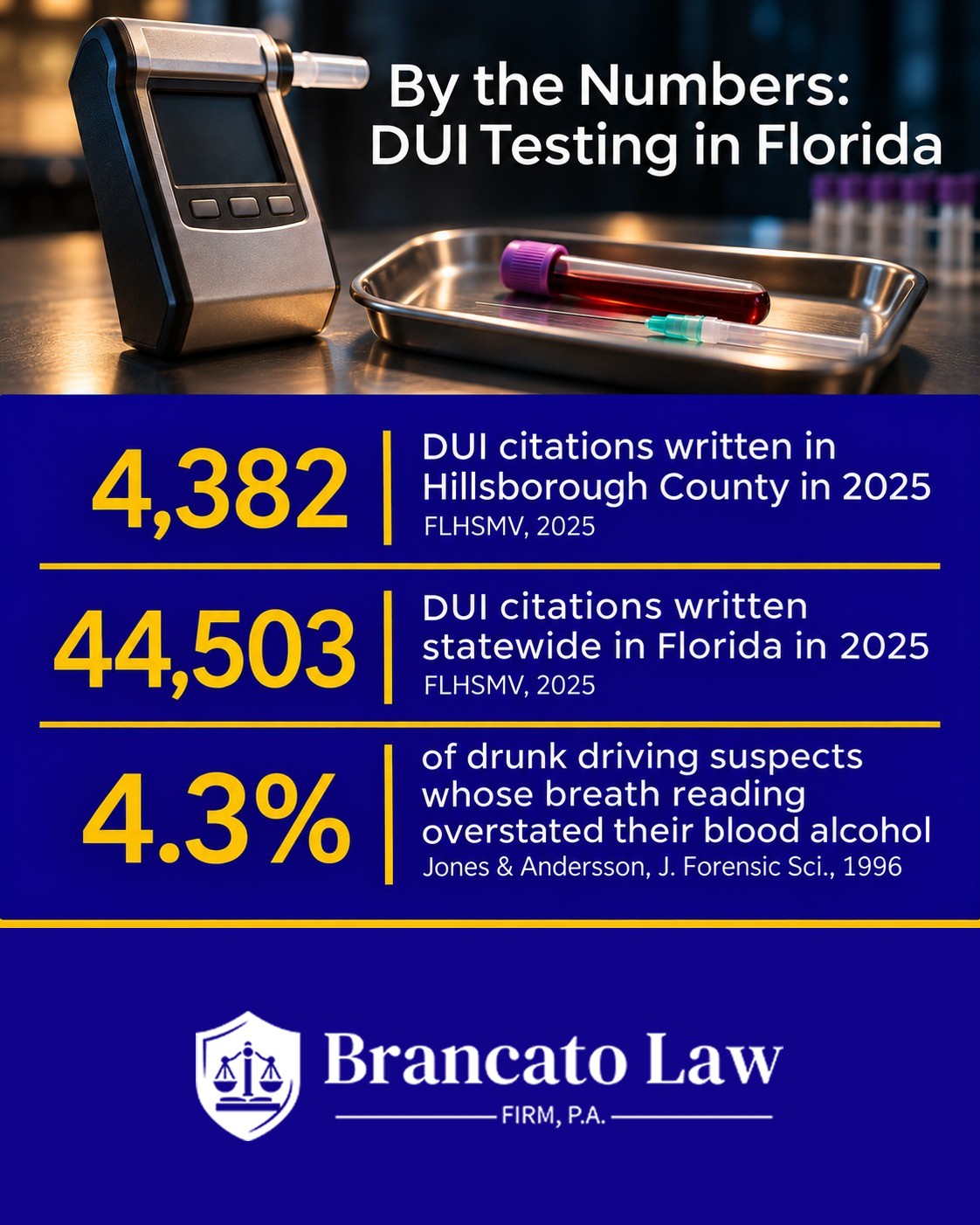
In Hillsborough County, the Sheriff’s Office wrote 2,117 of those 2025 citations and city police departments wrote 1,830, per the same FLHSMV report. In our experience, people arrested for DUI by the Hillsborough County Sheriff’s Office or Tampa Police are taken to Central Breath Testing, the Sheriff’s Office breath testing site, and that is where the breath test is requested. That room is also where a request for an independent blood test is made or lost, so its video is one of the first things our attorneys request in a Hillsborough County DUI case when a client says they asked for blood.
How do our attorneys use a blood test request in a DUI defense?
We start by pinning down exactly what was asked, when, and how officers answered. That record drives three different defenses, depending on whether the client took the breath test.
- Client took the breath test and asked for blood: we move to suppress the breath result under Unruh and Durkee if officers refused, ignored the request, or denied timely phone access.
- Client asked for blood before the breath test: we check whether the client actually refused or only asked a question, and whether the implied consent warning was read correctly before any “refusal” was recorded.
- Client got an independent test: we have a toxicologist compare the two results and the timeline, and we pull the Intoxilyzer’s inspection history (section 316.1932(1)(f)4. requires the State to disclose, on request, the date of the machine’s most recent required inspection).
These issues live at two stages. A suppression motion is decided before trial, but the same facts about a blocked blood test can still be argued to a jury as a reason to doubt the breath number. For the full range of DUI defenses, see our Tampa DUI lawyer page.
What should you do in the first 10 days after a DUI arrest?
Act on the license and the evidence first. After a DUI arrest with a breath result of 0.08 or higher, or a refusal, you have 10 days to request a review hearing or, if eligible, waive it and apply for a hardship license, as explained in our guide to protecting your driver’s license after a Florida DUI arrest. At the same time, your lawyer should ask for the Central Breath Testing and patrol car video before it is overwritten.
Write down what you remember about the blood test request while it is fresh: the exact words, who you asked, what they said, and whether anyone gave you a phone. Our overview of the Florida criminal case process shows where the arrest, first appearance, and pretrial motions fall, and our post on what happens after a DUI arrest in Hillsborough County walks through the local steps.
Frequently asked questions
Can I refuse the breathalyzer and demand a blood test in Florida?
You can, but Florida will treat it as a refusal of the breath test, with a license suspension and, since October 1, 2025, a misdemeanor charge. The Brancato Law Firm reviews the video in these cases to see whether the driver refused or was still asking questions when the officer marked a refusal.
Do police have to tell me I can get an independent blood test?
No. The Florida Supreme Court noted in Unruh that no Florida statute requires officers to advise you of the right, though they must help once you ask. Our attorneys at The Brancato Law Firm look for any request in the video, because even one clear request triggers the officer’s duty to give reasonable help.
Who can draw blood for an independent DUI test in Florida?
A physician, registered nurse, hospital-authorized blood drawer, licensed clinical laboratory director, supervisor, technologist, or technician, or another person you choose, under section 316.1932(1)(f)3. When a client has a sample drawn, The Brancato Law Firm makes sure the chain of custody and lab method can stand up in court before we rely on the result.
Can a breath test be thrown out if police refused my blood test request?
Yes, if police failure to give reasonable help effectively denied you the independent test, under Unruh v. State, 669 So. 2d 242 (Fla. 1996). The Brancato Law Firm files these suppression motions with the arrest video, the booking timeline, and the officers’ own reports, and you can read more on our DUI defense attorney in Tampa page.
If the officer’s form says “breath, blood, or urine,” can I pick blood?
Not unless the conditions for a blood test exist. Our attorneys at The Brancato Law Firm read the exact warning the officer gave, because a warning that misstates the law can undo a refusal. In Nader v. Florida Department of Highway Safety & Motor Vehicles, 87 So. 3d 712 (Fla. 2012), the Florida Supreme Court upheld a refusal suspension where the form listed all three tests but the officer offered only breath, and the driver refused only that test.
Does a lower independent blood result beat a 0.08 breath result?
Not automatically, because Florida treats a 0.08 breath result as its own form of DUI under section 316.193(1)(c), and blood drawn later will read lower as alcohol leaves the body. The Brancato Law Firm works with forensic toxicologists to show what the gap between the two results means for the machine’s accuracy and for impairment.
Can DUI charges be dropped in Florida if the breath test is suppressed?
Sometimes, because without the breath number the State must prove impairment from the driving, field sobriety exercises, and video. The Brancato Law Firm negotiates from the suppression ruling, and some cases are reduced or dismissed at that point; our post on reducing a DUI to reckless driving in Florida explains one common outcome.
Talk to a Tampa DUI defense attorney
The license deadline runs 10 days from the arrest, and breath room video does not wait. Call The Brancato Law Firm, P.A., founded by Tampa Criminal Defense Attorney Rocky Brancato, at (813) 727-7159. We will review what you asked for, what officers told you, and whether the breath result can be challenged. Call us at any hour. Our office is two blocks from the courthouse. Our firm has Spanish-speaking staff, and attorney Jean-Luc Adrien speaks Spanish, Haitian Creole, and French. For more about our defense strategies, visit our DUI defense page.
The Brancato Law Firm, P.A.
620 E. Twiggs Street, Suite 205, Tampa, FL 33602
(813) 727-7159
Serving Hillsborough, Pinellas, and Pasco Counties
The Brancato Law Firm, P.A. is a Tampa-based criminal defense practice. We are not affiliated with any other Brancato-named law firms.
Visit Us

Tampa, FL 33602

Contact Us Now
Free Legal Consultation (813) 727-7159
