- Free Consultation 24/7: (813) 727-7159 Tap Here To Call Us


From First DUI to Death Penalty



What Is the Right to Confrontation in Florida? (2026)


The right to confrontation is the constitutional right of a person accused of a crime to face the State’s witnesses and cross-examine them in front of the jury. It comes from the Sixth Amendment and Article I, Section 16 of the Florida Constitution, and it works in two ways: it guarantees a full chance to cross-examine witnesses who testify, including questions that expose bias, and it bars the State from using “testimonial” statements of a witness who does not testify unless the defense had an earlier chance to cross-examine that witness. In November 2026 a Florida appeals court ordered a new murder trial because the jury was never allowed to learn that the State’s identification witness was a sheriff’s deputy.
Most trials turn on cross-examination, the one point in the case when the State’s witness must answer the defense’s questions under oath in front of the jury. I learned how police witnesses prepare for that moment by teaching courtroom testimony and demeanor at the police academy. I later served as training director at the Hillsborough County Public Defender’s Office, where I designed trial skills programs, and as founder of The Brancato Law Firm, P.A., a Tampa criminal defense firm, I have tried more than 150 jury trials to verdict. Our attorneys prepare every cross-examination as if the case depends on it, because it often does.
What is the right to confrontation in a Florida criminal case?
The right to confrontation is the accused’s right to be confronted with the witnesses against him or her, which in practice means the right to cross-examine them. The Sixth Amendment to the U.S. Constitution guarantees it, and the Florida Constitution, Article I, Section 16, gives the accused the right “to confront at trial adverse witnesses.”
The right has two branches:
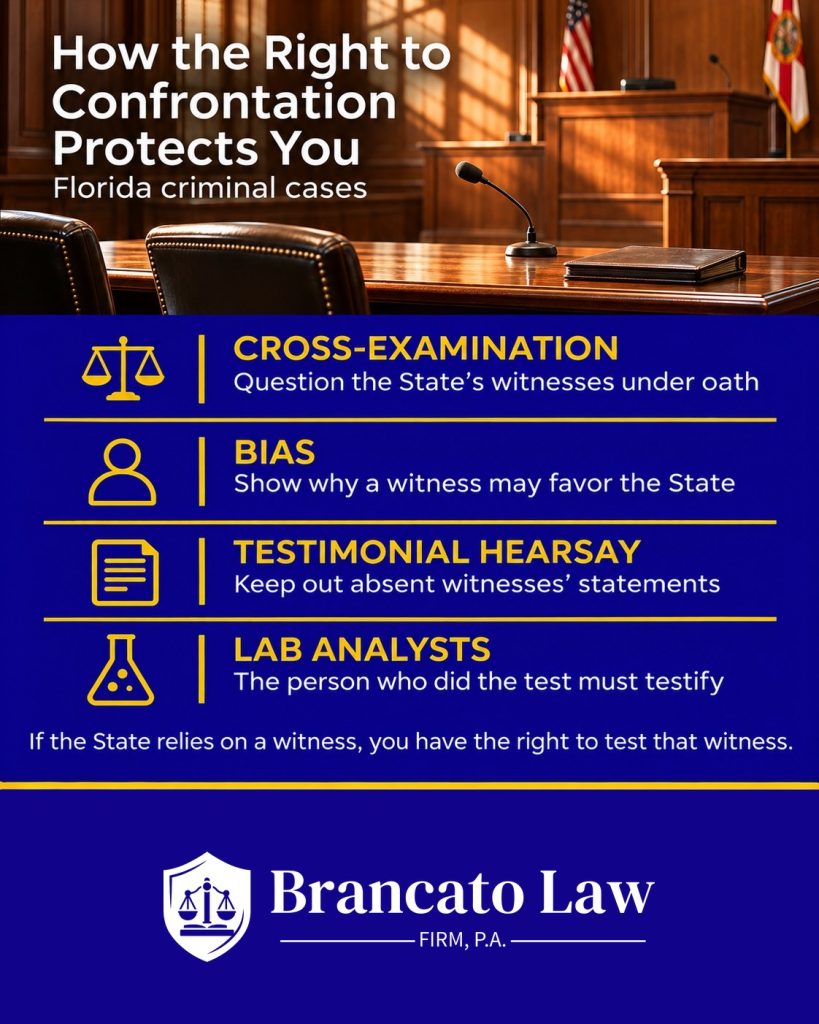
- The cross-examination branch. When a witness testifies against you, your lawyer has the right to a full and fair chance to test that witness’s memory, perception, and honesty, and to show bias or motive.
- The hearsay branch. When a witness does not come to court, the State generally cannot put that witness’s “testimonial” statements in front of the jury unless the witness is unavailable and the defense had an earlier chance to cross-examine.
Confrontation is a trial right, but it shapes the whole case. It decides which evidence the State can use, which witnesses it must bring to court, and how much bargaining power the defense has in plea negotiations. The Florida criminal case process page shows where trial falls among the stages of a case.
Why is cross-examination so important?
Cross-examination is how a jury learns whether a witness should be believed. In Davis v. Alaska, 415 U.S. 308 (1974), the key identification witness was on juvenile probation for burglary when he helped police, and the trial judge barred the defense from asking about it. The U.S. Supreme Court reversed, calling cross-examination “the principal means by which the believability of a witness and the truth of his testimony are tested,” and holding that exposing a witness’s motivation is a protected part of the right.
Florida’s Evidence Code puts the same idea into statute. Under section 90.608(2), Florida Statutes, any party may attack a witness’s credibility by showing that the witness is biased, and under section 90.610, a witness may be impeached with a prior conviction for a crime punishable by more than one year in prison or a crime involving dishonesty. Trial judges can still set reasonable limits, for example to stop harassment, repetition, or confusion of the issues. They cannot shut down questions that go to a key witness’s interest, motive, or bias.
What did the Fourth DCA decide in Huggins v. State in November 2026?
In Huggins v. State, No. 4D2025-3813 (Fla. 4th DCA Nov. 18, 2026), the Fourth District Court of Appeal reversed a first-degree murder conviction and a grand theft conviction from Palm Beach County and ordered a new trial because the trial judge improperly limited cross-examination.
The facts were simple. No eyewitness identified Mr. Huggins as the shooter. The only person who identified him was a man who looked at still photographs from surveillance video inside a Belle Glade market, taken shortly before the shooting, and said it was him. That man was a Palm Beach County Sheriff’s deputy, the agency investigating the murder, and a detective from that agency asked him to review the footage. Before trial, the defense asked to let the jury learn he was a deputy. The trial court refused, so he testified as an ordinary civilian. In closing, the prosecutor described him as having “no vested interest in this case” and as “just a guy.”
The appeals court held that the defense was entitled to explore the deputy’s employment as a possible source of bias, and that it did not have to prove the relationship actually influenced him before asking about it. The court repeated a principle Florida courts have applied for years: “a defendant’s right of confrontation is paramount to the state’s interest in protecting a witness from prejudice.” Because identity was the central issue and the deputy was the only identifying witness, the error was not harmless. The opinion is not final until any timely rehearing motion is resolved.
The lesson reaches far beyond Palm Beach County. More and more cases in Tampa Bay rest on an officer or deputy who “recognizes” someone in surveillance, doorbell, or body camera video. When that witness works for the investigating agency, Huggins says the jury is entitled to know it. Our posts on facial recognition arrests and Flock license plate cameras cover other identification technology that our attorneys test the same way. In homicide cases, where identification is often the whole case, our Tampa homicide defense attorneys treat the identifying witness as the center of the trial.
Can the State use a statement from a witness who does not testify?
Not if the statement is testimonial, unless the witness is unavailable and the defense had a prior opportunity to cross-examine. That is the rule of Crawford v. Washington, 541 U.S. 36 (2004), where the State played a wife’s recorded police statement describing a stabbing, even though she never testified and the defendant never had the chance to question her. The U.S. Supreme Court held that a recorded statement given “in response to structured police questioning” is testimonial and that admitting it violated the Sixth Amendment, no matter how reliable a judge thought it was.
Whether a statement is testimonial depends on why it was made. In Davis v. Washington, 547 U.S. 813 (2006), the Court explained that statements to police made to get help with an ongoing emergency, such as many 911 calls, are nontestimonial, while statements whose primary purpose is to prove past events for a later prosecution are testimonial.
| Type of statement | Usually testimonial? | Why |
|---|---|---|
| Recorded statement to a detective after the event | Yes | Its primary purpose is to prove past events for prosecution (Crawford). |
| 911 call during an ongoing emergency | Often no | Its primary purpose is to get help (Davis v. Washington). |
| Lab report prepared for the prosecution | Often yes | Created to prove a fact at trial; the analyst may have to testify (Smith v. Arizona). |
| Breath test operator’s affidavit of the test procedure | Yes, those portions | Prepared to prove an element of a DUI prosecution (State v. Belvin). |
| Casual statement to a friend | Usually no | Not made to build a prosecution, though hearsay rules may still exclude it. |
Florida’s statutes on child hearsay add another layer in child abuse and sex cases. Our guide to child hearsay in Florida sex cases explains how those statutes interact with the confrontation right.
Do lab analysts and breath test operators have to testify in Florida?
Often, yes. In Smith v. Arizona, 602 U.S. 779 (2024), the analyst who tested suspected drugs left the lab before trial, and the State called a different analyst who relied on her notes and report. The U.S. Supreme Court held that when a prosecution expert conveys an absent analyst’s statements to support an opinion, and the statements support that opinion “only if true,” they are offered for their truth. The Court sent the case back to decide whether those statements were testimonial.
Florida reached a similar result for DUI breath tests years earlier. In State v. Belvin, 986 So. 2d 516 (Fla. 2008), the Florida Supreme Court held that the parts of a breath test affidavit describing the operator’s procedures and observations are testimonial, and that admitting them without the operator violated the right of confrontation. The court also held that a defendant does not waive that right by skipping a discovery deposition. Our guide to expert witnesses in criminal defense explains how our attorneys challenge forensic testimony.
How often do felony cases in Hillsborough County go to trial?
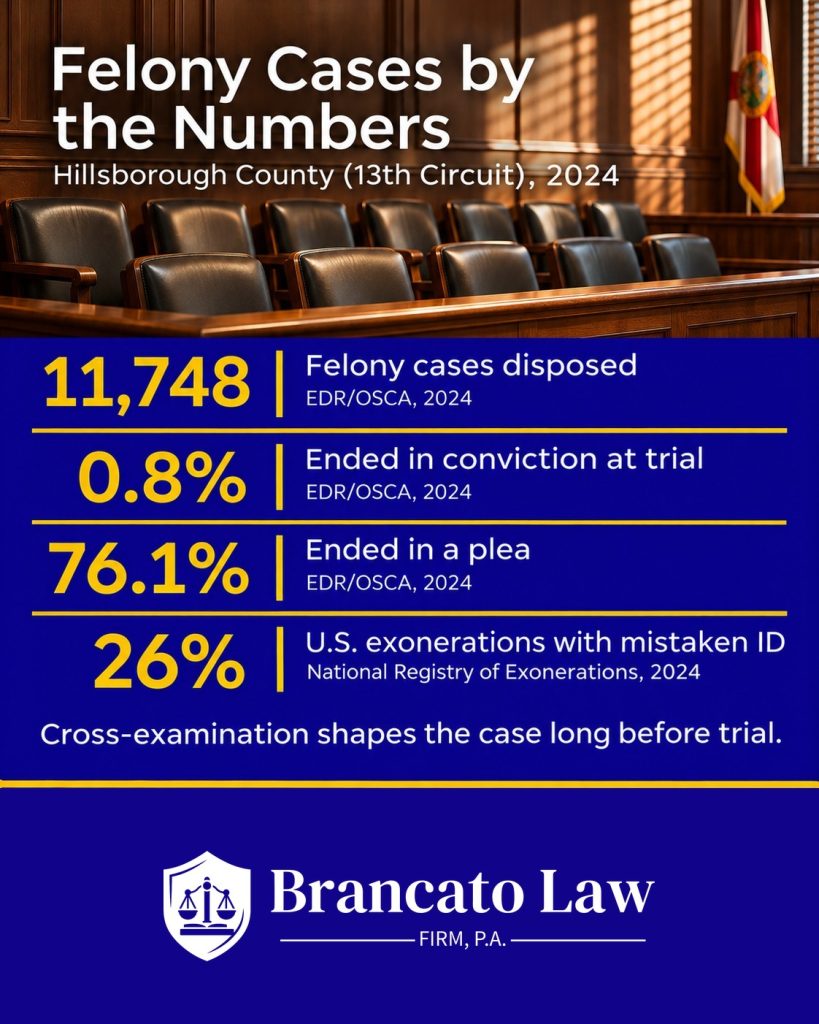
Rarely. In 2024, Florida’s 13th Judicial Circuit, which covers Hillsborough County, disposed of 11,748 felony cases, and only 91 of them, 0.8%, ended in a conviction after trial, according to the Florida Legislature’s Office of Economic and Demographic Research Analysis of Dispositions by Circuit (2024), which draws on Office of the State Courts Administrator data. Another 8,935, or 76.1%, ended in pleas, and 1,709, or 14.5%, were dismissed or ended in acquittal.
| Disposition | 13th Circuit (Hillsborough) | All of Florida |
|---|---|---|
| Total felony dispositions | 11,748 | 157,355 |
| Convicted after trial | 91 (0.8%) | 1,478 (0.9%) |
| Pled | 8,935 (76.1%) | 123,310 (78.4%) |
| Dismissed or acquitted | 1,709 (14.5%) | 22,175 (14.1%) |
| Other, such as pretrial intervention | 1,013 (8.6%) | 10,392 (6.6%) |
Those numbers do not make confrontation less important. They make it more important. Prosecutors make offers based on how they expect their witnesses to hold up on cross-examination, so a defense that can show a key witness is biased, mistaken, or absent changes the offer long before any jury is picked.
Why does cross-examining identification witnesses matter so much?
Because mistaken identifications send innocent people to prison. Of the 147 exonerations the National Registry of Exonerations recorded for 2024, 38, or 26%, involved convictions based at least in part on mistaken witness identification, according to its 2024 Annual Report, a project of the University of California Irvine, the University of Michigan Law School, and Michigan State University College of Law. Cross-examination is the tool the Constitution gives the accused to expose those errors in front of the jury, which is exactly what the defense in Huggins was denied.
How do our attorneys use the right to confrontation?
Our attorneys use the right at every stage, not only at trial:
- Depose the State’s witnesses. Florida allows discovery depositions in criminal cases, which many states do not. We depose officers, analysts, and identifying witnesses under oath before trial, so their trial testimony can be compared with what they said earlier.
- Investigate bias. We look for every reason a witness might lean toward the State: employment with the investigating agency, pending charges, deals, money, or a personal relationship with the complainant.
- Object to testimonial hearsay. When the State tries to prove its case through reports, affidavits, or recorded statements of people who will not testify, we object under Crawford and Belvin.
- Demand the real analyst. In drug, DNA, toxicology, and breath test cases, we require the person who did the work to come to court.
- Preserve the issue. Huggins was won because the defense filed a motion in limine before trial. We put confrontation objections on the record so they can be reviewed on appeal.
Jury selection matters too, because jurors’ assumptions about police witnesses shape how they hear a cross-examination. Our guide to how jury selection works in a Florida criminal trial explains how we address those assumptions before the first witness is sworn.
Frequently asked questions about the right to confrontation in Florida
Can a police officer testify that he recognized me in a surveillance video in Florida?
Yes, a witness who knows you can give lay opinion testimony identifying you in a video, and courts often keep the jury from learning the witness is an officer to avoid suggesting a prior record, but under Huggins v. State the defense may choose to reveal that employment to show bias. The Brancato Law Firm decides case by case whether exposing the witness’s ties to the investigating agency helps the client more than it risks.
Can the State use the alleged victim’s statement if the victim does not come to court?
It depends on whether the statement is testimonial: a recorded statement to a detective usually cannot come in without the witness, while a 911 call made to get help during an emergency often can. Our attorneys at The Brancato Law Firm sort every out-of-court statement into those categories early, because the answer often decides whether the State can go forward at all.
Does the right to confrontation apply in Florida DUI cases?
Yes, and Florida DUI cases are where it comes up most often, because the State relies on breath test operators, agency inspectors, and toxicologists. Under State v. Belvin, the operator’s procedures and observations in a breath test affidavit are testimonial, and The Brancato Law Firm holds the State to that rule in every DUI defense case that turns on a breath result.
Can my lawyer ask a witness about the witness’s criminal record?
Yes, under section 90.610 a witness can be impeached with a prior conviction for a crime punishable by more than a year in prison or a crime involving dishonesty or a false statement. The Brancato Law Firm runs criminal history checks on the State’s key witnesses so those convictions are ready for cross-examination.
Can a conviction be reversed if the judge limited cross-examination?
Yes, if the limitation cut off questioning about a key witness’s bias or motive and the State cannot show beyond a reasonable doubt that the error did not contribute to the verdict, as happened in Huggins. Our attorneys at The Brancato Law Firm make the record at trial with a proffer of the questions that were blocked, because an appeals court can only review what the record shows.
Is the right to cross-examine unlimited in Florida?
No, a trial judge may impose reasonable limits to prevent harassment, repetition, confusion of the issues, or questioning that is only marginally relevant. The Brancato Law Firm frames bias questions so they fall squarely within what Florida courts protect, so a limit on them becomes reversible error rather than a judgment call.
Facing Trial in Tampa? Talk to Us Before the Depositions Start
Cross-examination is won in preparation, and that preparation starts with the first deposition. The Brancato Law Firm, P.A., founded by Tampa Criminal Defense Attorney Rocky Brancato, can investigate the State’s witnesses, depose them under oath, and build the confrontation record your case needs. Call (813) 727-7159 at any hour. Our firm has Spanish-speaking staff, and attorney Jean-Luc Adrien speaks Spanish, Haitian Creole, and French. For more about how a case moves from arrest to trial, visit our Florida Criminal Case Process page.
The Brancato Law Firm, P.A.
620 E. Twiggs Street, Suite 205, Tampa, FL 33602
(813) 727-7159
Serving Hillsborough, Pinellas, and Pasco Counties
The Brancato Law Firm, P.A. is a Tampa-based criminal defense practice. We are not affiliated with any other Brancato-named law firms.
Visit Us

Tampa, FL 33602

Contact Us Now
Free Legal Consultation (813) 727-7159
