- Free Consultation 24/7: (813) 727-7159 Tap Here To Call Us


From First DUI to Death Penalty



Sex Crime Charges in Florida: A Complete 2026 Guide



Florida sorts sex offenses into a handful of charge families: sexual battery, lewd or lascivious offenses, unlawful sexual activity with a minor, child sexual abuse material, online solicitation and traveling to meet a minor, video voyeurism and indecent exposure, prostitution, and human trafficking. Almost all of them are felonies. Many carry mandatory minimum prison terms, which means a judge cannot go below the number no matter what the circumstances are. And nearly all of them carry sex offender registration that lasts for the rest of a person’s life unless a court removes it.
Several new laws that took effect on July 1, 2026 changed this area of the law significantly. Penalties went up across the child exploitation statutes, several offenses gained mandatory minimums that judges previously had discretion over, and the restrictions that follow people after a conviction expanded.
Sex crimes are the most common cases we handle at The Brancato Law Firm. Rocky Brancato spent years in a dedicated Major Crimes Unit at the Hillsborough County Public Defender’s Office handling only sex offense and child abuse cases, and later ran that office as Chief Operations Officer and Chief Assistant Public Defender, overseeing a staff of over 100 attorneys. One thing we tell nearly everyone who calls: the consequences that arrive after a case ends usually reshape a person’s life more than the sentence does. That is why this guide gives registration, designation, probation, and civil commitment as much room as the charges themselves.
A note on terminology before we start. Florida law no longer uses the phrase “child pornography.” As of July 1, 2026, the statutes use “child sexual abuse material,” often shortened to CSAM. The Legislature wrote the change into the bill as a rename rather than a redefinition, so cases charged under the old language still work the same way.
What Counts as a Sex Offense in Florida?
Florida’s sex offenses are spread across several chapters of the criminal code rather than gathered in one place.
| Chapter | What it covers |
| Chapter 794 | Sexual battery |
| Chapter 800 | Lewd or lascivious offenses and indecent exposure |
| Chapter 827 | Sexual performance by a child and child sexual abuse material |
| Chapter 847 | Online solicitation, traveling to meet a minor, transmission offenses |
| Chapter 796 | Prostitution |
| Chapter 787 | Human trafficking |
The chapter matters because it determines the penalty structure, whether a mandatory minimum applies, and whether the conviction triggers registration. Two charges that sound similar to a person reading a police report can sit in different chapters and carry sentences decades apart.
Three factors move a charge between tiers more than anything else:
- The age of the alleged victim. Under 12, 12 to 15, 16 to 17, and 18 or older are the dividing lines that appear over and over.
- The age of the accused. Nearly every statute treats an offender 18 or older more harshly than one under 18, and several carry mandatory minimums that apply only to adults.
- Force, coercion, or a weapon. These aggravators can lift a second-degree felony to a life felony.
Prior convictions, custodial authority over the alleged victim, and multiple accused people acting together can also reclassify a charge upward.
Sexual Battery Charges in Florida
Sexual battery is Florida’s legal term for what most people call rape. Section 794.011 defines it as oral, anal, or vaginal penetration by, or union with, the sexual organ of another person, or penetration by any other object. Consent under Florida law means intelligent, knowing, and voluntary consent. The statute is explicit that a person’s failure to physically resist does not establish consent.
Penalties turn on the ages of the people involved and whether force was used.
| Circumstances | Charge level | Maximum penalty |
| Accused 18 or older, alleged victim under 12 | Capital felony | Life without parole (see the section on the death penalty below) |
| Accused under 18, alleged victim under 12 | Life felony | Life in prison |
| Alleged victim 12 or older, deadly weapon used or threatened, or physical force likely to cause serious injury | Life felony | Life in prison |
| Accused 18 or older, alleged victim 12 to 17, without consent | First-degree felony | 30 years, or life under specified aggravating circumstances |
| Accused 18 or older, alleged victim 18 or older, without consent | Second-degree felony | 15 years, or 30 years under specified aggravating circumstances |
| Accused under 18, alleged victim 12 or older, without consent | Second-degree felony | 15 years, or 30 years under specified aggravating circumstances |
The statute lists the aggravating circumstances that raise a charge a full degree: the alleged victim was physically helpless or physically incapacitated, was administered a drug without their knowledge, was coerced by a threat of force or retaliation, is mentally defective and the accused knew or had reason to believe it, or the accused was a law enforcement or corrections officer or someone else in a position of control or authority. A prior conviction under the same chapter, or the accused holding a position of familial or custodial authority, can also push a charge into a higher tier than the table shows. Our explainer on sexual battery in Florida walks through each subsection in detail.
Capital Sexual Battery and the Death Penalty
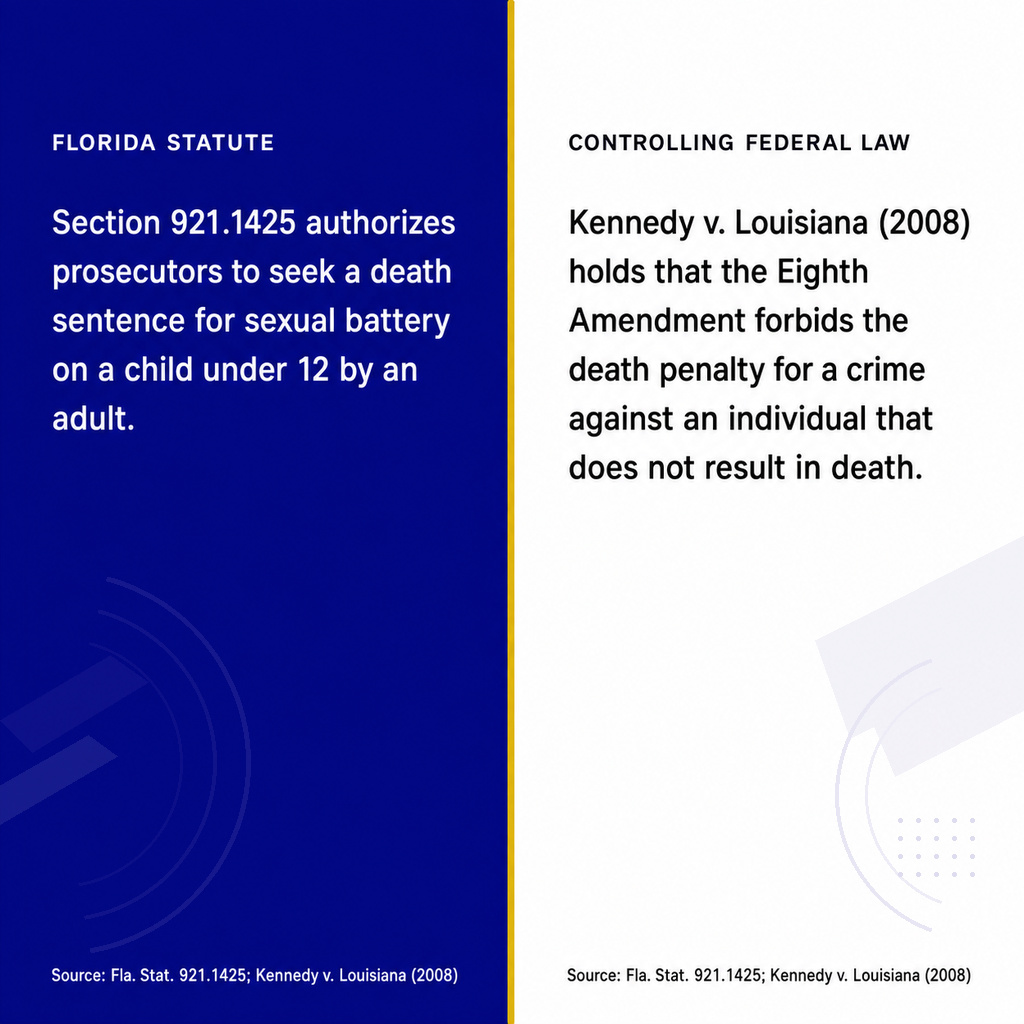
Florida law makes sexual battery on a child under 12 by an adult a capital felony. A 2023 law created a sentencing procedure at section 921.1425 that authorizes prosecutors to seek a death sentence in those cases. If the state intends to pursue it, it must file notice within 45 days of arraignment listing the aggravating factors it intends to prove.
The constitutional picture is more complicated than the statute suggests. In Kennedy v. Louisiana (2008), the United States Supreme Court held that the Eighth Amendment forbids the death penalty for a crime against an individual that does not result in death, including child rape. Florida’s statute openly disputes that ruling, and the Legislature wrote its disagreement with Kennedy into the text. Prosecutors have filed notice of intent to seek death in a small number of cases since the law took effect, but no death sentence has been imposed under it, and Kennedy remains controlling federal law, which means any death sentence entered under the Florida statute would face reversal on appeal. In practice, life imprisonment without parole is the sentence these cases produce.
Lewd or Lascivious Offenses in Florida
Section 800.04 covers lewd or lascivious acts committed upon or in the presence of a person under 16. It contains four separate offenses, and the difference between them is the conduct alleged.
| Offense | Conduct | Charge level |
| Lewd or lascivious battery | Sexual activity with a person 12 to 15 | Second-degree felony, or first-degree with a qualifying prior conviction |
| Lewd or lascivious molestation | Lewd touching of a person under 12 by an adult | Life felony |
| Lewd or lascivious molestation | Lewd touching of a person 12 to 15 by an adult, or of a person under 12 by an offender under 18 | Second-degree felony |
| Lewd or lascivious conduct | Lewd touching of a person under 16, or soliciting a person under 16 to commit a lewd act | Second-degree felony if the offender is 18 or older, third-degree if under 18 |
| Lewd or lascivious exhibition | Masturbation, exposure of the genitals, or another sexual act in the presence of a person under 16 with no physical contact | Second-degree felony if the offender is 18 or older, third-degree if under 18 |
Two rules inside this statute surprise people constantly. Consent is not a defense, and neither is the alleged victim’s lack of chastity. Separately, the statute states that a mistaken but genuine belief about the child’s age cannot be raised as a defense, even if the child lied about their age. We wrote about why age mistakes are no defense because it is one of the most common misunderstandings we hear on intake calls.
Florida has parallel statutes covering lewd or lascivious offenses against elderly or disabled adults, including section 825.1025. Our lewd and lascivious defense guide covers the strategy side of these cases.
What Is the Age of Consent in Florida?
Florida’s age of consent is 18. There is one narrow exception: section 794.05 makes it a second-degree felony for a person 24 or older to engage in sexual activity with a 16 or 17-year-old. A person under 24 is not charged under that statute for the same conduct. So in practical terms, a 16 or 17-year-old can legally consent to a partner who is 23 or younger, and cannot consent to anyone 24 or older.
Below 16, the analysis moves to chapter 794 and section 800.04, and the penalties climb steeply. Sexual activity with a person 12 to 15 is charged as lewd or lascivious battery or as sexual battery depending on the facts.
Our articles on the age of consent, on unlawful sexual activity with minors, and on statutory rape defense cover the age brackets in more detail.
Child Sexual Abuse Material Charges After July 1, 2026
This is the area the 2026 legislature changed most. House Bill 245 replaced “child pornography” with “child sexual abuse material” throughout the Florida Statutes. House Bill 1159 raised penalties, added mandatory minimums, and created new offenses. The Senate summaries of HB 245 and HB 1159 set out both bills in full.
Section 827.071 now reads as follows.
| Offense | Charge level | Mandatory minimum for an offender 18 or older |
| Use of a child in a sexual performance | First-degree felony, raised from second-degree | 15 years |
| Aggravated use of a child under 12 in a sexual performance | Life felony, newly created | 25 years |
| Promoting a sexual performance by a child | Second-degree felony | 5 years |
| Possession with intent to promote CSAM | Second-degree felony | None specified |
| Soliciting, possessing, controlling, or intentionally viewing CSAM | Second-degree felony | None specified |
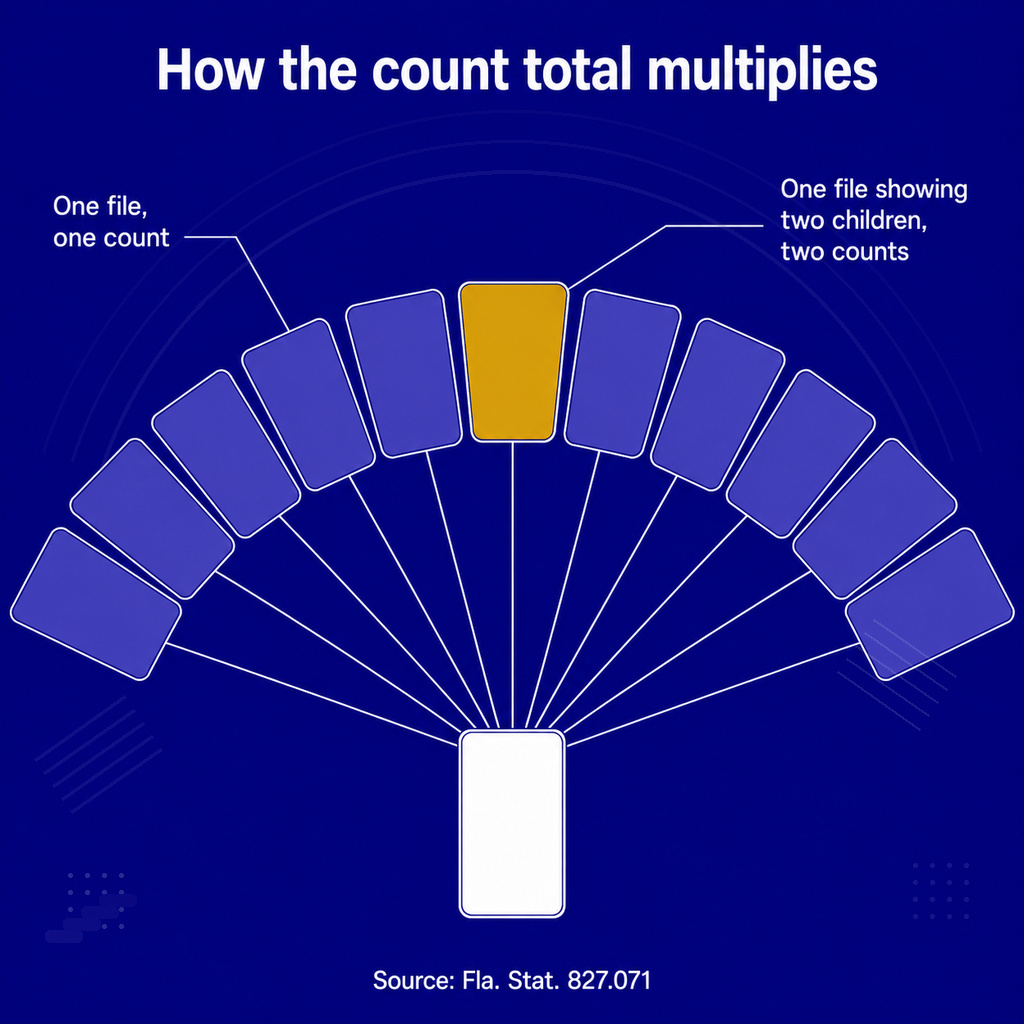
Each image is a separate offense under Florida law, and when a single image depicts more than one child, each child is a separate offense. That is how a possession case involving one device turns into an indictment with dozens of counts.
The statute now includes a narrow exception to the mandatory minimums. A court is not required to impose one if it makes written findings that the depicted child was 14 or older, the material was created with that child’s permission, the offender was no more than four years older, and the offender did not send it to any third party.
Transmission is charged separately under section 847.0137, a second-degree felony that carries a five-year mandatory minimum for an offender 18 or older. Our guides on CSAM defense in Tampa and on charge enhancements in these cases go deeper on how counts stack.
AI-Generated Material
Section 827.072 treats computer-generated and AI-generated material as a chargeable offense on its own terms. The 2026 legislation raised intentionally creating generated child sexual abuse material from a third-degree felony to a second-degree felony, and created a new second-degree felony for transmitting it. The statute reaches images portraying a fictitious person a reasonable person would take for a real child, so the state does not have to prove that a real child was depicted. That removes what defendants and their families often assume is an obvious defense.
Online Solicitation and Traveling to Meet a Minor
Section 847.0135 is the statute behind most internet sting cases in Hillsborough, Pinellas, and Pasco Counties.
- Solicitation. Using a computer, phone, or any device capable of transmitting data to seduce, solicit, lure, or entice a child, or a person believed to be a child, into unlawful sexual conduct is a third-degree felony. It becomes a second-degree felony if the person misrepresented their own age.
- Traveling to meet a minor. Traveling any distance for the purpose of engaging in unlawful sexual conduct with a child, or a person believed to be a child, after using an online service to solicit them is a second-degree felony.
- Each message can be its own count. The statute states that each separate use of an online service in violation of the section may be charged as a separate offense.
Two features of this statute drive nearly every sting prosecution. First, no actual child needs to exist. If the person on the other end was an undercover detective posing as a 14-year-old, the statute still applies as long as the accused believed they were communicating with a child. Second, the statute says outright that law enforcement involvement in detecting the offense is not a defense, which narrows entrapment arguments to the specific conduct of the officers rather than the existence of the operation.
That leaves the defense work in the details: who initiated contact, who escalated the conversation, what the officer said about age and when, whether the operation induced conduct the person was not otherwise predisposed to, and whether the digital evidence was collected and preserved properly. We cover this in our guides to online sting defense, computer solicitation charges, and traveling to meet a minor. Cases built by private “predator catcher” groups rather than law enforcement raise a different set of problems, which we address in our article on vigilante predator catchers.
Charges of this kind often arrive alongside device seizures and search warrants, which is where our Tampa internet crimes work usually begins.
Video Voyeurism and Indecent Exposure
Section 810.145, now titled digital voyeurism, covers secretly viewing, recording, or broadcasting someone who is dressing, undressing, or exposing their body somewhere they have a reasonable expectation of privacy. The charge level turns on the age of the accused rather than on whether it is a first offense. An offender under 19 commits a first-degree misdemeanor. An offender 19 or older commits a third-degree felony.
The charge rises to a second-degree felony for anyone with a prior conviction under the same section, and for an offense committed by someone responsible for a child’s welfare, by a school employee against a student of that school, or by anyone 24 or older against a child under 16. Sharing or selling the recording is charged separately.
Section 800.03, exposure of sexual organs, is a first-degree misdemeanor on a first conviction and a third-degree felony on a second or subsequent one.
These are the lowest-tier offenses in this guide, and they are still capable of triggering registration in certain circumstances. Our article on video voyeurism charges explains when that happens.
Prostitution and Solicitation Charges
Florida treats prostitution offenses under chapter 796. Most first-time charges here are misdemeanors, and they escalate quickly with repetition.
- Offering to commit prostitution is a second-degree misdemeanor on a first offense, a first-degree misdemeanor on a second, and a third-degree felony on a third or subsequent offense.
- Soliciting another person to commit prostitution is a first-degree misdemeanor on a first offense, a third-degree felony on a second, and a second-degree felony on a third or subsequent offense.
- Deriving support from the proceeds of prostitution is a second-degree felony on a first offense under section 796.05, and it climbs from there.
The escalation structure is why a second charge is a different situation from the first one. Our articles on prostitution law in Florida and on Tampa area prostitution stings cover how these operations are run and charged locally.
Human Trafficking Charges
Section 787.06 covers human trafficking, including trafficking for commercial sexual activity. Trafficking a minor for commercial sexual activity is a life felony, and the statute does not require the state to prove force, fraud, or coercion when the alleged victim is a minor. Trafficking offenses involving adults are generally first-degree felonies.
Trafficking charges frequently attach to conduct that the accused understood as something else entirely, including a prostitution arrangement between adults or a relationship the state characterizes differently. Our Tampa human trafficking defense guide covers the elements the state has to prove.
What Happens After a Sex Crime Conviction in Florida
This is the part almost everyone underestimates. A sentence ends. Registration, designation, and supervision conditions can last the rest of a person’s life, and they govern where a person lives, works, and travels.
Sex Offender Registration in Florida
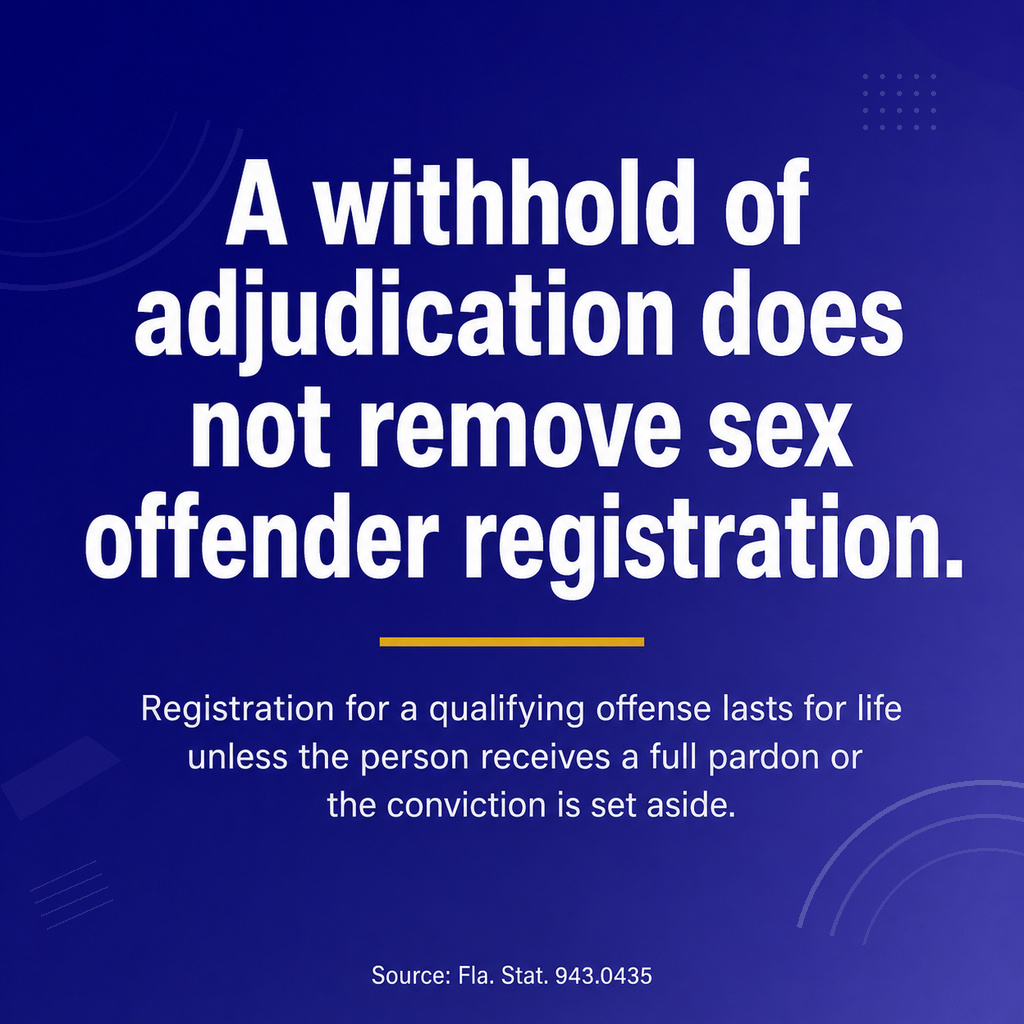
Under section 943.0435, a person convicted of a qualifying sex offense must register with the Florida Department of Law Enforcement and maintain that registration for life, unless they receive a full pardon or the conviction is set aside. Registration obligations include in-person reporting at set intervals, reporting changes of address, vehicle, employment, and email or internet identifiers, and appearing on a public database.
Two points that catch people off guard:
- A withhold of adjudication does not avoid registration. Withholding adjudication keeps a person from being a convicted felon for many purposes, but it does not remove the registration requirement for a qualifying offense. Our article on withhold of adjudication explains what a withhold does and does not do here.
- Juvenile adjudications can trigger it. A juvenile adjudicated delinquent of certain offenses can be required to register. Our parent’s guide to juvenile registration covers when that applies.
For the mechanics of the reporting obligation itself, see our guide to sex offender registration in Florida.
Sexual Offender Versus Sexual Predator
These are two different legal statuses, and the distinction has real consequences.
| Sexual offender | Sexual predator | |
| How it is applied | Automatic on conviction of a qualifying offense | Court must enter a written finding under section 775.21 |
| Who it covers | Most people convicted of a registrable sex offense | Offenders whose qualifying conviction meets statutory criteria, including certain capital, life, or first-degree felonies and repeat qualifying offenses |
| Community notification | Registry listing | Registry listing plus active law enforcement notification to the community |
| Path off the registry | Narrow petition routes exist | Far narrower, and the designation itself is usually the better target |
Because predator designation is entered by court order, it can be litigated, and it can be challenged when the criteria were not actually met. We have had a sexual predator designation removed on a motion to correct an illegal sentence after the prosecutor agreed the client did not meet the statutory criteria. Each case is unique. Past results do not guarantee future outcomes. We cover the criteria in our guides to the sexual offender designation and the sexual predator designation.
Sex Offender Probation Conditions
Section 948.30 imposes a set of special conditions on anyone placed on probation or community control for a qualifying sex offense. They apply by statute, not at the judge’s discretion. They include:
- A curfew, typically from 10 p.m. to 6 a.m.
- Mandatory treatment with a qualified sex offender therapist
- No contact with the alleged victim
- A prohibition on possessing obscene or pornographic material
- Restrictions on internet and computer use until a therapist evaluates the person
- Submission to a DNA sample
- Polygraph examinations and electronic monitoring in many cases
When the alleged victim was a minor, additional conditions attach automatically, including a prohibition on living within 1,000 feet of a school, daycare, park, playground, or other place where children regularly congregate, and a bar on unsupervised contact with children under 18. Our Florida sex offender probation guide walks through each condition and how violations are charged.
Residency and Proximity Restrictions Expanded in 2026
Senate Bill 212 took effect July 1, 2026 and widened the geography of these restrictions. Under the revised section 775.215, a person convicted of certain sex offenses where the alleged victim was under 16 may not live within 1,000 feet of a school, child care facility, park, playground, or public swimming pool. The pool restriction is new.
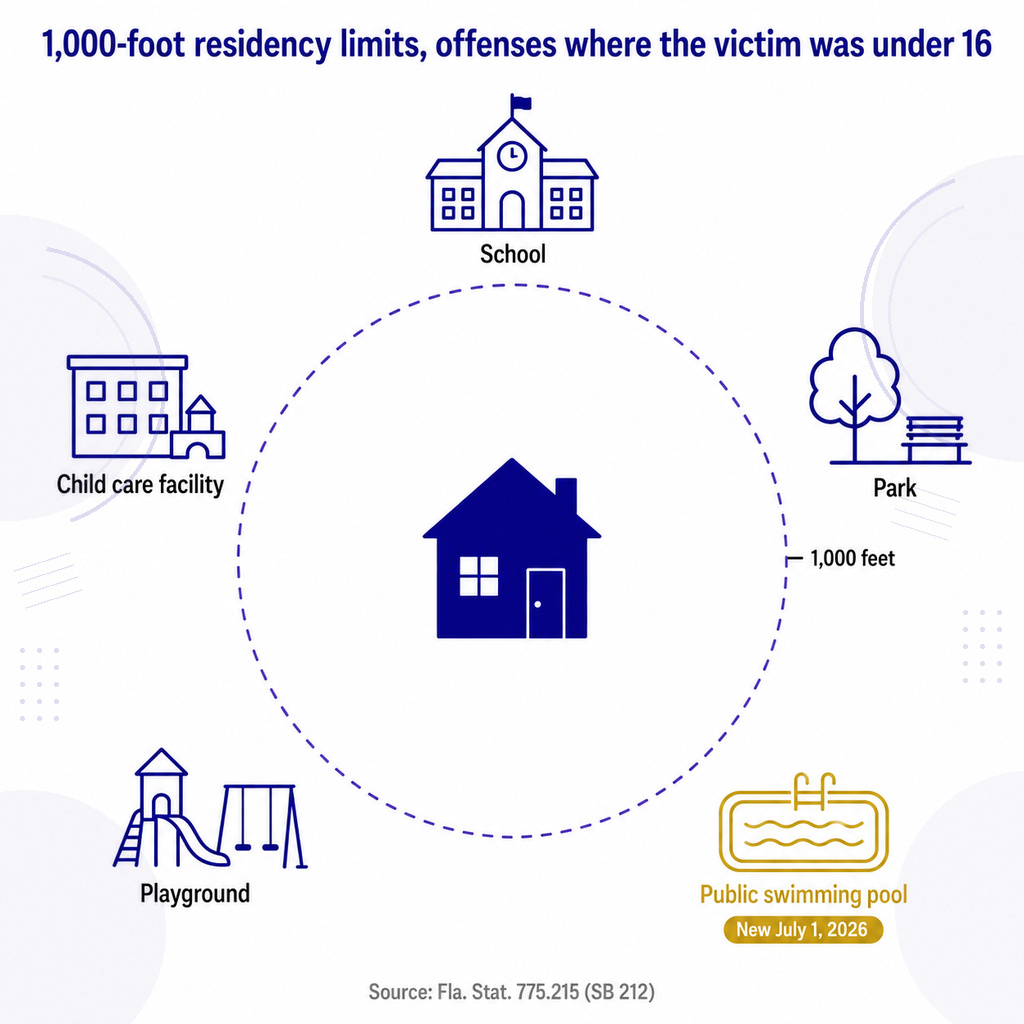
It applies to offenses committed on or after July 1, 2026, and to people already subject to residency restrictions who change their permanent residence on or after that date.
The same law made other changes worth knowing:
- The loitering and prowling restriction for registrants near places where children congregate increased from 300 feet to 500 feet.
- People on probation, community control, or conditional release for qualifying offenses involving a minor face new prohibitions on living within 1,000 feet of a public swimming pool, working or volunteering at one, or visiting one without prior approval.
- State agencies and local governments must check the registry before hiring or appointing anyone, paid or volunteer, at parks, playgrounds, public pools, and child care facilities.
The Senate summary of SB 212 lists the full set of amendments. For anyone already registered in Tampa Bay, the practical takeaway is that a move can now trigger the new restrictions even if the underlying conviction predates them.
Can Anyone Get Off the Florida Registry?
Rarely, and only through specific statutory routes. Two exist.
The first is the 25-year petition under section 943.0435(11). A registrant may be considered for removal after at least 25 years since release from confinement, supervision, or sanction, with no arrest for any felony or misdemeanor in that period, and only if the registering offense was not one of the disqualifying offenses listed in the statute. Removal is discretionary with the court even when every requirement is met, and the State Attorney can oppose the petition.
The second is the Romeo and Juliet provision at section 943.04354. It allows a court to remove the registration requirement where the alleged victim was 13 to 17, the offender was no more than four years older, the conduct was consensual, and the person has no other qualifying sex offense conviction.
That provision reaches sexual predators as well as sexual offenders on its face, but the qualifying criteria mean almost nobody carrying a predator designation will meet them. For most predators, the realistic path is a challenge to the designation itself rather than a removal petition.
We should be straightforward about something here. We receive a high volume of registry removal inquiries, and only a small fraction of callers actually qualify under these statutes. Our guides to registry removal and the Romeo and Juliet petition lay out the eligibility criteria so you can see where you stand before you pick up the phone.
Civil Commitment Under the Jimmy Ryce Act
Florida can hold someone in custody after their prison sentence ends. Under the Jimmy Ryce Act, sections 394.910 through 394.932, the state may petition to civilly commit a person as a sexually violent predator shortly before release. The state must prove by clear and convincing evidence that the person has a qualifying prior sex offense conviction and a mental abnormality or personality disorder making them likely to reoffend.
If the petition succeeds, the person is committed to the custody of the Department of Children and Families indefinitely, with annual reviews. Far fewer people are committed than are referred. Our Jimmy Ryce Act guide explains how the referral, the evaluation, and the jury trial work.
How Florida Sex Crime Cases Are Actually Fought
Sex cases are won and lost on preparation. Rocky Brancato has tried more than 150 jury trials to verdict, holds an AV Preeminent rating from Martindale-Hubbell, and is death-qualified under the Rules of the Florida Supreme Court, a certification that requires advanced training and reflects the preparation standard every case in the firm is built to. We have taken a sexual battery charge to trial and come back with a not guilty verdict on that count. Each case is unique. Past results do not guarantee future outcomes.
Here is where the work actually happens.
The Pre-File Window
The period between a report or an arrest and the State Attorney’s filing decision is the most important window in a sex crime case, and the one most often wasted. In Florida, an arrest does not file the charge. The State Attorney’s Office reviews the investigation and makes an independent decision about what to file, whether to file, and how many counts to bring.
Pre-file advocacy means putting evidence and context in front of the detective and the filing prosecutor before that decision is made. Depending on the case, that can include witness statements the detective never collected, digital records that establish a different timeline, medical or forensic material that undercuts the initial report, or documentation of a motive to fabricate.
The Brancato Law Firm has had multiple sex crime investigations close with no charges filed through pre-file work. Each case is unique. Past results do not guarantee future outcomes. What makes this window work is understanding how the filing decision is actually made inside a State Attorney’s Office, which is knowledge Rocky brought from running the largest criminal defense operation in Tampa Bay.
Once a charge is filed, the case takes on institutional momentum and everything gets harder. That is the honest reason we tell people not to wait.
Forensic and Digital Evidence
Sex crime prosecutions rest heavily on forensic and digital evidence, and that evidence is challengeable more often than people assume.
On the DNA side, section 943.326 requires a sexual assault kit to be submitted to the state lab within 30 days after law enforcement receives the evidence or the alleged victim requests testing, and requires the lab to complete testing within 120 days after submission. Those deadlines create a record, and the record can be checked. Beyond timing, the substance of a lab result can be examined: bench notes, raw electronic data, the analyst’s interpretation of the profile, and the statistical thresholds applied.
We handled a cold-hit sexual battery case built on an eight-year-old allegation and a CODIS match. Our team subpoenaed the lab’s bench notes, obtained the raw electronic DNA data, had an independent lab review it, and retained an expert geneticist who showed the state’s analyst had misread an allele at a critical locus. One of the state’s own experts agreed, and the prosecutor dismissed the case. Each case is unique. Past results do not guarantee future outcomes.
Medical evidence gets similar scrutiny. Findings from a Sexual Assault Nurse Examiner and conclusions from a Child Protection Team are often presented as neutral clinical fact when they involve interpretation, and interpretation can carry confirmation bias. Our articles on challenging SANE evidence and our forensic science defense work describe how those challenges are built. Cases involving allegations of harm to a child often run in parallel with our Tampa child abuse defense practice.
Evidence Rules That Apply Only in Sex Cases
Three rules change the shape of a sex crime trial compared to any other felony.
- The Williams Rule. Under section 90.404, when the charge is a sexual offense or child molestation, the state can introduce evidence of the defendant’s other sexual offenses or acts of molestation for its bearing on any relevant matter, which includes propensity. In most criminal cases, prior bad acts stay out. In sex cases, they frequently come in, and the pretrial fight over admissibility can decide the trial. See our guide to the Williams Rule.
- Child hearsay. Section 90.803(23) allows an out-of-court statement by a child under 18 describing abuse to be admitted if the court holds a reliability hearing and the child either testifies or is unavailable with corroborating evidence. That means a forensic interviewer or a nurse can relay what a child said. Our child hearsay article covers the reliability hearing.
- The rape shield law. Section 794.022 sharply limits evidence of an alleged victim’s prior sexual conduct, with narrow exceptions for establishing the source of semen or injury and for specific patterns proven at a pretrial hearing. Our rape shield guide explains where the exceptions actually apply.
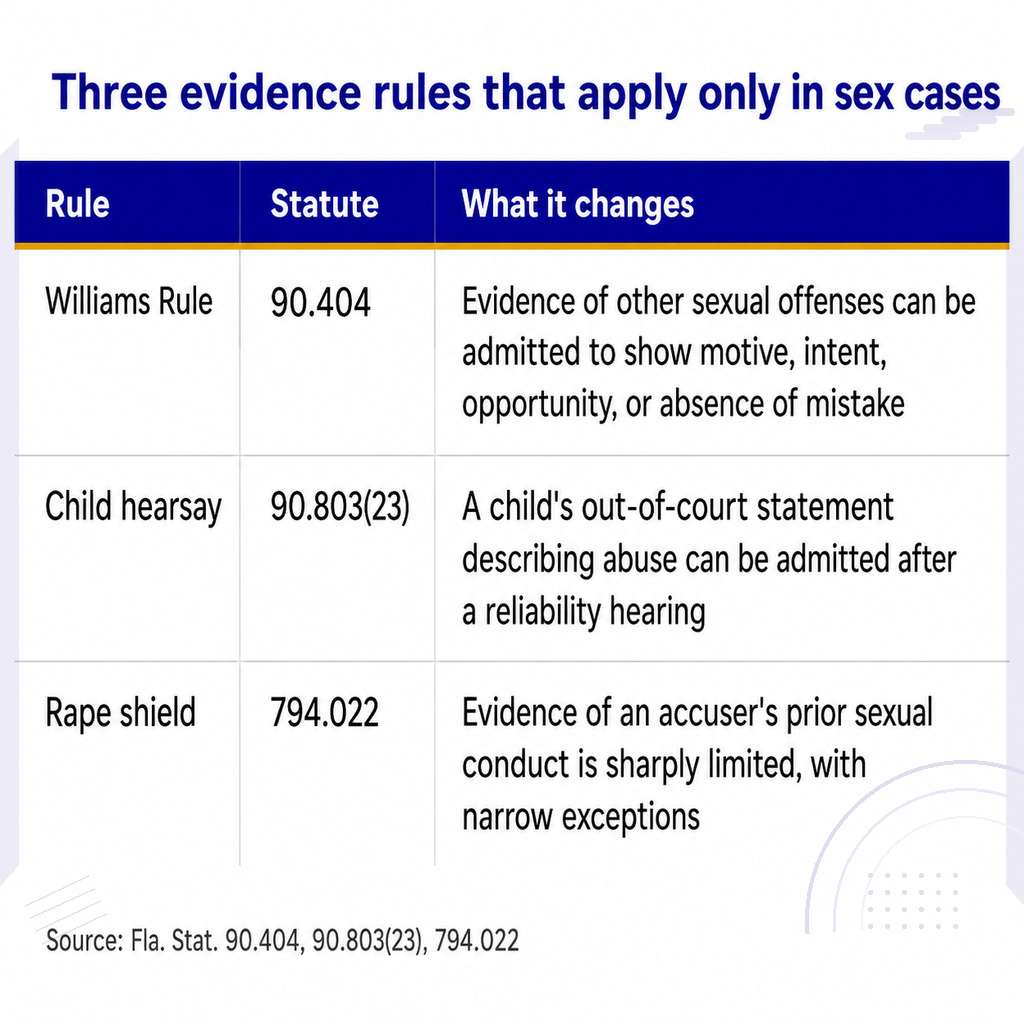
The combined effect is that a consent defense has to be proven through direct evidence and cross-examination rather than through the alleged victim’s history. Our article on the consent defense covers how that is done.
Statements Made to Detectives
Statements the accused made to detectives deserve their own review. Sex crime interrogations are long, they often happen before an arrest when the person believes they are helping, and Florida recognizes an exception that allows a confession to support a conviction with limited independent corroboration. Our articles on false confessions and the confession without corpus exception explain why that combination is dangerous.
Interview technique matters here as much as the words on the transcript. Rocky is a former police academy instructor who taught officers criminal procedure and courtroom testimony, which shapes how we examine investigative technique and cross-examine the detective who ran the interview.
What to Do in the First 48 Hours
If you have been arrested, contacted by a detective, or told you are under investigation, the next two days matter more than any other two days in the case.
- Stop talking to law enforcement. Say clearly that you are invoking your right to remain silent and your right to an attorney, then stop. Politeness does not require answering questions, and a detective telling you this is your chance to explain is not doing you a favor.
- Do not contact the accuser or their family. Not to apologize, not to ask what happened, not through a friend. Contact can produce a new charge and it hands the state a recorded statement.
- Preserve everything. Do not delete messages, photos, apps, or accounts, and do not reset a device. Deletion is recoverable, it is provable, and it creates a consciousness of guilt argument and potentially a separate charge. Preserve what exists instead.
- Write down the timeline while it is fresh. Names, times, locations, who else was present, what devices were used. Give it to your attorney rather than to anyone else.
- Call a defense attorney before charges are filed. The pre-file window is short and it does not reopen.
If contact with a detective has already happened, it is still worth getting counsel involved immediately. If you believe you may have messaged a minor online, our guide covers the steps to take right now.
Talk to a Tampa Sex Crimes Defense Attorney
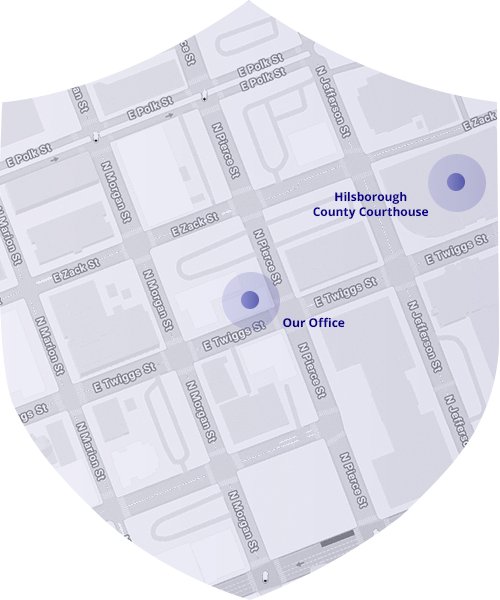
Sex crime charges in Florida carry consequences that outlast any sentence, and the choices made in the first days of a case tend to shape everything that follows. If you or a family member has been arrested or contacted by a detective in Hillsborough, Pinellas, or Pasco County, call The Brancato Law Firm at (813) 727-7159 for a free and confidential consultation. We handle sex crimes defense from our downtown Tampa office two blocks from the Hillsborough County Courthouse, we give a straight answer about where a case stands, and we provide a clear flat-fee quote before you commit to anything.
Visit Us

Tampa, FL 33602
Contact Us Now
Free Legal Consultation (813) 727-7159