- Free Consultation 24/7: (813) 727-7159 Tap Here To Call Us


From First DUI to Death Penalty



What Is Unlawful Sexual Activity With a Minor in Florida? Statute 794.05, Penalties, and Defenses (2026)


Fully rewritten and updated October 23, 2026.
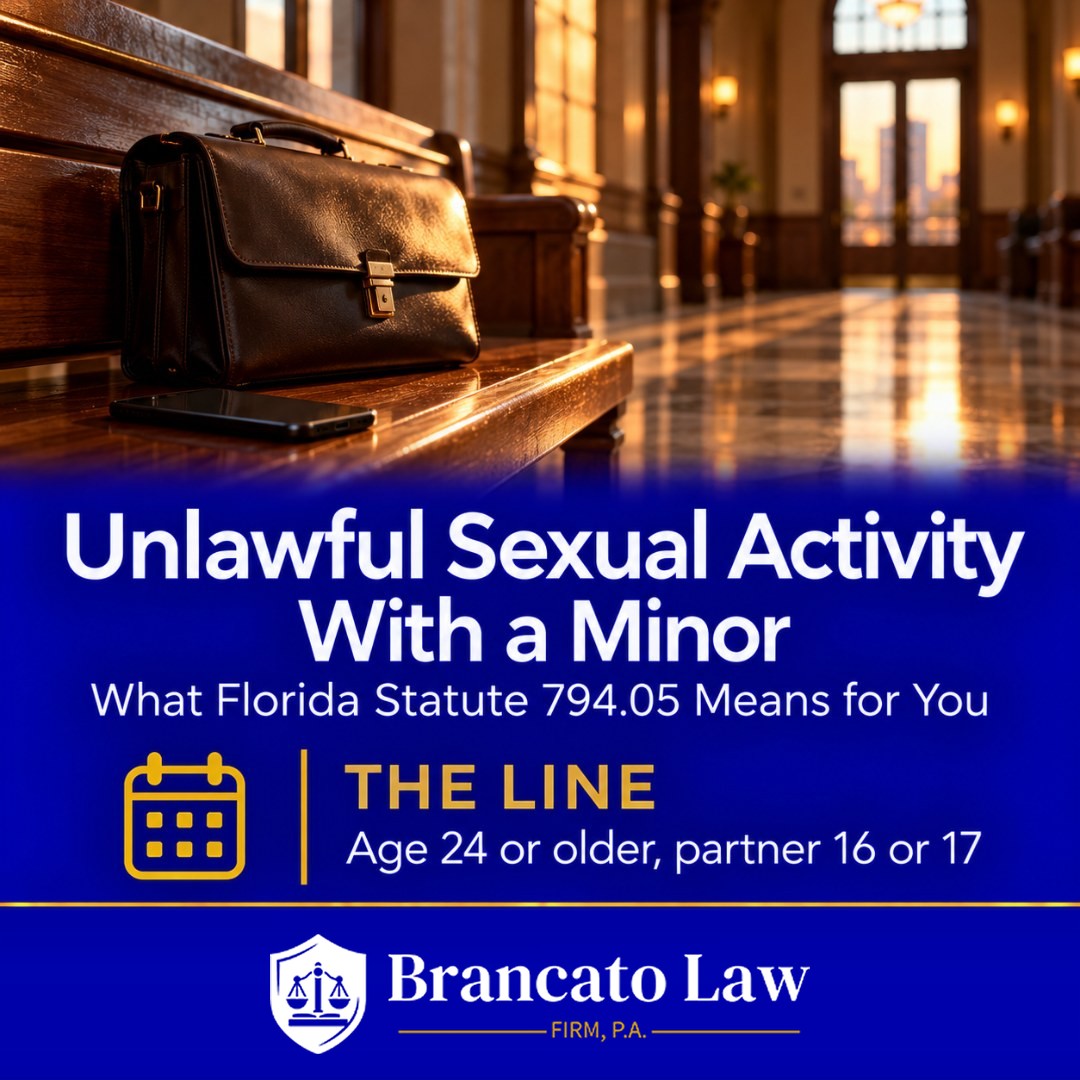
Unlawful sexual activity with a minor in Florida is the crime defined by section 794.05, Florida Statutes: a person 24 or older who engages in sexual activity with a 16- or 17-year-old commits a second-degree felony, punishable by up to 15 years in prison and a $10,000 fine. The minor’s agreement is not a defense, and under section 794.021 neither is a mistaken belief about the minor’s age. A conviction, even with adjudication withheld, requires sex offender registration, and Florida’s Romeo and Juliet law does not apply to this offense.
If a detective has called about your relationship with a 16- or 17-year-old, or you have already been charged under section 794.05, the birth dates and the dates of contact in the police report will shape every decision that follows. I’m Rocky Brancato, founder of The Brancato Law Firm, P.A., a Tampa criminal defense firm. I learned how these cases are built in the Major Crimes Unit of the Hillsborough County Public Defender’s Office, which handled homicide, sex crimes, and child abuse cases, and I have tried more than 150 jury trials to verdict over more than 25 years in Hillsborough County courtrooms. Our attorneys defend section 794.05 charges across Hillsborough, Pinellas, and Pasco Counties, starting with the ages, the dates, and the scoresheet.
What does Florida Statute 794.05 say?
Section 794.05, Florida Statutes, titled “Unlawful sexual activity with certain minors,” makes it a second-degree felony for “a person 24 years of age or older” to engage in sexual activity “with a person 16 or 17 years of age.” People also call this charge sexual conduct with a minor, unlawful sexual conduct with a minor, or statutory rape, but section 794.05 is the statute on the charging document. Our Tampa sex crimes lawyer page explains how The Brancato Law Firm defends this charge and the related offenses below. Florida law defines a minor as anyone who has not turned 18, under section 1.01(13), Florida Statutes, so a 17-year-old is still a minor.
The Florida standard jury instruction for this charge, Instruction 11.7, lists three elements the State must prove beyond a reasonable doubt:
| Element | What the State must prove | Where the defense looks |
|---|---|---|
| 1. Age of the minor | The alleged victim was 16 or 17 at the time of the act | Birth records and the date of each alleged act |
| 2. Age of the accused | The accused was 24 or older at the time of the act | Whether any act happened before the accused’s 24th birthday |
| 3. Sexual activity | Oral, anal, or female genital penetration by, or union with, the sexual organ of another, or anal or female genital penetration by any other object | Whether the act happened at all, and whether it was penetration or union |
Section 794.05 has four more provisions that matter in practice. Sexual activity “does not include an act done for a bona fide medical purpose.” The statute does not apply to a 16- or 17-year-old “who has had the disabilities of nonage removed under chapter 743,” which includes a married minor. The minor’s “prior sexual conduct is not a relevant issue” in the prosecution. And if the offense results in a birth, paternity is established under chapter 742, and an offender found to be the father must pay child support under chapter 61. Our attorneys at The Brancato Law Firm build a timeline of both people’s ages against every alleged act before anything else, because a one-day error on either birthday can take a count outside the statute.
The 24-year line has been tested in court. In State v. Walborn, 729 So. 2d 504 (Fla. 2d DCA 1999), a trial judge in the Second District, which hears appeals from Hillsborough, Pinellas, and Pasco Counties, dismissed a section 794.05 charge as a denial of equal protection. The Second District reversed and held the statute constitutional, finding it “reasonably related to the goal of protecting minors from sexual exploitation by adults.” Florida’s line is unusually high. A 2004 U.S. Department of Health and Human Services report prepared by The Lewin Group, Statutory Rape: A Guide to State Laws and Reporting Requirements, found that 16 states set a minimum age for the accused, and Florida’s 24 was the highest listed.
Is consent a defense to unlawful sexual activity with a minor?
No. The elements of section 794.05 say nothing about consent, so if the State proves the ages and the act, the minor’s willingness does not defeat the charge. Florida courts treat section 794.05 as a strict liability crime, which means the State does not have to prove the accused knew the minor’s age or intended to break the law.
A mistake about age is not a defense either. Section 794.021, Florida Statutes, says that when a crime in chapter 794 depends on the victim’s age, “ignorance of the age is no defense,” and neither is “misrepresentation of age” or “a bona fide belief” that the person was older. A fake ID or a dating profile that says 18 does not change the legal answer. Our post on ignorance of the victim’s age in Florida covers this rule across other sex offenses.
Two appellate cases apply that rule directly to section 794.05. In Hodge v. State, 866 So. 2d 1270 (Fla. 4th DCA 2004), a man convicted of sexual activity with a 17-year-old asked for jury instructions requiring proof that he knew her age and acted with criminal intent. The Fourth District held that “the legislature left no doubt as to its intention that this offense be treated as a strict liability crime,” and affirmed. In Feliciano v. State, 937 So. 2d 818 (Fla. 1st DCA 2006), a 26-year-old whose relationship began two months after the girl’s 17th birthday argued that punishing him without proof he knew her age violated due process. The First District rejected that challenge and affirmed. Because the law closes these doors, The Brancato Law Firm puts the defense where the State still carries the burden: the ages, the dates, and whether the act happened.
What are the penalties for unlawful sexual activity with a minor in Florida?
Unlawful sexual activity with a minor is a second-degree felony carrying up to 15 years in prison under section 775.082, Florida Statutes, and a fine of up to $10,000 under section 775.083, Florida Statutes. The legal ramifications reach well past the sentence itself.
| Consequence | What the law provides | Statute |
|---|---|---|
| Prison | Up to 15 years for each count | 775.082 |
| Fine | Up to $10,000 | 775.083 |
| Scoresheet ranking | Level 6 offense (36 points), plus 80 points for penetration or 40 for contact | 921.0022, 921.0024 |
| Sex offender registration | Required on conviction, even with adjudication withheld; lifelong unless removed | 943.0435 |
| Sex offender probation | Mandatory conditions, including a 10 p.m. to 6 a.m. curfew and treatment | 948.30 |
| Sexual predator designation | Possible if the person has a prior conviction for a listed sex offense | 775.21 |
| Child support | Required if the offense results in a birth and the offender is found to be the father | 794.05(5) |
Section 794.05 carries no mandatory minimum sentence. The real floor comes from the Criminal Punishment Code scoresheet, explained in the next section, and that is where our attorneys at The Brancato Law Firm do much of their sentencing work.
How does the Florida scoresheet score a section 794.05 conviction?
The scoresheet usually calls for prison, even for a person with no record, because Florida adds points for the sexual act itself. Section 921.0022, Florida Statutes, ranks section 794.05(1) as a Level 6 offense, worth 36 points. Section 921.0021(7)(b), Florida Statutes, then requires 80 points for sexual penetration “regardless of whether there is evidence of any physical injury,” or 40 points for sexual contact without penetration. Under section 921.0024, Florida Statutes, any total above 44 points produces a minimum prison sentence: subtract 28 and multiply by 0.75.
| One count, no prior record | Points | Lowest permissible sentence |
|---|---|---|
| Act involved penetration | 36 + 80 = 116 | 66 months in state prison |
| Act involved union without penetration | 36 + 40 = 76 | 36 months in state prison |
| Additional counts or prior record | More points for each | Higher, up to the 15-year maximum per count |
The difference between penetration and union is worth fighting over. In Neira v. State, 847 So. 2d 1134 (Fla. 4th DCA 2003), a 17-year-old testified that she had consensual intercourse with the defendant, and he denied penetration. The judge scored 80 penetration points instead of 40 contact points, which raised the lowest permissible sentence from 36 months to 66.15 months, and imposed 66.15 months. The Fourth District affirmed, holding that the jury did not have to make a separate penetration finding for scoresheet purposes, and certified the question to the Florida Supreme Court as one of great public importance. The lesson for anyone charged today: the nature of the act decides roughly two and a half years of the minimum sentence, so The Brancato Law Firm contests it with the evidence, the charging language, and the verdict form.
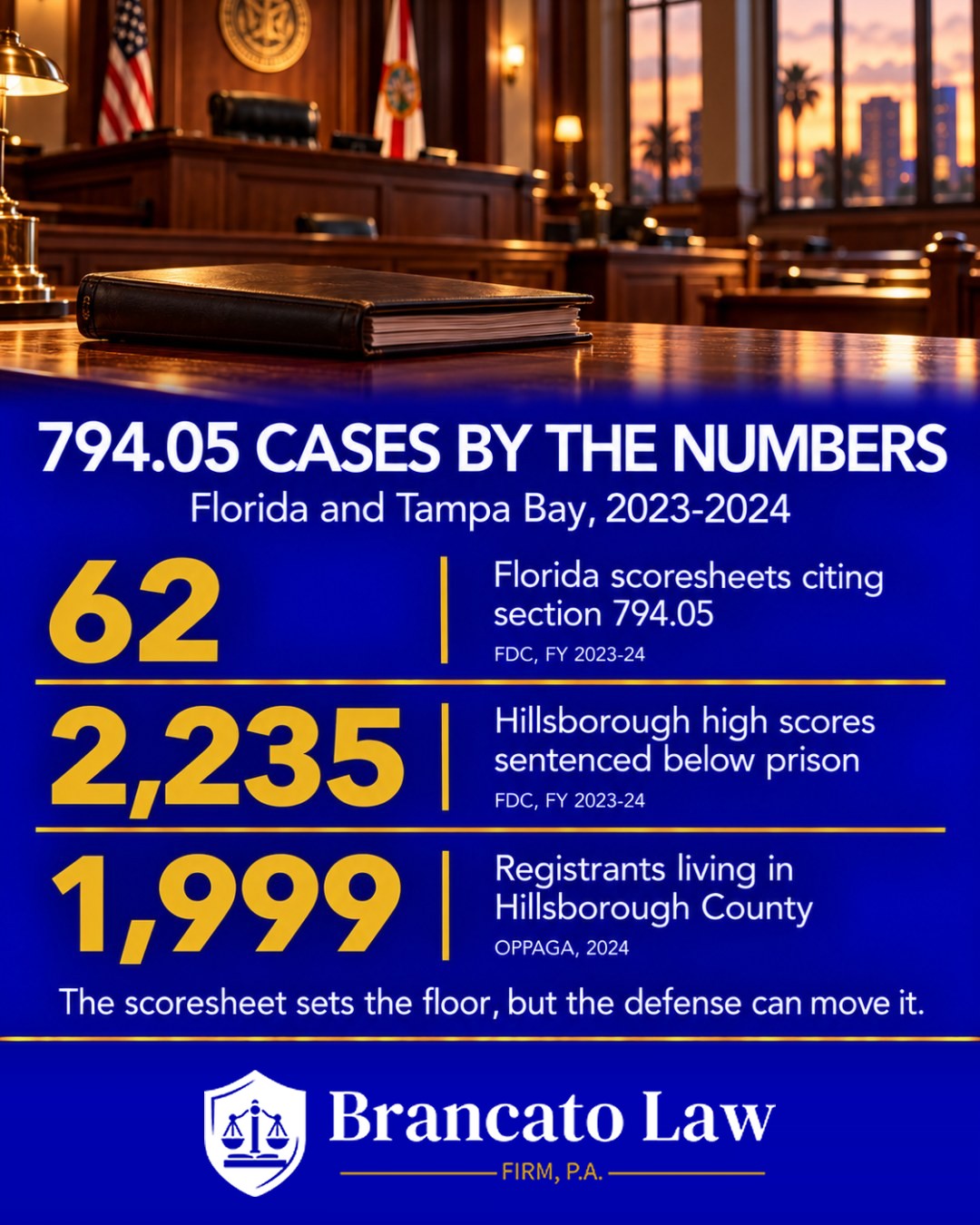
Section 794.05 cases are far less common than other sex charges, and a high score does not always mean prison in Hillsborough County. Scoresheets received by the Florida Department of Corrections (FDC) for sentences from July 1, 2023, through June 30, 2024, cited section 794.05 62 times, compared with 589 for section 800.04 and 472 for section 794.011, according to the FDC report Florida’s Criminal Punishment Code: Assessment and Analysis (2024). The same report shows that in fiscal year 2023-24, Hillsborough County judges sentenced 2,235 of the 3,594 felony scoresheets of all types that scored more than 44 points and recorded a sanction to county jail, probation, or community control instead of state prison.
Can a judge sentence below the scoresheet if the teen was a willing participant?
Yes. Consent is not a defense at trial, but Florida law lets a judge consider it at sentencing. Section 921.0026(2)(f), Florida Statutes, lists as a mitigating circumstance that “the victim was an initiator, willing participant, aggressor, or provoker of the incident,” and that ground can support a downward departure, meaning a sentence below the scoresheet minimum.
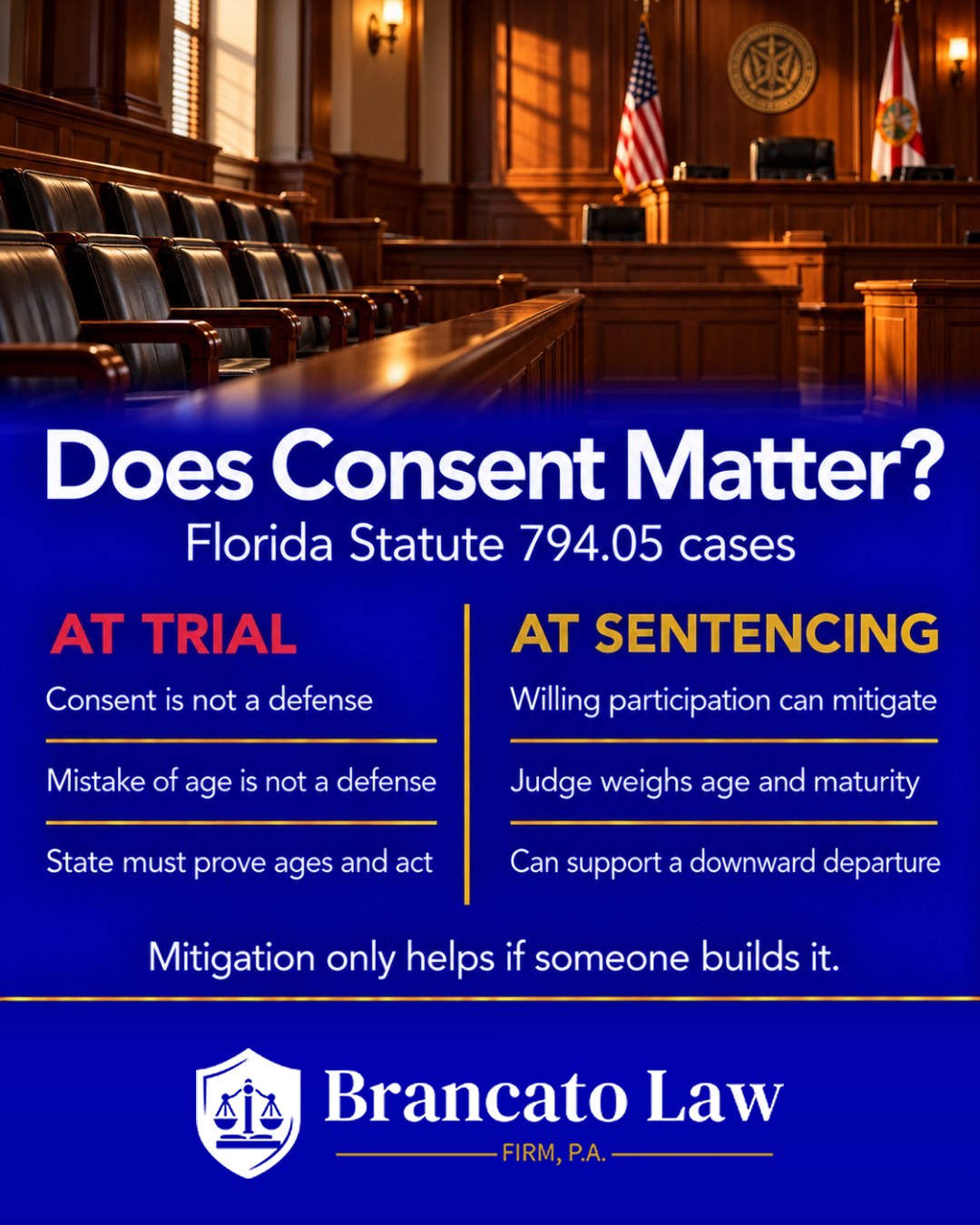
The Florida Supreme Court settled the question in State v. Rife, 789 So. 2d 288 (Fla. 2001). Ronald Rife was convicted of three counts of sexual battery on a 17-year-old who had moved into his home, under a statute that says the minor’s willingness “is not a defense.” Both testified the relationship was consensual and that they planned to marry when she turned 18. His scoresheet minimum was 297.4 months, about 24 years, and the trial judge departed to 102 months followed by 10 years of probation. The court approved the departure, holding that judges are not barred as a matter of law from relying on a minor’s willing participation, while cautioning that the judge must weigh “the victim’s age and maturity and the totality of the facts” and that a young person’s failure to resist “is not the same as willing participation.”
The Second District applied that rule to a section 794.05 case in Rivera v. State, 1 So. 3d 1158 (Fla. 2d DCA 2009). Nelson Rivera pleaded no contest to unlawful sexual activity with a minor and received 10 years in prison. He later claimed his lawyer never presented mitigation, including that the girl had lied about her age. The Second District reversed the summary denial of his claim and sent it back for further proceedings, noting that the sentencing court could have considered her willing participation as mitigation under Rife, even though her misrepresentation of age was no defense to the charge. Mitigation only helps if someone builds it and presents it, which is why The Brancato Law Firm prepares a written mitigation package, with records and witnesses, before any sentencing hearing. Our guide to how to get a downward departure in Florida explains the other legal grounds.
Does a 794.05 conviction require sex offender registration?
Yes. Section 943.0435, Florida Statutes, lists section 794.05 as a qualifying offense, and it defines “convicted” to include a guilty or no contest plea “regardless of whether adjudication is withheld.” A withhold of adjudication, which avoids a formal conviction for most other purposes, does not avoid registration here.
- Initial registration: in person at the sheriff’s office within 48 hours after conviction, or within 48 hours after release from Department of Corrections custody.
- Reregistration: in person twice a year, during the birth month and six months later. Section 794.05 is not on the list of offenses that require reporting every three months.
- Duration: for life, unless a court grants removal. Section 943.0435(11) allows a petition after at least 25 years from release from confinement or supervision, with no arrest for any felony or misdemeanor since release.
- Sexual predator risk: under section 775.21, Florida Statutes, a section 794.05 conviction can lead to sexual predator designation when the person has a prior conviction for a listed sex offense.
Where a person can live depends on whether they are on supervision. Florida’s statutory 1,000-foot residency restriction, section 775.215, applies to listed offenses where the victim was under 16, and section 794.05 is not on that list. Probation is different. For a chapter 794 offense, section 948.30, Florida Statutes, requires a 10 p.m. to 6 a.m. curfew, sex offender treatment at the probationer’s expense, and, when the victim was under 18, a ban on living within 1,000 feet of a school, child care facility, park, or playground and on contact with children under 18 without court approval. Our post on sex offender probation rules in Florida covers those conditions in detail.
Registration touches thousands of people in Tampa Bay. As of October 2024, 1,999 registered sex offenders lived in Hillsborough County communities, 1,579 in Pinellas County, and 872 in Pasco County, according to the Florida Legislature’s Office of Program Policy Analysis and Government Accountability in Report 24-11 (2024). Because registration follows a plea as surely as a guilty verdict, our attorneys at The Brancato Law Firm look first for a resolution to an offense that does not require registration, as several of the results below show. Our guide to sex offender registration in Florida explains the reporting rules.
Does Florida’s Romeo and Juliet law apply to section 794.05?
No. Florida’s Romeo and Juliet law, section 943.04354, Florida Statutes, lets a court remove the registration requirement only for convictions under section 800.04, section 827.071, or section 847.0135(5), and only when the minor was 13 to 17 and the offender was not more than 4 years older. Section 794.05 is not on that list. The age math rules it out anyway: a person 24 or older is always more than 4 years older than a 16- or 17-year-old.
The Romeo and Juliet law is also not a defense to any charge; it only affects registration after a conviction for a qualifying offense. For a section 794.05 registrant, the realistic path off the registry is the 25-year petition described above. Our Romeo and Juliet registry removal guide explains who qualifies, and our article on the age of consent in Florida lays out which age combinations are legal. The Brancato Law Firm reviews registration consequences, including any removal path, before a client decides on a plea.
How is section 794.05 different from lewd or lascivious battery and sexual battery?
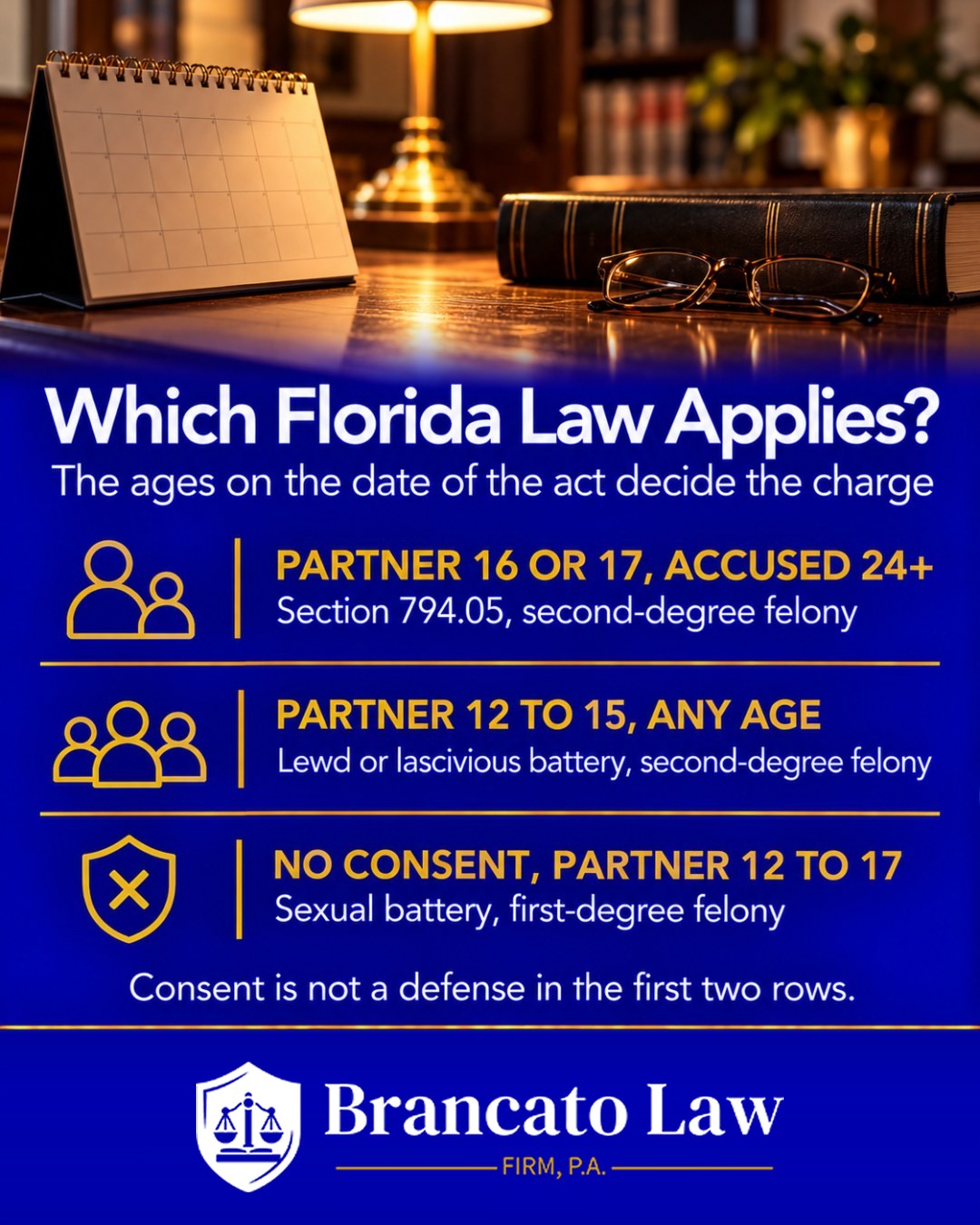
The younger person’s age and whether there was consent decide which statute applies. Section 794.05 covers only 16- and 17-year-olds with a partner 24 or older. Section 800.04, Florida Statutes, covers anyone under 16, whatever the other person’s age. Section 794.011, Florida Statutes, the sexual battery law, covers acts without consent and acts by a parent or other person in familial or custodial authority.
| Charge | Who it covers | Role of consent | Degree and maximum | Romeo and Juliet removal? |
|---|---|---|---|---|
| Unlawful sexual activity with certain minors, 794.05(1) | Accused 24 or older; minor 16 or 17 | Not an element; willingness is not a defense | Second-degree felony; 15 years | No |
| Lewd or lascivious battery, 800.04(4) | Sexual activity with a person 12 to 15; accused of any age | Section 800.04(2) bars consent as a defense | Second-degree felony; 15 years (first-degree for some repeat adult offenders) | Possible if within 4 years and the minor was 13 or older |
| Sexual battery, 794.011(5)(a) | Accused 18 or older; person 12 to 17 | Lack of consent is the core of the charge | First-degree felony; 30 years | No |
| Sexual battery by a person in familial or custodial authority, 794.011(8)(b) | Parent, stepparent, or other custodial adult; minor 12 to 17 | Statute says willingness “is not a defense” | First-degree felony; up to life | No |
The scoresheet also separates these charges. Section 921.0022 ranks lewd or lascivious battery at Level 8, two levels above section 794.05, so the same act scores higher when the younger person is 15 than when the younger person is 16. A claim that a 16- or 17-year-old did not consent changes the case entirely, because it turns a second-degree felony into a first-degree sexual battery charge. Our guides on how to fight a lewd and lascivious charge and how to fight a sexual battery charge in Florida cover those statutes, and The Brancato Law Firm defends every charge in this group.
What defenses work against an unlawful sexual activity charge?
The strongest defenses attack the facts the State must prove: the two ages, the dates, and the act. These are the issues our attorneys work through in every section 794.05 case.

- The accused was under 24 on the date of the act. Section 794.05 does not reach a 23-year-old. We match the accused’s birth date against each alleged date, because acts before the 24th birthday fall outside the statute even if later acts do not.
- The minor was not 16 or 17 on that date. The State must prove the minor’s age with competent evidence, usually birth records. If the minor had turned 18, section 794.05 does not apply; if the minor was 15 or younger, the charge is the wrong statute, and the State must charge and prove a different offense.
- No sexual activity as the statute defines it. Kissing or touching that is not penetration or union is not “sexual activity” under section 794.05. Whether the act was penetration or union also changes the scoresheet by 40 points.
- The accusation is not reliable. Many of these cases rest on one person’s account. We collect texts, social media, location data, and school and work records that confirm or contradict the timeline, and we look for reasons the account changed.
- The minor was emancipated or married. Section 794.05 does not apply to a minor whose disabilities of nonage were removed, and section 743.01, Florida Statutes, removes them for a minor who is or has been married. In Hodge, the Fourth District held this exception is an affirmative defense, so the accused must come forward with evidence of it. Under current law, section 741.04, Florida Statutes, allows a Florida marriage license for a 17-year-old only with parental consent and a spouse no more than 2 years older, so this defense mostly arises from out-of-state marriages or court-ordered emancipation.
- The statement or controlled call can be challenged. Many cases are built on an interview or a recorded call that the minor or a parent makes at a detective’s direction. Our article on fighting a false confession in a Florida sex crime case explains how we challenge those statements.
- Mitigation, if the facts are proven. When the evidence is strong, the willing participation mitigator under Rife, the client’s history, and treatment evaluations can support a sentence below the scoresheet or a negotiated plea to an offense that does not require registration.
A defense does not need a dramatic theory to work. In a case involving a 27-year-old and a 16-year-old, The Brancato Law Firm won a dismissal by showing that the accuser’s account did not hold together, as the results below show.
What should you do if a detective calls about a 16- or 17-year-old?
Decline the interview and call a defense lawyer before you say anything. In a section 794.05 investigation, consent is not a defense, so an admission that a relationship existed can supply most of the State’s case. Detectives often keep the tone friendly and say they “know it was consensual,” and some cases begin with a controlled call from the minor or a parent before any contact from police.
- Do not call, text, or message the minor or the minor’s family about the allegation.
- Do not delete anything. Messages and photos that show dates can prove when a birthday passed or when contact stopped.
- Do not post about the relationship or the investigation on social media.
- Write down the detective’s name, agency, and case number, and give them to your lawyer.
The weeks before an arrest are the best time to act. Our representation before charges are filed can include speaking with the detective for you and presenting information to the State Attorney’s Office before it decides whether to file.
If an arrest has already happened in Hillsborough County, expect to stay in jail until a judge sees you. Section 903.011, Florida Statutes, bars release before first appearance for anyone arrested for a second-degree felony, and the 13th Judicial Circuit’s 2026 bond schedule, Administrative Order S-2025-063, leaves second-degree felonies for a judge to decide. In Hillsborough County, first appearance happens within 24 hours of arrest, by video from the jail, and the judge usually sets no-contact conditions along with any bond. Our Hillsborough County criminal defense attorney page explains what comes next.
Real results in cases involving 16- and 17-year-olds
| Allegation | Result |
|---|---|
| A 27-year-old accused of unlawful sexual contact with a 16-year-old | Dismissed after our social media investigation and the accuser’s inconsistent statements |
| Lewd or lascivious molestation allegation; the alleged victim was 17 | No charges filed; the State issued a letter of release declining all charges (2026) |
| Felony accusation of touching a 16-year-old at an amusement park | Felony dismissed after out-of-state depositions; plea to a non-sexual offense with adjudication withheld and no sex offender registration (2026) |
Past results do not guarantee future outcomes. More results are on our case results page.
Frequently Asked Questions About Unlawful Sexual Activity With a Minor
Can unlawful sexual activity charges be dropped if the teen does not want to cooperate?
They can, but the decision belongs to the State Attorney’s Office, not the minor or the minor’s parents. The Brancato Law Firm has had an unlawful sexual conduct charge involving a 16-year-old dismissed, and a case involving a 17-year-old closed with a letter of release that reflected the alleged victim’s wishes, and our sex crimes defense attorneys push for that outcome from the first week.
Is all sexual activity between an adult and a minor illegal in Florida?
No. Consensual sexual activity between a 16- or 17-year-old and an adult partner under 24 does not violate section 794.05, although other laws, such as those covering school employees, custodial adults, and explicit images, can still apply. The Brancato Law Firm checks every one of those statutes against the facts, and our guide to the Florida age of consent maps the age combinations.
What charge applies if the younger partner is 15 instead of 16?
Sexual activity with a 15-year-old is lewd or lascivious battery under section 800.04(4), a second-degree felony, whether the other person is 18, 23, or 40, and consent is not a defense. Our attorneys at The Brancato Law Firm defend those cases with the same focus on ages and dates, as our article on lewd and lascivious charges in Florida explains.
What is the minimum sentence for unlawful sexual activity with a minor in Florida?
There is no mandatory minimum, but a single count involving penetration scores a lowest permissible sentence of 66 months in prison for a person with no record. The Brancato Law Firm attacks the penetration points and builds departure grounds, such as willing participation under State v. Rife, as described in our guide to downward departures in Florida.
Does a withhold of adjudication avoid sex offender registration for section 794.05?
No. Section 943.0435 requires registration for a section 794.05 plea or verdict “regardless of whether adjudication is withheld.” That is why The Brancato Law Firm negotiates toward offenses that carry no registration requirement, and our page on Florida sex offender registration lists what registrants must report.
Can a woman be charged with unlawful sexual activity with a minor in Florida?
Yes. Section 794.05 applies to “a person 24 years of age or older,” so it covers women and men equally, and it applies whether the minor is a boy or a girl. The Brancato Law Firm defends women and men accused under this statute, often through pre-file advocacy that starts before any arrest.
Can I be charged if I did not know my partner was 17?
Yes. Section 794.021 makes ignorance of age, a lie about age, and a good-faith belief that the person was older no defense. The Brancato Law Firm still documents what the accused was told and shown, because those facts can matter in plea negotiations and at sentencing, as our post on mistake of age in Florida sex cases explains.
Talk to a lawyer before you talk to the detective
Our attorneys start by contacting the detective so you are never interviewed alone, then lock down the birth dates, messages, and records that decide whether section 794.05 even applies. The Brancato Law Firm, P.A., founded by Tampa Criminal Defense Attorney Rocky Brancato, defends unlawful sexual activity charges from the first phone call through trial and sentencing. The days before an arrest are when our attorneys can do the most, so call (813) 727-7159 now for a free, confidential consultation. You can call us at any hour, and our office is two blocks from the courthouse. Our firm has Spanish-speaking staff, and attorney Jean-Luc Adrien speaks Spanish, Haitian Creole, and French. Read about our Spanish and Haitian Creole criminal defense services.
For more about our defense strategies, visit our Sex Crimes page.
The Brancato Law Firm, P.A.
620 E. Twiggs Street, Suite 205, Tampa, FL 33602
(813) 727-7159
Serving Hillsborough, Pinellas, and Pasco Counties
The Brancato Law Firm, P.A. is a Tampa-based criminal defense practice. We are not affiliated with any other Brancato-named law firms.
Visit Us

Tampa, FL 33602

Contact Us Now
Free Legal Consultation (813) 727-7159
