

From First DUI to Death Penalty



How to File an Injunction for Protection in Florida? (2026)


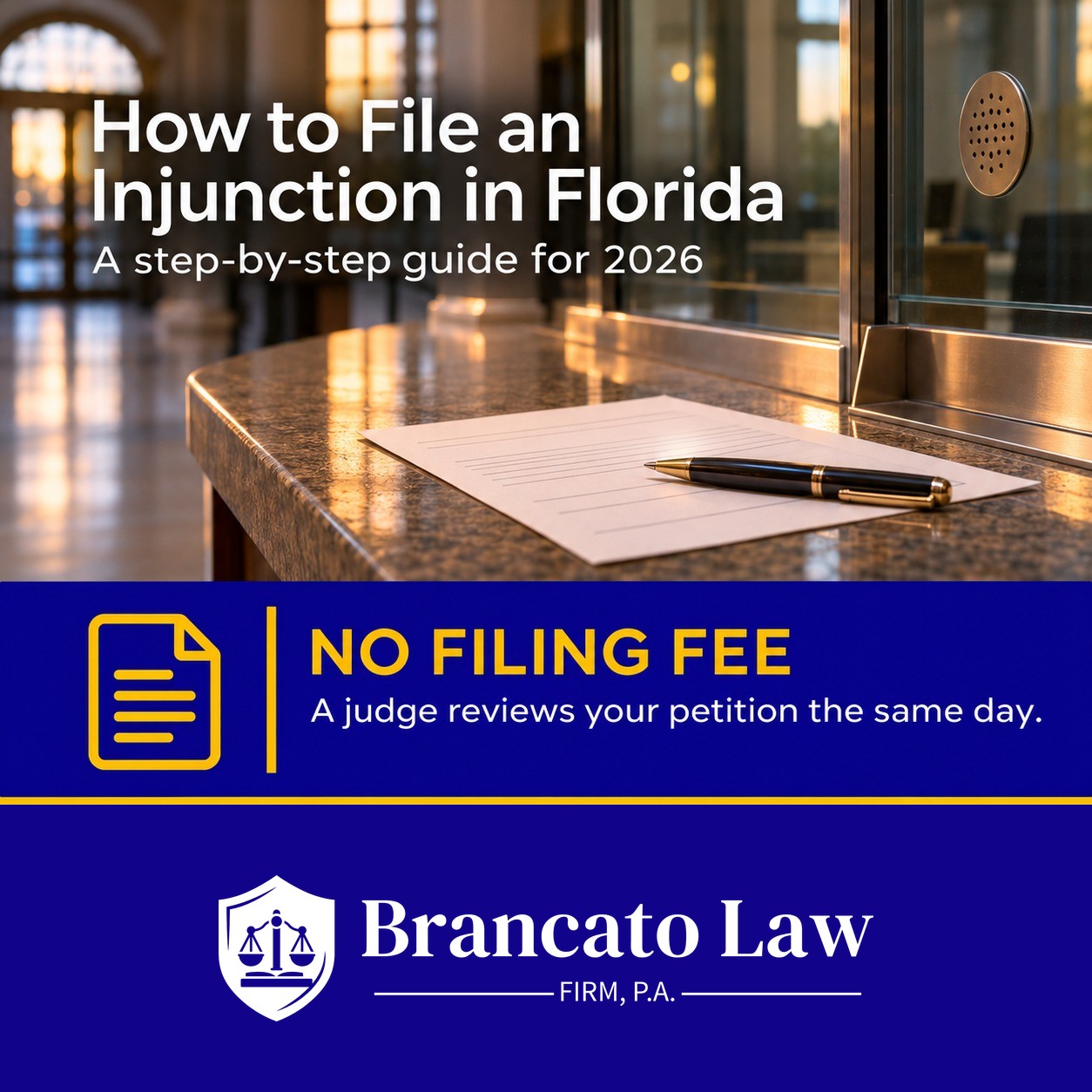
To file an injunction for protection in Florida, go to the Clerk of Court in the county where you live, the respondent lives, or the violence happened, and file a sworn petition that describes specific incidents with dates. There is no filing fee and you do not need a lawyer. A judge reviews the petition the same day and may grant a temporary injunction for up to 15 days, and a final hearing is set before it expires, where you must appear and prove your case with testimony and evidence. Florida offers five types: domestic violence, repeat violence, dating violence, sexual violence, and stalking.
A Florida judge decides whether to grant temporary protection from the petition alone, so the specific facts you write on the form matter more than anything else on the first day. As founder of The Brancato Law Firm, P.A., a Tampa criminal defense firm, I have spent more than 25 years in Hillsborough County courtrooms, including as former Chief Operations Officer of the Hillsborough County Public Defender’s Office, where I oversaw a staff of over 100 attorneys. Our attorneys represent petitioners whose injunction is connected to a criminal case, and this guide walks through every step of filing, with links to the free Clerk, shelter, and legal aid resources in Hillsborough, Pinellas, and Pasco counties.
Which type of injunction should you file in Florida?
The right injunction depends on your relationship with the other person and what happened. Florida law creates five separate injunctions for protection, each with its own statute and proof requirements, and the Clerk will ask you to pick one. Choosing the wrong type is a common reason a petition is denied, so our attorneys at The Brancato Law Firm suggest starting with the table below.
| Type | Who it covers | What you must show | Statute |
|---|---|---|---|
| Domestic violence | Spouses, former spouses, relatives by blood or marriage, people who live or lived together as a family, and parents of a child in common | You were a victim of domestic violence, or you have reasonable cause to believe you are in imminent danger of becoming one | s. 741.30 |
| Repeat violence | Anyone, including neighbors, co-workers, and acquaintances | Two incidents of violence or stalking, one within 6 months of filing | s. 784.046 |
| Dating violence | A continuing and significant romantic or intimate relationship that existed within the past 6 months | Violence plus reasonable cause to believe another act is imminent | s. 784.046 |
| Sexual violence | Any victim, regardless of relationship | One incident of sexual violence; in most cases it must be reported to law enforcement, with cooperation in any criminal case | s. 784.046 |
| Stalking | Anyone, regardless of relationship | Stalking or cyberstalking, usually at least two separate incidents | s. 784.0485 |
Who can file a domestic violence injunction in Florida?
A “family or household member” who is a victim of domestic violence, or who has reasonable cause to believe they are in imminent danger of becoming one, can file a domestic violence injunction under section 741.30, Florida Statutes. Section 741.28 defines domestic violence as assault, aggravated assault, battery, aggravated battery, sexual assault, sexual battery, stalking, aggravated stalking, kidnapping, false imprisonment, or any crime causing injury or death to a family or household member. Except for parents of a child in common, the two people must live together now or have lived together in the past.
You can file whether or not a divorce or custody case is pending, though you must disclose any pending case in the petition. Leaving the home to escape the violence does not take away your right to file. The statute says neither side needs a lawyer, the Clerk may not charge a filing fee, and the court may not require a bond. If your relationship does not fit, a repeat violence, dating violence, or stalking petition may. Our attorneys at The Brancato Law Firm explain these differences in our Tampa domestic violence attorney practice.
How do you file an injunction in Hillsborough County, step by step?
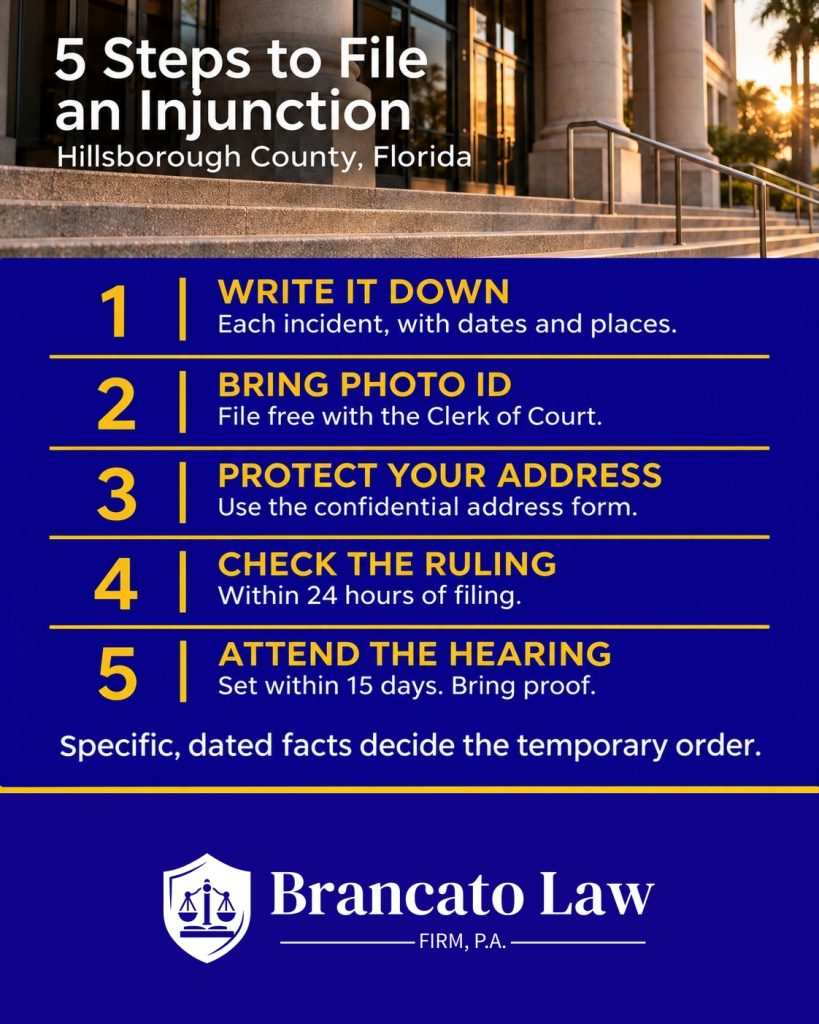
In Hillsborough County, you file the petition in person with the Clerk of Court, and a judge reviews it the same day. The Hillsborough Clerk’s Domestic Violence and Injunctions page and its filing brochure set out the requirements. These are the steps in order.
- Write down the incidents first. List each act of violence, threat, or stalking with the date, place, what was said or done, and who saw it. Gather photos, texts, voicemails, social media messages, medical records, and police report numbers.
- Get the right forms. The Clerk provides the petition free at the counter, and you can print the packets from the Clerk’s domestic violence forms page ahead of time. Write in black ink, on the front of each page only.
- Go to a filing location with state-issued photo ID. You must be 18 or older, or have a parent or guardian sign with you. The main office is the George E. Edgecomb Courthouse, 800 E. Twiggs Street, Room 205, open 8:00 a.m. to 5:00 p.m. on weekdays and 7:00 a.m. to 10:00 a.m. on weekends and holidays. You can also file at the Plant City Courthouse, 301 N. Michigan Avenue, and at the Hillsborough County Sheriff’s Office locations listed on the Clerk’s filing locations page.
- Bring the respondent’s information. The Clerk asks for the respondent’s full name, date of birth, physical description, home address, and workplace, because a deputy must find the person to serve them.
- Protect your address if you need to. For domestic violence, sexual violence, and stalking petitions, you can file a confidential address form. If you do, leave your address off every other page, because the respondent receives a copy of everything else you file.
- Check the judge’s ruling. The brochure says to check no sooner than 2 hours after filing and within 24 hours, using the Clerk’s texting service, HOVER case search, or by calling (813) 276-8100 and saying “Restraining Order.”
- Pick up certified copies and keep them with you. If a temporary injunction is granted, get two certified copies of the injunction and petition. Then mark the final hearing date, which the Clerk sets within 15 days and which you must attend.
The Clerk also publishes the injunction brochure in Spanish. If you need help in Spanish or Haitian Creole with a related criminal case, attorney Jean-Luc Adrien speaks Spanish, Haitian Creole, and French, and our firm has Spanish-speaking staff.
What should you write in an injunction petition?
Write specific facts with dates, places, and exact words, because at the temporary stage the judge can consider only your sworn petition. The repeat violence statute, section 784.046(6)(b), says that at an ex parte hearing no evidence other than the verified petition or an affidavit may be used unless the respondent appears or had notice. Hillsborough’s brochure tells petitioners the same thing: the petition must include specific facts and circumstances, including dates, that meet the legal elements.
For a domestic violence petition based on fear of future violence, section 741.30(6)(b) lists what the judge must weigh. Address every one that applies:
- The history between you, including threats, harassment, stalking, and physical abuse
- Attempts to harm you, your family, or people close to you
- Threats to hide, kidnap, or harm your children
- Injuring, killing, or threatening a family pet or service animal
- Using or threatening to use a gun, knife, or other weapon
- Physically stopping you from leaving the home or calling police
- A criminal history involving violence or threats of violence
- A prior protective order, including one from another state or the military
- Destroying your phone, clothing, or other property
- A pattern of abusive, threatening, intimidating, or controlling behavior
Everything in the petition is sworn under penalty of perjury, and the respondent gets a copy. Stick to what happened and what you saw, heard, or have proof of. Vague statements such as “he is abusive” or “I am scared of her” without incidents behind them are the most common reason a judge denies temporary relief. Our attorneys at The Brancato Law Firm review petitions for clients who also have a criminal case, so the sworn facts line up with what they told police.
What happens after you file a petition for an injunction?
After you file, a judge reviews the petition and either grants a temporary injunction, sets a hearing without one, or denies it. If the judge grants a temporary injunction, it lasts no more than 15 days under section 741.30(5), and the full hearing must be set before it expires. The court can continue the hearing for good cause, including time to serve the respondent, and the temporary injunction is extended while the case is continued.
| Stage | When | What you do |
|---|---|---|
| File the petition | Day 1 | File at the Clerk with photo ID and the respondent’s information |
| Judge’s ruling | Check 2 to 24 hours after filing | Check HOVER, the texting service, or call (813) 276-8100 |
| Service on the respondent | Usually within several business days | The Clerk sends the papers to the sheriff where the respondent lives; track service on HOVER |
| Final hearing | Within 15 days of filing | Appear, testify under oath, and bring witnesses and evidence; if the respondent was not served, appear anyway and the hearing is reset |
| Final judgment | At the end of the hearing | If granted, you receive a copy in court; the Clerk issues a Hope Card |
If the judge denies the temporary injunction, Hillsborough’s Clerk advises that you can pick up the order and file a supplemental petition with more information. For stalking petitions, section 784.0485(5)(b) requires a written denial stating the legal grounds, and if the only reason is that no immediate danger appears, the court must still set a full hearing with notice. Our attorneys at The Brancato Law Firm help clients with a related criminal case decide whether to supplement or proceed to the hearing.
What happens at the final injunction hearing?
The final hearing is a short trial before a circuit judge, where you must prove your case with sworn testimony and evidence. In Ohrn v. Wright, 963 So. 2d 298 (Fla. 5th DCA 2007), the appellate court reversed a repeat violence injunction because the judge did not swear the witnesses and would not let one side call a supporting witness. The court held that at an injunction hearing, all witnesses should be sworn, each party may call witnesses with relevant information, and cross-examination should be allowed. That cuts both ways: the respondent can question you, and you can question the respondent.
Fear alone is not enough unless it is objectively reasonable. In Oettmeier v. Oettmeier, 960 So. 2d 902 (Fla. 2d DCA 2007), a wife obtained an injunction after her husband moved out and later let himself into the house with a locksmith; she found what turned out to be a BB gun. The Second District, which hears appeals from Hillsborough, Pinellas, and Pasco counties, reversed because there was no competent evidence of an objectively reasonable fear of imminent violence, describing the facts as a relationship gone awry. Stalking petitions have their own rule: in Garcia v. Soto, 337 So. 3d 355 (Fla. 4th DCA 2022), the court reversed because the petitioner proved only one qualifying incident, and several approaches during one restaurant visit counted as a single incident.
Bring proof that does not depend only on your word:
- Printed texts, emails, and social media messages with dates showing
- Photos of injuries or property damage, with the date they were taken
- Medical records, police report numbers, and 911 call information
- Witnesses who saw or heard incidents, in person, since a written statement from someone who is not present is usually objected to as hearsay
- Copies for the judge and the respondent
The Clerk warns that if you do not appear, the petition may be dismissed. Hillsborough’s caseload is large enough that the 13th Judicial Circuit opened a new Protective Injunctions Division “M” on June 29, 2026, under Administrative Order S-2026-016. Our attorneys at The Brancato Law Firm prepare clients with related criminal cases for this hearing the way we prepare witnesses for trial.
What can a final injunction order in Florida?
A final domestic violence injunction can order much more than “stay away.” Under section 741.30(6)(a), the court can bar the respondent from committing any act of domestic violence, give you exclusive use of a shared home, give you up to 100 percent of the time-sharing in a temporary parenting plan, set temporary child support, order the respondent into a batterers’ intervention program, and award custody of pets. The terms stay in effect until a judge modifies or dissolves them.
A final domestic violence or stalking injunction also bars the respondent from having any firearm or ammunition. Possessing one is a first-degree misdemeanor under section 790.233, and federal law can apply as well. After a final judgment, Florida’s Hope Card Program under section 741.311 provides a free wallet-sized card showing the order’s details for police. The Hillsborough Clerk began issuing Hope Cards on August 23, 2024 and gives one automatically to every petitioner with a final order. Our attorneys at The Brancato Law Firm advise clients to carry the card and a certified copy together.
Do injunctions for protection actually work?
Research shows long-term protective orders are linked to a large drop in police-reported violence. In 2024, Florida’s clerks processed 78,131 applications for injunctions against domestic, dating, repeat, and sexual violence and stalking, according to the Florida Court Clerks and Comptrollers, reported by The Florida Bar News. The Florida Domestic Violence Hotline received 16,742 calls in fiscal year 2024-25, and 5,777 of them went to its legal hotline, according to the Florida Department of Children and Families 2025 Domestic Violence Annual Report.
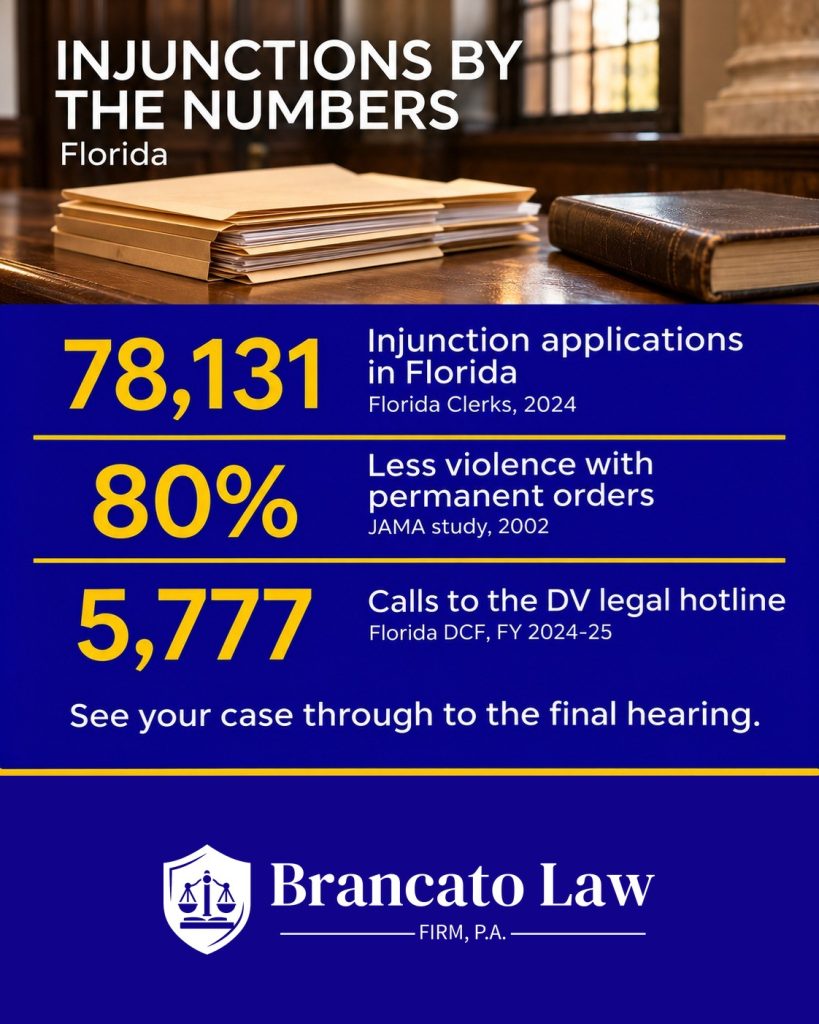
The leading study, Holt and colleagues’ “Civil Protection Orders and Risk of Subsequent Police-Reported Violence” (JAMA, 2002), followed 2,691 Seattle women with a police-reported incident of intimate partner violence. Having a permanent protection order was associated with an 80 percent reduction in police-reported physical violence in the following year, while temporary orders alone did not show that benefit. The lesson for Florida petitioners is to see the case through to the final hearing, and to pair the order with a safety plan from a certified domestic violence center. Our attorneys at The Brancato Law Firm make the same point to every petitioner we represent.
What if you also have a criminal case connected to the injunction?
If you are facing a criminal charge or investigation that arises from the same relationship, coordinate the injunction with your criminal defense before you file or testify. What you swear to in the petition and at the hearing is recorded and can be used in the criminal case. That is why The Brancato Law Firm represents petitioners who have a related criminal case: the two cases have to tell the same true story.
One example from our case results: a young woman came to Rocky after her abusive ex falsely accused her of assault, and a warrant was out for her arrest. Rather than have her turn herself in, Rocky contacted the intake prosecutor and presented evidence of the ex’s abuse, and the State dropped the charge and recalled the warrant. She never went to jail or appeared in court, and Rocky then helped her obtain a protective order against the ex. Past results do not guarantee future outcomes. This kind of early intervention is the heart of our representation before charges are filed.
Florida courts may not issue mutual injunctions, but section 741.30(1)(i) allows separate injunctions when each party proves its own case. A criminal no-contact order set at first appearance is a different order from a civil injunction, and either can exist without the other. Our guide to the Florida criminal case process explains how the criminal side moves from arrest to trial.
Where can you get free help filing an injunction in the Tampa Bay area?
Every county in our area has a certified domestic violence center, and Hillsborough has free injunction attorneys through The Spring of Tampa Bay. You do not need a lawyer to file, but you do not have to do it alone. The Hillsborough County resources are listed first, followed by Pinellas and Pasco.
| Resource | What it does | Contact |
|---|---|---|
| The Spring of Tampa Bay | Hillsborough’s certified domestic violence center: 24/7 hotline, emergency shelter, safety planning, counseling | (813) 247-SAFE (7233); TTY (813) 248-1050 |
| The Spring’s Injunction for Protection Project | Free Florida Bar-licensed attorneys for injunction petitions in Hillsborough County | Call or text (813) 495-3523 |
| Hillsborough County Clerk of Court | Free petition forms, filing, case status, Hope Cards | (813) 276-8100 |
| Bay Area Legal Services | No-cost domestic violence attorneys | (813) 232-1343 |
| State Attorney’s Victim Assistance Program, 13th Circuit | Help for victims in a related criminal case | (813) 272-6472 |
| Sixth Judicial Circuit (Pinellas and Pasco) | Filing locations for Pinellas and Pasco clerks and local help | Pinellas Clerk (727) 464-7000 |
| CASA (Community Action Stops Abuse) | Pinellas domestic violence center and injunction attorneys | (727) 895-4912 |
| Pasco County Clerk and Comptroller | Protective injunction petitions and forms | pascoclerk.com |
| Sunrise of Pasco County | Pasco domestic and sexual violence center, 24/7 hotline | (352) 521-3120 |
| Florida Domestic Violence Hotline | Statewide 24/7 hotline with a legal line | 1-800-500-1119 |
For a life-threatening emergency, call 911 first. Our attorneys at The Brancato Law Firm refer petitioners without a related criminal case to these organizations, because they are free and they work in these courtrooms daily.
How long does an injunction last in Florida, and can it be changed?
A final injunction for protection lasts until a judge modifies or dissolves it, unless the order sets an end date. Under section 741.30(6)(c), either party may move at any time to modify or dissolve the injunction. A petitioner who no longer wants the case can file a verified motion to voluntarily dismiss on the Clerk’s form, but cannot simply withdraw it at the counter.
Violating a domestic violence, repeat, dating, sexual violence, or stalking injunction is a crime, and it can be prosecuted or enforced through contempt. Our post on how an injunction violation is charged in Florida explains the penalties under section 741.31. If you were served with a petition rather than filing one, read our companion guide on how to fight an injunction petition in Florida. Our attorneys at The Brancato Law Firm handle both sides of this line when a criminal case is involved.
What should you do today if you are in danger?
If you are in danger right now, call 911, then call The Spring at (813) 247-SAFE (7233) for a safety plan and a place to stay. You can file the same day, and in Hillsborough the Edgecomb Courthouse filing office is open from 7:00 a.m. to 10:00 a.m. on weekends and holidays. Keep a copy of your petition and any temporary injunction with you once it is granted, and call police if the respondent contacts you after being served. Our attorneys at The Brancato Law Firm will talk with you at any hour if a criminal case is part of the picture.
Frequently asked questions about filing an injunction in Florida
Can I file an injunction online in Hillsborough County?
Yes, the Clerk lists online filing through TurboCourt on its filing locations page, along with the courthouse and sheriff’s office locations. The Brancato Law Firm still suggests filing in person when you can, because a deputy clerk can check that the petition is complete before it goes to the judge.
How much does it cost to file a restraining order in Florida?
It costs nothing; Florida law prohibits a filing fee for domestic violence, repeat, dating, sexual violence, and stalking petitions, and no bond is required. Our attorneys at The Brancato Law Firm tell petitioners that the free Hope Card issued after a final order also carries no fee under section 741.311.
Can a parent file an injunction on behalf of a child in Florida?
Yes, a parent or legal guardian of a minor child living at home can file for repeat violence, dating violence, sexual violence, or stalking protection on the child’s behalf under section 784.046 and section 784.0485. The Brancato Law Firm notes that when the respondent is the child’s other parent, the filing parent must have been an eyewitness or have direct physical evidence or eyewitness affidavits.
What happens if the judge denies my temporary injunction?
A denial of the temporary injunction is not the end of the case; you can file a supplemental petition with more detail, and the judge may set a hearing with notice instead. Our attorneys at The Brancato Law Firm look first at whether the petition left out dated incidents that the statute requires.
Can I drop an injunction I filed in Florida?
Yes, by filing a verified motion to voluntarily dismiss, which a judge must approve. The Brancato Law Firm reminds petitioners that until the judge signs the order, the injunction stays in force, and only the respondent can be charged for contact the order prohibits, as our guide to alleged victims dropping charges explains for the criminal side.
Do I need a lawyer to file an injunction for protection?
No, the statute says neither party must have a lawyer, and the Clerk must help you with the forms. When the injunction is tied to a criminal charge or investigation, our domestic violence defense attorneys at The Brancato Law Firm represent petitioners so the civil and criminal cases stay consistent.
Will the respondent see my new address?
Not if you use the confidential address form for a domestic violence, sexual violence, or stalking petition and leave your address off every other page. The Brancato Law Firm also points petitioners to Florida’s Address Confidentiality Program, which The Spring of Tampa Bay helps survivors apply for.
For more about how our firm handles domestic violence cases on both sides of an injunction, visit our Domestic Violence page.
If your injunction is tied to an arrest, a warrant, or a pending charge, talk to a criminal defense attorney before you file or testify, because the final hearing is set within 15 days. Call The Brancato Law Firm, P.A., founded by Tampa Criminal Defense Attorney Rocky Brancato, at (813) 727-7159, and our attorneys will review your petition and your criminal exposure together. You can call us at any hour. Our firm has Spanish-speaking staff, and attorney Jean-Luc Adrien speaks Spanish, Haitian Creole, and French. Our office is two blocks from the courthouse, and we represent clients in Hillsborough, Pinellas, and Pasco counties.
The Brancato Law Firm, P.A.
620 E. Twiggs Street, Suite 205, Tampa, FL 33602
(813) 727-7159
Serving Hillsborough, Pinellas, and Pasco Counties
The Brancato Law Firm, P.A. is a Tampa-based criminal defense practice. We are not affiliated with any other Brancato-named law firms.
Visit Us

Tampa, FL 33602

Contact Us Now
Free Legal Consultation (813) 727-7159
