

From First DUI to Death Penalty



How to Fight an Injunction Petition in Florida? (2026)


To fight an injunction petition in Florida, appear at the final hearing, which is set within 15 days, with witnesses and documents, and hold the petitioner to the legal standard. For a domestic violence injunction, the petitioner must prove actual domestic violence or an objectively reasonable fear of imminent violence; for a stalking injunction, at least two separate incidents, each proven by competent evidence. Do not contact the petitioner while a temporary injunction is in place, even to apologize or ask them to drop it. If you also face a criminal charge, your sworn testimony can be used against you, so plan it with a criminal defense attorney.
As founder of The Brancato Law Firm, P.A., a Tampa criminal defense firm, and a former Chief Operations Officer of the Hillsborough County Public Defender’s Office, where I oversaw a staff of over 100 attorneys, I have watched injunction hearings decide where people live, whether they see their children, and whether they can own a gun, all in a hearing that often lasts less than an hour. I have also spent more than 25 years in Hillsborough County courtrooms. Our attorneys defend respondents at final injunction hearings and handle the criminal case that so often runs alongside one, and this guide explains how that defense works.
What does it mean to be served with a temporary injunction in Florida?
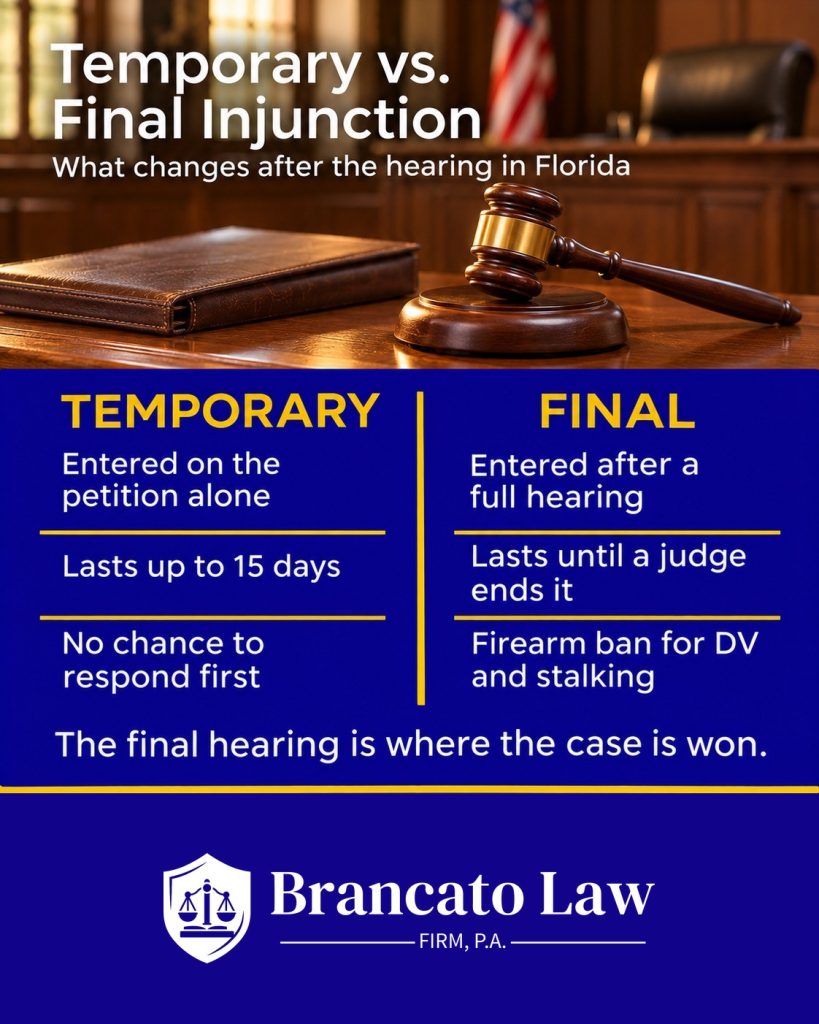
A temporary injunction is a court order entered on the petitioner’s sworn paperwork alone, before you have had any chance to respond. A judge may grant one under section 741.30(5), Florida Statutes when the petition shows an immediate and present danger of domestic violence, and it lasts no more than 15 days unless the hearing is continued. It is not a finding that you did anything. The Florida Senate’s staff report on protective injunctions put it plainly: at the temporary stage the court relies on the four corners of the petition and may not consider other evidence.
The order still takes effect the moment you are served, and breaking it is a crime. It can order you out of a shared home, bar all contact, set temporary time-sharing for your children, and keep you away from the petitioner’s home, work, and school. Our attorneys at The Brancato Law Firm tell every client the same first rule: obey every term until a judge changes it.
| Temporary (ex parte) injunction | Final injunction | |
|---|---|---|
| How it is entered | On the petition alone, without hearing from you | After a full hearing with sworn testimony from both sides |
| How long it lasts | Up to 15 days, extended if the hearing is continued | Until a judge modifies or dissolves it, unless it sets an end date |
| Firearms | Often ordered surrendered under the order’s terms | Possession is a crime under s. 790.233 for domestic violence and stalking injunctions, and federal law may also apply |
| Violation | A crime under s. 741.31 and contempt | A crime and contempt; a repeat can become a felony |
| Your chance to respond | None before entry | Testify, call witnesses, cross-examine, present evidence |
What does the petitioner have to prove at the final hearing?
The petitioner carries the burden of proof, and the elements depend on the type of injunction. If the petition was filed under the wrong statute, or the relationship does not qualify, the petition fails no matter what the testimony shows. Our attorneys at The Brancato Law Firm start every case by checking the petition against the statute it was filed under.
| Type | Relationship requirement | What must be proven |
|---|---|---|
| Domestic violence | A “family or household member” under s. 741.28: spouses, former spouses, relatives, people who live or lived together as a family, or parents of a child in common | An act of domestic violence, or reasonable cause to believe the petitioner is in imminent danger of one |
| Repeat violence | None | Two incidents of violence or stalking, one within 6 months of filing |
| Dating violence | A continuing and significant romantic or intimate relationship within the past 6 months; not a casual acquaintance | Violence, plus reasonable cause to believe another act is imminent |
| Sexual violence | None | One incident of a listed sex offense, generally reported to police with cooperation in any criminal case |
| Stalking | None | Willful, malicious, and repeated following, harassment, or cyberstalking under s. 784.048 |
Two appellate rules do much of the work. First, fear has to be objectively reasonable. In Oettmeier v. Oettmeier, 960 So. 2d 902 (Fla. 2d DCA 2007), the Second District, which hears appeals from Hillsborough, Pinellas, and Pasco counties, reversed an injunction against a husband who had moved out and later entered the house with a locksmith. The wife was afraid, and the trial judge believed her, but the appellate court held that subjective fear without an objectively reasonable basis is speculation that cannot support an injunction.
Second, a stalking injunction needs two separately proven incidents. “Harass” under section 784.048 means a course of conduct that causes substantial emotional distress and serves no legitimate purpose, and courts judge the distress by a reasonable person standard. In Garcia v. Soto, 337 So. 3d 355 (Fla. 4th DCA 2022), the court reversed a stalking injunction because four approaches to the petitioner’s table during one restaurant visit were one continuous incident, and a later conversation would not cause a reasonable person substantial distress. That left one incident, and one is not enough.
How do our attorneys fight an injunction petition in Florida?
Our attorneys fight injunction petitions with evidence, cross-examination, and a plan for any criminal case, in that order. These are the seven approaches The Brancato Law Firm uses most in Hillsborough, Pinellas, and Pasco courtrooms.
1. Hold the petitioner to the statute and the relationship
We compare every allegation to the elements of the statute the petitioner chose. A dating violence petition fails if the relationship ended more than 6 months before filing or was never continuing and significant. A repeat violence petition fails without two incidents, one within 6 months. A domestic violence petition fails if the parties never lived together and have no child in common.
2. Test whether the fear is objectively reasonable
When a domestic violence petition rests on fear of future violence, we walk the judge through the factors in section 741.30(6)(b), such as threats, weapons, prior violence, and prior protective orders, and show which ones are missing. Arguments, breakups, and rude messages are not domestic violence. Under Oettmeier, a relationship gone bad is not the same as imminent danger.
3. Break a stalking claim into separate incidents
We list each claimed incident and ask whether it stands alone, whether it was part of one continuous event, and whether it had a legitimate purpose, such as arranging child exchanges or returning property. Under Garcia, several contacts during one event count once.
4. Build the timeline from records, not memory
We collect the full text and call history, social media messages, phone location data, work schedules, receipts, doorbell and dash camera video, and any 911 audio and body camera footage. Petitions are written in a hurry and often get dates, places, and sequences wrong. A screenshot of a reply the petitioner left out of the petition, or a timecard showing you were at work, can decide the hearing.
5. Cross-examine and lock in sworn testimony
You have a due process right to a real hearing. In Ohrn v. Wright, 963 So. 2d 298 (Fla. 5th DCA 2007), the court reversed an injunction because the judge did not swear the witnesses and refused to let the respondent call a witness; due process requires sworn witnesses, the right to call witnesses with relevant information, and cross-examination. Our attorneys use cross-examination to expose gaps and contradictions, and the petitioner’s sworn answers become a record that matters if a criminal case follows.
6. Protect your rights in any criminal case
If the same events led to an arrest or an investigation, we decide before the hearing whether you will testify and on what subjects. Our usual approach is to agree that the temporary injunction stays in place and ask the judge to set the final hearing for a status date instead, a request judges typically grant. The section below on testifying explains why this matters so much.
7. Show the motive behind the petition
When a petition is filed in the middle of a divorce, custody fight, or eviction, the timing matters, and we put it in front of the judge. The Florida Senate Judiciary Committee’s 2011 interim report on protective injunctions recognized that misuse of injunctions does occur through false petitions, including to gain leverage in a divorce or custody case. A motive is not a defense by itself, but it gives the judge a reason to look harder at testimony that is not backed by records.
How many injunction petitions are filed in Florida, and how many are dismissed?
Florida courts handle tens of thousands of injunction petitions a year. In 2024, Florida’s clerks processed 78,131 applications for injunctions against domestic, dating, repeat, and sexual violence and stalking, according to the Florida Court Clerks and Comptrollers, reported by The Florida Bar News. Florida also recorded 71,146 domestic violence arrests in 2024, according to criminal history data in the Florida Department of Children and Families 2025 Domestic Violence Annual Report, and many of those arrests are followed by an injunction petition.
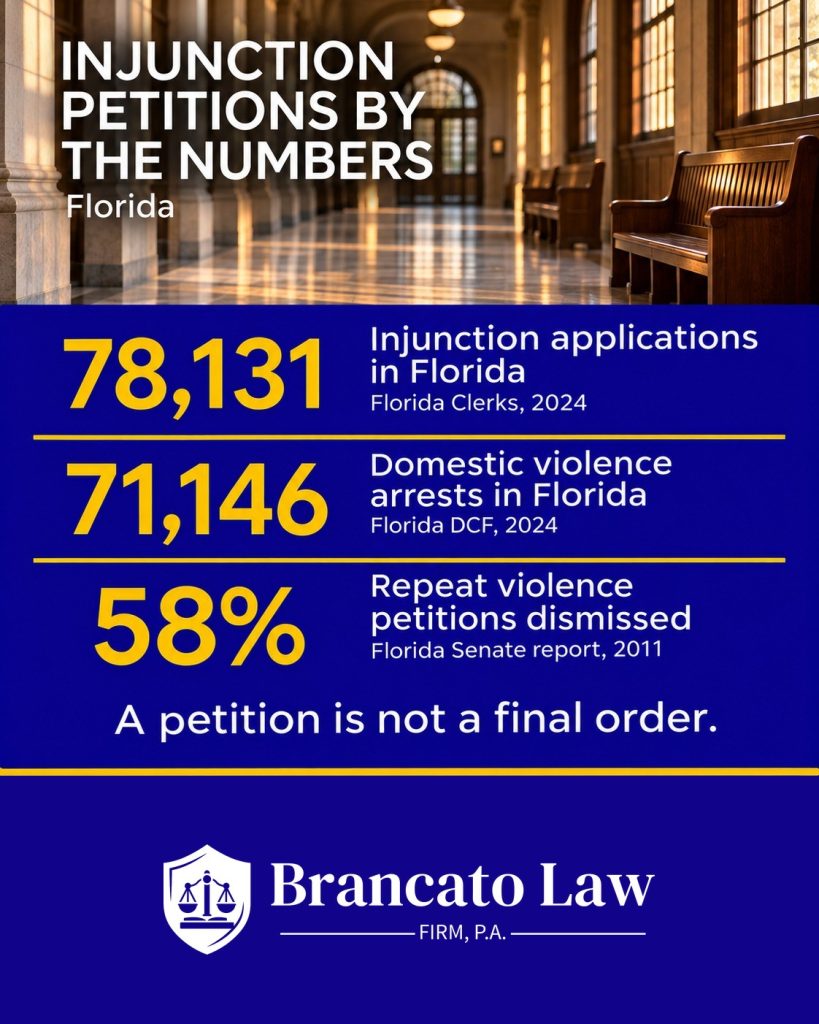
Petitions are not automatically granted. The Florida Senate’s 2011 interim report, the most recent statewide review we have found, reported that about 58 percent of repeat violence petitions were dismissed at that time, and that in a survey of Florida judges, 14 of 33 who answered named repeat violence cases as the greatest source of misuse. In Hillsborough, the 13th Judicial Circuit opened a new Protective Injunctions Division “M” on June 29, 2026, under Administrative Order S-2026-016, to keep up with the caseload. Our attorneys at The Brancato Law Firm prepare each hearing knowing the judge may have a full docket that morning.
Should you testify at an injunction hearing if you have a pending criminal case?
Not without a criminal defense attorney’s advice, because anything you say under oath at the hearing can be used by the State Attorney’s Office. Injunction hearings are recorded, and prosecutors can obtain the record. The Fifth Amendment protects you from being forced to testify against yourself, but invoking it in the civil hearing may leave the petitioner’s account unanswered.
Courts do not have to pause the injunction case for you. In Speegle v. Rhoden, 236 So. 3d 498 (Fla. 1st DCA 2018), a man charged with battery asked the court to stay a dating violence injunction hearing until his criminal case ended, offering to keep the temporary injunction in place. The trial court refused, the petitioner testified and he did not, and the court entered a permanent injunction. The First District affirmed, holding there is no automatic right to a stay when a related criminal case is pending and that the decision is within the trial judge’s wide discretion.
Here is how that works in practice in Hillsborough, Pinellas, and Pasco courtrooms. When our client also faces a criminal charge, our attorneys will often agree to the temporary injunction and ask the judge to set a status date on the final injunction hearing, and judges typically grant it. The temporary injunction keeps protecting the petitioner, the State has time to make its filing decision and turn over discovery, and our client is not put in the position of testifying at the injunction hearing in a way that hurts the criminal case. Our client must still obey every term of the temporary injunction while the case is on hold.
That is why our attorneys plan the hearing around the criminal case, not the other way around. Sometimes the right move is to request a continuance; sometimes it is to defend through cross-examination, documents, and other witnesses without the respondent testifying; and sometimes limited testimony on a safe subject is enough. If you are under investigation and not yet charged, our pre-file advocacy can shape what reaches the prosecutor before a filing decision is made. The Florida criminal case process guide explains how the criminal side moves from arrest to trial.
What are the consequences of a final injunction in Florida?
A final injunction can affect your home, your children, your guns, your job, and your immigration status for years. It is a civil order, but it reaches far into daily life. Our attorneys at The Brancato Law Firm review these consequences with every client before the hearing:
- Firearms. Having any firearm or ammunition while subject to a final domestic violence or stalking injunction is a first-degree misdemeanor under section 790.233. Federal law, 18 U.S.C. § 922(g)(8), separately bars firearm possession under many protective orders involving an intimate partner entered after notice and a hearing. In United States v. Rahimi, 602 U.S. 680 (2024), the U.S. Supreme Court upheld that federal ban, 8 to 1, as applied to a person a court has found to be a credible threat to another person’s safety. Our post on domestic violence and gun rights in Florida covers the criminal side.
- Home and children. A final domestic violence injunction can give the petitioner exclusive use of a shared home, up to 100 percent of time-sharing in a temporary parenting plan, and temporary child support, and it can order you into a batterers’ intervention program.
- Public record. The injunction is a court record that can be found in background checks by employers, landlords, and licensing agencies.
- Immigration. Under 8 U.S.C. § 1227(a)(2)(E)(ii), a noncitizen whom a court finds has violated the protective terms of a protection order can be deportable. Attorney Jean-Luc Adrien speaks Spanish, Haitian Creole, and French, so clients can understand these risks in their own language.
- Future charges. Any contact the order prohibits becomes a new crime. Our guide on how to fight an injunction violation charge in Florida explains how quickly a repeat violation can become a felony.
Should you agree to the injunction or to a continuance?
Agreeing to a final injunction, even “without admitting” anything, still makes you subject to a final injunction, with the same firearm ban under section 790.233 and the same criminal exposure for violations. Some respondents agree to avoid a hearing without realizing that. An agreed continuance with the temporary injunction extended, or an order with narrower terms, may be a better outcome, depending on the facts and any criminal case.
Never contact the petitioner to ask them to drop the case, and never ask friends or family to pass along a message. Indirect contact can violate the order and can also be charged as witness tampering if a criminal case is open. A petitioner who wants to end the case can file a verified motion to dismiss with the Clerk on their own. Our attorneys at The Brancato Law Firm handle any communication through proper channels.
Can a final injunction be dissolved or appealed?
Yes, both are possible. Under section 741.30(6)(c) and section 784.0485(6)(b), either party may move at any time to modify or dissolve a final injunction, and the statutes say no specific allegations are required. In practice, judges look for changed circumstances, such as time passed without incident, a completed criminal case, or a new parenting plan.
An appeal to the Second District Court of Appeal must generally be filed within 30 days of the final judgment. Appeals turn on the hearing record, so a hearing where the judge cut off testimony, refused a witness, or granted relief without evidence of each element is the kind of record that gets reversed. Our attorneys at The Brancato Law Firm make the record at the hearing with an appeal in mind.
Can you file your own injunction against the petitioner?
Yes, if you can prove your own case, but a judge will not issue “mutual” orders. Section 741.30(1)(i) prohibits mutual orders of protection while allowing separate injunctions when each party meets the statute on their own petition. A counter-petition filed only to even the score is sworn under penalty of perjury and can hurt your credibility. If you were the one being abused, our companion guide on how to file an injunction for protection in Florida explains the process, and The Brancato Law Firm represents petitioners who have a related criminal case.
What should you do in the first 48 hours after being served?
The hearing date is printed on the papers and comes fast, so the first two days set up the defense. Take these steps right away:
- Read every term of the temporary injunction, including distances, places, and any order to leave the home or surrender firearms, and follow all of it.
- Make no contact with the petitioner in person, by phone, text, email, or social media, and do not send messages through friends, family, or the children unless the order allows exchanges.
- Look up the case on HOVER if it is in Hillsborough County, or on the Clerk’s site in Pinellas or Pasco, and get a copy of the petition and any attachments.
- Save every text, call log, photo, video, and social media message, and write down where you were on each date in the petition.
- List witnesses who saw the events or can confirm where you were, and ask them to keep the hearing date open.
- Do not post about the case or the petitioner online.
- Call a criminal defense attorney before you talk to police or write a statement, especially if there was an arrest.
The Hillsborough Clerk’s injunction page tells respondents to attend the hearing with witnesses and evidence. If you do not appear, the judge can enter a final injunction based on the petitioner’s testimony alone. Call The Brancato Law Firm as soon as you are served, so our attorneys have the full window to prepare.
Frequently asked questions about fighting an injunction in Florida
Can a temporary injunction be dismissed before the final hearing?
Usually the case is decided at the final hearing, but a petitioner can voluntarily dismiss before then, and a legally defective petition can be challenged by motion. The Brancato Law Firm reviews the petition the day you hire us to see whether it even alleges the elements of the statute it was filed under.
Can you get an injunction hearing continued in Florida?
Yes, the court can continue the hearing for good cause shown by either party, and the temporary injunction is extended in the meantime. When a related criminal case is pending, our attorneys at The Brancato Law Firm often agree to keep the temporary injunction in place and ask for a status date on the final hearing, which judges typically grant, while remembering from Speegle v. Rhoden that the judge has discretion to refuse.
What happens if you do not show up to an injunction hearing?
The judge can hear from the petitioner alone and enter a final injunction that stays in place until it is modified or dissolved. The Brancato Law Firm’s office is two blocks from the courthouse, and our attorneys stand beside clients at these hearings so no one has to face one alone.
Can an injunction be dropped if the petitioner changes their mind?
Yes, the petitioner can file a verified motion to voluntarily dismiss, and the judge decides whether to grant it. Our attorneys at The Brancato Law Firm warn clients that asking the petitioner to do this is contact the order forbids, as our guide to alleged victims who want charges dropped explains.
Does a domestic violence injunction show up on a background check?
It is a public court record, so it can appear in court record searches by employers, landlords, and licensing boards, though it is not a criminal conviction. The Brancato Law Firm fights the petition at the hearing because the record is far harder to deal with after a final judgment.
Can I lose my guns from a temporary injunction in Florida?
Yes, a temporary injunction can order you to surrender firearms, and once a final domestic violence or stalking injunction is entered, possessing any firearm or ammunition is a crime under section 790.233. Our Tampa domestic violence attorney team at The Brancato Law Firm explains federal firearm consequences before any agreement is signed.
Do I need a lawyer to fight an injunction in Florida?
The law does not require one, but the hearing is a trial with sworn testimony, evidence rules, and cross-examination, often scheduled within 15 days. Our attorneys at The Brancato Law Firm are especially important when a criminal investigation is open, because we coordinate the hearing with representation before charges are filed.
For more about our defense strategies, visit our Domestic Violence page.
Your final hearing is likely set within 15 days of the petition, and the records that win these hearings are easiest to collect in the first few days. Our attorneys will start by reading the petition against the statute and building your timeline. Call The Brancato Law Firm, P.A., founded by Tampa Criminal Defense Attorney Rocky Brancato, at (813) 727-7159; you can call us at any hour. Our firm has Spanish-speaking staff, and attorney Jean-Luc Adrien speaks Spanish, Haitian Creole, and French. Our office is two blocks from the courthouse, and we defend injunction petitions in Hillsborough, Pinellas, and Pasco counties.
The Brancato Law Firm, P.A.
620 E. Twiggs Street, Suite 205, Tampa, FL 33602
(813) 727-7159
Serving Hillsborough, Pinellas, and Pasco Counties
The Brancato Law Firm, P.A. is a Tampa-based criminal defense practice. We are not affiliated with any other Brancato-named law firms.
Visit Us

Tampa, FL 33602

Contact Us Now
Free Legal Consultation (813) 727-7159
