

From First DUI to Death Penalty



How to Fight a Witness Tampering Charge in Florida? (2026)


To fight a witness tampering charge in Florida, the defense attacks intent and method: under section 914.22, the State must prove the accused knowingly used intimidation, physical force, threats, misleading conduct, or an offer of money, with the intent to make someone withhold testimony, skip court, avoid a subpoena, stay silent with police, or testify falsely. Witness tampering is always a felony, and its degree rises with the seriousness of the case it affected, from a third-degree felony in a misdemeanor case to a life felony in a capital case. Pleading for forgiveness without fear, contact the accused did not direct, and recorded calls taken out of context are common defenses.
Most witness tampering charges in Tampa begin with a recorded phone call from the jail, and a single sentence on that recording can turn a misdemeanor battery case into a felony. That pattern is familiar to me from more than 25 years in Hillsborough County courtrooms, including as former Chief Operations Officer of the Hillsborough County Public Defender’s Office, where I oversaw a staff of over 100 attorneys, and now as founder of The Brancato Law Firm, P.A., a Tampa criminal defense firm. Our attorneys defend tampering charges by obtaining the full recordings and messages, not just the excerpt in the arrest report, and by holding the State to the exact intent the statute requires.
What is witness tampering in Florida?
Witness tampering is knowingly using intimidation, physical force, threats, misleading conduct, or a payment or benefit to influence a witness, victim, or informant in a criminal case or investigation. Under section 914.22, Florida Statutes, the crime is complete when the accused does, or attempts, one of those acts with the intent to make any person:
- Withhold testimony, or a record, document, or other object, from an official investigation or proceeding.
- Alter, destroy, or conceal evidence so it cannot be used.
- Evade a subpoena to appear or produce evidence.
- Stay away from a court proceeding after being subpoenaed.
- Hinder, delay, or prevent reporting a crime, or a probation or pretrial release violation, to a police officer or judge.
- Testify untruthfully.
A case does not need to be filed yet. Section 914.22(5) says an official proceeding “need not be pending or about to be instituted,” so pressuring someone not to call police can be charged before any arrest. “Misleading conduct,” defined in section 914.21, includes knowingly making a false statement, concealing a material fact to create a false impression, and using a trick or scheme to mislead. Tampering charges arise most often in domestic violence cases; our Tampa domestic violence defense attorney page covers those cases.
Is witness tampering a felony in Florida?
Yes. Witness tampering under section 914.22(1) is always a felony, and the degree depends on the most serious charge in the case or investigation that was affected. Tampering in a misdemeanor case is a third-degree felony, so the tampering charge is often more serious than the original arrest. A separate crime, harassing a witness under section 914.22(3), covers intentional harassment that actually hinders or dissuades a witness, and it starts as a first-degree misdemeanor.
| Underlying case or investigation | Tampering, 914.22(1)-(2) | Harassing a witness, 914.22(3)-(4) |
|---|---|---|
| Misdemeanor (for example, simple battery) | Third-degree felony: up to 5 years | First-degree misdemeanor: up to 1 year |
| Third-degree felony (for example, felony battery) | Second-degree felony: up to 15 years | Third-degree felony: up to 5 years |
| Second-degree felony (for example, aggravated battery) | First-degree felony: up to 30 years | Second-degree felony: up to 15 years |
| First-degree felony, or first-degree punishable by life | First-degree felony punishable by up to life | First-degree felony (up to life if the case is punishable by life) |
| Life or capital felony | Life felony | First-degree felony punishable by up to life |
| Level unknown, or a noncriminal matter | Third-degree felony | Third-degree felony |
Maximum prison terms come from section 775.082. Because the tampering count is usually scored as a more serious offense than the original charge, it can add prison points to a scoresheet that otherwise would have called for probation.
Does the victim have to be trying to call police for it to be tampering?
No. In McCloud v. State, 260 So. 3d 911 (Fla. 2018), a man was convicted of tampering after he took his older daughter’s phone during a domestic dispute, asked whether she was going to call “those people” on him, and threw his wife’s phone to the ground. The Florida Supreme Court held that the statute focuses on what the accused did and intended, and “does not require any action on the part of a victim.” It approved the Second District’s decision and disapproved a line of First District cases that had required proof the victim was trying to reach police at that moment.
The practical lesson from McCloud is that grabbing or breaking a phone during an argument can be charged as a felony even if no one had dialed 911. The defense focus shifts to intent: whether the accused took the phone to stop a report to police, or for some other reason the evidence supports, such as an argument about the phone itself.
Is asking a victim to drop the charges witness tampering?
Not by itself, if there is no intimidation, threat, misleading statement, or offer of money, but context can change the answer. In Banegas-Membran v. State, 182 So. 3d 865 (Fla. 4th DCA 2016), a man jailed in a St. Lucie County case wrote his former girlfriend a letter begging her to stay silent and warning that a trial could set off a custody fight over her children. The Fourth District reversed his tampering conviction and ordered a judgment of acquittal, holding that “intimidation necessarily includes an element of fear” and that a plea that tugs at the heartstrings is not intimidation under Florida’s statute.
Two years later, in Pickett v. State, 254 So. 3d 1162 (Fla. 3d DCA 2018), the Third District upheld a tampering conviction based on repeated calls urging a victim to come to court and drop the charges. The difference was context: the defendant made many calls, including calls routed through other people to hide that he was calling, and he had previously held a gun to her head and threatened to kill her. Read together, these cases show that the words alone rarely decide a tampering case. Our attorneys build the full history of the relationship and the communications, because a request that reads as a threat in a two-line police summary can read very differently in the complete recording.
How do our attorneys fight a witness tampering charge?
Our attorneys fight tampering charges by testing the method, the intent, and the proof that the accused, not someone else, made the contact. These are the approaches The Brancato Law Firm uses most often in Hillsborough, Pinellas, and Pasco County courts.
1. No intimidation, threat, or misleading conduct
Apologizing, asking for forgiveness, or saying “I hope you will not go to court” is not automatically tampering. Under Banegas-Membran, the State must prove one of the specific methods in the statute, and an emotional appeal without fear does not qualify as intimidation.
2. No intent to affect testimony or a report
The State must prove the accused intended to influence testimony, a subpoena, or a report to police. A call about the children, the rent, or a shared car can mention the case without being aimed at the testimony. We transcribe the entire call and show the jury what the conversation was about.
3. Someone else made the contact
Third-party contact is a common basis for these charges, and it is also a common weakness. When a friend or relative reaches out to the alleged victim, the State must prove the accused asked them to and what the accused intended. Text records, call logs, and the third party’s own account often show the contact was their idea.
4. Recordings taken out of context or not authenticated
Jail calls are recorded, but the State must still prove who was speaking on each end, and excerpts can mislead. We request the complete set of calls, not the prosecutor’s clips, and challenge voice identification when the calls were made on another inmate’s account.
5. The correct charge level
Because the degree depends on the underlying case, we check what the affected investigation actually involved. If the original charge is reduced or dismissed, that can matter in negotiations over the tampering count. A case at the “indeterminable” level is a third-degree felony under section 914.22(2)(f), not a higher degree.
6. Early work with the intake prosecutor
Many tampering charges are filed separately from the original case, which creates a window to present context before the State commits to the new charge. That is where representation before charges are filed can make the biggest difference.
What does a real witness tampering case look like?
A recent case from our firm shows how a tampering charge can be resolved early. An active-duty service member with a top secret clearance was arrested for domestic violence battery. While he was in jail, he was charged in a separate case with tampering with a witness for allegedly asking another person to contact the alleged victim. After his first attorney did not respond, he hired our firm. Rocky worked with the intake prosecutor, and the tampering case was dismissed. The domestic violence case was then dismissed as well, preserving his military career. More results are on our case results page. Past results do not guarantee future outcomes.
| Charges | County court stage | Result |
|---|---|---|
| Domestic violence battery; tampering with a witness (separate case) | Tampering case resolved at intake; battery case resolved afterward | All charges dismissed (April to May 2026) |
Why do prosecutors take witness tampering so seriously?
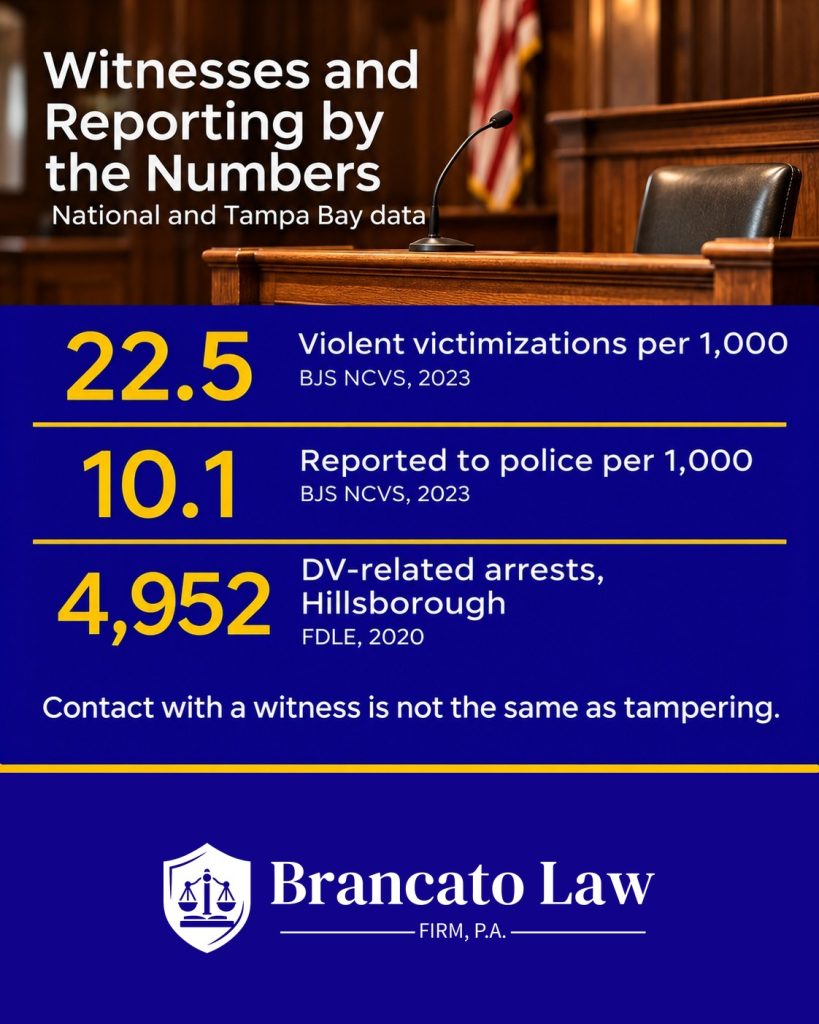
Prosecutors treat tampering as a threat to every other case they handle, because their cases depend on witnesses who are willing to come to court. National data shows how many crimes never reach police at all. In 2023, the Bureau of Justice Statistics’ National Crime Victimization Survey measured violent victimization at 22.5 per 1,000 persons age 12 or older, but the rate of violent victimization reported to police was 10.1 per 1,000, meaning fewer than half of violent victimizations were reported.
Research on intimidation explains part of that gap. A 1995 National Institute of Justice report, Victim and Witness Intimidation: New Developments and Emerging Responses, found that some prosecutors estimated intimidation as a factor in 75 to 100 percent of violent crimes in some gang-dominated neighborhoods. The same report noted that outside those neighborhoods, fear and intimidation play a much smaller part in witnesses’ failure to cooperate. That distinction matters in court: most witnesses who decline to testify have their own reasons, and our attorneys push back when the State assumes a reluctant witness must have been pressured.
Domestic violence cases supply many tampering charges in our area. In 2020, the Florida Department of Law Enforcement recorded 4,952 domestic violence related arrests in Hillsborough County, 3,776 in Pinellas County, and 2,597 in Pasco County.
What happens after a witness tampering arrest in Hillsborough County?
A tampering arrest in Hillsborough County goes to first appearance within 24 hours, where a judge reviews probable cause and sets release conditions, almost always including no contact with the alleged victim or witness, directly or through others. In our experience, Hillsborough County does not offer pretrial services supervision as a release option, though some neighboring counties do, so the no-contact condition is enforced through new charges and bond revocation. Our post on Hillsborough first appearance explains that hearing, and our guide to the Florida criminal case process covers every stage after arrest.
Contact after a no-contact order is its own problem. It can bring a separate charge, covered in our post on violating a no-contact order in Florida, and when an injunction is in place, a charge explained in our guide on how to fight an injunction violation in Florida. Our Hillsborough County criminal defense page covers local procedure.
What should you do if you are accused of witness tampering?
Stop all contact with the witness, including through friends and family, and assume every call and message is recorded. Our attorneys give every client these instructions:
- Do not discuss the case on jail phones, video visits, or tablets. Every one of those is recorded and can be played in court.
- Do not ask anyone to pass along a message, even an apology. Third-party contact is one of the most common bases for these charges.
- Save, do not delete, texts and messages from the witness. Deleting can create a separate tampering with evidence problem.
- Let your lawyer communicate with the witness’s attorney or the prosecutor if the witness wants the case dropped.
Frequently asked questions about witness tampering in Florida
Can witness tampering charges be dropped in Florida?
Yes, tampering charges can be dropped when the recordings and messages do not show intimidation, threats, misleading conduct, or an offer of money aimed at testimony. The Brancato Law Firm has had a tampering case dismissed at the intake stage, and we present the full communications to the prosecutor through pre-file advocacy whenever the timing allows.
Is it tampering if the victim contacts me first?
Answering a victim’s call is not automatically tampering, but discussing the case or her testimony can be, and it may also violate a no-contact order. Our attorneys at The Brancato Law Firm use the victim’s own messages to show who started the contact and what was actually said.
Can a victim legally ask the State to drop domestic violence charges?
Yes, a victim can tell the prosecutor she does not want to proceed, and that is not tampering by the victim. The Brancato Law Firm explains how that works in our post on whether a victim can drop domestic violence charges in Florida.
Is offering to pay for damages witness tampering?
It can be, if the payment is offered to make someone withhold testimony or skip court, because section 914.22 includes offering a “pecuniary benefit or gain.” Lawyers at The Brancato Law Firm handle restitution and civil compromise through counsel and the court so that a legitimate payment is never mistaken for a bribe.
Is witness tampering charged in the same case as the original charge?
It is often filed as a separate case, which means a separate bond, a separate scoresheet, and a separate chance to resolve it early. Our domestic violence defense team at The Brancato Law Firm coordinates both cases so that a resolution in one does not damage the other.
What is the difference between tampering with a witness and tampering with evidence?
Tampering with a witness targets a person, while tampering with evidence under section 918.13 involves destroying, altering, or concealing physical evidence. The Brancato Law Firm defends both charges, which often appear together after an arrest.
For more about our defense strategies, visit our Domestic Violence page.
A tampering charge can follow a single phone call, so call The Brancato Law Firm, P.A., founded by Tampa Criminal Defense Attorney Rocky Brancato, at (813) 727-7159 before anyone says more about the case on a recorded line. Our attorneys will start by requesting every recording the State has. You can call us at any hour. Our firm has Spanish-speaking staff, and attorney Jean-Luc Adrien speaks Spanish, Haitian Creole, and French. Our office is two blocks from the courthouse, and we defend witness tampering cases in Hillsborough, Pinellas, and Pasco counties.
The Brancato Law Firm, P.A.
620 E. Twiggs Street, Suite 205, Tampa, FL 33602
(813) 727-7159
Serving Hillsborough, Pinellas, and Pasco Counties
The Brancato Law Firm, P.A. is a Tampa-based criminal defense practice. We are not affiliated with any other Brancato-named law firms.
Visit Us

Tampa, FL 33602

Contact Us Now
Free Legal Consultation (813) 727-7159
