

From First DUI to Death Penalty



How to Fight Stalking Charges in Florida? (2026)


To fight a stalking charge in Florida, the defense tests each element the State must prove: that the accused willfully, maliciously, and repeatedly followed, harassed, or cyberstalked one specific person, that the conduct served no legitimate purpose, and that it would cause substantial emotional distress to a reasonable person. Simple stalking under section 784.048(2) is a first-degree misdemeanor punishable by up to 1 year in jail. Aggravated stalking is a third-degree felony punishable by up to 5 years in prison when the State adds a credible threat, an injunction or other court order, a victim under 16, or a no-contact order from a prior sex-offense sentence. Too few separate incidents, a legitimate reason for the contact, constitutionally protected speech, and doubts about who actually sent the messages are the most common defenses.
As founder of The Brancato Law Firm, P.A., a Tampa criminal defense firm, and a former Chief Operations Officer of the Hillsborough County Public Defender’s Office, where I oversaw a staff of over 100 attorneys, I have tried more than 150 jury trials to verdict. Stalking cases rarely turn on one dramatic moment. They turn on a stack of texts, calls, posts, and sightings that the State asks a jury to read as one pattern. Our attorneys take that stack apart incident by incident, because the statute requires the State to prove every piece, and the screenshots the police receive are almost never the whole conversation.
What counts as stalking in Florida?
Stalking in Florida means willfully, maliciously, and repeatedly following, harassing, or cyberstalking another person. That is the entire offense under section 784.048(2), Florida Statutes, and it is a first-degree misdemeanor. The real fight is over the defined words inside that sentence, because each one is a separate element the State must prove beyond a reasonable doubt.
| Term | What the statute says | What our attorneys test |
|---|---|---|
| Harass | A course of conduct directed at a specific person that causes substantial emotional distress and serves no legitimate purpose | Whether each act was aimed at the complainant, and whether it had a real reason behind it |
| Course of conduct | A series of acts over a period of time, however short, showing a continuity of purpose; constitutionally protected activity such as picketing or organized protest is excluded | Whether there are at least two separate incidents close enough in time to form one pattern |
| Substantial emotional distress | Distress greater than ordinary upset, judged by a reasonable person in the complainant’s position | Whether a reasonable person, not just this complainant, would suffer that level of distress |
| Willfully and maliciously | Knowingly and intentionally, and without lawful justification or excuse | Whether the accused knew the contact was unwanted, and whether a lawful reason existed |
| Cyberstalk | A course of electronic communication directed at or pertaining to a specific person, or unauthorized access to that person’s online accounts or Internet-connected home systems, causing substantial emotional distress with no legitimate purpose | Who controlled the account or device, and whether the posts are protected speech |
Florida’s appellate courts apply these definitions strictly. In Paylan v. Statton, 376 So. 3d 822 (Fla. 2d DCA 2023), a Pinellas County woman sought a stalking injunction against a former boyfriend who had sent her seven profane emails in the spring of 2020 and then took a lawn ornament from her yard more than a year later. The Second District, the appeals court that covers Hillsborough, Pinellas, and Pasco, affirmed the dismissal. It held that the emails were too stale to link with the later incident, that one remaining incident cannot be stalking as a matter of law, and that courts measure substantial emotional distress with “a reasonable person standard, not a subjective standard.” Paylan was a civil injunction case, but it applied the same definitions found in the criminal statute, which is why our attorneys raise the same arguments in a criminal courtroom.
When does stalking become aggravated stalking in Florida?
Stalking becomes aggravated stalking, a third-degree felony, when one of four facts is added to the repeated following, harassing, or cyberstalking. A third-degree felony carries up to 5 years in prison and a $5,000 fine under sections 775.082 and 775.083, Florida Statutes. Simple stalking carries up to 1 year in county jail and a $1,000 fine. The added fact also controls the scoresheet, and that is where many people are surprised.
| Charge | Added fact the State must prove | Degree and maximum | Scoresheet level |
|---|---|---|---|
| Stalking, s. 784.048(2) | Willful, malicious, repeated following, harassing, or cyberstalking | First-degree misdemeanor; up to 1 year and $1,000 | Not scored (misdemeanor) |
| Aggravated stalking, s. 784.048(3) | A credible threat to the person | Third-degree felony; up to 5 years and $5,000 | Level 6 |
| Aggravated stalking, s. 784.048(4) | The conduct occurred after an injunction for protection or any other court-imposed prohibition of conduct toward the person | Third-degree felony; up to 5 years and $5,000 | Level 7 |
| Aggravated stalking, s. 784.048(5) | The person stalked was a child under 16 | Third-degree felony; up to 5 years and $5,000 | Level 6 |
| Aggravated stalking, s. 784.048(7) | The conduct targeted the victim of a prior sex-offense sentence after a court barred contact | Third-degree felony; up to 5 years and $5,000 | Level 7 |
The levels come from the offense severity ranking chart in section 921.0022, Florida Statutes. The difference between Level 6 and Level 7 is larger than it looks. Under section 921.0024, a Level 6 primary offense scores 36 points, and a total of 44 points or less allows any sentence short of state prison. A Level 7 primary offense scores 56 points by itself, which produces a lowest permissible sentence of 21 months in state prison even for a person with no record. That is why an aggravated stalking charge built on an injunction is often the most dangerous version of this case, and why our attorneys look hard at whether the order was valid, served, and actually covered the conduct.
At sentencing, the judge must also consider an order barring any contact with the victim for up to 10 years, under section 784.048(9). The judge can enter that order even when the sentence is probation.
What is cyberstalking under Florida law?
Cyberstalking is stalking done through email or other electronic communication, or by getting into another person’s online accounts or Internet-connected home devices without permission. Under section 784.048(1)(d), the communications must form a course of conduct, cause substantial emotional distress, and serve no legitimate purpose. Most stalking cases our attorneys see now include texts, direct messages, or social media posts, and many include nothing else.
The Legislature later broadened the definition, adding communications made “directly or indirectly” and communications “pertaining to” a specific person. Before that change, Florida courts drew a sharp line between messages sent to a person and posts about a person. In David v. Textor, 189 So. 3d 871 (Fla. 4th DCA 2016), two business rivals in the hologram industry were fighting a patent lawsuit when one obtained a cyberstalking injunction against the other over emails and online posts. The Fourth District reversed. It held that emails demanding that a lawsuit be dropped served a legitimate purpose, that online posts written for others to read were not directed at the complainant, and that banning speech about a person was an unconstitutional prior restraint.
The Second District addressed the amended statute in Budlove v. Johnson, No. 2D22-1549 (Fla. 2d DCA Dec. 29, 2023), a Pasco County case. A mother whose parental rights had been terminated posted online about the dependency case and the people involved in it, and the trial court entered stalking injunctions that banned her from posting anything about the case. The Second District reversed that part of the injunctions as a content-based prior restraint on speech about a court proceeding, while leaving the no-contact terms in place. The lesson for a criminal case is direct: the amendment widened what the State can charge, but the First Amendment still protects public commentary that does not cross into true threats or incitement, and the statute itself excludes constitutionally protected activity.
Legal scholars have drawn the same line. In “One-to-One Speech vs. One-to-Many Speech, Criminal Harassment Laws, and ‘Cyberstalking’,” 107 Northwestern University Law Review 731 (2013), UCLA law professor Eugene Volokh argued that harassment laws are on much firmer ground when they restrict unwanted speech sent to one person than when they restrict speech about a person addressed to the public. Our attorneys use that distinction to sort a cyberstalking file: messages sent to the complainant are measured against the statute, and public posts are measured against the Constitution first.
Repeated phone calls can also be charged on their own as a second-degree misdemeanor under section 365.16, which covers obscene, anonymous, and repeated calls made to harass. Our guide on how to fight a harassing phone call charge in Florida explains that statute and its defenses.
How do our attorneys fight a stalking charge in Florida?
Our attorneys fight a stalking charge by testing every element against the full record, not the selection of messages the complainant gave the police. These are the steps The Brancato Law Firm takes most often in Hillsborough, Pinellas, and Pasco County cases.
- Count the incidents. Stalking requires repeated conduct forming a course of conduct. We build a timeline of every alleged contact and look for gaps that break the pattern, as the gap of more than a year did in Paylan.
- Restore the full conversation. We subpoena complete phone and platform records so the jury sees who started each exchange, whether contact was mutual, and what was deleted.
- Identify the legitimate purpose. Messages about shared children, money, property, a lease, a business, or a lawsuit often have a lawful reason, as the litigation emails did in Textor.
- Apply the reasonable person test. The State must prove the conduct would cause substantial emotional distress to a reasonable person in the complainant’s position, which is more than embarrassment or ordinary upset.
- Separate speech from stalking. Public posts, reviews, and commentary about a person get First Amendment analysis before they get stalking analysis.
- Challenge the credible threat. In Counterman v. Colorado, 600 U.S. 66 (2023), a man was prosecuted under Colorado’s stalking law for hundreds of Facebook messages to a singer he had never met. The U.S. Supreme Court held that when a prosecution rests on threatening words, the First Amendment requires proof that the speaker at least recklessly disregarded a substantial risk that the words would be seen as threatening violence. Our attorneys apply that rule to any aggravated stalking charge under subsection (3).
- Prove who sent it. Fake accounts, shared phones, and spoofed numbers are common. We test the State’s proof that the accused actually controlled the account or device, often with a forensic examiner.
- Attack the order in an injunction case. For a subsection (4) charge, we check service, the order’s exact wording, and whether the conduct fell inside it. Our guide on how to fight an injunction violation in Florida covers those issues in detail.
Our Tampa domestic violence defense attorney page explains how these defenses fit into the larger domestic violence practice, since many stalking cases arise between former partners.
How common is stalking, and how often is it reported?
Stalking is common, but most of it is never reported to police. In 2019, about 1.3% of U.S. residents age 16 or older, an estimated 3.4 million people, experienced stalking, according to the U.S. Bureau of Justice Statistics report Stalking Victimization, 2019. The same report found that only 29% of stalking victims reported it to police that year.
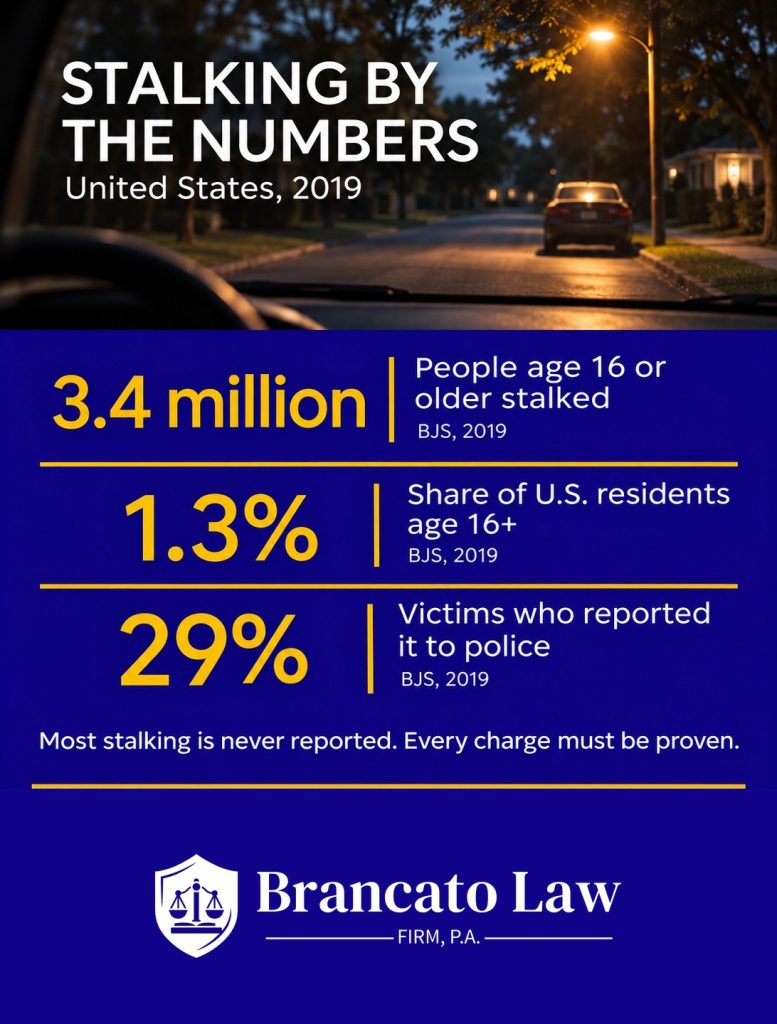
Those numbers cut two ways in a courtroom. They explain why prosecutors take stalking seriously. They also mean that the cases that do reach the State Attorney’s Office often arrive after a relationship has ended badly, a custody fight has started, or an injunction hearing is pending, which are the situations where motive to exaggerate is strongest. Our attorneys investigate that history in every case.
What happens after a stalking arrest in Hillsborough County?
A stalking arrest in Hillsborough County leads to first appearance within 24 hours, where a judge reviews probable cause and sets release conditions by video from the jail. Officers do not need a warrant: section 784.048(6) lets them arrest on probable cause alone, which is why many stalking arrests happen at the scene of a complaint. Our post on Hillsborough first appearance explains that hearing step by step.
Expect a no-contact condition. In stalking cases, the judge almost always orders no contact with the complainant as a condition of release, and any contact, even a reply to a message the complainant sends, can lead to a new arrest and loss of bond. In our experience, Hillsborough County does not offer pretrial services supervision as a release option, though some neighboring counties do, so the conditions the judge sets at first appearance are usually the conditions the person lives with for months.
The State Attorney’s Office then decides whether to file formal charges and at what level. That filing decision is the best moment to present the full message history and the legitimate reasons for any contact. Our page on representation before charges are filed explains that work, our Hillsborough County criminal defense page covers local procedure, and our guide to the Florida criminal case process maps every stage from arrest to trial.
How is a criminal stalking charge different from a stalking injunction?
A stalking injunction is a civil court order, and a stalking charge is a criminal prosecution, but each one feeds the other. A complainant can petition for an injunction for protection against stalking under section 784.0485, Florida Statutes, without any criminal case at all. The injunction hearing often happens within weeks, long before the criminal case is resolved.
| Feature | Criminal stalking case | Civil stalking injunction |
|---|---|---|
| Who brings it | The State Attorney’s Office | The person who says they were stalked |
| Burden of proof | Beyond a reasonable doubt | Competent, substantial evidence of at least two incidents |
| Possible result | Jail or prison, probation, conviction, and a no-contact order of up to 10 years | Court order restricting contact, which can last indefinitely |
| Right to appointed counsel | Yes | No |
| Risk to the accused | A conviction | Testimony that can be used in the criminal case, and future contact charged as aggravated stalking |
The injunction hearing is where many criminal cases are won or lost. Testimony given there is under oath and recorded, and the State can use it later. Once an injunction is entered, repeated contact becomes a Level 7 felony under section 784.048(4) instead of a misdemeanor. The Brancato Law Firm treats the injunction hearing and the criminal case as one defense, so that nothing said in the first damages the second.
What should you do if you are accused of stalking in Florida?
Stop all contact and preserve everything. The steps below protect both the criminal case and any injunction case.
- Do not contact the complainant, directly, through friends, or by social media, even to apologize or explain.
- Do not delete messages, posts, or accounts. Deletion looks like consciousness of guilt and destroys the context that often proves the defense.
- Write down the history: when the relationship started and ended, who reached out and why, and any shared children, property, or business.
- Do not talk to detectives about the case. Politely say you want a lawyer.
- Comply exactly with any injunction or release condition until a judge changes it.
- Call a defense attorney before the injunction hearing and before the State’s filing decision.
Frequently asked questions about stalking charges in Florida
Can stalking charges be dropped in Florida?
Yes, but only the State Attorney’s Office can drop them, usually by filing a nolle prosequi when the evidence will not prove every element. The Brancato Law Firm presents the full message history, the legitimate reasons for contact, and the gaps in the timeline to prosecutors before the filing decision, when a decision not to file is most likely. Our post on whether a victim can drop domestic violence charges explains why a complainant’s wishes alone do not end a case.
Is one text message or one encounter enough for a stalking charge in Florida?
No. Stalking requires repeated conduct forming a course of conduct, and Florida courts have held that a single incident is not stalking as a matter of law. Our attorneys at The Brancato Law Firm build a full timeline in every case, because removing one stale or explainable incident can leave the State without a pattern at all.
Can posting about someone online be cyberstalking in Florida?
It can be, but public posts about a person receive First Amendment protection unless they are true threats, incitement, or similar unprotected speech. The Brancato Law Firm separates messages sent to the complainant from posts made to the public, because the Second District in Budlove v. Johnson refused to let an injunction ban public speech about a court case.
Does aggravated stalking carry mandatory prison in Florida?
No mandatory minimum applies, but a Level 7 aggravated stalking charge based on an injunction scores at least 21 months in state prison on the Criminal Punishment Code scoresheet, even with no prior record. Our attorneys at The Brancato Law Firm look for grounds to reduce the charge to simple stalking, which is not scored, or to support a downward departure. Our domestic violence defense team handles these scoresheet issues regularly.
Can I be charged with stalking for contacting my ex about our children?
Contact about shared children usually has a legitimate purpose, and a legitimate purpose defeats the harassment element. The Brancato Law Firm gathers the parenting plan, court orders, and the full message thread to show what each contact was about, because tone alone does not make a lawful message criminal.
How long can a no-contact order last after a stalking sentence in Florida?
Up to 10 years. Under section 784.048(9), the sentencing judge must consider an order barring all contact with the victim, based on the seriousness of the facts and the risk of future violations. The Brancato Law Firm presents evidence on those factors at sentencing so that any order is no longer than the facts justify.
Should I talk to the police if I am being investigated for stalking?
No. Explaining the relationship to a detective usually supplies the intent and repetition the State needs. Our attorneys at The Brancato Law Firm speak for clients during the investigation, and our page on pre-file advocacy explains how that early work can keep a case from being filed.
Talk to a Tampa stalking defense attorney now
If you have been arrested, served with a stalking injunction petition, or contacted by a detective, the injunction hearing and the State’s filing decision may be only days away. Call The Brancato Law Firm, P.A., founded by Tampa Criminal Defense Attorney Rocky Brancato, at (813) 727-7159. You can call us at any hour, and our office is two blocks from the courthouse. Our firm has Spanish-speaking staff, and attorney Jean-Luc Adrien speaks Spanish, Haitian Creole, and French. For more about our defense strategies, visit our Domestic Violence Defense page.
The Brancato Law Firm, P.A.
620 E. Twiggs Street, Suite 205, Tampa, FL 33602
(813) 727-7159
Serving Hillsborough, Pinellas, and Pasco Counties
The Brancato Law Firm, P.A. is a Tampa-based criminal defense practice. We are not affiliated with any other Brancato-named law firms.
Visit Us

Tampa, FL 33602

Contact Us Now
Free Legal Consultation (813) 727-7159
