

From First DUI to Death Penalty



How to Fight a Harassing Phone Call Charge in Florida? (2026)


To fight a harassing phone call charge in Florida, the defense attacks intent and identity. Section 365.16 makes it a second-degree misdemeanor, punishable by up to 60 days in jail and a $500 fine, to make obscene calls, anonymous calls, or repeated calls with intent to abuse, threaten, or harass the person called. The State must prove the caller’s purpose, not just that the calls were unwanted, and a call made at least in part to communicate a real message can fall outside the statute.
A Florida prosecutor who files a harassing phone call charge has to prove what was in the caller’s head, and that is where most of these cases are won. As founder of The Brancato Law Firm, P.A., a Tampa criminal defense firm, and a former Chief Operations Officer of the Hillsborough County Public Defender’s Office, where I oversaw a staff of over 100 attorneys, I have spent more than 25 years in Hillsborough County courtrooms and tried more than 150 jury trials to verdict. Our attorneys pull the call logs, the voicemails, and the full text history on both sides before we let the State define what the calls were about.
Most of these charges grow out of a breakup, a custody fight, a business dispute, or a debt. They often travel with domestic violence allegations, which is why our Tampa domestic violence defense attorney page covers them alongside stalking and injunction cases. This guide explains what section 365.16 prohibits, how the courts have read it, the defenses that work, and what happens to a case in Hillsborough County.
What is a harassing phone call charge in Florida?
A harassing phone call charge is a misdemeanor under section 365.16, Florida Statutes, titled “Obscene or harassing telephone calls.” The statute lists four separate ways to commit the offense, and each one has its own intent requirement. A charging document should say which subsection the State is relying on, and our attorneys hold the prosecutor to that choice.
| Subsection | Conduct | Intent the State must prove | What our attorneys test |
|---|---|---|---|
| 365.16(1)(a) | A call to a place where the person has a reasonable expectation of privacy, with an obscene, lewd, lascivious, filthy, vulgar, or indecent comment, request, suggestion, or proposal | Intent to abuse, threaten, or harass (the Florida Supreme Court cut “offend” and “annoy” from this subsection in Gilbreath) | Where the call was received, whether the language fits the statute, and whether the caller meant to harass or was arguing |
| 365.16(1)(b) | A call, whether or not anyone talks, without disclosing the caller’s identity | Intent to annoy, abuse, threaten, or harass | Whether the person receiving the call already knew who was calling, and who actually placed the call |
| 365.16(1)(c) | Making or causing the other person’s phone to ring repeatedly or continuously | Intent to harass | How many calls, over what period, and whether there was a reason for them |
| 365.16(1)(d) | Repeated calls in which conversation takes place | Made “solely to harass” | Any other purpose behind the calls, which defeats the “solely” element under Durie |
Subsection (2) adds a second offense for anyone who “knowingly permits” a telephone under his or her control to be used for a prohibited purpose. Subsection (5) excludes calls made in good faith in the ordinary course of business or commerce, which matters when the calls were about a debt, a lease, or a job.
What are the penalties for harassing phone calls in Florida?
A violation of section 365.16 is a misdemeanor of the second degree. Under section 775.082, that carries up to 60 days in jail, and under section 775.083, a fine of up to $500. A judge can also impose probation with a no-contact condition, and a conviction stays on a public record unless the case ends in a way that allows sealing.
The bigger risk is what the same calls can be charged as. When the State sees a pattern, it often looks at stalking, which carries more time, or at a violation of an injunction if one was in place. Our attorneys look at the charge the State chose and the charges it could still add before we advise a client to say anything about the calls.
| Charge | Statute | Degree | Maximum jail and fine |
|---|---|---|---|
| Obscene or harassing telephone calls | § 365.16 | Second-degree misdemeanor | 60 days; $500 |
| Knowingly permitting a phone to be used for harassing calls | § 365.16(2) | Second-degree misdemeanor | 60 days; $500 |
| Stalking (including cyberstalking) | § 784.048(2) | First-degree misdemeanor | 1 year; $1,000 |
| Violation of a domestic violence injunction | § 741.31(4)(a) | First-degree misdemeanor | 1 year; $1,000 |
Does section 365.16 cover text messages?
The text of section 365.16 speaks only of telephone calls and of causing a telephone to ring. It does not mention text messages, email, or social media. When the State’s evidence is a string of texts or direct messages, it usually turns to section 784.048, which defines “cyberstalk” as a course of conduct communicating words, images, or language “by or through the use of electronic mail or electronic communication,” causing substantial emotional distress and serving no legitimate purpose.
That difference matters for the defense. If a complaint is mostly texts but the State charged section 365.16, our attorneys at The Brancato Law Firm check whether the calls alone prove the offense. If the State charged cyberstalking instead, the “no legitimate purpose” element becomes the fight, as our guide on how to fight stalking charges in Florida explains.
How have Florida courts limited the harassing phone call law?
Florida’s appellate courts have narrowed section 365.16 twice in ways that help the defense. In Gilbreath v. State, 650 So. 2d 10 (Fla. 1995), a woman was convicted after a vulgar, threatening call to a postal manager’s home, the latest of about 30 similar calls over two years. The Florida Supreme Court upheld subsection (1)(a) against a free speech challenge, but only after limiting it to calls made with intent to abuse, threaten, or harass a person at a place where that person has a reasonable expectation of privacy. The Court struck the words “offend” and “annoy” from that subsection as too vague.
In Durie v. State, 901 So. 2d 171 (Fla. 5th DCA 2005), a man on probation left three five-minute voicemails for the assistant attorney general handling his appeal, arguing his innocence, criticizing her work, and threatening a Florida Bar complaint. The trial court revoked his probation for harassing calls. The Fifth District reversed. It held that subsection (1)(d) requires calls made “solely to harass,” that “solely” means to the exclusion of every other purpose, and that his detailed legal arguments showed he was trying, at least in part, to persuade her. The court added that subsection (1)(d), unlike the stalking statute, has no requirement that the other purpose be legitimate.
The lesson from both cases carries into every defense our firm builds. These statutes punish the act of calling with a specific purpose, not rude or angry speech. A caller who was trying to get a child exchange arranged, collect money, end a relationship on his or her own terms, or argue about a real dispute has a purpose the jury has to weigh, and the full recording or call history usually shows it.
Why do courts treat unwanted calls differently from other speech?
Courts allow more regulation of speech aimed at one unwilling listener than speech aimed at the public. In Protecting Listeners From Unwanted One-to-One Speech, published in volume 98 of the Southern California Law Review in 2025, law professor Eugene Volokh explains that one-to-one speech to a listener who has made clear he or she is unwilling can be restricted in ways that public speech cannot, and lists telephone harassment laws as one example.
The same reasoning sets the boundary for the defense. The law reaches calls forced on someone who does not want them. It does not reach a two-way conversation, a single heated call, or a message to someone who kept answering and calling back. Our attorneys build the timeline of who called whom, and when, because a record of mutual contact undercuts the claim that the complainant was an unwilling listener.
How common are harassment and stalking complaints?
Phone harassment complaints often sit inside larger stalking allegations, which are common and underreported. According to the Bureau of Justice Statistics report Stalking Victimization, 2019, about 1.3% of people age 16 or older, or 3.4 million people, were stalking victims in 2019, and less than a third of them (29%) reported it to police. Those are national survey figures from 2019.
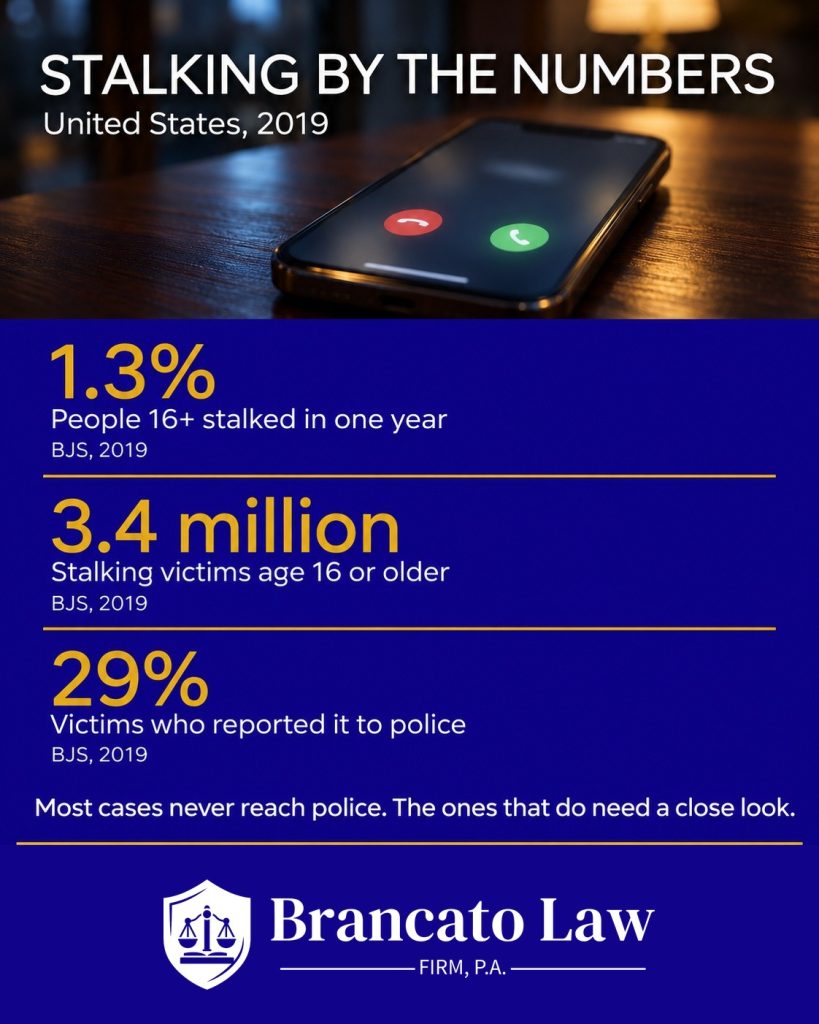
Because most incidents never reach police, the ones that do often arrive after months of conflict, with screenshots selected by one side. At The Brancato Law Firm, we treat the first set of screenshots the police received as the State’s best version of the story, not the whole story.
How do our attorneys fight a harassing phone call charge?
Our attorneys fight these charges by testing each element the State must prove, starting with the ones prosecutors tend to assume. These are the defenses we look at first:
- Purpose. Under subsection (1)(d), any purpose other than harassment defeats the charge under Durie. Under the other subsections, a real reason for the call still weighs against an intent to abuse, threaten, or harass.
- Identity of the caller. Caller ID can be spoofed, phones are shared, and calling apps mask numbers. We subpoena carrier records and compare them to the complainant’s screenshots before accepting that our client placed the calls.
- Anonymity. Subsection (1)(b) requires a call made without disclosing the caller’s identity. If the person receiving the call recognized the number or the voice, the State has to rely on a different subsection.
- Place of the call. Subsection (1)(a) covers calls to a location where the person had a reasonable expectation of privacy, a limit the Florida Supreme Court relied on in Gilbreath.
- Number and timing. “Repeated” and “repeatedly” are elements. In Durie, the court doubted that three back-to-back voicemails cut off by the system were “repeated” calls at all.
- Business calls. Calls made in good faith in the ordinary course of business or commerce are excluded by section 365.16(5).
- Mutual contact. Phone records showing the complainant called back, texted first, or kept the conversation going undercut the claim of harassment and the complainant’s credibility.
Many of these cases begin with a complaint to police and a request for a sworn statement before any arrest. That is the best time to bring in a lawyer, and our representation before charges are filed often keeps a dispute about phone calls from becoming a criminal case at all.
What happens to a harassing phone call case in Hillsborough County?
In Hillsborough County, a section 365.16 charge is a county court misdemeanor in the 13th Judicial Circuit, and the State Attorney’s Office decides whether to file it. The case moves through the stages described on our Florida criminal case process page: an arrest or notice to appear, arraignment, discovery, and then a plea, a diversion agreement, or trial.
A first-time defendant may be a candidate for diversion. In our experience, Hillsborough prosecutors route first-time misdemeanors to the Misdemeanor Intervention Program (MIP), which the Hillsborough County Sheriff’s Office runs with the State Attorney’s Office: the participant is monitored for three to five months, and the State then drops the charge with a nolle prosequi. When the complainant is a current or former partner or family member, the case is treated as domestic violence and usually goes to the domestic violence intervention track instead, where the alleged victim can object. Our attorneys learn which track the State has in mind before the arraignment, and make the case for the better one. More on the county’s courts and programs is on our Hillsborough County criminal defense page.
Can a harassing phone call charge be dropped in Florida?
Yes. A harassing phone call charge can be dropped when the State cannot prove intent or identity, when the complainant’s own records show mutual contact, or through a diversion program such as MIP. Prosecutors decide whether to proceed, so an alleged victim cannot simply withdraw the charge, but a complainant’s wishes and the full call history still affect what the State does. Our guide on whether an alleged victim can drop domestic violence charges explains that process when the calls were between partners.
What should you do if you are accused of harassing phone calls?
Stop all contact, keep every record, and speak with a lawyer before speaking with police. These steps protect the defense:
- Do not call, text, or message the complainant again, even to apologize or explain. A new call becomes new evidence, and if an injunction or no-contact order is in place it can be a separate crime.
- Save your full call log, voicemails, and the entire text thread, including the other person’s messages. Do not delete anything.
- Write down why you were calling: a child exchange, money owed, property, or a shared lease. Purpose is often the whole case.
- Do not give a recorded statement to a detective without counsel. If you are arrested, the first stop is first appearance; our guide to first appearance in Hillsborough County explains what happens there.
Frequently asked questions about harassing phone call charges
Is it illegal to keep calling an ex after they tell you to stop in Florida?
It can be. Repeated calls made with intent to harass violate section 365.16, and a pattern that causes substantial emotional distress can be charged as stalking under section 784.048. Our attorneys at The Brancato Law Firm look first at why the calls were made, because calls about children, property, or money have a purpose the State must overcome.
Can I be charged if someone else used my phone to make the calls?
Only if you knowingly let the phone be used for a prohibited purpose. Section 365.16(2) makes that a separate second-degree misdemeanor, but the State must prove you knew. The Brancato Law Firm subpoenas carrier and device records to show who actually had the phone when each call was placed.
Does one angry or vulgar phone call count as harassment in Florida?
A single call can violate subsection (1)(a) if it contains obscene or vulgar language and is made with intent to abuse, threaten, or harass a person at a place where that person expects privacy. The other subsections require anonymity or repeated calls. When we review a one-call case, our attorneys at The Brancato Law Firm focus on the exact words, where the call was received, and what the caller was trying to accomplish, as in Gilbreath v. State.
Are debt collection or work calls covered by the harassing phone call law?
No, if they are made in good faith in the ordinary course of business or commerce. Section 365.16(5) excludes those calls from the statute. When a dispute over money or work led to the charge, The Brancato Law Firm gathers the invoices, contracts, and messages that show the business reason for each call.
Can a harassing phone call charge be resolved without a conviction in Hillsborough County?
Often, yes, for a person with no prior record. Diversion through MIP ends with the State dropping the charge, and other cases end in a dismissal or a withhold of adjudication. Our attorneys at The Brancato Law Firm press for those outcomes early, and our domestic violence defense team handles the cases that come with a partner or family relationship.
What is the difference between a harassing phone call charge and cyberstalking?
A section 365.16 charge is about telephone calls and is a second-degree misdemeanor; cyberstalking under section 784.048 covers electronic communications such as texts and messages and is a first-degree misdemeanor. Cyberstalking also requires that the conduct serve no legitimate purpose. The Brancato Law Firm reviews which statute fits the evidence, because the wrong charge can be a reason to dismiss.
Talk to our Tampa defense attorneys about a harassing phone call charge
For more about our defense strategies, visit our Domestic Violence Defense page. If police have called you about phone calls or you have been arrested, call The Brancato Law Firm, P.A., founded by Tampa Criminal Defense Attorney Rocky Brancato, at (813) 727-7159 before you give any statement or contact the other person again, because what you say in the first few days often becomes the State’s evidence. You can call us at any hour. Our firm has Spanish-speaking staff, and attorney Jean-Luc Adrien speaks Spanish, Haitian Creole, and French. Our office is two blocks from the courthouse, and we defend these charges in Hillsborough, Pinellas, and Pasco counties.
The Brancato Law Firm, P.A.
620 E. Twiggs Street, Suite 205, Tampa, FL 33602
(813) 727-7159
Serving Hillsborough, Pinellas, and Pasco Counties
The Brancato Law Firm, P.A. is a Tampa-based criminal defense practice. We are not affiliated with any other Brancato-named law firms.
Visit Us

Tampa, FL 33602

Contact Us Now
Free Legal Consultation (813) 727-7159
