

From First DUI to Death Penalty



How to Fight a Scheme to Defraud Charge in Florida? (2026)


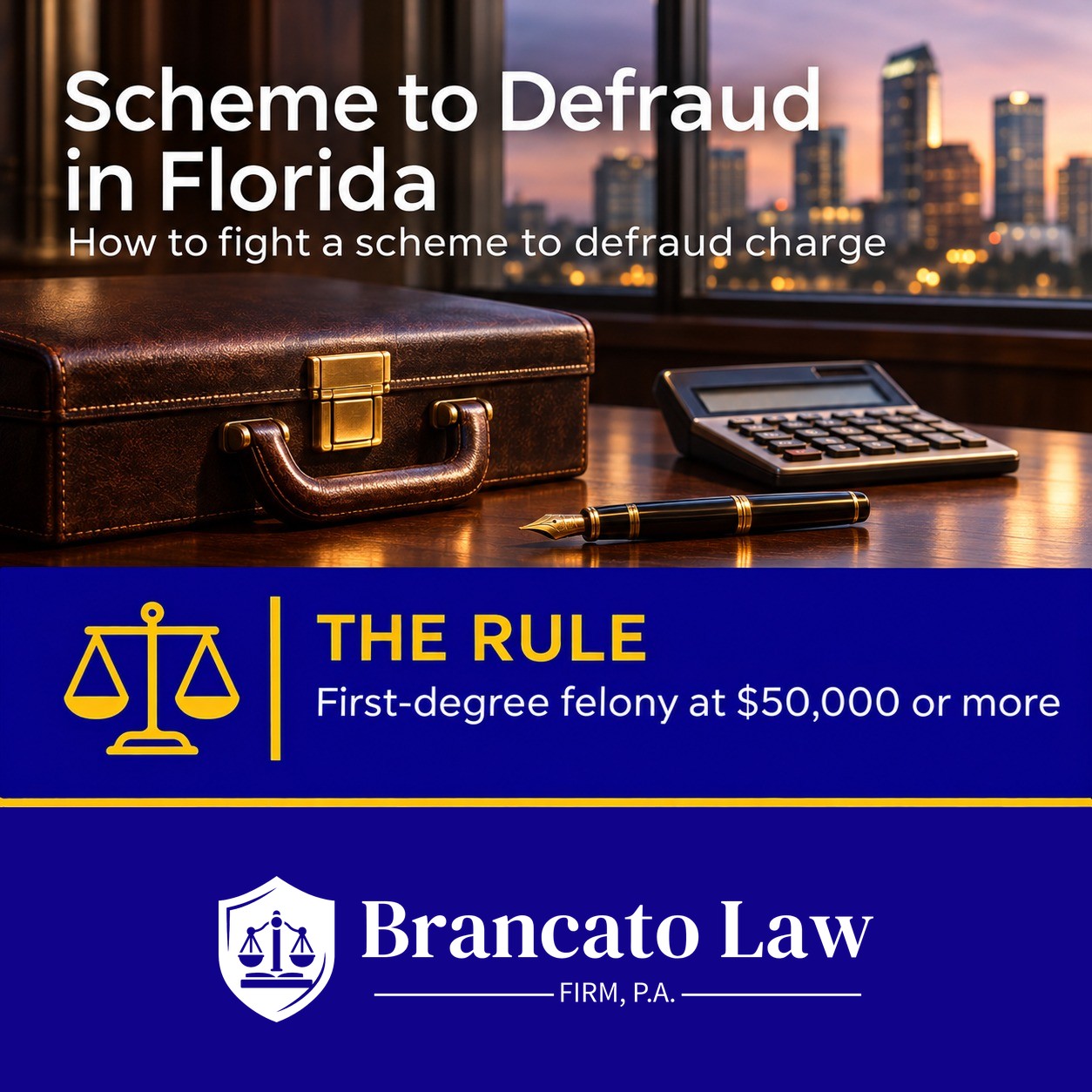
To fight a scheme to defraud charge in Florida, the defense attacks the two elements that separate organized fraud from ordinary theft: a systematic, ongoing course of conduct, and an intent to defraud through false representations or promises. Under section 817.034, organized fraud is a first-degree felony at $50,000 or more, a second-degree felony from $20,000 to $50,000, and a third-degree felony below $20,000, with the values of separate transactions added together. Many cases are reduced to theft, resolved through restitution, or kept from being filed at all when the defense reaches the prosecutor early.
A prosecutor charging a scheme to defraud has to show more than missing money: the State must prove a pattern and a lie. As founder of The Brancato Law Firm, P.A., a Tampa criminal defense firm, I have spent more than 25 years in Hillsborough County courtrooms, including as former Chief Operations Officer of the Hillsborough County Public Defender’s Office, where I oversaw a staff of over 100 attorneys. Our attorneys defend organized fraud cases in Hillsborough, Pinellas, and Pasco Counties, and the strongest work usually happens before charges are filed.
What is a scheme to defraud in Florida?
A scheme to defraud is “a systematic, ongoing course of conduct with intent to defraud one or more persons, or with intent to obtain property from one or more persons by false or fraudulent pretenses, representations,” or promises, under section 817.034(3)(d), Florida Statutes, the Florida Communications Fraud Act. A person who engages in that scheme and obtains property through it commits organized fraud.
In plain terms, the State must prove four things: a course of conduct that was systematic and ongoing, an intent to defraud or a false representation or promise, that property was obtained, and its total value. Prosecutors use the charge in contractor deposit cases, investment and loan cases, business and employee fraud, benefits fraud, and repeated card or check fraud. Our attorneys explain the full range of these cases on our Tampa white collar crime attorney page.
| Organized fraud (s. 817.034(4)(a)) | Grand theft (s. 812.014) | |
|---|---|---|
| Core act | Obtaining property through a scheme to defraud | Knowingly obtaining or using property of another |
| Extra elements | A systematic, ongoing course of conduct, plus intent to defraud or a false representation or promise | None beyond the theft itself |
| How value is counted | Values from one scheme are added together, from one victim or many | Generally by the property taken in the charged theft |
| Top degree | First-degree felony at $50,000 or more | First-degree felony at $100,000 or more |
| Same conduct, both charges? | Not both: grand theft is a lesser offense and must be vacated | Not both, for the same conduct |
What are the penalties for organized fraud in Florida?
Organized fraud is graded by the total value obtained in the scheme. The values of separate properties “obtained in one scheme to defraud, whether from the same person or from several persons, shall be aggregated,” so many small transactions can add up to a first-degree felony. Maximum prison terms come from section 775.082, and the severity levels from section 921.0022.
| Aggregate value | Degree | Maximum prison | Severity level | Primary offense points |
|---|---|---|---|---|
| $50,000 or more | First-degree felony | 30 years | Level 7 | 56 |
| $20,000 to less than $50,000 | Second-degree felony | 15 years | Level 5 | 28 |
| Less than $20,000 | Third-degree felony | 5 years | Level 3 | 16 |
The level drives the real exposure. Under section 921.0024, a Level 7 primary offense alone scores 56 points, and when total points exceed 44, the lowest permissible prison sentence is the total minus 28, reduced by 25 percent. That puts a first-time defendant charged with $50,000 or more of organized fraud at a minimum of 21 months in prison unless the judge grants a downward departure. A separate offense, communications fraud under section 817.034(4)(b), is charged for each communication in furtherance of the scheme and is a third-degree felony when $300 or more was sought.
When is a fraud case really just a theft, or a contract dispute?
A scheme to defraud requires proof of fraud, not just a pattern of taking. In Cooks v. State, 249 So. 3d 774 (Fla. 1st DCA 2018), the State charged a man with a scheme to defraud after a series of shoplifting incidents at a Live Oak Walmart, where he would fill a cart and run out without paying. The First District reversed. The court found “no basis in the record for concluding Cooks acted with an intent to defraud or that he made a fraudulent representation,” and held that “a conviction for violating section 817.034(4)(a) requires proof of more than mere theft.” The case went back for a judgment on the lesser offense of grand theft.
The same principle protects business owners and contractors. A deal that went bad, a project that ran over budget, or a deposit spent on materials for a job that collapsed is not fraud unless the State proves the person intended to deceive. The Brancato Law Firm builds that record from contracts, invoices, bank statements, and messages that show good-faith work. Our post on how Florida grades grand theft by value explains the theft thresholds the case may fall back to.
Can the State charge both organized fraud and grand theft?
The State can charge both, but a person cannot be convicted of both for the same conduct. In Beamon v. State, 23 So. 3d 209 (Fla. 4th DCA 2009), a woman used a debit card she took from an acquaintance in 28 transactions over about a month, totaling more than $1,500. The Fourth District upheld her organized fraud conviction, finding that 28 uses over a month “can fairly be described as ‘an ongoing course of conduct,'” and that each swipe carried an implied claim that she was entitled to use the card. The court also restated that a defendant “cannot be convicted constitutionally of both organized scheme to defraud and grand theft for the same conduct.”
Gomez v. State, 220 So. 3d 495 (Fla. 3d DCA 2017) shows what that means at sentencing. A Miami-Dade defendant pleaded guilty in five cases that included grand theft, organized fraud, and worthless check counts. The Third District ordered the grand theft convictions vacated in the two cases where they rested on the same conduct as organized fraud, and sent the case back for resentencing on a corrected scoresheet. Our attorneys check every count for this kind of stacking, because removed counts lower the scoresheet. Our guide to worthless check charges covers the bad-check counts that often appear in these cases.
How common is fraud in Florida?
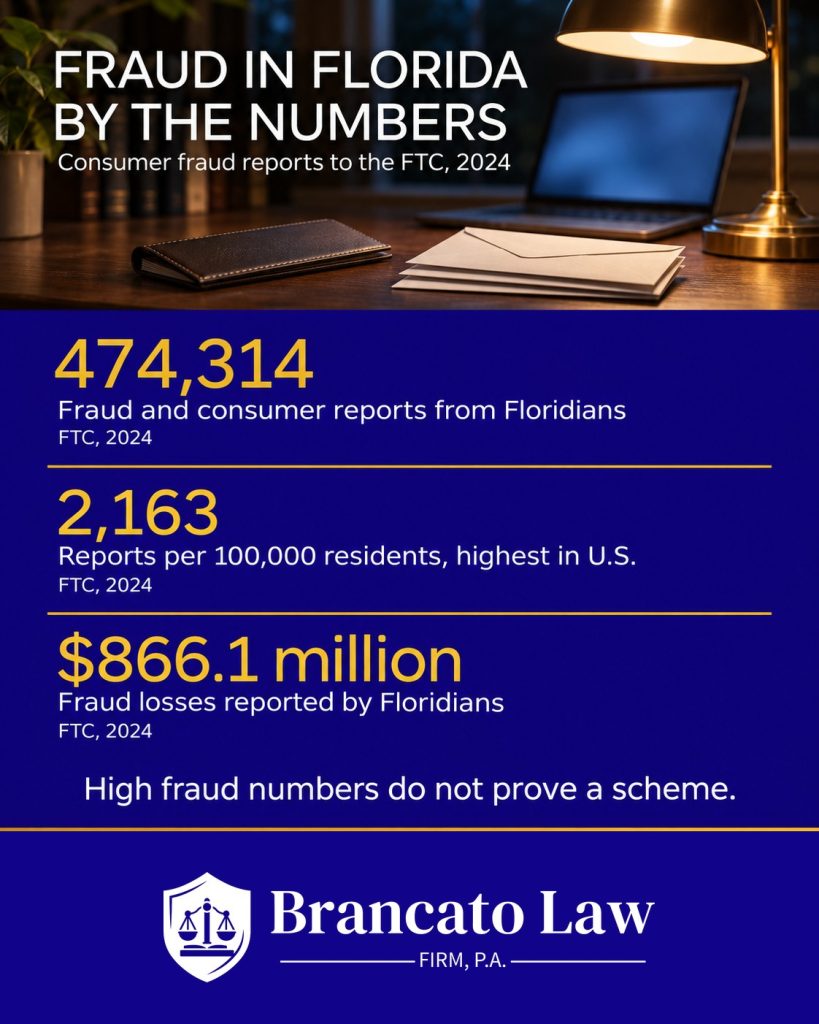
Florida reports more fraud per person than any other state. In 2024, Floridians filed 474,314 fraud and other consumer reports with the Federal Trade Commission, 2,163 per 100,000 residents, the highest rate in the country, and reported $866.1 million in fraud losses, according to the FTC Consumer Sentinel Network Data Book 2024.
The FBI’s Internet Crime Complaint Center counted 52,191 complaints from Florida in 2024, third among the states, with reported losses of $1,071,909,632, also third, in its 2024 Internet Crime Report. Nationally, investment fraud alone accounted for more than $6.5 billion in reported losses that year. Those numbers drive the resources detectives and prosecutors put into fraud cases, and they explain why people who moved money for someone else are often swept into the investigation.
How do our attorneys fight a scheme to defraud charge?
Our attorneys fight a scheme to defraud charge by separating what the State can prove from what it assumes. These are the defenses that come up most often.
- No intent to defraud. A failed business, a missed deadline, or a disputed invoice is a civil matter unless the State proves a deliberate lie. Under Cooks, theft alone is not a scheme.
- No systematic, ongoing course of conduct. One transaction, or a few unrelated ones, may not be a scheme at all.
- Value and aggregation. The degree depends on the total. Our attorneys audit the State’s numbers, remove transactions that were authorized or repaid, and challenge adding together transactions that were not part of one scheme.
- Double jeopardy and stacked counts. Grand theft counts for the same conduct must go, which can lower the scoresheet.
- Identity and role. Employees, relatives, and money mules are often charged for someone else’s plan. The evidence of who designed the scheme, and who knew, matters.
- Suppression. Bank records, phone extractions, and statements are tested for warrant and Miranda problems.
Card and check fraud cases are often charged as organized fraud when there are many transactions. Our guides on credit card fraud charges and cashing a fake check cover those fact patterns.
Can restitution keep you out of prison for organized fraud?
Restitution can be the strongest tool in an organized fraud case, both before and after charges. Florida law lets a judge go below the scoresheet minimum when “the need for payment of restitution to the victim outweighs the need for a prison sentence,” or when the offense “was committed in an unsophisticated manner and was an isolated incident for which the defendant has shown remorse,” under section 921.0026(2)(e) and (j). A downward departure must be supported by evidence, so our attorneys build a repayment plan, financial records, and mitigation before sentencing.
For lower-value cases, first-time defendants may qualify for diversion, explained in our guide to the Hillsborough County PTI program. Fraud that is closer to a property crime is also covered on our Tampa theft and property crimes attorney page.
What happens in a Hillsborough County fraud investigation?
Most Hillsborough County fraud cases start with a detective, a bank investigator, or a state agency collecting records for weeks or months before anyone is arrested. The State Attorney’s Office for the 13th Judicial Circuit then decides whether to file, what statute to use, and what value to allege. Our guide to the Florida criminal case process explains what follows if a case is filed, from first appearance through plea or trial.
That investigation window is where our firm does its most important work. Our representation before charges are filed includes reviewing the records the detective is likely to rely on, presenting documents that show good faith, and negotiating restitution so the State Attorney can decline the case or file a lesser charge. Our Hillsborough County criminal defense page describes how we handle cases in the 13th Circuit. Hillsborough County does not offer pretrial services supervision, though nearby counties do, so planning for release conditions also starts before any arrest.
Frequently asked questions about scheme to defraud charges in Florida
Can a scheme to defraud charge be dropped in Florida?
Yes. Prosecutors drop or reduce organized fraud charges when intent cannot be proven, when the conduct is a civil dispute, or after restitution is arranged. The Brancato Law Firm presents that evidence before a filing decision whenever possible, through our pre-file advocacy.
Is a contractor who took a deposit and did not finish the job guilty of fraud?
Not unless the State proves the contractor intended to deceive the customer when the money was taken. Our attorneys at The Brancato Law Firm use material receipts, subcontractor payments, and job records to show the work was real and the failure was a business problem.
How does Florida add up the value in an organized fraud case?
Section 817.034 adds together the value of all property obtained in one scheme, whether from one person or many. The Brancato Law Firm audits the State’s total transaction by transaction, because dropping below $50,000 or $20,000 changes the degree; our white collar defense lawyers explain the math at a first meeting.
What is the minimum sentence for organized fraud over $50,000 in Florida?
For a person with no other scored offenses, the scoresheet minimum is 21 months in prison, from 56 points under section 921.0024. Our attorneys at The Brancato Law Firm pursue downward departures based on restitution or an isolated, unsophisticated offense when the facts support them.
What is communications fraud in Florida?
Communications fraud is a separate charge for each communication made to obtain property as part of a scheme to defraud, and it is a third-degree felony when the property sought is $300 or more. The Brancato Law Firm reviews whether each charged email, call, or message was really part of the scheme the State alleges.
Can I be charged if I only received money into my account for someone else?
Yes, if the State believes you knew the money came from a fraud. Our attorneys at The Brancato Law Firm often represent people who were recruited online to move money, and our guide to fake check charges explains how knowledge is proven in those cases.
For more about our defense strategies, visit our White Collar Crime page.
If a detective has asked for records or an interview, our attorneys will start by finding out what the State already has. Call The Brancato Law Firm, P.A., founded by Tampa Criminal Defense Attorney Rocky Brancato, at (813) 727-7159 before you answer questions; we are available 24/7, two blocks from the courthouse. Our firm has Spanish-speaking staff, and attorney Jean-Luc Adrien speaks Spanish, Haitian Creole, and French.
The Brancato Law Firm, P.A.
620 E. Twiggs Street, Suite 205, Tampa, FL 33602
(813) 727-7159
Serving Hillsborough, Pinellas, and Pasco Counties
The Brancato Law Firm, P.A. is a Tampa-based criminal defense practice. We are not affiliated with any other Brancato-named law firms.
Visit Us

Tampa, FL 33602

Contact Us Now
Free Legal Consultation (813) 727-7159
