- Free Consultation 24/7: (813) 727-7159 Tap Here To Call Us


From First DUI to Death Penalty



Can You Be Charged for Cashing a Fake Check in Florida? (2026)


Yes. In Florida, cashing or depositing a check you knew was fake can be charged as uttering a forged instrument, depositing an item with intent to defraud, or grand theft, and each is at least a third-degree felony punishable by up to five years in prison. The key word is knew: Florida courts require proof that you actually knew the check was forged, not just that you should have known, so a person tricked by a fake check scam has a real defense. The risk of charges rises when a person keeps a cut of the money, cashes more than one check, uses more than one bank, or brings others into the scheme.
The check looked real. The person who sent it had a reason: an overpayment for something you were selling, an advance for a work-from-home job, a prize, or a favor for someone you met online. The bank made the money available, you sent most of it where you were told to send it, and a week or two later the bank called to say the check was fake and your account was negative. Then a detective left a business card. Getting in front of that detective is what our firm does: representation before charges are filed is a staple of our practice. As founder of The Brancato Law Firm, P.A., a Tampa criminal defense firm, and a former COO of the Hillsborough County Public Defender’s Office, overseeing a staff of over 100 attorneys, I have seen how a person’s first conversation with law enforcement can turn a scam victim into a defendant.
What is a fake check scam?
A fake check scam is a scheme in which someone gives or sends you a counterfeit or altered check and persuades you to send part of the money back, or to someone else, before your bank learns the check is bad. The Federal Trade Commission explains in its guide How To Spot, Avoid, and Report Fake Check Scams that “by law, banks have to make deposited funds available quickly,” but that fake checks “can take weeks to be discovered,” leaving the person who deposited the check to repay the bank.
The federal rule behind that timing is Regulation CC. Under 12 C.F.R. § 229.10, a bank generally must make funds from a cashier’s, certified, or teller’s check deposited in person available by the next business day. Available is not the same as cleared. The common versions of the scam include:
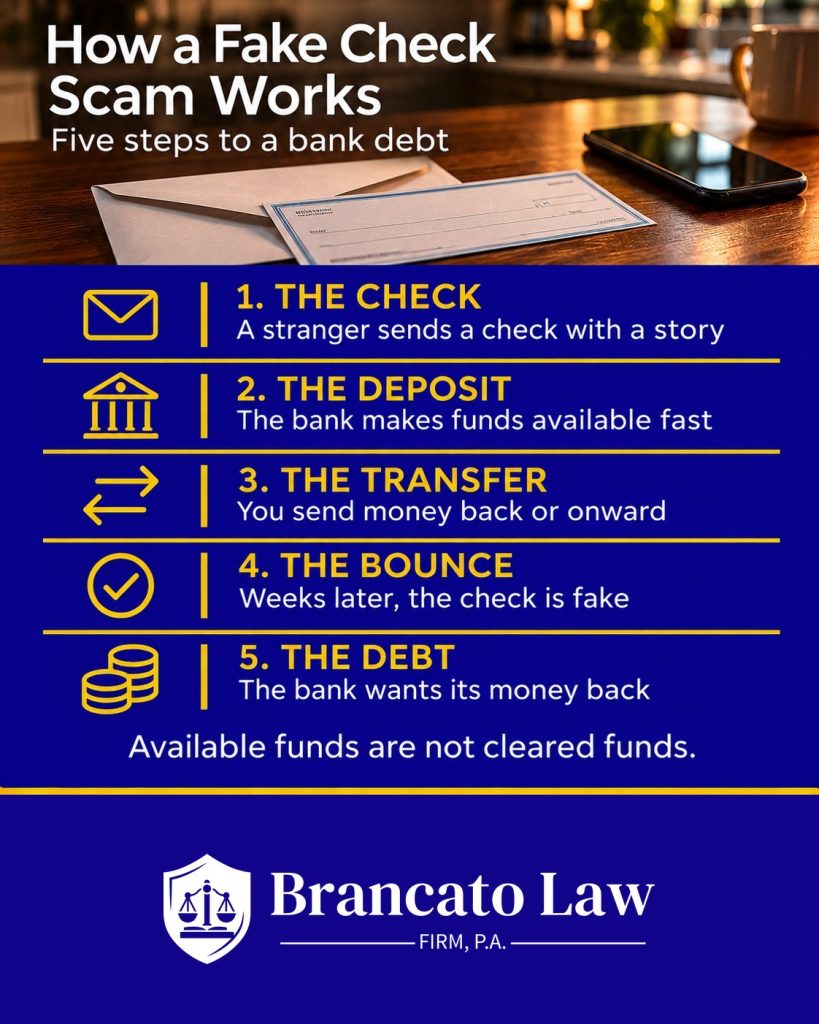
- The overpayment. A buyer sends a check for more than the price and asks you to wire or send back the difference.
- The job or “secret shopper” check. A new employer sends a check and asks you to buy gift cards, equipment, or send money to a “vendor.”
- The prize or sweepstakes. You “won” money, but you have to send back taxes or fees first.
- The keep-a-percentage deal. Someone asks you to deposit a check into your account, keep 10% for your trouble, and send the rest on. This is the version most likely to lead to charges.
- The borrowed account. Someone asks to use your account, your debit card, or your mobile deposit app to deposit a check for them.
What Florida crimes can you be charged with for cashing a fake check?
Prosecutors usually choose among five statutes, and several can be charged together. Each requires proof of knowledge or intent to defraud, which is where these cases are won or lost.
| Charge | Statute | What the State must prove | Degree |
|---|---|---|---|
| Uttering forged bills, checks, drafts, or notes | s. 831.09 | You passed or tendered a forged or counterfeit check as true, knowing it was forged, with intent to injure or defraud | Third-degree felony |
| Uttering a forged instrument | s. 831.02 | You uttered a forged instrument as true, knowing it was forged, intending to injure or defraud | Third-degree felony |
| Cashing or depositing an item with intent to defraud | s. 832.05(3) | You cashed or deposited an item in a bank with intent to defraud | Third-degree felony |
| Grand theft | s. 812.014 | You knowingly obtained the bank’s money with intent to deprive it | Third degree from $750; second degree from $20,000; first degree from $100,000 |
| Organized fraud (scheme to defraud) | s. 817.034 | A systematic, ongoing course of conduct with intent to defraud, and you obtained property | Third degree under $20,000; second degree from $20,000; first degree from $50,000 |
Under section 775.082, a third-degree felony carries up to 5 years in prison, a second-degree felony up to 15 years, and a first-degree felony up to 30 years. Organized fraud adds up every check in the same scheme to decide the degree, so several “small” checks can become a first-degree felony. Our guide to how value decides grand theft charges in Florida explains the theft thresholds in detail, and our Tampa white collar crime attorney page covers fraud charges more broadly.
Do you have to know the check was fake to be guilty in Florida?
Yes. For uttering, Florida law requires proof that you actually knew the check was forged, and showing that you should have known is not enough. The Second District Court of Appeal, which hears appeals from Hillsborough, Pinellas, and Pasco Counties, applied that rule in Ginn v. State, 26 So. 3d 706 (Fla. 2d DCA 2010).
Mr. Ginn’s roommate, who was behind on rent, told him to take traveler’s checks out of an envelope of the roommate’s mail. Mr. Ginn cashed two $500 checks at a check-cashing store and used the money to pay his mortgage and utilities. The checks were forged, and he was convicted of uttering and grand theft. The Second District reversed and ordered him discharged. The court held that “it is not sufficient for the State to show that the defendant should have known the instrument was forged,” and that a person who passes a forged check “in good faith, entirely innocent of the fact that it is a forgery,” cannot be convicted of uttering it. Because he did not intend to steal when he cashed the checks, the theft convictions fell too.
One part of Ginn’s reasoning has since changed. In Bush v. State, 295 So. 3d 179 (Fla. 2020), the Florida Supreme Court abandoned the special “reasonable hypothesis of innocence” standard that courts had used in purely circumstantial cases. Today the question on appeal is whether a rational jury could find knowledge beyond a reasonable doubt. The actual-knowledge requirement itself remains, but after Bush the defense has to put the evidence of good faith in front of the jury, not rely on the State’s failure to rebut it. That makes the messages, emails, and records from the scam the most important evidence in the case.
What turns a scam victim into a fraud suspect?
The facts that move a person from victim to suspect are the facts that suggest knowledge. In our experience, detectives and prosecutors focus on these:
| Facts that support a scam victim | Facts that suggest knowledge or intent |
|---|---|
| One check, deposited once | Several checks, often at several banks or branches |
| Money sent on the scammer’s instructions | Keeping a percentage or “fee” |
| Messages showing a believable reason for the check | A new account opened just to receive checks |
| Prompt report to the bank once warned | Continuing to deposit checks after a bank warning |
| Honest answers to the bank teller | False statements about where the check came from |
| No one else involved | Recruiting friends or family to deposit checks |
A person who did everything in the left column can still be investigated, because the bank lost money and the scammer is usually out of reach. That is why the first contact with law enforcement matters so much.
What happened in the Florida state-employee fraud ring?
Florida officials have now made 37 arrests, 17 of them state employees, in a case involving about $1.7 million in property damage payouts, according to FOX 13’s November 18, 2026 report. Officials allege that a former Department of Financial Services employee processed more than 220 suspicious claims through the state’s Division of Risk Management for family members and acquaintances. The four newest defendants, arrested in Gadsden County on November 17, are charged with grand theft and cashing an item with intent to defraud. These are allegations, and every person charged is presumed innocent.
The case shows how check-fraud charges reach people who did not design the scheme. A person who received and cashed a payment someone else arranged can face the same felony as the organizer, and the defense will turn on what that person knew when the check was cashed. It also shows how aggregation under the organized fraud statute can raise the stakes when many payments are tied together.
How common is fraud in Florida?
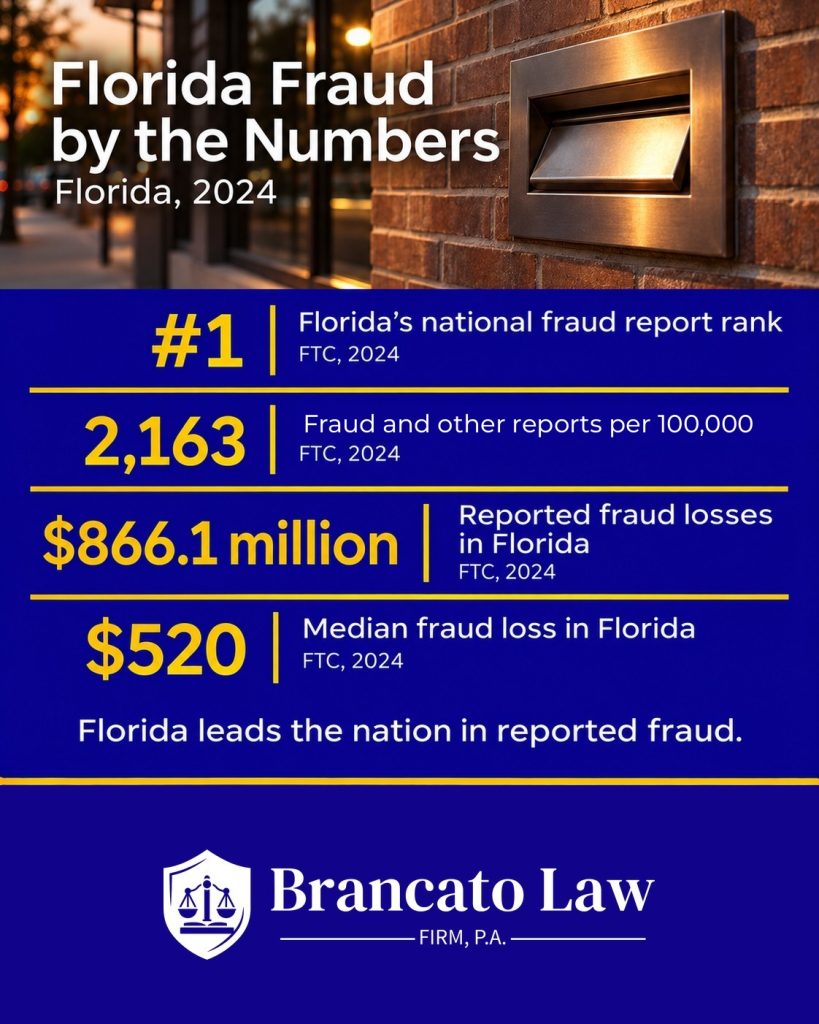
Florida led the nation in 2024 with 2,163 fraud and other consumer reports per 100,000 residents, and Floridians reported $866.1 million in fraud losses that year, with a median loss of $520, according to the Federal Trade Commission’s Consumer Sentinel Network Data Book 2024. Those losses fall on banks as well as people, and banks refer losses to law enforcement. When the scammer is overseas or anonymous, the account holder whose name is on the deposit is the person investigators can find.
What should you do if your bank or a detective contacts you about a check?
Stop, keep everything, and talk to a lawyer before you explain anything. Specifically:
- Do not send any more money, even if the person promises a replacement check or blames the bank.
- Preserve every message. Save texts, emails, app chats, social media messages, the envelope, the check image, and the deposit receipt. Screenshot profiles before they disappear.
- Do not give a statement to a detective without counsel. You have the right to remain silent, and an innocent explanation given badly can be used to prove knowledge.
- Do not close accounts or delete apps. Deleting evidence can be treated as consciousness of guilt.
- Let your lawyer handle repayment talks. The bank may demand repayment, and a civil demand is separate from the criminal case. Our post on civil theft demand letters in Florida explains how civil demands interact with a pending case.
How do our attorneys defend fake check cases before charges are filed?
Our attorneys try to end these cases before they are filed. Pre-file advocacy is a staple of our practice, and nearly every month a case of ours is never filed because of the work our attorneys do at the front end. We decide strategically, case by case, what to give the detective or the State Attorney’s Office: the scam messages, the timeline, bank records, and proof of where the money went. When the evidence shows a person was used rather than a participant, that presentation can end the investigation. Our page on representation before charges are filed explains how that process works.
When a case is filed, other doors remain. A first-time defendant charged with a third-degree felony may be a candidate for pretrial intervention, which can end in a dismissal. Our guides to the Hillsborough County PTI program and Hillsborough County diversion programs explain eligibility. At trial, the State has to prove knowledge beyond a reasonable doubt, and the scam evidence is how our attorneys show the jury what really happened. Where the case touches stolen personal information, our guide on how to fight an identity theft charge in Florida covers that overlap. The Florida criminal case process page shows each stage, starting with the investigation.
Frequently asked questions about cashing a fake check in Florida
Can I go to jail for depositing a fake check I got in the mail in Florida?
You can be charged, but a conviction requires proof that you knew the check was fake and intended to defraud, and a person who deposited one check in good faith has a strong defense. The Brancato Law Firm gathers the messages and records that show what you believed when you made the deposit, often before a charging decision is made.
Is it a crime to let someone use my bank account to deposit a check?
It can be, if the State can prove you knew the check was fraudulent or that you were helping move stolen money. Our attorneys at The Brancato Law Firm look closely at what you were told and when, because people are often recruited into these schemes through job offers or online relationships that look legitimate.
What if I kept part of the money as a fee?
Keeping a percentage is the fact prosecutors point to most often as proof of knowledge, but it does not by itself prove you knew the check was fake. The Brancato Law Firm presents the full context, including how the arrangement was described to you, through pre-file advocacy before the State commits to a charge.
If I pay the bank back, will the charges go away?
Not automatically, because a criminal case belongs to the State, not the bank, but restitution is often a major factor in whether a case is filed, reduced, or resolved through diversion. Our attorneys at The Brancato Law Firm structure any repayment so it helps the criminal case without being treated as an admission.
Can check fraud charges be dropped in Florida?
Yes, prosecutors drop or decline fake check cases when the evidence of knowledge is weak, when the person was clearly a scam victim, or after pretrial intervention is completed. The Brancato Law Firm pushes for a no-file first, then for diversion, and prepares for trial when neither is offered; our fraud defense attorneys handle each path.
Do I have to talk to a detective about a check I deposited?
No, you have the right to remain silent and the right to a lawyer, and asserting those rights through counsel is the safest course when your knowledge is the issue. The Brancato Law Firm can speak with the detective for you and decide what, if anything, should be provided.
A Detective Called About a Check? Call Us Before You Call Back
The window before charges are filed is the best chance to end a fake check case. The Brancato Law Firm, P.A., founded by Tampa Criminal Defense Attorney Rocky Brancato, can contact the detective, organize the scam evidence, and present your side before the State decides whether to file. Call (813) 727-7159 at any hour. Our firm has Spanish-speaking staff, and attorney Jean-Luc Adrien speaks Spanish, Haitian Creole, and French. For more about our defense strategies, visit our Tampa White Collar Crime page.
The Brancato Law Firm, P.A.
620 E. Twiggs Street, Suite 205, Tampa, FL 33602
(813) 727-7159
Serving Hillsborough, Pinellas, and Pasco Counties
The Brancato Law Firm, P.A. is a Tampa-based criminal defense practice. We are not affiliated with any other Brancato-named law firms.
Visit Us

Tampa, FL 33602

Contact Us Now
Free Legal Consultation (813) 727-7159
