

From First DUI to Death Penalty



How to Fight Credit Card Fraud Charges in Florida? (2026)


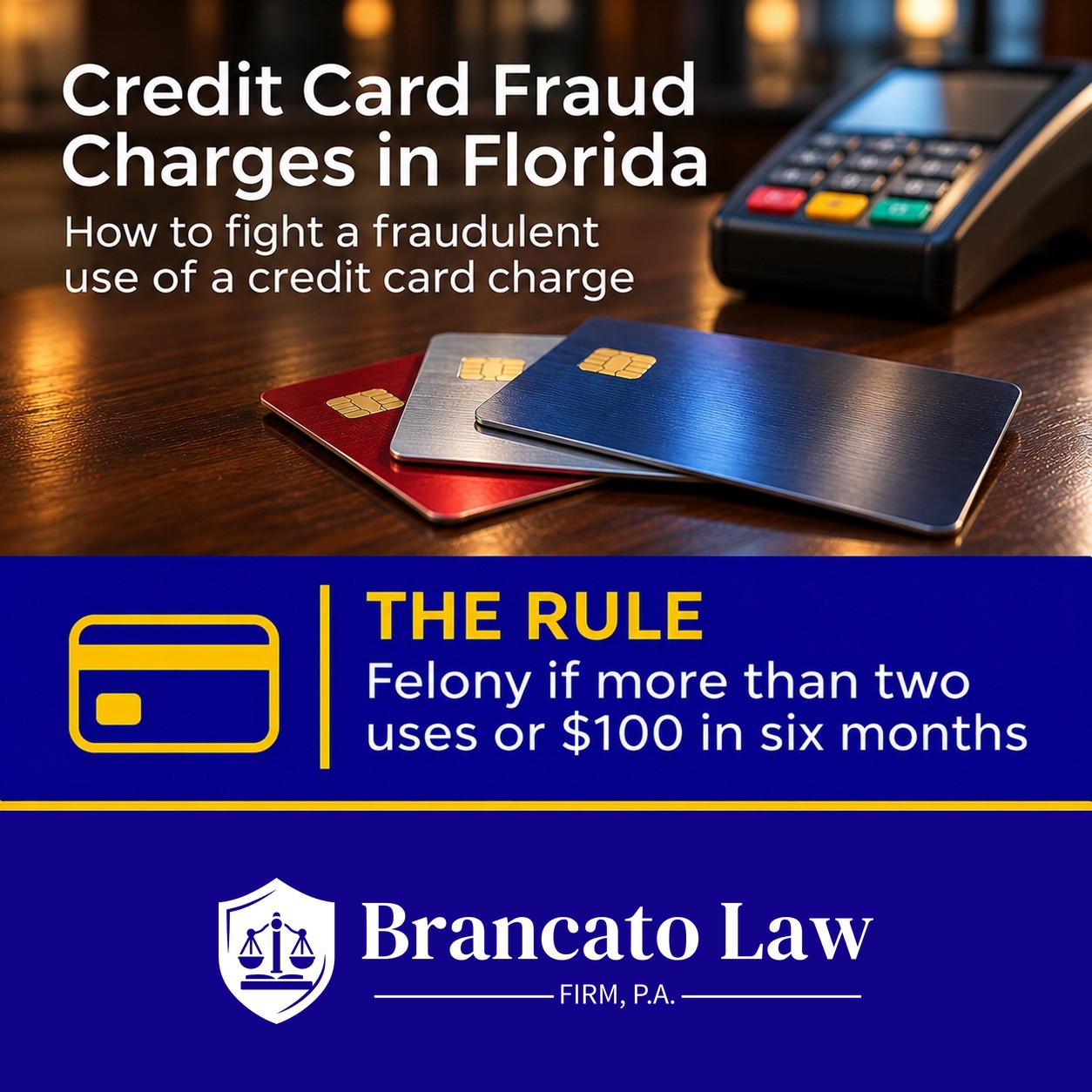
To fight a credit card fraud charge in Florida, the defense attacks the two things the State must prove under section 817.61: that the card was used without the cardholder’s consent, and that the person who used it intended to defraud. Our attorneys also check how the State counted the uses and the dollar value, because more than two uses or $100 or more within six months is what turns a first-degree misdemeanor into a third-degree felony. Many first-time cases end in a dismissal through pretrial intervention once restitution is addressed.
If a bank investigator or a detective has called about charges on someone else’s card, the first few weeks decide whether a case is ever filed. I’m Rocky Brancato, founder of The Brancato Law Firm, P.A., a Tampa criminal defense firm, and a former Chief Operations Officer of the Hillsborough County Public Defender’s Office, where I oversaw a staff of over 100 attorneys. Our attorneys defend credit card fraud and related fraud charges in Hillsborough, Pinellas, and Pasco Counties by testing consent, intent, identity, and the State’s math on every transaction.
What counts as fraudulent use of a credit card in Florida?
Fraudulent use of a credit card is using a card, or claiming to be its holder, with intent to defraud, in order to get money, goods, services, or anything else of value. Section 817.61, Florida Statutes, describes three ways to commit the offense:
- Using a card that was obtained or kept in violation of Florida’s credit card laws, or a card the person knows is forged.
- Getting something of value by representing, without the cardholder’s consent, that the person is the holder of a specified card.
- Getting something of value by representing that the person holds a card that was never actually issued.
The word “credit card” reaches further than most people expect. Under section 817.58(4), Florida Statutes, it includes debit cards, bank service cards, check guarantee cards, and electronic benefits transfer (EBT) cards. Swiping a roommate’s debit card at a gas pump falls under the same statute as charging a stolen Visa. Our Tampa theft and property crimes attorney page explains how our attorneys handle the wider group of theft and fraud charges these cases are often filed with.
| Element | What it means in practice | Where the defense looks |
|---|---|---|
| Use or representation | The accused used the card, or claimed to be the cardholder, to obtain something of value. | Surveillance video, receipts, IP and device data, who actually had the card. |
| No consent / unlawful card | The card was taken or kept unlawfully, was forged, or was used without the cardholder’s consent. | Texts, prior use, shared accounts, employer or family permission. |
| Intent to defraud | The person meant to cheat the issuer, the merchant, the cardholder, or someone else. | Belief the use was allowed, repayment plans, honest mistakes. |
| Count and value (for a felony) | More than two uses, or $100 or more, in any six-month period. | Which charges belong to the same card and the same six months. |
Is credit card fraud a felony in Florida?
Credit card fraud is a felony in Florida when the card is used more than two times, or $100 or more is obtained, in any six-month period. Two or fewer uses, and less than $100, is a first-degree misdemeanor. The penalty levels come from section 817.67, Florida Statutes, which sets the degree, and from section 775.082 and section 775.083, which set the maximum jail, prison, and fines.
| Charge | Statute | Degree | Maximum penalty |
|---|---|---|---|
| Fraudulent use, two or fewer uses and under $100 in six months | s. 817.61; s. 817.67(1) | First-degree misdemeanor | Up to 1 year in county jail and a $1,000 fine |
| Fraudulent use, more than two uses or $100 or more in six months | s. 817.61; s. 817.67(2) | Third-degree felony | Up to 5 years in prison and a $5,000 fine |
| Credit card theft (taking a card without consent, or receiving one known to be taken) | s. 817.60(1); s. 817.67(1) | First-degree misdemeanor | Up to 1 year in county jail and a $1,000 fine |
| Dealing in credit cards of another (receiving two or more cards of different cardholders in 12 months) | s. 817.60(5); s. 817.67(2) | Third-degree felony | Up to 5 years in prison and a $5,000 fine |
Credit card cases rarely come alone. The same facts can support a theft charge, a credit card theft charge under section 817.60, or an identity theft charge under section 817.568, which carries mandatory minimums at higher dollar amounts. Our guide to fighting an identity theft charge in Florida covers that statute. The Brancato Law Firm reviews the charging document line by line, because the choice of statute often matters more than the facts.
Is every swipe of the card a separate charge?
No. In Florida, every unauthorized use of the same credit card within a six-month period is one offense, not one charge per swipe. The Second District Court of Appeal decided this in Neal v. State, 109 So. 3d 1245 (Fla. 2d DCA 2013), a case where a man used the same stolen card seven times in Sarasota County and nine times in Charlotte County over four days in July 2009.
Each county filed its own felony count. Neal pleaded no contest in Sarasota County, and a Charlotte County jury later convicted him. The Second District reversed the Charlotte conviction. The court held that “the unusual structure of section 817.61 requires the consolidation of all unauthorized uses of the same credit card within a six-month period into a single offense,” so the second prosecution violated double jeopardy.
The lesson is practical. Prosecutors sometimes file several counts for a string of purchases on one card, or two counties each file their own case. The Second District hears appeals from Hillsborough, Pinellas, and Pasco Counties, so Neal binds the trial courts where our firm practices. Our attorneys map every transaction by card and by date, and move to dismiss counts that split one offense into several.
Does the State have to prove you pretended to be the cardholder?
It depends on how the State charged the case. When the charging document alleges only that the accused represented himself or herself as the cardholder, the State must prove that representation. In A.M. v. State, 794 So. 2d 645 (Fla. 2d DCA 2001), a teenager used her mother’s card for $349 in purchases over several days, but signed her own name and told merchants the card was her mother’s. The Second District reversed the delinquency finding because the State charged a false-representation theory it never proved.
Swiping a card can count as that representation, though. In Jones v. State, 239 So. 3d 203 (Fla. 4th DCA 2018), a man used a debit card from a purse stolen at a Palm Beach County monastery retreat to buy food twice at a McDonald’s. The Fourth District affirmed his conviction and held that “the act of swiping constitutes a representation that the swiper had authority to use the card.” The court distinguished A.M. because the State charged Jones in the alternative, including use of an unlawfully obtained card.
Together, these cases show why the wording of the information matters. When the State picks one theory and the evidence supports another, our attorneys raise it in a motion for judgment of acquittal at trial, and the issue is preserved for appeal.
How common is credit card fraud in Florida?
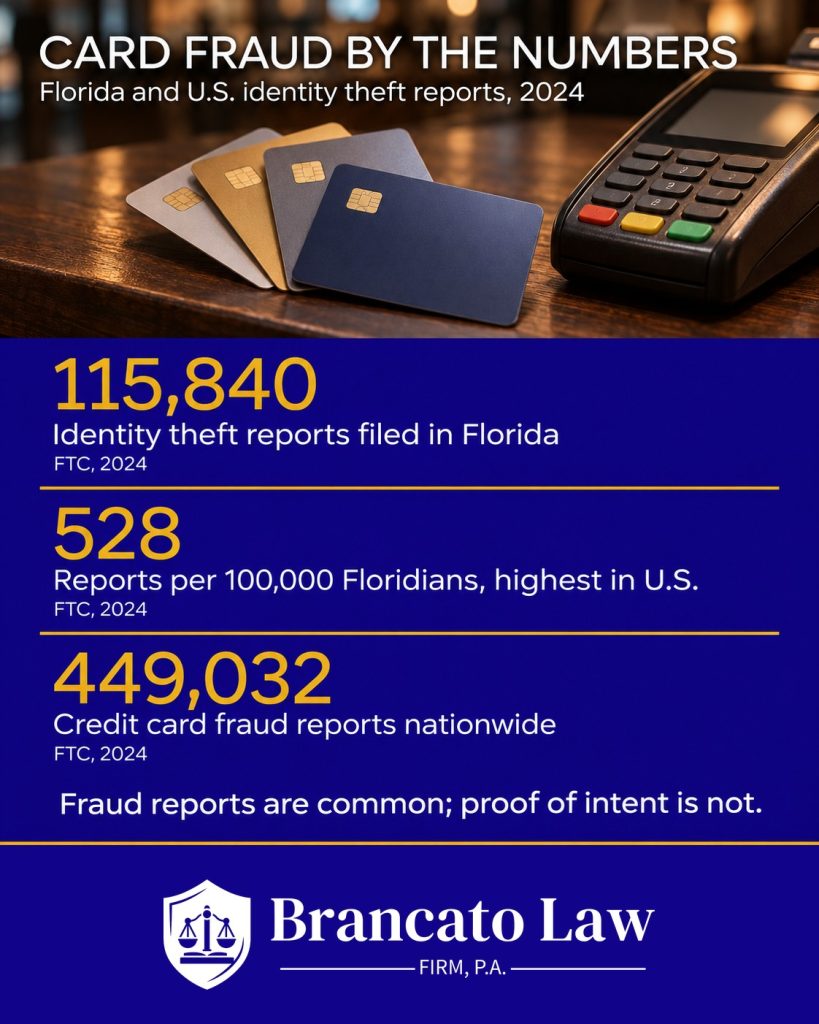
Florida reports more identity theft per person than any other state. In 2024, Floridians filed 115,840 identity theft reports with the Federal Trade Commission, a rate of 528 reports per 100,000 residents, the highest in the country, according to the FTC Consumer Sentinel Network Data Book 2024. Nationally, credit card fraud was the most common type of identity theft the FTC received that year, with 449,032 reports. Florida consumers also reported $866.1 million in fraud losses in 2024.
Most of those cases never reach a police report. The Bureau of Justice Statistics found that misuse of an existing credit card accounted for 30.5% of identity theft victims’ most recent incidents in 2021, and that only about 7% of identity theft victims reported the incident to police (Harrell and Thompson, Victims of Identity Theft, 2021, BJS, October 2023). The same study found that the most common way victims learned of the misuse was a call from their bank or card company about suspicious activity. In practice, that means many credit card prosecutions begin with a bank fraud department’s file, and those files often leave out who else had access to the card.
How do our attorneys fight a credit card fraud charge?
Our attorneys fight a credit card fraud charge by testing each element the State must prove and the evidence behind each transaction. The defenses below are the ones that come up most often.
- Consent. Many cases involve a spouse, partner, parent, roommate, or employer who allowed use of the card and later disputed the charges. Text messages, past use, and shared bills can show permission.
- No intent to defraud. A person who honestly believed the use was allowed, or who was told to buy supplies with a company card, did not intend to cheat anyone.
- Identity. The State must prove who used the card. Our attorneys subpoena surveillance video, store receipts, delivery records, and IP addresses, and test whether a photo lineup or a bank investigator’s identification holds up.
- Counting and value. The felony depends on more than two uses or $100 or more within six months. Charges outside the window, on a different card, or never actually completed can drop the case to a misdemeanor.
- Charging errors. Under A.M., the State must prove the theory it charged. Split counts on the same card within six months can be dismissed under Neal.
- Suppression. Statements taken without Miranda warnings, and searches of a phone or car without a valid warrant or consent, can be challenged in a motion to suppress.
Some of the strongest cases for the defense start as scams. People who were told to buy gift cards or move money for an online “employer” are often the victims of the fraud they are accused of. Our post on being charged for cashing a fake check in Florida explains how that pattern plays out with checks.
Can a credit card fraud case end without a conviction?
Yes. A first-time defendant charged with a third-degree felony is often a candidate for pretrial intervention (PTI), a diversion program that ends in a dismissal when the person completes its conditions, which usually include restitution. Our guide to the Hillsborough County PTI program explains eligibility. When diversion is not available, our attorneys negotiate for a reduction to a misdemeanor, a withhold of adjudication (no formal conviction on the record), or a sentence without jail.
Repaying the money does not end a criminal case by itself, because the case belongs to the State, not the bank. Restitution is still one of the strongest tools the defense has. The Brancato Law Firm often works out restitution before the State Attorney makes a filing decision, which is part of our representation before charges are filed.
What happens after a credit card fraud arrest in Hillsborough County?
In Hillsborough County, a person arrested for felony credit card fraud is taken to the Orient Road Jail and sees a judge at first appearance within 24 hours. Felony charges are then filed, reduced, or declined by the State Attorney’s Office for the 13th Judicial Circuit. Our guide to the Florida criminal case process walks through each stage after arrest, from first appearance to plea or trial.
One local detail catches families off guard. Pretrial services supervision is not available in Hillsborough County, even though nearby counties offer it, so a judge setting release conditions has fewer middle-ground options. Our attorneys come to first appearance ready with a bond argument, a verified address, and proof of work or school. Our Hillsborough County criminal defense attorney page explains how we handle cases in the 13th Circuit.
What should you do if a bank or detective calls about card charges?
Do not explain the charges, apologize, or offer to pay over the phone until you have spoken with a lawyer. Bank fraud investigators and detectives often call before any charge is filed, and anything said on that call goes into the report the State Attorney reviews.
- Save texts, emails, and records that show permission to use the card or account.
- Write down who else had access to the card, the phone, or the online account.
- Do not delete messages or close accounts; that can look like hiding evidence.
- Call a criminal defense attorney before returning the detective’s call.
The Brancato Law Firm contacts the detective or the bank on the client’s behalf, presents consent or restitution evidence, and asks the State Attorney not to file. That pre-file advocacy is often the difference between a closed file and an arrest.
Frequently asked questions about credit card fraud charges in Florida
Can credit card fraud charges be dropped in Florida?
Yes. Prosecutors drop or decline credit card fraud charges when the evidence of identity or intent is weak, when the cardholder gave permission, or after the accused completes pretrial intervention. The Brancato Law Firm presents that evidence to the State Attorney early, often before a case is filed, through our pre-charge representation.
Is using a family member’s credit card without permission a crime in Florida?
It can be, if the use was without consent and with intent to defraud. Our attorneys at The Brancato Law Firm look closely at past use, shared accounts, and family texts, because cases like A.M. v. State show the State must prove the exact theory it charged.
Can I be charged in two counties for using the same card?
Not for uses of the same card within the same six-month period. Under Neal v. State, those uses are one offense, and a second prosecution violates double jeopardy; The Brancato Law Firm checks for overlapping cases in Hillsborough, Pinellas, and Pasco Counties.
Does Florida’s credit card fraud law cover debit cards and EBT cards?
Yes. Section 817.58(4) defines “credit card” to include debit cards, bank cards, check guarantee cards, and EBT cards. Our attorneys at The Brancato Law Firm see debit card cases as often as credit card cases, and the same defenses apply.
What is the jail time for a first offense of credit card fraud in Florida?
A misdemeanor carries up to one year in county jail, and a third-degree felony up to five years in prison, though many first offenses end with diversion, probation, or a withhold of adjudication. The Brancato Law Firm builds the mitigation and restitution record that our theft and fraud defense lawyers use to argue for those outcomes.
If I pay the money back, will the credit card fraud charge go away?
Not automatically, because the State, not the bank, decides whether to prosecute. Restitution does weigh heavily in charging and plea decisions, and The Brancato Law Firm often arranges it before the filing decision; our guide to theft in Florida explains how restitution works in related cases.
For more about our defense strategies, visit our Theft and Property Crimes page. Fraud cases that involve employers, businesses, or larger schemes are covered on our white collar crime defense page.
The time to act is before the detective’s report reaches the State Attorney. Call The Brancato Law Firm, P.A., founded by Tampa Criminal Defense Attorney Rocky Brancato, at (813) 727-7159; you can call us at any hour, and our office is two blocks from the courthouse. Our firm has Spanish-speaking staff, and attorney Jean-Luc Adrien speaks Spanish, Haitian Creole, and French.
The Brancato Law Firm, P.A.
620 E. Twiggs Street, Suite 205, Tampa, FL 33602
(813) 727-7159
Serving Hillsborough, Pinellas, and Pasco Counties
The Brancato Law Firm, P.A. is a Tampa-based criminal defense practice. We are not affiliated with any other Brancato-named law firms.
Visit Us

Tampa, FL 33602

Contact Us Now
Free Legal Consultation (813) 727-7159
