- Free Consultation 24/7: (813) 727-7159 Tap Here To Call Us


From First DUI to Death Penalty



How Does the State Prove Value in a Florida Grand Theft Case?



| Key Takeaway: In Florida, the value of the stolen property is an element of grand theft that the State must prove beyond a reasonable doubt — and testimony about what the property cost when it was purchased is not enough by itself. Value means the fair market value of the property at the time and place of the theft, and unless the State’s evidence accounts for the property’s age, condition, and depreciation, a grand theft conviction cannot stand. On August 28, 2026, a Tampa case — Russell v. State — reversed a grand theft conviction for exactly this failure of proof. |
I’m Tampa Criminal Defense Attorney Rocky Brancato. In more than 25 years defending theft, burglary, and property cases in Hillsborough County courtrooms, I have seen more grand theft convictions undone by the value element than by any other single issue.
A Tampa Theft Case Was Just Reversed Over Proof of Value
On August 28, 2026, Florida’s Second District Court of Appeal threw out a Hillsborough County grand theft conviction because the State never properly proved what the stolen property was worth. The case is Russell v. State, No. 2D2024-1373 (Fla. 2d DCA Aug. 28, 2026), an appeal from a Tampa courtroom.
The facts were about as bad for the defense as theft facts get. A homeowner came home from work to find two strange bicycles at his back gate and heard a commotion in his bedroom. He called 911, Tampa police responded, and the defendant walked out of the house carrying a bag containing the homeowner’s property: six wristwatches, two film cameras, an unopened kitchen knife set, and a men’s hair trimmer. The State charged burglary of an unoccupied dwelling and grand theft from a dwelling, alleging the property was worth $100 or more but less than $750 under the 2022 version of the statute.
At trial, the State tried to prove value through the homeowner’s testimony and photographs of the items. That was the mistake. The victim testified about what he paid for the items — but not about their fair market value at the time of the theft or how much they had depreciated. The Second District held that testimony about the purchase price of stolen items, without testimony about depreciation or fair market value, is legally insufficient to sustain a grand theft conviction. The panel went further, openly stating that “[t]he Florida Supreme Court should reconsider Negron” — the 1974 decision that created this rule — while acknowledging, “That said, we are bound to apply Negron.”
The lesson is the one we build theft defenses around at The Brancato Law Firm: even when the State can prove someone took property, it still has to prove — beyond a reasonable doubt — what that property was actually worth. When it can’t, a felony becomes a misdemeanor.
What Does “Value” Mean Under Florida’s Theft Statute?
Value means the market value of the property at the time and place of the offense — not what the owner paid for it, and not what it would cost new. Section 812.012(10)(a)1, Florida Statutes, defines value as “the market value of the property at the time and place of the offense or, if such cannot be satisfactorily ascertained, the cost of replacement of the property within a reasonable time after the offense.”
| Fla. Stat. § 812.012(10)(a)1: “Value means the market value of the property at the time and place of the offense or, if such cannot be satisfactorily ascertained, the cost of replacement of the property within a reasonable time after the offense.” |
Two more parts of the definition matter in real cases. First, if the value of the property cannot be ascertained at all, the statute directs that the trier of fact may find a minimum value — and if no minimum can be established, the value is deemed to be less than $100, which is second-degree petit theft. § 812.012(10)(b), Fla. Stat. Second, the State may aggregate the value of separate property stolen “pursuant to one scheme or course of conduct” to reach a higher threshold. § 812.012(10)(c), Fla. Stat. In our Hillsborough County cases, we scrutinize both: an aggregation theory that doesn’t hold together, or a valuation that can’t actually be ascertained, can drop a felony to a misdemeanor before trial ever starts.
What Are Florida’s Grand Theft Value Thresholds?
Grand theft starts at $750 for most property — but only $40 when the property is taken from a dwelling. The thresholds under Section 812.014, Florida Statutes, determine whether a theft is a misdemeanor or a felony, and what degree:
| Value of property | Charge | Level | Maximum penalty |
| Less than $100 | Petit theft, 2nd degree | Misdemeanor (2nd degree) | 60 days jail |
| $100 – $749 | Petit theft, 1st degree | Misdemeanor (1st degree) | 1 year jail |
| $40 – $749 taken from a dwelling | Grand theft, 3rd degree — § 812.014(2)(d)1 | Felony (3rd degree) | 5 years prison |
| $750 – $19,999 | Grand theft, 3rd degree — § 812.014(2)(c) | Felony (3rd degree) | 5 years prison |
| $20,000 – $99,999 | Grand theft, 2nd degree | Felony (2nd degree) | 15 years prison |
| $100,000 or more | Grand theft, 1st degree | Felony (1st degree) | 30 years prison |
The Brancato Law Firm, P.A. — Tampa theft defense — (813) 727-7159
| Warning: Two traps hide in this table. Theft from a dwelling is a felony at just $40 — a charge we see out of Tampa burglary arrests constantly. And prior theft convictions raise the stakes on their own: a second theft conviction makes petit theft a first-degree misdemeanor, and two or more priors make any theft a third-degree felony, regardless of value. § 812.014(3)(b)–(c), Fla. Stat. |
Every dollar figure in this table is also a line the State must prove beyond a reasonable doubt. The difference between $749 and $750 is the difference between a misdemeanor and a felony — which is why the value fight matters so much.
Why Isn’t the Purchase Price Enough to Prove Value?
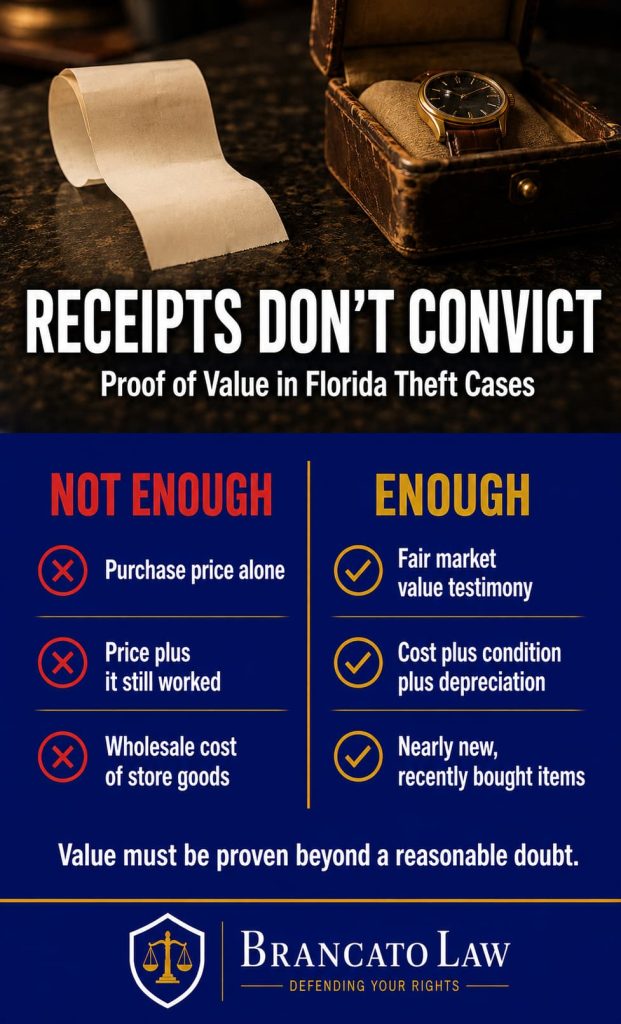
Because what you paid for something is not what it’s worth after you’ve owned and used it. The Florida Supreme Court settled this in Negron v. State, 306 So. 2d 104 (Fla. 1974): “The law in Florida is well settled that testimony as to the cost of stolen property is insufficient in itself to establish the value at the time of the theft.” Negron also confirmed that proof of value “is essential to a conviction for grand larceny and must be established by the State beyond and to the exclusion of every reasonable doubt.”
Florida’s appellate courts have applied that rule for fifty years. Purchase price plus a bare statement that the item “was in working order” is still not enough. K.W. v. State, 983 So. 2d 713, 715 (Fla. 2d DCA 2008). For electronics, the courts are even more skeptical: because televisions, computers, and similar items are “subject to accelerated obsolescence,” purchase price alone is generally insufficient to prove their value — a six-month-old television’s receipt could not sustain a grand theft conviction. Lucky v. State, 25 So. 3d 691 (Fla. 4th DCA 2010). And where goods are stolen from a store, the State cannot rely on wholesale cost; it must show retail prices demonstrating market value and salability near the time of the theft. Negron, 306 So. 2d at 108.
This is where prosecutors get sloppy, and where we do damage. When I cross-examine a victim or a loss-prevention witness on value, I am building the record for a judgment of acquittal on the felony — exactly the motion that won in Russell.
The Four Factors Florida Courts Use to Establish Market Value
When there’s no direct testimony of fair market value, Florida law gives the jury exactly four factors to work with, drawn from Negron and reaffirmed in State v. Hawthorne, 573 So. 2d 330, 332 (Fla. 1991): (1) original market cost; (2) the manner in which the item was used; (3) its general condition and quality; and (4) the percentage of depreciation since purchase.
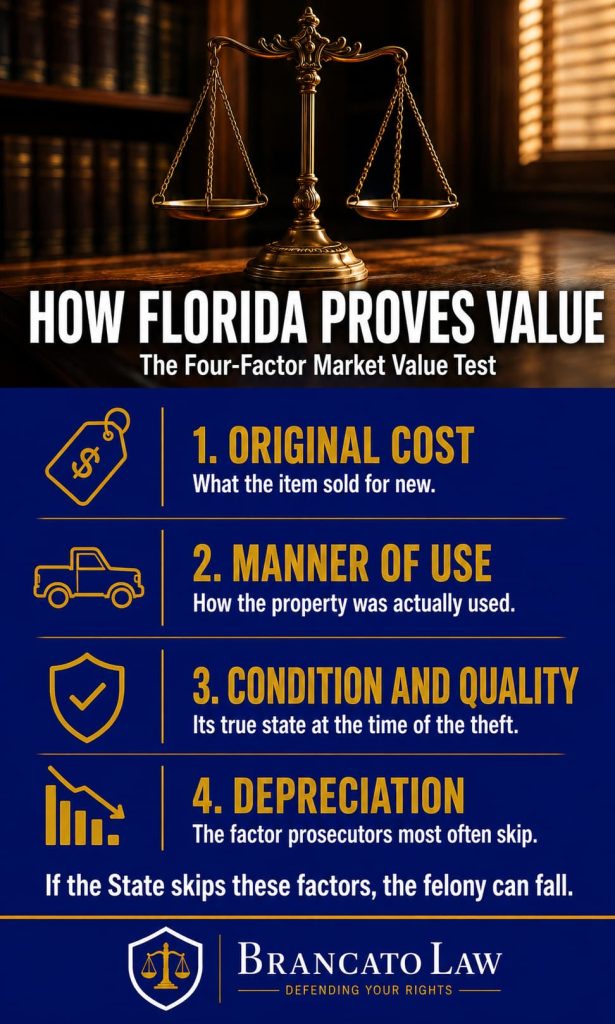
Here is how each factor plays out — and where The Brancato Law Firm attacks:
| Factor | What the State must show | How we attack it |
| 1. Original market cost | What the item actually sold for new | Receipts missing; witness guessing; wholesale vs. retail confusion |
| 2. Manner of use | How the property was used day to day | Heavy use, wear, or damage the witness never addressed |
| 3. Condition and quality | The item’s actual state at the time of theft | “It worked” is legally insufficient; photographs don’t speak to value |
| 4. Percentage of depreciation | How much value it lost since purchase | The factor prosecutors most often skip entirely — as in Russell |
If the State’s witness never testifies to depreciation and never gives a fair market value, the four-factor path fails — and with it, the felony.
When Is Purchase Price Alone Actually Enough?
Almost never — the narrow exception is property that is essentially brand new. In K.W. v. State, the Second District affirmed where the evidence showed a cell phone was purchased for $450 only three months before the theft and was in “brand new,” working condition; on those facts, the phone’s value was “so obvious as to defy contradiction” that it met the $100 threshold. 983 So. 2d at 716.
That exception is real, and an honest theft defense accounts for it. But notice how much the State needed even there: price, purchase date, and specific condition testimony — not just a number. Compare Russell, where an unopened kitchen knife set was among the stolen items, and the State still lost the felony because the witness never connected price to value at the time of the theft. In our experience trying theft cases in the 13th Judicial Circuit, prosecutors rarely build that record, because they rarely think about value until the defense makes it the issue.
Who Is Allowed to Testify About the Value of Stolen Property?
An owner is presumed competent to testify about the value of their own property — but mere ownership is not enough. Florida courts apply a two-prong test: first, whether the witness is competent to testify to value, and second, whether the testimony actually proves the property met the statutory threshold at the time of the theft. An owner is presumed competent because an owner “necessarily knows something about the quality, cost, and condition” of their property; but the witness must still have personal knowledge, and their testimony must still add up to market value. Lucky v. State, 25 So. 3d 691, 692–93 (Fla. 4th DCA 2010).
Both prongs are defense opportunities. We depose the State’s value witness before trial, pin down what they actually know — and what they’re guessing at — and use that record twice: once in a motion for judgment of acquittal, and again in closing.
Can a Grand Theft Conviction Be Reduced to Petit Theft?
Yes — when the State fails to prove value, the felony is reversed and the case is remanded for entry of judgment on petit theft, a misdemeanor. That is the standard remedy Florida appellate courts apply, as in Lucky, and it is the practical stake in every value fight: the difference between a felony record with prison exposure and a misdemeanor.
But the better outcome is not needing the appeal. When The Brancato Law Firm handles a grand theft case in Hillsborough, Pinellas, or Pasco County, the value challenge starts before trial: demanding the State’s valuation evidence in discovery, moving to reduce the charge where the proof can’t reach the threshold, and preserving the judgment-of-acquittal argument at trial. A felony reduced to a misdemeanor before filing — through pre-file advocacy with the State Attorney’s Office — never shows up as a felony arrest disposition at all.
What Should You Do in the First 48 Hours After a Theft Arrest in Tampa?
The first 48 hours decide how much of the value fight is still winnable. If you or a family member has been booked at Orient Road or Falkenburg Road Jail on a grand theft or burglary charge, three things matter immediately:
- Do not discuss the property or its value with anyone. Statements about what items were “worth” — to detectives, in jail calls, or to the alleged victim — become the State’s value evidence.
- Preserve everything that bears on condition and age. Photographs, receipts, repair records, and listings for comparable used items are exactly the depreciation evidence that decides these cases.
- Get counsel involved before the State Attorney files. The filing decision in the 13th Judicial Circuit is where a borderline felony becomes a misdemeanor — or doesn’t. I spend that window putting valuation problems in front of the prosecutor, because charges that are filed right are easier to fight and easier to resolve.
Call The Brancato Law Firm at (813) 727-7159 — we answer 24/7.
Frequently Asked Questions About Grand Theft Value in Florida
Is grand theft a felony in Florida?
Yes — every grand theft is a felony. Third-degree grand theft (generally $750 to $19,999, or $40 or more taken from a dwelling) carries up to 5 years; second-degree ($20,000 to $99,999) up to 15 years; first-degree ($100,000 or more) up to 30 years. § 812.014(2), Fla. Stat. We defend these cases throughout Hillsborough, Pinellas, and Pasco Counties.
What is the minimum value for grand theft in Florida?
$750 for most property — but only $40 if the property was taken from a dwelling, and lower thresholds apply to specific items like firearms and motor vehicles regardless of value. § 812.014(2), Fla. Stat. In our Tampa cases, the dwelling provision is the one that surprises people most.
Does the State have to prove what the stolen property was worth?
Yes, beyond a reasonable doubt — value is an element of grand theft, not a detail. Negron v. State, 306 So. 2d 104 (Fla. 1974). In our Hillsborough County theft trials, the State’s value proof is often the weakest part of its case, and we build the defense around it.
Is a receipt or purchase price enough to convict someone of grand theft?
No — testimony about the purchase price alone is legally insufficient to prove value at the time of the theft, as the Second District just reaffirmed in Russell v. State (Aug. 28, 2026). The State must connect price to fair market value through condition, use, and depreciation. We hold prosecutors to every piece of that showing.
Can a grand theft charge be reduced to petit theft?
Yes — when the value evidence can’t support the felony threshold, the charge drops to petit theft, a misdemeanor. That reduction can happen at the filing stage, on a motion at trial, or on appeal. The Brancato Law Firm pushes for it at the earliest stage possible, where it does the most good.
Do I need a lawyer for a grand theft charge in Florida?
Yes — because the line between a felony and a misdemeanor in a theft case is usually a fight over proof, not facts, and it is winnable with the right record. The Brancato Law Firm, P.A. has defended theft and burglary cases in Tampa courtrooms for more than 25 years, including over 150 jury trials. Call (813) 727-7159 for a free, confidential consultation.
For more about our defense strategies, visit our Hillsborough County Criminal Defense page.
Related reading: What Is Theft in Florida? · What Is Dealing in Stolen Property in Florida? · Is a Porch a Dwelling? Florida Court Clarifies Burglary Law · The Criminal Court Process in Hillsborough County
Charged With Grand Theft in Tampa Bay? The Value Fight Starts Now
The State’s value evidence gets built in the first weeks after arrest — and so does the record that beats it. If you’re facing a grand theft or burglary charge in Hillsborough, Pinellas, or Pasco County, call Tampa Criminal Defense Attorney Rocky Brancato at The Brancato Law Firm, P.A.: (813) 727-7159. If charges haven’t been filed yet, early action may keep a felony off the table entirely.
The Brancato Law Firm, P.A. is a Tampa-based criminal defense practice. We are not affiliated with any other Brancato-named law firms.
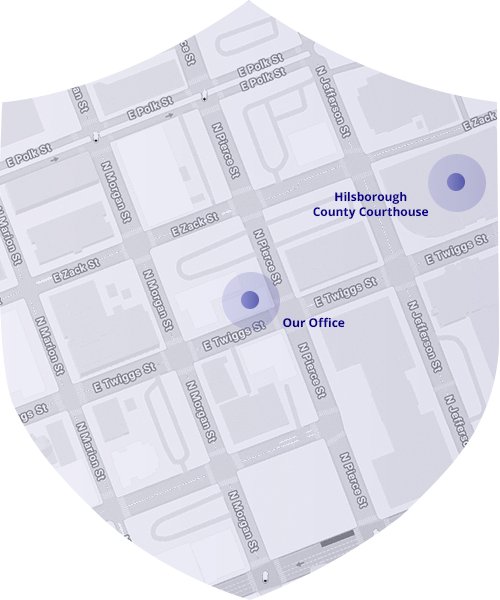
Visit Us

Tampa, FL 33602
Contact Us Now
Free Legal Consultation (813) 727-7159