

From First DUI to Death Penalty



How to Fight a Riot Charge in Florida? (2026)


To fight a riot charge in Florida, the defense makes the State prove that the person willfully joined a violent public disturbance of three or more people who shared a common intent to help each other commit violent and disorderly conduct. Under section 870.01, riot and inciting a riot are third-degree felonies punishable by up to 5 years in prison. Aggravated rioting and aggravated inciting are second-degree felonies punishable by up to 15 years. In DeSantis v. Dream Defenders (2024), the Florida Supreme Court held that being present at a protest that turns violent is not enough: the person must engage in the violence or intend to assist it.
If you were arrested after a protest, a street fight, or a crowd that got out of hand, the first thing to know is that a riot charge keeps you in jail until a judge sees you, with no bond off the schedule. I’m Rocky Brancato, founder of The Brancato Law Firm, P.A., a Tampa criminal defense firm, and a former Chief Operations Officer of the Hillsborough County Public Defender’s Office, where I oversaw a staff of over 100 attorneys. Over more than 25 years in Hillsborough County courtrooms and more than 150 jury trials to verdict, I have seen crowd cases built on a few seconds of video. Our attorneys defend riot charges by separating what each client actually did from what the crowd around them did, because Florida law now requires that line to be drawn.
What is a riot charge in Florida?
A riot charge in Florida means the State accuses a person of willfully participating in a violent public disturbance involving three or more people who acted “with a common intent to assist each other in violent and disorderly conduct.” Section 870.01(2), Florida Statutes, also requires a result: injury to another person, damage to property, or imminent danger of either. The Legislature wrote that definition in 2021 through House Bill 1, the “Combatting Violence, Disorder, and Looting, and Law Enforcement Protection Act.” Before 2021, Florida courts used the common-law definition of riot, which the Florida Supreme Court described in State v. Beasley, 317 So. 2d 750 (Fla. 1975) as “a tumultuous disturbance of the peace by three or more persons, assembled and acting with a common intent.”
Riot is treated as a crime of violence, and the defense of these cases is part of the work on our Tampa violent crime lawyer page. The same statute covers four related offenses: affray (a mutual public fight), inciting a riot, aggravated rioting, and aggravated inciting a riot. Subsection (7) states that the law “does not prohibit constitutionally protected activity such as a peaceful protest.”
What are the penalties for riot and inciting a riot in Florida?
Riot and inciting a riot are third-degree felonies punishable by up to 5 years in prison and a $5,000 fine under section 775.082. Aggravated rioting and aggravated inciting a riot are second-degree felonies punishable by up to 15 years and a $10,000 fine. The offense severity chart in section 921.0022 ranks riot and inciting a riot at Level 3 and the aggravated versions at Level 4. A Level 3 offense scores 16 points standing alone and a Level 4 scores 22, both below the 44 points that make prison the lowest permissible sentence, so a person with no record usually faces probation unless other charges or victim injury add points.
| Offense | Subsection | Degree and level | Maximum penalty |
|---|---|---|---|
| Affray (mutual public fight) | 870.01(1) | First-degree misdemeanor | 1 year jail, $1,000 fine |
| Riot | 870.01(2) | Third-degree felony, Level 3 | 5 years prison, $5,000 fine |
| Aggravated rioting | 870.01(3) | Second-degree felony, Level 4 | 15 years prison, $10,000 fine |
| Inciting a riot | 870.01(4) | Third-degree felony, Level 3 | 5 years prison, $5,000 fine |
| Aggravated inciting a riot | 870.01(5) | Second-degree felony, Level 4 | 15 years prison, $10,000 fine |
| Unlawful assembly | 870.02 | Second-degree misdemeanor | 60 days jail, $500 fine |
What makes a riot aggravated in Florida?
A riot becomes aggravated rioting when, in the course of the riot, the person does one of five things listed in section 870.01(3). Each one raises the charge from a third-degree to a second-degree felony, so the defense examines each factor on its own.
| Factor | What the State must prove | Where the defense looks |
|---|---|---|
| 25 or more participants | The person participated with 25 or more other persons | Whether the State can count 25 people who shared the violent intent, not just 25 people present |
| Great bodily harm | Caused great bodily harm to a person not participating in the riot | Medical records, and whether the injured person was part of the riot |
| Property damage over $5,000 | Caused property damage in excess of $5,000 | Repair estimates, and which damage this person caused |
| Deadly weapon | Displayed, used, threatened to use, or attempted to use a deadly weapon | Whether the object was a deadly weapon as used |
| Endangering vehicles | By force or threat of force, endangered the safe movement of a vehicle on a public road | Video of traffic, and whether there was force or a threat of force |
Aggravated inciting a riot under section 870.01(5) covers inciting a riot that results in great bodily harm or more than $5,000 in property damage, and supplying a deadly weapon or teaching someone to prepare one with intent that it be used in a riot. The road factor matters in Tampa Bay protests and car meetups, where crowds spill into streets such as Dale Mabry Highway or Bayshore Boulevard.
Can you be charged with riot just for being at a protest that turned violent?
No. Being present when a crowd turns violent is not a riot under Florida law. In DeSantis v. Dream Defenders, 389 So. 3d 413 (Fla. 2024), civil rights groups challenged the 2021 riot definition in federal court, and a federal judge blocked its enforcement. The federal appeals court asked the Florida Supreme Court what the statute means. The Florida Supreme Court answered that a person cannot “willfully participate” in a violent public disturbance without acting with a common intent to assist others in violent and disorderly conduct, so “to be guilty of the crime of riot, one must ‘engage in,’ or at least ‘intend to assist others in engaging in, violent and disorderly conduct.'”
The court also read “willfully” to mean “intentionally, knowingly, and purposely,” and agreed that “A peaceful protestor, under the most natural reading of the statute, is no rioter.” With that reading in hand, the federal appeals court in Dream Defenders v. Governor of the State of Florida, 119 F.4th 872 (11th Cir. 2024) lifted the injunction and wrote that “Mere attendance at a violent protest is not enough.” For a client, that holding is the center of the defense: the State must prove intent to assist violence, and standing near it, filming it, or failing to leave does not prove that intent.
What does the State need to prove for inciting a riot?
For inciting a riot, the State must prove the person willfully incited another person to participate in a riot, and that a riot or imminent danger of a riot resulted. Speech is protected unless it crosses a narrow line. Under Brandenburg v. Ohio, 395 U.S. 444 (1969), the First Amendment protects advocacy of force unless it is directed to inciting or producing imminent lawless action and is likely to produce it. Florida applied a similar limit in Beasley, where the information charged only that the defendant “did incite or encourage a riot.” The Florida Supreme Court upheld the old statute only with a limiting construction and affirmed dismissal of that charge, holding that the words must “advocate violence and tend to incite an immediate breach of the peace” and that the charging document must allege a clear and present danger of a riot.
In practice, inciting cases rest on social media posts, chants, livestream audio, and witness memory of who said what. Our attorneys pull the full recordings, because a clipped post or a single shouted phrase often looks different in context, and angry or offensive speech is not incitement unless it is aimed at producing immediate violence.
How do our attorneys fight a riot charge in Florida?
We fight riot charges by testing each element against the evidence for this one client, not the crowd. These are the defenses we raise most often.
- No intent to assist violence. Under Dream Defenders, the State must prove the client engaged in violence or intended to help others do it. Presence, chanting, filming, or failing to leave is not that proof.
- No violent public disturbance. A loud, disruptive, or obstructive crowd is not a riot unless three or more people acted with a common intent to assist each other in violent and disorderly conduct with one of the required results.
- Misidentification. Crowd cases are built on body camera, drone, and phone video, often of people in similar clothing or masks. We obtain the full footage and challenge identifications drawn from blurry frames.
- Self-defense or defense of others. A person who used force to protect himself or someone else from an attack inside a chaotic crowd may have a legal justification, including a self-defense claim under Florida law.
- The aggravator is not proven. The $5,000 damage figure, the 25-person count, the weapon, or the vehicle danger each has to be proven, and each failure drops the charge to a third-degree felony.
- Protected speech. For inciting, words that were not directed to producing imminent violence are protected by the First Amendment under Brandenburg.
- The facts fit a lesser offense. A one-on-one fight may be an affray, a crowd that would not disperse may be unlawful assembly, and a scuffle with an officer may be resisting an officer without violence, all misdemeanors.
Older Florida cases show the kind of proof that convicts. In Cooper v. State, 503 So. 2d 971 (Fla. 4th DCA 1987), the Fourth District upheld a riot conviction for a man who was part of a large, threatening crowd that refused police orders to disperse and who swung a fence post at a police dog as officers moved in. That was individual violent conduct, and it is the kind of evidence our attorneys look for gaps in.
How often are people arrested for riot in Florida?
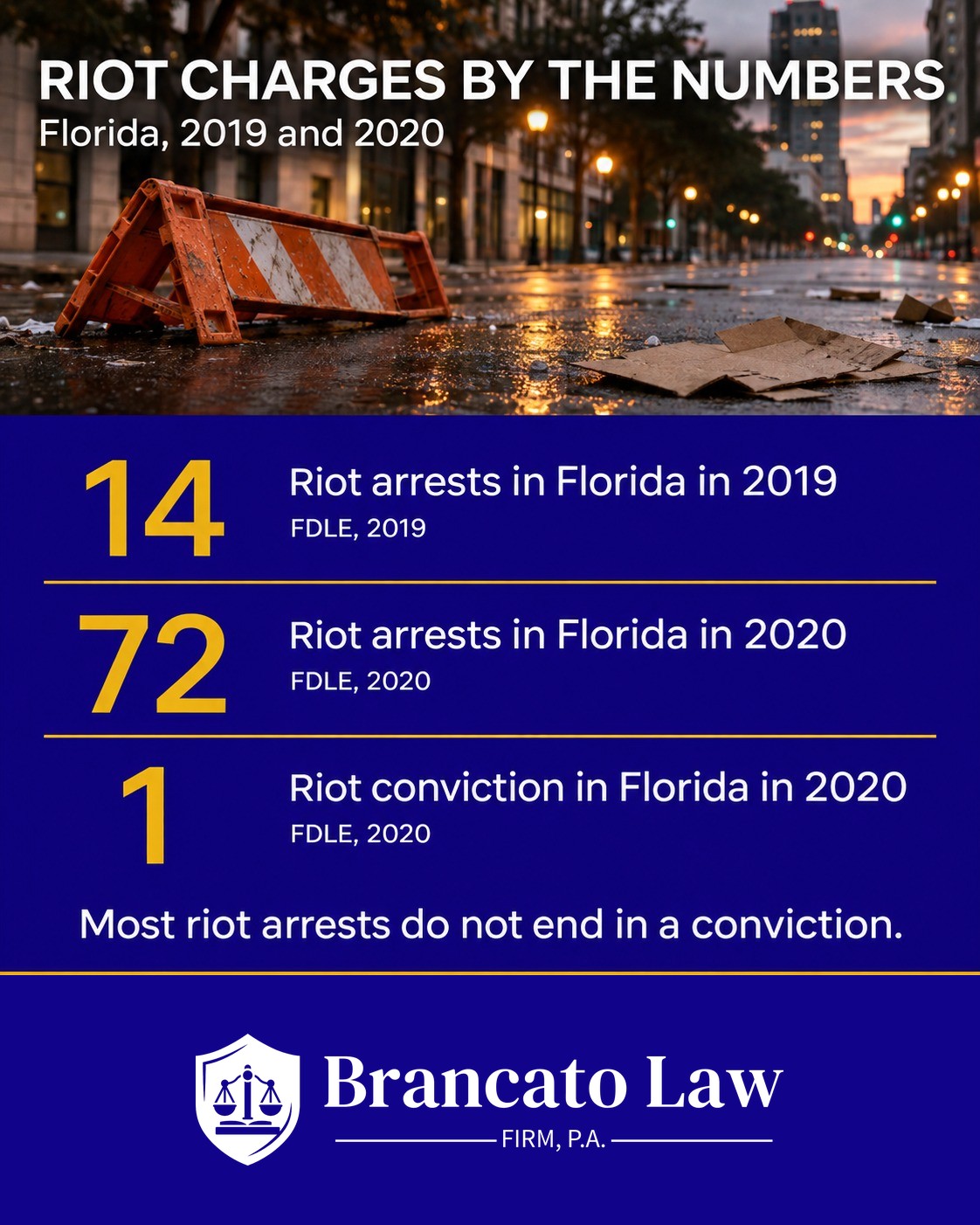
Riot arrests in Florida are rare and swing sharply with events. Florida Department of Law Enforcement data reported by the Legislature’s Criminal Justice Impact Conference show 14 arrests for riot in calendar year 2019, with 3 convictions, and 72 arrests in calendar year 2020, with 1 conviction and 2 adjudications withheld. The same 2021 analysis reported that the Department of Corrections recorded one prison admission for rioting across fiscal years 2018-19 and 2019-20. The jump in 2020 came with the protests that followed the death of George Floyd, and the near absence of convictions shows how often these charges fail or are reduced.
Legal scholars have long warned that riot laws can sweep in people who did nothing violent. Nancy C. Marcus, in “When ‘Riot’ Is in the Eye of the Beholder: The Critical Need for Constitutional Clarity in Riot Laws,” 60 American Criminal Law Review 281 (2023), argued that riot statutes are often vague and overbroad enough to threaten constitutional rights, and discussed the federal challenge to Florida’s 2021 definition. The Florida Supreme Court’s narrow reading answered part of that concern, but the risk of a charge built on presence alone still falls on the individual defendant.
How are riot cases handled in Hillsborough County?
In Hillsborough County, riot cases are prosecuted by the State Attorney’s Office for the 13th Judicial Circuit, and the arrest itself is handled differently from most felonies. Section 870.01(6) requires that anyone arrested for riot, inciting, or the aggravated versions “be held in custody until brought before the court” for bail, so the bond schedule does not apply. In Hillsborough, that means waiting at the Orient Road or Falkenburg Road Jail for first appearance in Hillsborough County, where the judge sits downtown and the arrested person appears by video, at 1:30 p.m. on weekdays and 10:00 a.m. on weekends and holidays. Having our attorneys at that hearing, with employment, family, and community ties ready, is often the difference between going home and staying in jail.
Hillsborough has been the center of Florida’s recent riot arrests. The Legislature’s 2021 impact analysis found that, among the three counties it studied, only Hillsborough County had riot arrests on May 30 and 31, 2020, with 7 that weekend, and the House final bill analysis noted that more than 40 people were arrested in Tampa for burglary and rioting during that unrest. Many of those arrests came days or weeks later from video, which is why a person who learns that the Tampa Police Department or the Hillsborough County Sheriff’s Office is reviewing footage should consider representation before charges are filed. A first-time defendant charged with a third-degree riot may be a candidate for the pretrial intervention program in Hillsborough County, which can end in dismissal, and our guide to the Florida criminal case process explains each stage after arrest.
Can riot charges be dropped in Florida?
Yes. Riot charges are dropped or reduced when the State cannot prove intent to assist violence, cannot identify the client on video, or cannot prove the aggravating factor. Our attorneys collect every available recording, including body camera, drone, business surveillance, and the livestreams that protesters and bystanders post, and build a timeline that shows where the client was and what the client did. We then show the prosecutor which element is missing, and we negotiate for dismissal, diversion, or a reduction to a misdemeanor such as affray, unlawful assembly, or disorderly conduct.
Frequently asked questions about riot charges in Florida
Is blocking a road during a protest a riot in Florida?
Not by itself. Endangering vehicles “by force, or threat of force” is an aggravating factor only when a riot is already occurring, which requires a violent disturbance and intent to assist violence. The Brancato Law Firm reviews traffic and drone video to show whether there was any force or threat aimed at drivers, and our disorderly conduct guide covers the misdemeanor charges that often apply instead.
Can I get bond on a riot charge in Florida?
Yes, but not until a judge sees you. Section 870.01(6) requires a person arrested for riot to stay in custody until first appearance, where the judge sets bond and conditions. Our attorneys at The Brancato Law Firm prepare for that hearing as soon as the family calls, so the judge hears about work, family, and ties to Tampa Bay.
What is the difference between affray and riot in Florida?
An affray is a mutual fight between people in a public place “to the terror of the people,” and it is a first-degree misdemeanor. A riot requires three or more people acting with a common intent to assist each other in violence, and it is a felony. The Brancato Law Firm often argues that a street fight charged as riot is at most an affray, which is a step our violent crimes defense attorneys take early in negotiations.
Can posting on social media be inciting a riot?
It can, but only if the post is directed to producing imminent violence and is likely to do so, under the First Amendment standard in Brandenburg v. Ohio. General anger, political advocacy, or offensive language is protected. Our attorneys at The Brancato Law Firm obtain the complete post, the replies, and the timing to show the words were not a call to immediate action.
Will a riot charge show up on a background check?
Yes. An arrest for riot appears on Florida criminal history records even if the case is later dropped. The Brancato Law Firm pursues dismissals and withholds of adjudication that can make a client eligible to seal or expunge the record, a goal we raise at the start of the case, not the end. For young clients, our guide to teen takeover arrests in Tampa Bay explains how these charges affect students.
Can police arrest me for riot weeks after a protest?
Yes. Riot has a three-year statute of limitations as a third-degree felony, and police often identify people from video after the event and arrest them later. If officers contact you or you learn you are being identified from footage, The Brancato Law Firm can speak with investigators for you through our pre-file advocacy before any decision to arrest.
For more about our defense strategies, visit our Violent Crimes page.
A riot arrest means a night or more in jail before any judge sets bond, and the video that can clear you may be overwritten within days. Our attorneys will move to preserve recordings and prepare for first appearance from the first call. Call The Brancato Law Firm, P.A., founded by Tampa Criminal Defense Attorney Rocky Brancato, at (813) 727-7159; you can call us at any hour. Our firm has Spanish-speaking staff, and attorney Jean-Luc Adrien speaks Spanish, Haitian Creole, and French. Our office is two blocks from the courthouse, and we defend riot and protest-related charges in Hillsborough, Pinellas, and Pasco counties.
The Brancato Law Firm, P.A.
620 E. Twiggs Street, Suite 205, Tampa, FL 33602
(813) 727-7159
Serving Hillsborough, Pinellas, and Pasco Counties
The Brancato Law Firm, P.A. is a Tampa-based criminal defense practice. We are not affiliated with any other Brancato-named law firms.
Visit Us

Tampa, FL 33602

Contact Us Now
Free Legal Consultation (813) 727-7159
