

From First DUI to Death Penalty



How to Fight a Money Laundering Charge in Florida? (2026)


To fight a money laundering charge in Florida, the defense attacks the two things the State must prove beyond the money itself: that you knew the funds came from a felony, and that the transaction was meant to promote a crime, hide the money, or avoid a reporting rule. Under section 896.101, money laundering is a third-degree felony above $300, a second-degree felony at $20,000, and a first-degree felony at $100,000, measured over any 12-month period. Many cases are won or reduced by showing that a person simply received or spent money in their own name, with no plan to conceal it and no knowledge of where it came from.
Money laundering cases are usually decided by what the accused person knew, not by how much money moved. I have watched that play out over more than 25 years in Hillsborough County courtrooms, including as former Chief Operations Officer of the Hillsborough County Public Defender’s Office, where I oversaw a staff of over 100 attorneys. I’m Rocky Brancato, founder of The Brancato Law Firm, P.A., a Tampa criminal defense firm, and our attorneys defend money laundering charges in Hillsborough, Pinellas, and Pasco Counties, often while the case is still an investigation and nothing has been filed.
What is money laundering under Florida law?
Money laundering in Florida is conducting a financial transaction with money you know came from a felony, when the transaction is meant to promote a crime, hide the money, or avoid a reporting requirement. The crime is defined in section 896.101, Florida Statutes, the Florida Money Laundering Act. The money must come from a “specified unlawful activity,” which the statute defines as any racketeering activity listed in section 895.02, a long list that includes drug trafficking, theft, fraud, and many other felonies.
Section 896.101(3) makes three kinds of conduct a crime:
- Laundering through a transaction. Conducting a financial transaction with criminal proceeds, knowing the money is dirty, to promote more crime, to conceal or disguise the money’s nature, location, source, ownership, or control, or to avoid a state reporting or money transmitter registration rule.
- Transporting money. Moving cash, checks, or other funds with the intent to promote a listed crime, or to conceal criminal proceeds or avoid a reporting rule.
- Sting transactions. Doing a transaction with money that an undercover officer represents as criminal proceeds. In these cases the money is not actually dirty; the State relies on what the officer said.
A “financial transaction” is broad. It covers wires, deposits, checks, money orders, cash, and the transfer of title to real estate, a vehicle, a vessel, or an aircraft. The current statute also lists virtual currency as a “monetary instrument,” wording the Legislature added after the Bitcoin sales in the Espinoza case discussed below. Our attorneys explain how these charges overlap with fraud, theft, and embezzlement on our Tampa white collar crime attorney page.
What does the State have to prove in a Florida money laundering case?
The State must prove four things beyond a reasonable doubt: a transaction or transport, money that actually came from a listed crime (or that an officer represented as criminal), knowledge, and a forbidden purpose. Each element is a separate place to fight the case. This table shows the elements of a section 896.101(3)(a) charge and the questions our attorneys ask about each one.
| Element | What it means | What our attorneys test |
|---|---|---|
| 1. A financial transaction | A deposit, wire, check, cash payment, crypto transfer, or title transfer that the person conducted or attempted | Was there a real transaction, or only possession of cash? |
| 2. Proceeds of specified unlawful activity | The money in fact came from a racketeering-list crime under s. 895.02 | Can the State prove the underlying crime with evidence, or only suspicion? |
| 3. Knowledge | The person knew the money came from some felony, though not necessarily which one | What do the texts, statements, and circumstances show the person actually knew? |
| 4. A forbidden purpose | Intent to promote crime, or knowledge that the transaction was designed to conceal the money or avoid a reporting rule | Was the money spent openly, in the person’s own name, with nothing hidden? |
Knowledge has one important twist. For any transaction or transport involving more than $10,000 in currency, section 896.101(2)(d) lets the State prove a person “should have known” after a reasonable inquiry. That lower standard does not apply to a person who had a duty to file a currency transaction report or IRS Form 8300 and filed it as required. Business owners who handle cash should know that their own compliance records can defeat this theory.
What are the penalties for money laundering in Florida?
Money laundering in Florida is always a felony, and the degree depends on the total value of the financial transactions in any 12-month period. Section 896.101(5) sets three tiers, and the Criminal Punishment Code ranks each one at a high offense level in section 921.0022. A Level 7 offense alone scores to a lowest permissible sentence of 21 months in state prison before any prior record or additional counts are added.
| Value of transactions in any 12 months | Felony degree | Maximum prison | Offense level | Lowest permissible sentence (this offense alone) |
|---|---|---|---|---|
| More than $300 but less than $20,000 | Third degree | 5 years | Level 7 | 21 months |
| $20,000 to less than $100,000 | Second degree | 15 years | Level 8 | 34.5 months |
| $100,000 or more | First degree | 30 years | Level 9 | 48 months |
The fines are larger than for most Florida felonies. Under section 896.101(6), a court may impose a fine of up to $250,000 or twice the value of the transactions, whichever is greater, and up to $500,000 or five times the value for a second violation. Section 896.101(7) adds a civil penalty of up to the value of the transactions or $25,000, whichever is greater. Because the tiers turn on totals across 12 months, prosecutors often add separate deposits together to reach a higher degree, and the value math is one of the first things our attorneys check.
A separate statute, section 896.104, makes it a crime to structure transactions to evade reporting or registration requirements, such as breaking cash deposits into smaller amounts. The offense severity chart ranks structuring at the same Levels 7, 8, and 9 by value.
How do our attorneys fight a money laundering charge in Florida?
Our attorneys fight money laundering charges by attacking knowledge, purpose, the underlying crime, and the value, usually in that order. These are the six defenses we evaluate in every case:
- You did not know the money came from a felony. Knowledge is the heart of the charge.
- Nothing was concealed. Spending or depositing money openly, in your own name, is not a design to disguise it.
- No intent to promote a crime. Holding or carrying money is not the same as using it to fund the next offense.
- The underlying crime cannot be proven. No specified unlawful activity means no laundering.
- The value is wrong. A lower total can drop the case a full felony degree.
- The sting went too far. Entrapment remains available even in undercover cases.
1. Challenging knowledge: the money mule problem
Many people charged with money laundering were recruited, not criminals. The U.S. Treasury’s 2026 National Money Laundering Risk Assessment (March 2026) describes money mules as “individuals who are often recruited online and receive and forward stolen funds,” and it reports that romance and impersonation scammers rely on U.S.-based mules, sometimes using one scam’s victims to move another scam’s money. A person who believed they were helping a partner, an employer, or a buyer can lack the knowledge the statute requires. Our attorneys build that defense from the messages, the person’s own losses, and the absence of any payment for the work.
2. Challenging concealment: what Hardie shows
Concealment means more than spending stolen money. In Hardie v. State, 162 So. 3d 297 (Fla. 2d DCA 2015), a Lakeland pastor was convicted of grand theft and money laundering after moving church funds from a mortgage account at one bank into a benevolent account at a second bank, writing checks to himself, and depositing the cash at a third bank. The Second District affirmed the laundering convictions because those “multiple transactions involving three different banks served to disguise the original ownership of the money.” The lesson runs both ways: a layered trail supports the charge, but a person who simply deposited or spent money in their own name, with no extra steps to hide it, has a strong argument that the concealment element is missing.
3. Challenging intent to promote: what Dallas shows
Running off with cash is not laundering. In Dallas v. State, 995 So. 2d 1062 (Fla. 5th DCA 2008), an Orange County deputy saw a man hand over crack cocaine for a few rolled-up dollars and then run. He was convicted of delivery and of unlawfully transporting currency to promote drug activity. The Fifth District reversed the currency conviction, holding that the evidence “was insufficient to prove either” an intent to promote the completed sale or future sales, and that any inference about future sales “would be based on pure speculation.” When the State stacks a transportation count on a small drug or theft case, our attorneys use Dallas to argue for a judgment of acquittal.
4. Challenging the underlying crime
Money laundering depends on another crime. Outside of sting cases, the State must prove the money in fact came from a specified unlawful activity, such as drug trafficking or organized fraud. If the evidence of that crime is weak, suppressed, or never charged, the laundering count is exposed too. Many Tampa-area laundering cases grow out of fraud investigations, and our guide to scheme to defraud charges explains how that underlying offense is proven.
5. Challenging the value
The felony degree turns on dollar totals. A second-degree charge at $20,000 can drop to a third-degree felony if transfers between a person’s own accounts were counted twice, legitimate income was mixed in, or transactions fall outside the 12-month window. Our attorneys rebuild the bank records line by line, because a lower tier changes both the maximum sentence and the scoresheet.
6. Challenging a sting: what Espinoza shows
Undercover cases are harder to dismiss early but can be fought at trial. In State v. Espinoza, 264 So. 3d 1055 (Fla. 3d DCA 2019), a Miami Beach man sold Bitcoin for cash to an undercover detective who hinted the cash came from crime. The trial court dismissed the money laundering counts for lack of intent, but the Third District reversed, holding that intent and knowledge are fact questions that cannot be decided on a sworn motion to dismiss. Section 896.101(4) also says an undercover stratagem is not a defense by itself, while expressly preserving the defense of entrapment. In sting cases, our attorneys focus on what the officer actually said, who pushed the deal, and whether an ordinary law-abiding person would have been induced.
Can the State freeze or seize your money before a conviction?
Yes. Section 896.101(8) lets the State ask a circuit court for a temporary injunction that stops anyone from withdrawing or moving funds tied to the alleged laundering, and the State can then obtain a warrant, seize the money, and file a civil forfeiture case. This often happens before any criminal charge. When a seizure proceeds under the Florida Contraband Forfeiture Act, section 932.703 sets short deadlines that are easy to miss.
| Step | Deadline | Why it matters |
|---|---|---|
| Notice of seizure by certified mail | Mailed within 5 working days after the seizure | The notice starts your clock |
| Your written request for an adversarial preliminary hearing | Within 15 days after you receive the notice, by certified mail, return receipt requested | Missing it gives up an early chance to test probable cause |
| The hearing itself | Within 10 days after the agency receives the request, or as soon as practicable | The court decides whether probable cause supports holding the property |
Our guide to fighting civil asset forfeiture in Florida explains the rest of that process. Anything you say in a forfeiture hearing can be used in the criminal case, so our attorneys coordinate both cases from the start.
Is money laundering a state or federal crime in Tampa?
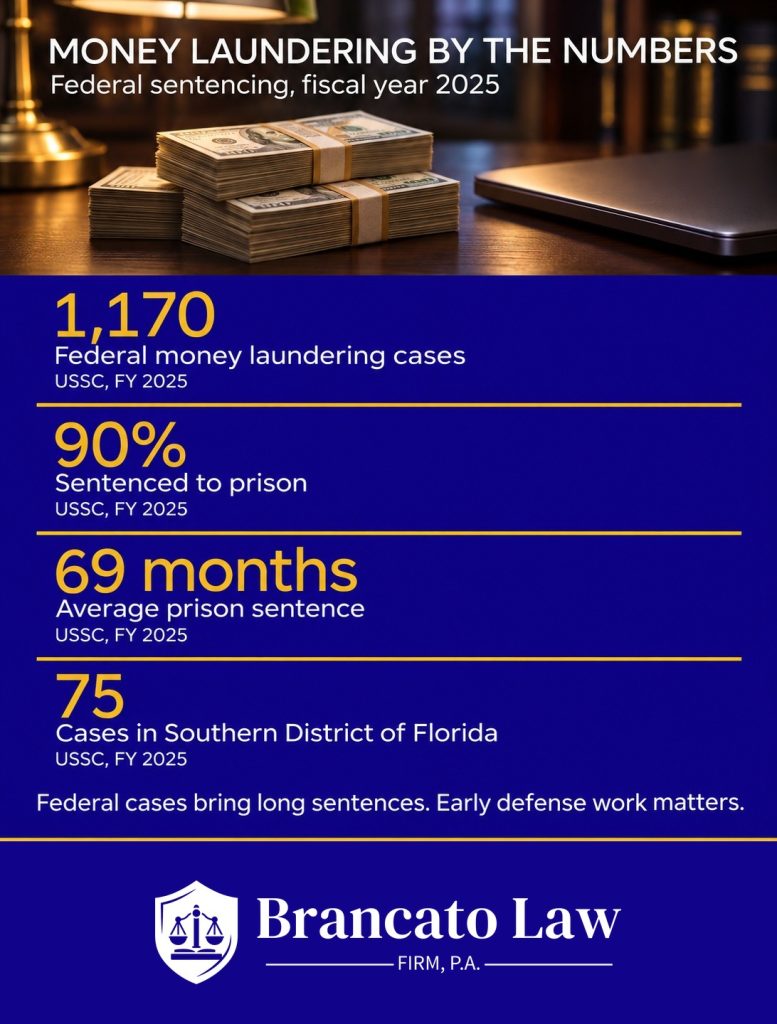
Money laundering is both a state and a federal crime, and the same conduct can be charged in either system. The federal statute, 18 U.S.C. § 1956, carries up to 20 years in prison. Federal numbers show how seriously these cases are punished: in fiscal year 2025, 1,170 federal cases involved money laundering, 90% of those sentenced went to prison, and the average sentence was 69 months, according to the U.S. Sentencing Commission. The Southern District of Florida had more money laundering cases than any other federal district that year, with 75.
Which state prosecutor handles a Florida case depends on geography. In our Hillsborough County cases, a money laundering count usually arrives attached to the underlying charge and is prosecuted by the State Attorney’s Office for the 13th Judicial Circuit. When the alleged conduct spans two or more judicial circuits, such as Hillsborough (13th Circuit) and Pinellas or Pasco (6th Circuit), section 16.56 gives the Office of Statewide Prosecution authority over violations of the Money Laundering Act. Knowing which office holds the file tells our attorneys who to call and how the case is likely to be valued.
What should you do if you are under investigation for money laundering?
If a detective, a bank, or a state agency is asking about your money, the most important step is to stop talking and get a lawyer before charges are filed. Money laundering cases are built from records over weeks or months, and the decision to file, and at what value, is often made before the person under investigation knows about it. Our attorneys provide representation before charges are filed to reach the prosecutor while the case can still be shaped.
- Do not explain the money to police or bank investigators. Statements about where funds came from are the State’s best proof of knowledge.
- Do not move, withdraw, or “clean up” funds. A new transaction after you learn of an investigation can become a new count.
- Keep your records. Pay stubs, loan papers, sale receipts, and tax returns can prove a lawful source.
- Save every message from the person who sent or asked you to move money, especially if you were recruited online.
- Call a defense lawyer before any interview, and before you respond to a seizure notice.
If you are arrested, the case moves to first appearance within 24 hours, where bond is set. Our guide to the stages of a Florida criminal case walks through what happens after that. For lower-value first offenses, our attorneys also look at whether diversion is possible, as explained in our guide to the Hillsborough County PTI program.
Frequently asked questions about Florida money laundering charges
Can money laundering charges be dropped in Florida?
Yes. Prosecutors drop or reduce money laundering counts when the knowledge or concealment evidence is thin, when the value is overstated, or when the underlying crime falls apart. Our attorneys at The Brancato Law Firm present that evidence to the prosecutor early, and our white collar defense attorneys in Tampa often negotiate the laundering count away while the underlying charge is resolved.
Is it money laundering just to spend money from a crime?
Not by itself. Spending or depositing money in your own name, with no step designed to hide it and no intent to fund more crime, does not meet the purpose element, as the reversal in Dallas v. State shows. The Brancato Law Firm uses that line between ordinary spending and concealment to challenge laundering counts that prosecutors add to theft and drug cases.
What if I was a money mule and did not know the money was stolen?
Lack of knowledge is a complete defense to money laundering in Florida. Our attorneys at The Brancato Law Firm gather the recruiting messages, your own losses, and proof that you were not paid like a partner in the scheme, and our pre-file advocacy work aims to show the prosecutor you were a victim before any charge is filed.
Can police freeze my bank account in a Florida money laundering case?
Yes. A circuit court can issue a temporary injunction freezing funds linked to alleged laundering, and the State can seize the money and seek forfeiture, sometimes before any arrest. The Brancato Law Firm moves quickly to request the adversarial preliminary hearing, and our guide to fake check charges explains how frozen accounts often start in scam cases.
Does buying or selling cryptocurrency count as money laundering in Florida?
It can. Florida’s statute lists virtual currency as a monetary instrument, and the State has charged Bitcoin sales to undercover officers as laundering. Our attorneys at The Brancato Law Firm focus those cases on what the seller was actually told and whether the officer induced the deal.
Will a first money laundering charge in Hillsborough County mean prison?
Not necessarily, but the scoresheet points toward it. A third-degree laundering charge alone scores to a lowest permissible sentence of 21 months, so the defense must reduce the charge, win the case, or prove a legal reason for a lower sentence. The Brancato Law Firm builds that mitigation from the first week, the same way our guide to credit card fraud charges describes for other financial cases.
For more about our defense strategies, visit our White Collar Crime page.
Frozen accounts and seizure notices come with deadlines measured in days, so the first call matters. Our attorneys will review what the State is claiming, protect your right to a forfeiture hearing, and contact the prosecutor before the case is valued. The Brancato Law Firm, P.A., founded by Tampa Criminal Defense Attorney Rocky Brancato, is two blocks from the courthouse; call us at any hour at (813) 727-7159. Our firm has Spanish-speaking staff, and attorney Jean-Luc Adrien speaks Spanish, Haitian Creole, and French.
The Brancato Law Firm, P.A.
620 E. Twiggs Street, Suite 205, Tampa, FL 33602
(813) 727-7159
Serving Hillsborough, Pinellas, and Pasco Counties
The Brancato Law Firm, P.A. is a Tampa-based criminal defense practice. We are not affiliated with any other Brancato-named law firms.
Visit Us

Tampa, FL 33602

Contact Us Now
Free Legal Consultation (813) 727-7159
