

From First DUI to Death Penalty



How to Fight Selling Drugs Near a School Charges in Florida? (2026)


Selling drugs, or possessing them with intent to sell, within 1,000 feet of a school, child care facility, park, community center, college, place of worship, convenience store, public housing, or certain treatment facilities is a separate and more serious crime in Florida under section 893.13(1)(c) through (h). For cocaine, heroin, fentanyl, methamphetamine, and oxycodone, the charge becomes a first-degree felony, and near a school, park, community center, or public recreational facility it carries a 3-year mandatory minimum prison term. The best defenses attack the underlying sale, the distance measurement, and the State’s proof that the protected place qualified on the day of the offense.
Drug-free zone charges are often won or lost on a fact that has nothing to do with the drugs: whether the building down the street was really a school, a park, or a church in use on the day of the sale. As founder of The Brancato Law Firm, P.A., a Tampa criminal defense firm, and a former Chief Operations Officer of the Hillsborough County Public Defender’s Office, where I oversaw a staff of over 100 attorneys, I have seen appellate courts throw out the 1,000-foot enhancement because the State assumed that fact instead of proving it. Our attorneys check every element of the location before we talk about anything else.
What Is the Florida Law Against Selling Drugs Near a School?
Florida makes it a separate, higher-degree crime to sell, manufacture, or deliver a controlled substance, or to possess one with intent to do so, within 1,000 feet of protected places. Section 893.13(1)(c), Florida Statutes, covers child care facilities and public or private elementary, middle, and high schools “between the hours of 6 a.m. and 12 midnight,” and covers state, county, or municipal parks, community centers, and publicly owned recreational facilities at any time. Separate paragraphs of the same statute add colleges and universities, places of worship, convenience businesses, public housing, and facilities such as substance abuse treatment providers, recovery residences, assisted living facilities, and pain clinics.
The law does not require that a child was present, that the sale happened on school grounds, or that the buyer was a student. Being within 1,000 feet of the real property of the protected place is enough. That is why these charges show up in ordinary street-level cases handled by our Tampa drug crimes attorney team.
What Are the Penalties for a Drug-Free Zone Charge in Florida?
The penalty depends on the drug’s schedule under section 893.03 and on the type of protected place. Drugs in the first group below, which include cocaine, heroin, fentanyl, methamphetamine, oxycodone, are the ones that carry first-degree felony exposure of up to 30 years under section 775.082. Cannabis, MDMA, and most Schedule III and IV pills such as alprazolam fall in the second group.
| Protected place (within 1,000 feet) | Statute | Cocaine, heroin, fentanyl, meth, oxycodone | Cannabis, MDMA, alprazolam and similar |
|---|---|---|---|
| K-12 school (6 a.m. to midnight), park, community center, publicly owned recreational facility | s. 893.13(1)(c) | First-degree felony; 3-year mandatory minimum | Second-degree felony (up to 15 years) |
| Licensed child care facility that posts the required sign | s. 893.13(1)(c) | First-degree felony; no 3-year minimum | Second-degree felony |
| College, university, or other postsecondary school | s. 893.13(1)(d) | First-degree felony | Second-degree felony |
| Place of worship with regular religious services, or a convenience business | s. 893.13(1)(e) | First-degree felony | Second-degree felony |
| Public housing facility | s. 893.13(1)(f) | First-degree felony | Second-degree felony |
| Mental health or substance abuse treatment facility, recovery residence, assisted living facility, pain clinic | s. 893.13(1)(h) | First-degree felony | Second-degree felony |
Without the location, the same conduct is a lower felony. A sale of cocaine is ordinarily a second-degree felony and a sale of cannabis is a third-degree felony under section 893.13(1)(a). The 1,000-foot element is what moves the case up one degree and, near a school or park, adds three years of prison the judge cannot reduce.
How Many Places in Hillsborough County Trigger the 1,000-Foot Rule?
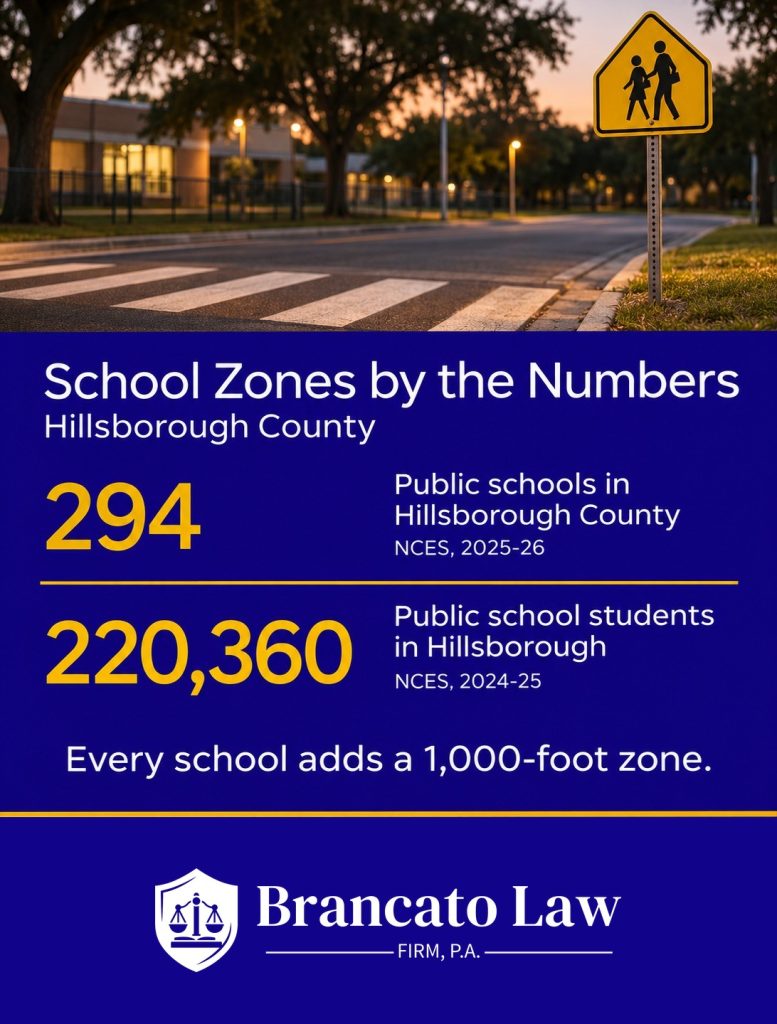
In an urban county, a large share of the map sits inside some protected zone. In the 2024-2025 school year, the Hillsborough County school district served 220,360 students, and its 2025-2026 directory listing shows 294 public schools, according to the National Center for Education Statistics district profile. That count leaves out private schools, child care centers, parks, community centers, churches, and convenience stores, each of which carries its own 1,000-foot circle.
Research on similar laws shows how far those circles reach. A 2014 Boston College Journal of Law & Social Justice note, A “Dubious Distinction”: New Jersey’s Drug-Free School Zones, reported that 51% of Newark fell inside a drug-free school zone, and, citing New Jersey’s sentencing commission, that only two reported school-zone cases between 1987 and 2005 took place on school property and none involved selling drugs to children. Florida’s list of protected places is longer than New Jersey’s, so the overlap in Tampa neighborhoods is often greater. Our attorneys use that reality in negotiations: the enhancement usually reflects where a person lives, not a choice to target children.
What Must the State Prove About the Location?
The State must prove the protected place was what the statute requires at the time of the offense, and that the sale or possession happened within 1,000 feet of its real property. Florida appellate courts have reversed the enhancement repeatedly when prosecutors relied on assumptions:
- Vana v. State, 419 So. 3d 1172 (Fla. 6th DCA 2025): a Lee County man was convicted of selling drugs within 1,000 feet of a municipal park after 2018 controlled buys near his home. The city’s property broker testified the park was city-owned, but never said it was city-owned in 2018. The court held that the State “adduced no evidence that the park by Vana’s home was a state, county, or municipal park when he sold drugs in 2018” and reduced the convictions to plain sale. Our post on the Vana park-ownership decision covers it in detail.
- Moore v. State, 18 So. 3d 715 (Fla. 2d DCA 2009): an officer saw a cocaine sale around the corner from a Winter Haven church. The church witness did not appear, and the officer had last seen people attending Sunday services a year earlier. The Second District, which now hears appeals from Hillsborough, Pinellas, and Pasco Counties, held the State did not prove the church was regularly conducting services when the sale occurred and reduced the first-degree felony to possession with intent to sell, a second-degree felony.
The lesson from both cases is the same: the State has to prove the status of the place on the date of the offense, with a witness who actually knows. A building that looks like a school or church, or that is one today, is not proof of what it was on the day of the sale.
What Are the Best Defenses to Selling Drugs Near a School?
The best defenses split into two groups: defenses to the sale itself, and defenses to the 1,000-foot enhancement. Our attorneys work through both:
- Challenge the sale or intent to sell. If the State cannot prove a sale, delivery, or intent to sell, the zone charge falls with it. Small amounts, no packaging, and no buyer often support possession only.
- Challenge the search. Drugs found through an unlawful stop or search can be suppressed, which ends the case entirely.
- Check the measurement. We ask who measured the distance, from what point to what point, with what tool, and when. In Vana, officers measured four years after the sales.
- Check the status of the place on the offense date. Was the school operating, the park publicly owned, the church holding regular services, the store a convenience business as defined by law?
- Check the time. The school portion of section 893.13(1)(c) applies only between 6 a.m. and midnight.
- Check the child care sign. The statute does not apply to a child care facility unless it posts a sign of at least 2 square feet identifying it as a licensed child care facility, in a conspicuous place visible to the public.
- Negotiate the enhancement away. When the location proof is weak, the realistic outcome is often a plea to plain sale or possession, which removes the mandatory minimum.
Can You Avoid the 3-Year Mandatory Minimum?
Yes, in several ways. The 3-year minimum applies only to first-group drugs within 1,000 feet of a school, park, community center, or publicly owned recreational facility, so a finding that the place did not qualify removes it. A judge cannot depart below a statutory mandatory minimum, so the work happens before sentencing: suppression motions, motions for judgment of acquittal on the location element, and negotiations for a plea to an offense without the minimum. Our post on Florida drug trafficking and mandatory minimums explains how minimums interact with the scoresheet.
In Hillsborough County, drug-free zone cases are filed in the 13th Judicial Circuit and move through arraignment, discovery, and pretrial motions like any felony. Our Florida criminal case process guide walks through each stage, and our Hillsborough County criminal defense page covers local procedure.
Does a Drug-Free Zone Charge Affect Drug Court in Hillsborough County?
Yes. Hillsborough’s drug court, Division W of the 13th Judicial Circuit, offers a pretrial track that dismisses the felony on graduation, but a judge may keep a defendant out if the State proves the person was dealing. A zone charge is by definition a sale or intent-to-sell charge, so it walks straight into that exception. When the facts point to personal use, our attorneys push to reduce the charge to possession first, which can reopen the door to drug court. Our guide to Hillsborough County drug court explains the tracks.
What Should You Do If You Are Charged Near a School?
Do not discuss where you were, who you met, or what was sold with police, and do not assume the location is beyond challenge. If you learn of an investigation before an arrest, pre-file advocacy can sometimes keep the State from filing the zone enhancement at all.
- Write down exactly where the alleged sale or arrest happened, including the street address.
- Photograph the area, including any school, church, park, or store signs, as soon as possible.
- Keep paperwork showing where you live and work, which can explain your presence.
- Do not talk about the case on jail phones or social media.
- Call a defense lawyer before arraignment.
Frequently Asked Questions About Selling Drugs Near a School in Florida
Is it a drug-free zone violation if school was out for the day?
For schools, the statute applies only between 6 a.m. and 12 midnight, so a sale at 2 a.m. near a school is not a school-zone offense. Parks, community centers, churches, and convenience businesses have no time limit. The Brancato Law Firm checks the exact time of every alleged sale against the statute, as part of the defense work described on our drug crimes defense page.
Does the State have to prove I knew the school was there?
The statute’s text does not mention knowledge of the protected place; it focuses on the location. What the State must prove is the place’s status and the distance, and that is where our attorneys at The Brancato Law Firm focus, because those are the elements appellate courts have most often found missing.
Can a drug sale near a church be charged if the church is closed?
Only if the church regularly conducts religious services; the statute protects a place of worship “at which a church or religious organization regularly conducts religious services.” In Moore v. State, testimony about services seen a year earlier was not enough. The Brancato Law Firm investigates the church’s actual schedule on the offense date.
Is a convenience store really a drug-free zone in Florida?
Yes. Section 893.13(1)(e) covers sales within 1,000 feet of a convenience business as defined in section 812.171, which puts many gas stations and corner stores in play. Our attorneys at The Brancato Law Firm check whether the store met the statutory definition, which the State must prove like any other element.
Can drug-free zone charges be dropped in Florida?
Yes. The enhancement is dropped or reduced when the State cannot prove the place qualified on the offense date, the distance was inaccurate, or the sale itself fails. The Brancato Law Firm raises those issues in pretrial motions and negotiations; if you are still under investigation, our representation before charges are filed starts that work earlier.
What is the difference between a drug-free zone charge and trafficking?
Trafficking depends on the weight of the drug; a zone charge depends on location, and any amount can qualify. A large-quantity case can carry both. Our attorneys at The Brancato Law Firm analyze both enhancements separately, because defeating one does not automatically defeat the other.
Talk to a Tampa Lawyer About a Drug-Free Zone Charge
A 3-year mandatory minimum can turn on a single witness the State has not lined up yet, so the early weeks of the case matter. The Brancato Law Firm, P.A., founded by Tampa Criminal Defense Attorney Rocky Brancato, will check the location, the measurement, and the sale before your arraignment. Call (813) 727-7159; you can call us at any hour. Our firm has Spanish-speaking staff, and attorney Jean-Luc Adrien speaks Spanish, Haitian Creole, and French. Learn more about our Spanish and Haitian Creole criminal defense services.
For more about our defense strategies, visit our Tampa Drug Crimes Defense page.
The Brancato Law Firm, P.A.
620 E. Twiggs Street, Suite 205, Tampa, FL 33602
(813) 727-7159
Serving Hillsborough, Pinellas, and Pasco Counties
The Brancato Law Firm, P.A. is a Tampa-based criminal defense practice. We are not affiliated with any other Brancato-named law firms.
Visit Us

Tampa, FL 33602

Contact Us Now
Free Legal Consultation (813) 727-7159
