- Free Consultation 24/7: (813) 727-7159 Tap Here To Call Us


From First DUI to Death Penalty



What If You’re Charged With the Wrong Drug in Florida?


Rewrite/update date: September 2, 2026
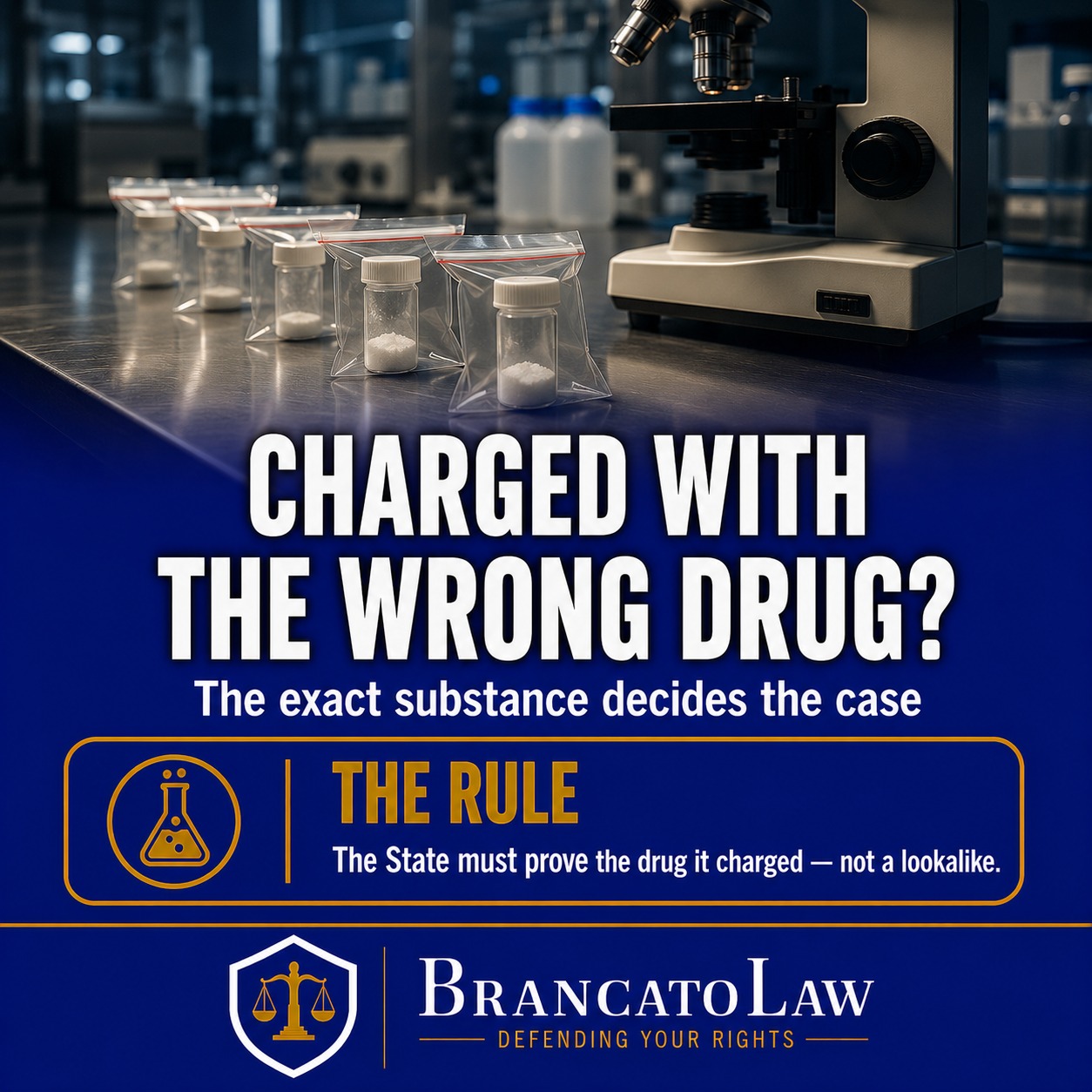
| It can end the case. In Florida, the State must prove the exact substance named in the charging document — in July 2026, an appellate court ordered a full acquittal because the State charged trafficking in “fentanyl” but its own evidence proved the substance was para-fluorofentanyl, a legally distinct drug. Florida’s double jeopardy rules also strike duplicate drug counts: you cannot be convicted of both simple possession and possession with intent to sell the same drugs, and certain trafficking charges involving multiple opioids are one crime, not several. The chemistry and the paperwork are defenses — if someone audits them. |
I’m Rocky Brancato, founder of The Brancato Law Firm, P.A., a Tampa criminal defense firm. Our attorneys defend drug cases across Tampa Bay from the pre-file stage forward — engaging the State Attorney’s Office before charges are finalized — and the first documents we audit in every case are the lab report and the charging document, side by side. As two Florida appellate decisions this year show, when those documents don’t match, convictions come apart.
Does the State Have to Prove the Exact Drug It Charged?
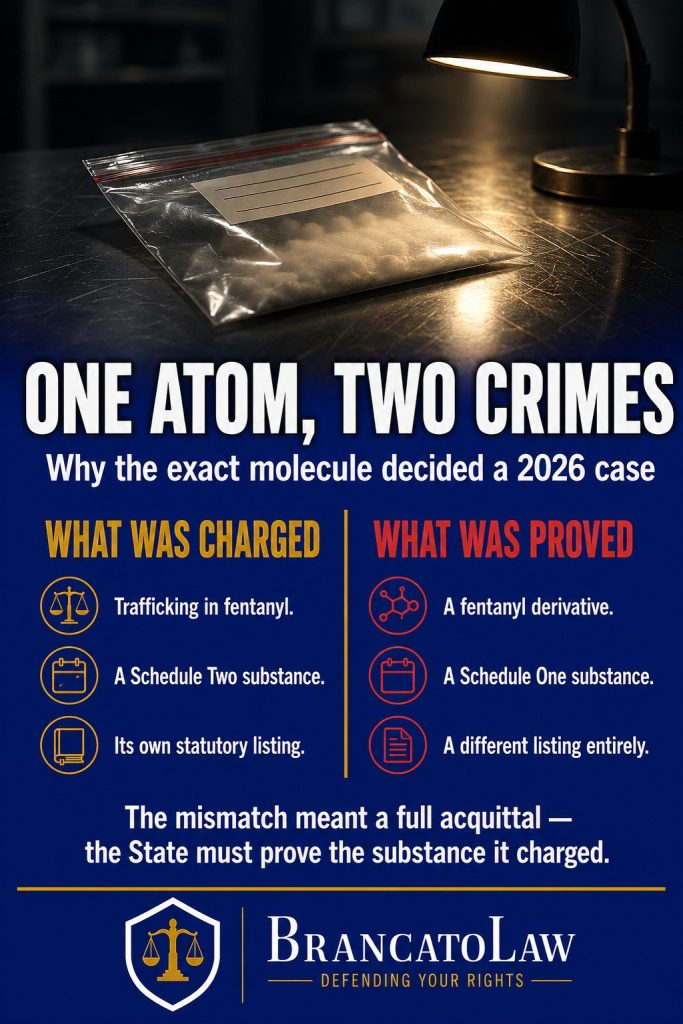
Yes — and if it proves a different one, you are entitled to an acquittal, not a do-over. In Quinones Santiago v. State, No. 6D2024-1003 (Fla. 6th DCA July 24, 2026), the State charged a man with trafficking in fentanyl, identified in the charging document by fentanyl’s specific statutory listing. At trial, the State’s own evidence showed the substance in the pill bottle was actually para-fluorofentanyl — a fentanyl derivative with an extra fluorine atom, listed in a different schedule under a different statutory subsection. The State argued the difference was “a distinction without a difference.” The Sixth District disagreed: “the statutes tell a different story,” and under long-standing Florida law, where an offense can be committed in various ways, the evidence must establish it was committed in the manner charged. Because the State charged one substance and proved another, it failed to prove its case — the court reversed and remanded for a judgment of acquittal.
The court even added a pointed admonishment: problems like this “should be avoided by the State taking a moment to double-check its charging documents.” That double-check is exactly what our attorneys do from the defense side, because prosecutors filing hundreds of cases do not always match the lab chemistry to the statutory subsection — and the mismatch is a complete defense that must be raised the right way, at the right moment, to end the case rather than merely delay it.
Why Does the Exact Substance Matter So Much?
Because Florida’s drug statutes treat chemically similar substances as legally different crimes, with different schedules and different consequences. The controlled-substance schedules live in Fla. Stat. § 893.03, and the trafficking statute, Fla. Stat. § 893.135, then attaches weight thresholds and mandatory minimum sentences to specific listed substances — in the disjunctive, as alternative ways of committing the crime.
| Substance | Where Florida law lists it | Legal status |
|---|---|---|
| Fentanyl | § 893.03(2)(b) — Schedule II | Restricted medical use; charged under its own trafficking listing |
| Para-fluorofentanyl | § 893.03(1)(a) — Schedule I “fentanyl derivatives” | No accepted medical use; a different trafficking listing |
| Cathinone-family substances (“bath salts”) | Schedule I, with catch-all structural language | Coverage often turns on chemical-structure definitions |
| Prescription opioids (morphine, opium, hydromorphone) | § 893.135(1)(c)1. group | One “trafficking in illegal drugs” crime measured by aggregate weight |
Two lessons follow. First, the chemistry is a moving target — clandestine labs constantly tweak molecules, and the Legislature responds with derivative and analog listings — so whether a specific molecule actually falls within the charged listing is a genuinely litigable question that requires reading lab data against statutory text. Second, the label on the charge controls the trial: the State cannot charge one listing and convict on another, which is why the defense audit starts with the information itself.
Can You Be Convicted Twice for the Same Drugs?
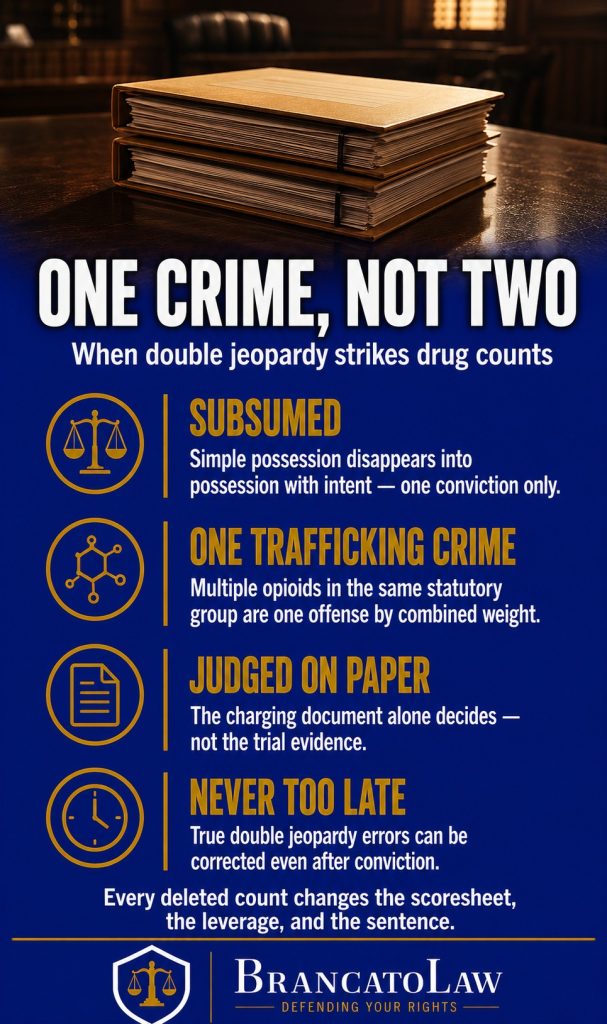
No — and in May 2026 a Florida appellate court threw out three duplicate convictions in a single case to prove it. In Medders v. State, No. 4D2025-0875 (Fla. 4th DCA May 27, 2026), the defendant was convicted of both simple possession and possession with intent to sell the same drugs, plus two identically worded trafficking counts. The Fourth District reversed the duplicates. Simple possession “is subsumed by” possession with intent — every element of the lesser crime sits inside the greater one, so under the double jeopardy test codified at Fla. Stat. § 775.021(4), only one conviction can stand. And the two trafficking counts collapsed into one for a subtler reason: the statute’s opioid-trafficking provision defines a single crime of “trafficking in illegal drugs” measured by the aggregate weight of “any” of the listed substances — so possessing two different listed opioids is one trafficking offense, not two.
| Charging scenario | Allowed after Medders? |
|---|---|
| Simple possession + possession with intent to sell, same drugs | No — one conviction only; the possession count is subsumed |
| Two trafficking counts for two opioids in the § 893.135(1)(c)1. group | No — one crime of “trafficking in illegal drugs,” measured by aggregate weight |
| Identically worded counts that don’t allege distinct conduct | Vulnerable — double jeopardy is judged from the charging document itself |
| Counts for genuinely different drug families under different subsections | Generally yes — separate listings can support separate counts |
Two practical notes from Medders. The double jeopardy question is answered from the charging document alone — not from what the evidence later showed — which means a sharp reading of the information can identify doomed counts before trial ever starts. And these errors are correctable even after conviction, because a true double jeopardy violation is fundamental. In a system where every added count raises the scoresheet, the plea leverage, and the sentence exposure, deleting duplicate counts is not housekeeping — it changes outcomes.
Does the “Wrong Drug” Defense Always Work?
No — and an honest read of 2026’s cases shows the line. Ten days before Quinones Santiago, the same appellate court ruled for the State in State v. Smith, No. 6D2024-0495 (Fla. 6th DCA July 10, 2026), a case about cyputylone — a designer stimulant in the “bath salts” family that is not listed anywhere in the schedules by name. The trial court had dismissed the charges for exactly that reason. The Sixth District reversed: Florida’s substituted-cathinone listing works by chemical structure, not by name, covering any compound containing the defined core structure “whether or not” further modified — language the court read as “regardless of whether.” Because cyputylone contains that core structure, it is a controlled substance even though no statute spells out its name.
Put Smith and Quinones Santiago side by side and the real rule emerges. The State gets the benefit of broad, structure-based schedule definitions — a novel molecule cannot dodge the statute with a cosmetic modification. But the State is held strictly to its own paperwork: whatever listing it charges is the listing it must prove. The defense in a designer-drug case is therefore rarely “this substance isn’t illegal” and usually “the State charged the wrong listing, proved the wrong substance, or can’t establish the chemistry beyond a reasonable doubt.” That is a technical fight, fought with chemists and statutes — which is precisely why who reads the lab file matters.
How Do Defense Lawyers Attack the Substance Element?
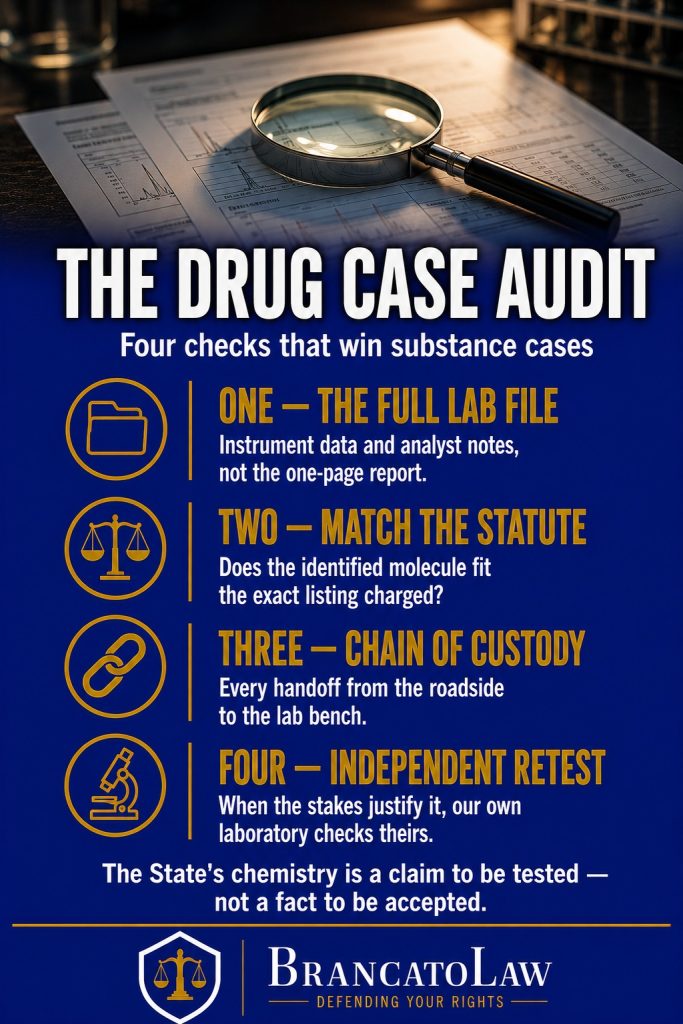
By treating the State’s chemistry as a claim to be tested, not a fact to be accepted. In Tampa Bay drug cases, our attorneys work through a fixed sequence: obtain the full lab file (not just the one-page report) — the instrument data, the analyst’s notes, the testing method; compare the identified molecule against the exact statutory listing charged in the information, the way Quinones Santiago requires; scrutinize chain of custody from roadside seizure through the FDLE or private lab; and where the stakes justify it, retest the substance with an independent laboratory through our forensic expert network. The same audit covers the counts themselves: possession counts that duplicate intent-to-sell counts, multiple trafficking counts built on one group of substances, and weights that only cross a mandatory-minimum threshold when separate items are improperly combined. Every one of those issues is strongest when raised early — some belong in pre-file discussions with the State Attorney’s Office, some in motions, and some (like the Quinones Santiago mismatch) at the judgment-of-acquittal stage in trial. For the trafficking-specific playbook, including mandatory minimums and threshold weights, see our guide to defending a fentanyl trafficking charge in Florida.
What Should You Do After a Drug Arrest in Tampa Bay?
Say nothing about what the substance “is” — you may know less than you think, and so may the field test. Roadside presumptive tests are notoriously unreliable, deputies routinely charge based on them, and the formal lab report often arrives after the State’s filing decision. That window between arrest and filing is where our attorneys do some of their most valuable work: putting testing problems, search issues from the traffic stop or cannabis-odor search, and charging-document defects in front of the prosecutor before the information is filed. In Hillsborough County that decision typically comes within weeks, through the State Attorney’s Office at the 13th Judicial Circuit. If you were just arrested, our step-by-step guide to what to do after being arrested in Tampa covers the first 72 hours.
For more about our defense strategies, visit our Hillsborough County criminal defense page.
Frequently Asked Questions
What happens if the lab report shows a different drug than I was charged with?
That mismatch is a defense — potentially a complete one. Under Quinones Santiago v. State (Fla. 6th DCA 2026), the State must prove the substance identified in the charging document; proving a chemically and legally different substance entitles the defendant to a judgment of acquittal. Our attorneys compare the lab file to the information in every drug case for exactly this reason.
Can the State just fix the charge if it named the wrong drug?
Often it can amend before trial — which is why the timing of raising the issue is strategic, and why defense counsel may litigate it at the judgment-of-acquittal stage rather than handing the State an early warning. How and when to raise a substance mismatch is a judgment call The Brancato Law Firm, P.A. makes case by case, based on the discovery timeline and the State’s proof.
Is para-fluorofentanyl the same as fentanyl under Florida law?
No. Fentanyl is a Schedule II substance with its own statutory listing; para-fluorofentanyl is a Schedule I “fentanyl derivative” under a different subsection — chemically similar, legally distinct. As the Sixth District put it, “the statutes tell a different story,” and the difference decided Quinones Santiago.
Can I be convicted of both possession and possession with intent to sell?
Not for the same drugs. Simple possession is subsumed within possession with intent to sell, so double jeopardy — codified in Fla. Stat. § 775.021(4) — allows only one conviction, as Medders v. State (Fla. 4th DCA 2026) reaffirmed. If both convictions appear on a judgment, the duplicate can be struck, even after the fact.
Can I get two trafficking charges for two different drugs?
It depends on which listings are involved. For the opioid group in § 893.135(1)(c)1. — morphine, opium, hydromorphone and related substances — Medders holds there is one crime of “trafficking in illegal drugs” measured by aggregate weight, not a separate count per substance. Different drug families under different subsections can still be charged separately. We chart every count against the statute in trafficking cases because the count structure drives the mandatory minimums.
Do drug charges in Florida carry mandatory minimum sentences?
Trafficking charges under § 893.135 do — tied to substance and weight thresholds — which is why the exact substance and the exact weight are both worth fighting over. A successful challenge to the substance identification, the aggregation of weights, or the count structure can move a case out of mandatory-minimum territory entirely. The Brancato Law Firm, P.A. builds drug defenses around those pressure points.
Quinones Santiago and Medders are 2026’s reminders that drug cases are won on precision — the right molecule, the right statute, the right number of counts. If you or someone you love is facing a drug charge anywhere in Tampa Bay, call the attorneys of The Brancato Law Firm, P.A. — founded by Tampa Criminal Defense Attorney Rocky Brancato — at (813) 727-7159 before the State’s filing decision is made. The lab file and the charging document are already being written; someone should be auditing them for you.
The Brancato Law Firm, P.A.
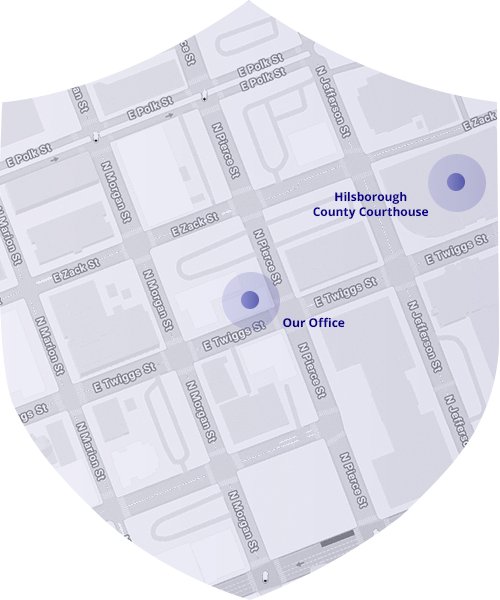
620 E. Twiggs Street, Suite 205, Tampa, FL 33602
(813) 727-7159
Serving Hillsborough, Pinellas, and Pasco Counties
The Brancato Law Firm, P.A. is a Tampa-based criminal defense practice. We are not affiliated with any other Brancato-named law firms.
Visit Us

Tampa, FL 33602
Contact Us Now
Free Legal Consultation (813) 727-7159