

From First DUI to Death Penalty



How to Fight Forgery Charges in Florida? (2026)


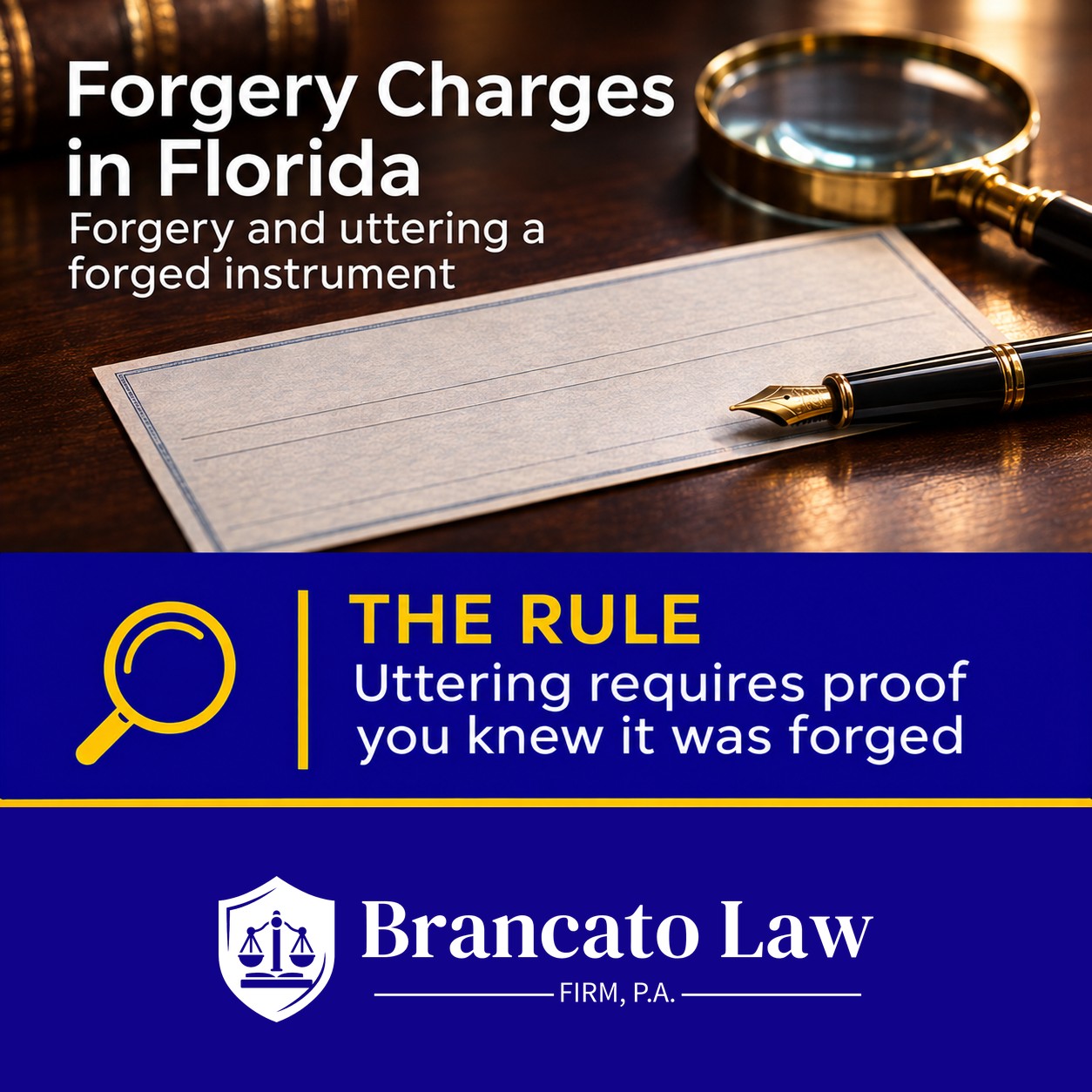
To fight a forgery charge in Florida, the defense attacks intent and knowledge: the State must prove the accused made or altered the document, or passed it as genuine, with intent to injure or defraud, and for uttering, that the person actually knew it was forged. Forgery under section 831.01 and uttering under section 831.02 are each third-degree felonies, punishable by up to five years in prison. Because both rank at Level 2 on Florida’s sentencing chart, a person with no record usually faces a non-prison sentence, and many first-time cases end in pretrial intervention.
Forgery cases are usually won or lost on one question: what the accused knew when the check or document changed hands. I learned how detectives build those files as a former police academy instructor, and later as a former Chief Operations Officer of the Hillsborough County Public Defender’s Office, where I oversaw a staff of over 100 attorneys. As founder of The Brancato Law Firm, P.A., a Tampa criminal defense firm, I have seen our attorneys turn many forgery cases on the paper trail that the bank or police never collected.
What is the difference between forgery and uttering in Florida?
Forgery is making or altering a document; uttering is passing it off as genuine. Under section 831.01, Florida Statutes, forgery means falsely making, altering, forging, or counterfeiting a listed document “with intent to injure or defraud any person.” Under section 831.02, uttering means presenting that document “as true,” knowing it is false, with the same intent to defraud. A person who signs someone else’s name on a check can face a forgery count, and cashing it can add an uttering count.
| Forgery (s. 831.01) | Uttering (s. 831.02) | |
|---|---|---|
| The act | Falsely making, altering, forging, or counterfeiting a document | Offering a false or altered document to someone as genuine |
| Knowledge | The person created or changed the document | The person knew the document was false, altered, or forged |
| Intent | Intent to injure or defraud any person | Intent to injure or defraud any person |
| Typical facts | Signing another person’s name, changing the amount or payee on a check, faking a deed | Cashing or depositing the check, recording the deed, handing over the receipt |
| Degree | Third-degree felony | Third-degree felony |
Checks have their own parallel statutes. Section 831.07 covers forging bank bills, checks, drafts, or promissory notes, section 831.09 covers uttering them, and section 831.08 covers possessing 10 or more forged checks or bills. Our Tampa theft and property crimes attorney page explains how these charges are usually filed together with grand theft.
What documents can be forged under Florida law?
Florida’s forgery statute lists the documents it covers, and a document outside the list cannot support a forgery count under section 831.01. The list includes:
- Public records, and certificates or attestations of a court clerk, notary public, or other public officer.
- Deeds, wills, bonds, charters, letters of attorney (powers of attorney), and insurance policies.
- Promissory notes, bills of exchange, bills of lading, and orders or receipts for money, goods, or other property.
- Passage tickets, passes, and other evidence of transportation issued by a common carrier.
The Brancato Law Firm checks the charged document against this list early. A charge that names the wrong statute, or a document the statute does not cover, can be the basis for a motion to dismiss before the case ever reaches a jury.
Is forgery a felony in Florida?
Yes. Forgery and uttering a forged instrument are each third-degree felonies in Florida, punishable by up to five years in prison under section 775.082 and a $5,000 fine under section 775.083. Each forged check or document can be charged as its own count, so a stack of checks can mean a stack of felonies.
The sentencing picture is less severe than the maximum suggests. Florida’s offense severity chart in section 921.0022 ranks forgery, uttering, forging checks, and uttering forged checks at Level 2. A Level 2 primary offense scores 10 points on the scoresheet under section 921.0024, and when total points are 44 or fewer, the lowest permissible sentence is a nonstate prison sanction such as probation or county jail. For a non-forcible third-degree felony that scores 22 points or fewer, section 775.082(10) requires a nonstate prison sanction unless the judge makes written findings that it could endanger the public.
| Charge | Statute | Degree | Severity level |
|---|---|---|---|
| Forgery | s. 831.01 | Third-degree felony | Level 2 |
| Uttering a forged instrument | s. 831.02 | Third-degree felony | Level 2 |
| Forging bank bills, checks, drafts, or promissory notes | s. 831.07 | Third-degree felony | Level 2 |
| Possessing 10 or more forged notes, bills, checks, or drafts | s. 831.08 | Third-degree felony | Level 2 |
| Uttering forged notes, bills, checks, drafts, or promissory notes | s. 831.09 | Third-degree felony | Level 2 |
Prior convictions, additional counts, and a related grand theft charge all add points. Our attorneys build the scoresheet ourselves before any plea discussion, because a mistake in the State’s scoresheet can be the difference between probation and prison.
Does the State have to prove you knew the check was forged?
Yes. For uttering, the State must prove the accused actually knew the document was forged; proof that the person should have known is not enough. The Second District Court of Appeal applied that rule in Ginn v. State, 26 So. 3d 706 (Fla. 2d DCA 2010), a case about two $500 American Express traveler’s checks cashed at a check-cashing store in November 2007.
Billy Ginn testified that his roommate, who was behind on rent, told him to take traveler’s checks from mail the roommate had received. Ginn cashed two of them to pay his mortgage and utilities, using his own name, driver’s license, and address. The checks turned out to be forged. The Second District reversed his uttering and grand theft convictions and ordered his discharge, holding that “there is no statute providing that possession of a forged instrument gives rise to a presumption that the holder knows the document is a forgery, and no case law so holds either.” A flaw in the hologram that an investigator noticed later showed, at most, that Ginn should have known, not that he did know.
The rule has limits. In State v. Konegen, 18 So. 3d 697 (Fla. 4th DCA 2009), a real estate worker cashed a $5,000 cashier’s check from a would-be renter he knew only by email. He said he warned the bank teller he did not know if the check was real; the teller testified he never did. The Fourth District reinstated his conviction because the conflicting testimony was a question for the jury. Since Bush v. State, 295 So. 3d 179 (Fla. 2020), Florida courts also no longer apply a special appellate standard to cases built only on circumstantial evidence, so the defense’s evidence of what the client knew matters even more. The Second District hears appeals from Hillsborough, Pinellas, and Pasco Counties, and our firm builds that evidence from the first week.
How common is check fraud in Florida?
Check fraud is widespread, and Florida is near the top of the list. Between February 27 and August 31, 2023, financial institutions filed 15,417 reports with the U.S. Treasury’s Financial Crimes Enforcement Network (FinCEN) on check fraud tied to mail theft, involving more than $688 million in suspicious activity, according to FinCEN’s September 2024 analysis. Florida had 1,423 report subjects in that period, the third-highest count of any state.
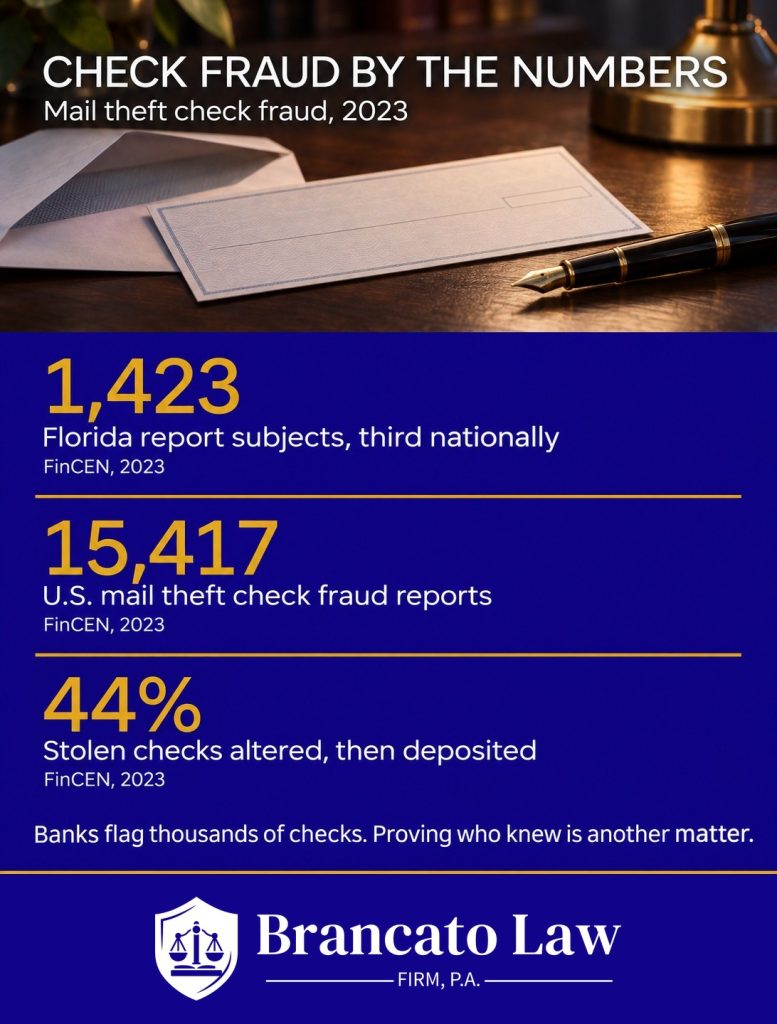
The same FinCEN Financial Trend Analysis found that about 44% of those reports involved altered checks, 26% involved counterfeit checks, and 20% involved fraudulently signed checks. It also reported that FinCEN received over 680,000 filings related to check fraud overall in 2022, nearly double the year before. Those numbers explain why bank investigators now refer cases to police quickly, and why people who deposited a check for someone else are often the first to be questioned. Our post on being charged for cashing a fake check in Florida covers that scam pattern.
How do our attorneys fight a forgery charge?
Our attorneys fight a forgery charge by attacking the elements the State finds hardest to prove: knowledge, intent, and identity. These are the defenses that come up most often in our cases.
- Authority to sign. A person allowed to sign for a parent, spouse, business, or client did not forge anything. Powers of attorney, past practice, and texts can prove authority.
- No knowledge. Under Ginn, a person who received a check from someone else and believed it was real did not commit uttering. We collect the messages, emails, and payment history that show where the check came from.
- No intent to defraud. Signing a name to move money the person was owed, or to pay a shared bill, is different from intending to cheat someone.
- Identity. The State must prove who wrote or altered the document. Our attorneys challenge handwriting comparisons, retain a forensic document examiner when it helps, and subpoena teller-window and ATM video.
- Wrong document or wrong statute. The document must be one listed in section 831.01, or a check or note under sections 831.07 through 831.09.
- Suppression. Statements given without Miranda warnings, and phone searches without a valid warrant, can be challenged before trial.
Forgery often travels with other fraud charges. Our guides on fighting credit card fraud charges in Florida and fighting an identity theft charge explain those related statutes.
Can a forgery case end without a felony conviction?
Yes. A first-time defendant charged with forgery or uttering is often a candidate for pretrial intervention (PTI), which ends in dismissal once the person completes the program, usually including restitution. The Brancato Law Firm explains eligibility in our guide to the Hillsborough County PTI program. Other outcomes include a reduction to a misdemeanor, or a withhold of adjudication, which means the court does not formally convict the person.
Restitution paid before the State files can change the whole case. When a bank or a family member reports a forged check, our attorneys often reach the State Attorney’s Office first with proof of authority or repayment, as part of our representation before charges are filed.
What happens after a forgery arrest in Hillsborough County?
A person arrested for forgery in Hillsborough County is booked at the Orient Road Jail and sees a judge at first appearance within 24 hours, where bond and release conditions are set. The State Attorney’s Office for the 13th Judicial Circuit then decides whether to file an information. Our Florida criminal case process guide explains each stage from arrest through plea or trial.
Hillsborough County does not offer pretrial services supervision, though nearby counties do, so a judge at first appearance has fewer options between a cash bond and release on recognizance. Our attorneys arrive with proof of address, work, and family ties. Our Hillsborough County criminal defense page describes how we handle cases in the 13th Circuit.
What should you do if a bank or detective asks about a forged check?
Say as little as possible and call a criminal defense lawyer before giving any statement. Detectives often call people who deposited or cashed the check, and an innocent explanation given without context can become the State’s best evidence of knowledge.
- Keep every text, email, and app message with the person who gave you the check or document.
- Keep copies of anything showing you had authority to sign, such as a power of attorney or business records.
- Do not contact the alleged victim to explain or apologize.
- Do not move or spend money the bank has frozen or flagged.
The Brancato Law Firm speaks with the detective for the client, presents the documents that show authority or lack of knowledge, and asks the State not to file. That pre-file advocacy can end a case before an arrest.
Frequently asked questions about forgery charges in Florida
Can forgery charges be dropped in Florida?
Yes. Prosecutors drop forgery charges when the evidence of knowledge or intent is weak, when the accused had authority to sign, or after pretrial intervention is completed. The Brancato Law Firm puts that evidence in front of the State Attorney early, often through our pre-charge defense work.
Is signing someone else’s name on a check forgery in Florida?
It is forgery only if the signature was made without authority and with intent to injure or defraud. Our attorneys at The Brancato Law Firm often defend family members and employees who signed with permission that was later denied, and the theft and fraud defense team gathers the records that prove it.
Can I be charged with uttering if I did not know the check was fake?
You can be charged, but the State must prove you actually knew it was forged. Under Ginn v. State, possession of a forged check does not create a presumption of knowledge, and The Brancato Law Firm builds the record of where the check came from.
What is the sentence for a first-time forgery charge in Florida?
The maximum is five years in prison, but a first offense at Level 2 usually scores low enough that the lowest permissible sentence is probation or another nonstate sanction. Our attorneys at The Brancato Law Firm prepare the scoresheet and mitigation before negotiating, and our white collar crime defense page covers larger fraud cases.
Is each forged check a separate felony in Florida?
Yes, prosecutors usually charge each forged or uttered check as its own count, and a forgery count and an uttering count can be filed for the same check. The Brancato Law Firm reviews whether every count is supported and whether additional counts were added only to raise the scoresheet.
Will paying the money back make a forgery charge go away?
Not on its own, because the State decides whether to prosecute. Repayment does weigh heavily in filing and plea decisions, and The Brancato Law Firm often uses it to secure diversion through the Hillsborough PTI program.
For more about our defense strategies, visit our Theft and Property Crimes page.
Our attorneys will start by finding out who gave you the document and what you were told about it, because that is the evidence the State is looking for too. Call The Brancato Law Firm, P.A., founded by Tampa Criminal Defense Attorney Rocky Brancato, at (813) 727-7159 before you speak with a detective or bank investigator. We are available 24/7, and our office is two blocks from the courthouse. Our firm has Spanish-speaking staff, and attorney Jean-Luc Adrien speaks Spanish, Haitian Creole, and French.
The Brancato Law Firm, P.A.
620 E. Twiggs Street, Suite 205, Tampa, FL 33602
(813) 727-7159
Serving Hillsborough, Pinellas, and Pasco Counties
The Brancato Law Firm, P.A. is a Tampa-based criminal defense practice. We are not affiliated with any other Brancato-named law firms.
Visit Us

Tampa, FL 33602

Contact Us Now
Free Legal Consultation (813) 727-7159
