

From First DUI to Death Penalty



How to Fight a Felony Battery Charge in Florida? (2026)


To fight a felony battery charge in Florida, the defense attacks the one element that separates it from a misdemeanor: proof that the touch or strike caused great bodily harm, permanent disability, or permanent disfigurement under section 784.041. If the medical evidence shows only bruises, swelling, or an injury that healed, the charge can be reduced to simple battery, a first-degree misdemeanor. Self-defense, a defective charging document, and identity are also complete defenses. Felony battery is a third-degree felony punishable by up to 5 years in prison and a $5,000 fine, and it scores as a Level 6 offense on the Florida scoresheet.
If you were arrested for felony battery after a fight, the police report probably describes one punch or one shove and an injury that the officer thought looked serious. Whether that injury meets the legal definition of great bodily harm is the question that decides most of these cases. I’m Rocky Brancato, founder of The Brancato Law Firm, P.A., a Tampa criminal defense firm, and a former Chief Operations Officer of the Hillsborough County Public Defender’s Office, where I oversaw a staff of over 100 attorneys. In more than 25 years in Hillsborough County courtrooms, and more than 150 jury trials to verdict, I have seen felony battery charges rise or fall on the emergency room chart, and our attorneys start every one of these cases by getting the full medical records.
What is felony battery in Florida?
Felony battery in Florida is an intentional, unwanted touch or strike that causes great bodily harm, permanent disability, or permanent disfigurement. Section 784.041(1), Florida Statutes, makes it a crime when a person “actually and intentionally touches or strikes another person against the will of the other” and “causes great bodily harm, permanent disability, or permanent disfigurement.” The State does not have to prove the accused meant to cause that injury. It only has to prove the strike was intentional and the serious injury resulted.
That makes felony battery the middle step between simple battery and aggravated battery. Simple battery under section 784.03 needs no injury at all. Aggravated battery under section 784.045 requires that the person intentionally or knowingly caused the serious injury, or used a deadly weapon, which our firm explains in our post on how to fight an aggravated battery charge in Florida. Our attorneys defend all three charges on our Tampa violent crime lawyer page, and the table below shows where felony battery sits.
The table compares the three battery charges by what the State must prove and the maximum penalty.
| Charge | What the State must prove | Degree and maximum penalty |
|---|---|---|
| Simple battery (s. 784.03) | An intentional unwanted touch or strike, or intentionally causing bodily harm | First-degree misdemeanor: up to 1 year in jail and a $1,000 fine |
| Felony battery (s. 784.041(1)) | An intentional touch or strike that causes great bodily harm, permanent disability, or permanent disfigurement | Third-degree felony: up to 5 years in prison and a $5,000 fine; Level 6 on the scoresheet |
| Aggravated battery (s. 784.045) | The person intentionally or knowingly caused great bodily harm, permanent disability, or permanent disfigurement, or used a deadly weapon, or the victim was known to be pregnant | Second-degree felony: up to 15 years in prison |
Section 784.041 also contains a separate crime, domestic battery by strangulation, which applies to family or household members and dating partners. Our firm covers that charge in its own post on how to fight domestic battery by strangulation in Florida.
What counts as great bodily harm in a Florida felony battery case?
Great bodily harm means serious injury, more than the bruises and swelling that come with an ordinary fight. Florida courts still use the definition the Second District quoted in Owens v. State, 289 So. 2d 472 (Fla. 2d DCA 1974): harm that is “great as distinguished from slight, trivial, minor, or moderate harm,” which “does not include mere bruises as are likely to be inflicted in a simple assault and battery.” In Owens, the victim had a broken nose, one eye swollen shut, and a busted lip, and the court left it to the jury to decide whether that was great bodily harm. The Second District hears appeals from Hillsborough, Pinellas, and Pasco County courts, so Owens is the starting point in Tampa Bay felony battery cases.
The definition cuts both ways. Because the statute does not list injuries, the same broken nose can be argued as great bodily harm by the State and as moderate harm by the defense. Whether an injury qualifies is a question of fact for the jury, but the finding still needs real evidence behind it. D.M. v. State, 237 So. 3d 1096 (Fla. 3d DCA 2017) shows the limit. A juvenile was found guilty of felony battery after knocking out another boy’s tooth, but the tooth was a baby tooth, the adult tooth grew in, and the boy never saw a doctor. The Third District reversed the felony and ordered the conviction reduced to misdemeanor battery, holding that the State failed to prove great bodily harm, permanent disability, or permanent disfigurement.
In our experience, these facts usually decide the great bodily harm question:
- Whether the person needed surgery, stitches, or only an ice pack and over-the-counter medicine
- Whether a fracture was confirmed by imaging or only suspected in the field
- How long the injury lasted, and whether it healed completely
- Whether the photographs taken that night match the description in the arrest report
- Whether a scar is permanent or faded, which matters for the permanent disfigurement theory
What are the penalties for felony battery in Florida?
Felony battery is a third-degree felony punishable by up to 5 years in prison under section 775.082 and a fine of up to $5,000 under section 775.083. The offense severity ranking chart in section 921.0022 lists felony battery at Level 6, and section 921.0024 assigns a Level 6 primary offense 36 sentence points. Because the charge requires a serious injury, the scoresheet almost always adds victim injury points as well: 4 for slight, 18 for moderate, and 40 for severe injury.
Those points decide the lowest sentence a judge can impose without a legal reason to go lower. When total points are 44 or less, the lowest permissible sentence is a nonstate prison sanction such as probation or county jail. Above 44 points, the statute subtracts 28 and reduces the rest by 25 percent to set a minimum prison term in months. The table below shows how the injury score alone can change the result for a person with no prior record.
The table shows sample scoresheet outcomes for felony battery as the only offense, with no prior record and no other points.
| Victim injury scored | Total points | Lowest permissible sentence |
|---|---|---|
| Slight (4 points) | 40 | Any nonstate prison sanction, such as probation |
| Moderate (18 points) | 54 | 19.5 months in state prison |
| Severe (40 points) | 76 | 36 months in state prison |
This is why the injury level matters twice: once to decide whether the crime is a felony at all, and again to score the sentence. A judge can go below the lowest permissible sentence only with a valid legal reason, which our firm explains in our post on downward departures in Florida.
A prior prison sentence raises the stakes. In Brooks v. State, 93 So. 3d 402 (Fla. 2d DCA 2012), the Second District held that felony battery qualifies for Prison Releasee Reoffender sentencing because it is a felony that involves “the use or threat of physical force or violence against an individual.” Under section 775.082(9), a person who commits felony battery within 3 years of release from prison faces a mandatory 5-year sentence, served at 100 percent, if the State seeks it. Our attorneys explain that statute on our Prison Releasee Reoffender page.
How is felony battery different from aggravated battery and battery with a prior?
The difference between felony battery and aggravated battery is intent. In T.S. v. State, 965 So. 2d 1288 (Fla. 2d DCA 2007), a teenager punched a co-worker once, almost as a reflex, after she threw tea in his face, and the punch fractured her eye socket. The Second District held that the injury proved felony battery but that nothing showed he intended or knew he would cause that level of harm, so it ordered the aggravated battery reduced to felony battery. Felony battery is often the charge prosecutors file, or accept in a plea, when the injury is serious but the blow was quick and unplanned.
Medical research supports what we see in these cases. A study of 840 patients treated for assault-related facial fractures at Helsinki University Hospital from 2013 to 2018, published in the International Journal of Oral and Maxillofacial Surgery, found that single hits accounted for 30.4% of the assaults, and half of the victims fell during the assault. The authors concluded that a single punch can cause severe injury. That is the fact pattern felony battery was built for: one blow, a fall, and an injury nobody planned.
People also use “felony battery” for a different charge. Under section 784.03(2), a simple battery becomes a third-degree felony when the person has one prior conviction for battery, aggravated battery, felony battery, or resisting an officer with violence. No injury is required for that version, and the statute counts a prior plea as a conviction even if adjudication was withheld or the plea was no contest. Our post on how to fight a battery charge in Florida covers simple battery and how a prior record changes it. Our post on how to fight a second battery charge in Florida covers the prior-conviction version in depth.
How do our attorneys fight a felony battery charge?
Our attorneys fight felony battery by testing each element the State must prove, starting with the injury. These are the six defenses we raise most often.
1. Attack the great bodily harm element with the medical records
The injury is usually the weakest point in the State’s case. We subpoena the full hospital chart, imaging reports, and follow-up records, because an arrest report written at 2 a.m. often says “fracture” when the radiologist later found none. If the records show a moderate injury that healed, we move to have the charge reduced to misdemeanor battery, or we argue it to a jury using the Owens standard.
2. Raise self-defense and Stand Your Ground immunity
A person may use force to defend against an imminent unlawful attack. In Florida, the defense can ask for a pretrial immunity hearing where the State must disprove self-defense by clear and convincing evidence, and a win ends the case before trial. Our firm explains the difference in our post on Stand Your Ground versus self-defense in Florida.
3. Challenge a charging document that does not match the conviction
Felony battery is a necessarily lesser-included offense only when the State charged the great bodily harm version of aggravated battery. In Kirkland v. State, 225 So. 3d 920 (Fla. 1st DCA 2017), the defendant was charged with aggravated battery with a deadly weapon for hitting a man on the leg with a stick, and the trial judge convicted him of felony battery instead. The First District held that the conviction was fundamental error because the charge never alleged great bodily harm, and it ordered a judgment for simple battery. We read the information line by line for errors like this.
4. Contest identity and the sequence of events
Fights outside bars and at parties often involve several people, poor lighting, and witnesses who arrived late. We collect surveillance video, phone recordings, and 911 audio early, and we interview witnesses before their memories merge with what they heard afterward. If someone else threw the blow that caused the injury, our client did not commit felony battery.
5. Negotiate a reduction to misdemeanor battery
When the evidence on injury is thin, a reduction to simple battery under section 784.03 removes the felony, the Level 6 score, and the Prison Releasee Reoffender exposure. We build that negotiation on medical evidence, video, and mitigation, so the prosecutor sees the trial risk in writing.
6. Work the case before charges are filed
Many felony battery cases start with an arrest, but the State Attorney’s Office decides later what to file. Representation before charges are filed lets our attorneys present medical records and witness statements while the filing decision is still open, which can lead to a misdemeanor filing or no filing at all.
What happens after a felony battery arrest in Hillsborough County?
After a felony battery arrest in Hillsborough County, the person is booked into jail and sees a judge at first appearance within 24 hours under Florida Rule of Criminal Procedure 3.130. In Hillsborough, the judge sits downtown and the arrested person appears by video from the jail, and the judge sets bond and release conditions, usually including no contact with the alleged victim. Our post on Hillsborough County first appearance walks through that hearing, and our Hillsborough County criminal defense page covers local courts.
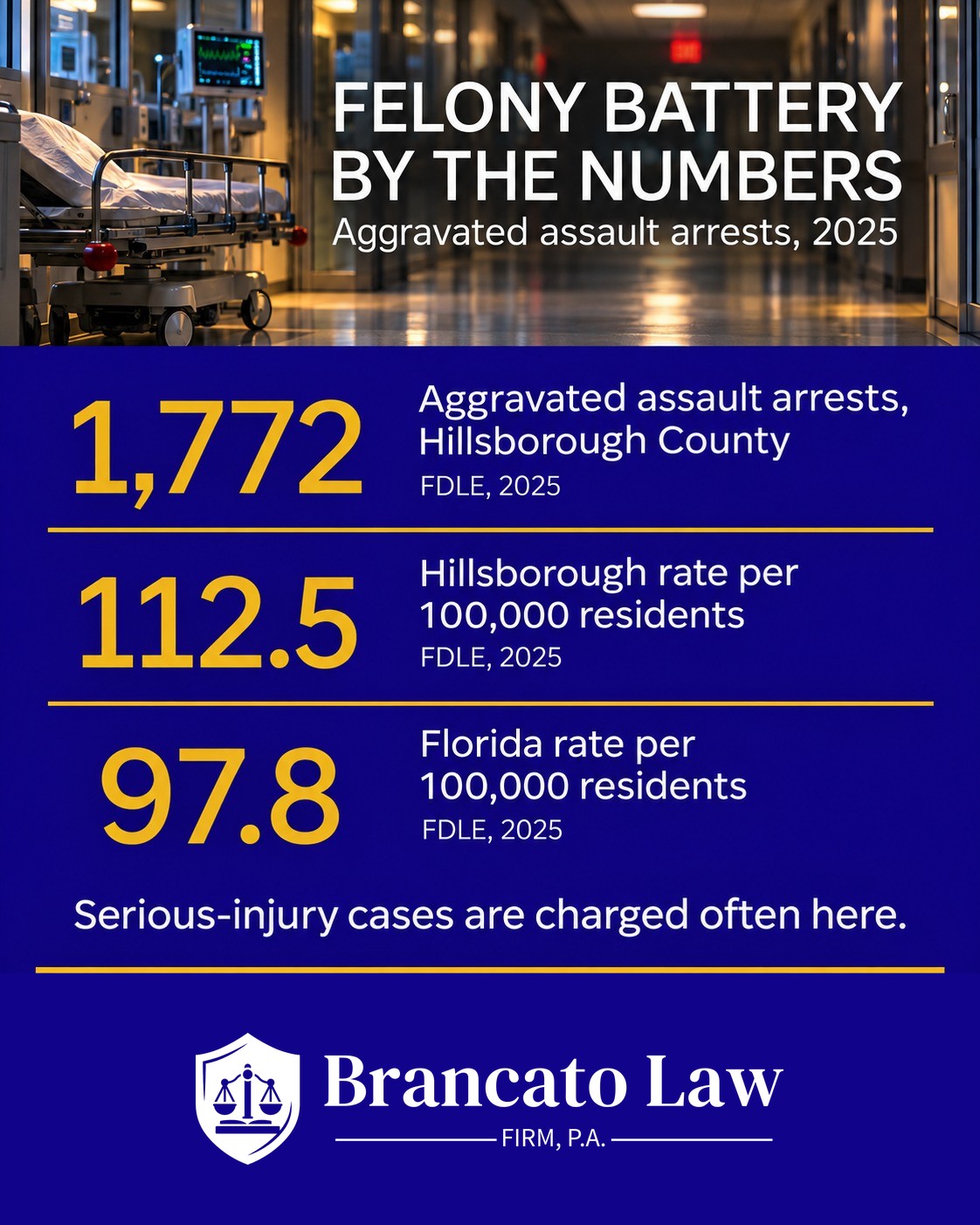
Arrest data shows how often serious violence leads to an arrest in this county. In 2025, Hillsborough County recorded 1,772 aggravated assault arrests, a rate of 112.5 per 100,000 residents, compared with 97.8 per 100,000 statewide, according to Florida Department of Law Enforcement arrest data published on the Florida Department of Health’s FLHealthCHARTS site. Those counts do not list felony battery separately; aggravated assault, defined there as an assault or threat with a weapon that could cause great bodily injury, is the closest serious-injury category they report.
The volume is large. In 2024, the Orient Road Jail booked over 42,000 people, according to the Hillsborough County Sheriff’s Office 2024 Annual Report. A first appearance judge moving through that many cases sees only the arrest affidavit, so a lawyer who brings facts about the injury and the person’s ties to the community can change the release conditions. Pretrial services supervision is not available in Hillsborough County, though some nearby counties offer it, so a well-supported bond argument matters more here.
From there, the case follows the steps on our Florida criminal case process page: filing, arraignment, discovery, depositions, motions, and then plea or trial.
What should you do, and avoid, after a felony battery arrest?
The first week after a felony battery arrest is when the evidence is easiest to save and the easiest to damage. These steps protect the defense:
- Do not contact the alleged victim, even to apologize. A no-contact order is a bond condition, and a message can be used as an admission.
- Do not post about the fight on social media or discuss it on recorded jail calls.
- Write down who was present, where cameras might be, and what happened before the first blow.
- Photograph your own injuries, if any, and keep any medical records from your treatment.
- Call a defense lawyer before speaking with detectives or the prosecutor.
Frequently asked questions about felony battery in Florida
Can felony battery charges be dropped in Florida?
Yes, the State Attorney can drop or reduce a felony battery charge when the medical records do not show great bodily harm, when video supports self-defense, or when the alleged victim’s account falls apart. Our attorneys at The Brancato Law Firm often begin by sending prosecutors the medical evidence that undercuts the injury element, and our violent crimes defense page explains how we approach these cases.
Can a broken nose be felony battery in Florida?
A broken nose can be felony battery, but it is not automatically great bodily harm, and a nose fracture that heals without surgery can be argued as moderate harm. The Brancato Law Firm uses the treating records and imaging to show the jury or prosecutor what the injury really was, relying on Owens, where a broken nose with an eye swollen shut was left to the jury to decide.
Is felony battery a lesser-included offense of aggravated battery in Florida?
Felony battery is a necessarily lesser-included offense of aggravated battery only when the State charged the great bodily harm version, not aggravated battery with a deadly weapon. Our team at The Brancato Law Firm checks the charging document before any plea or trial so a client is not convicted of a crime the State never charged, as happened in Kirkland v. State.
Will a felony battery conviction make a future battery a felony?
Yes, under section 784.03(2), a person with one prior conviction for felony battery who commits any later battery faces a third-degree felony, even if the earlier case ended in a no contest plea with adjudication withheld. The Brancato Law Firm weighs that future risk when advising a client whether to accept a felony battery plea or fight for a misdemeanor.
Does felony battery require intent to injure someone?
No, felony battery requires an intentional touch or strike, but the State does not have to prove the person intended the serious injury that followed. Our attorneys at The Brancato Law Firm use that line between felony battery and aggravated battery to argue that an overcharged aggravated battery should be reduced to felony battery or lower.
Can I go to prison for a first felony battery offense in Florida?
Yes, a first felony battery with a moderate or severe injury scored on the scoresheet can produce a minimum prison sentence even with no prior record, while a slight injury score allows probation. The Brancato Law Firm reviews the scoresheet with each client early, using pre-file advocacy where possible to keep the injury score and the charge as low as the evidence allows.
For more about our defense strategies, visit our Violent Crimes page.
Hospital records, surveillance video, and witness memories are easiest to collect in the first days after an arrest, so do not wait for the State to file. Our attorneys at The Brancato Law Firm, P.A., founded by Tampa Criminal Defense Attorney Rocky Brancato, will start by getting the medical records and reviewing your scoresheet exposure. Call (813) 727-7159 for a free consultation; you can call us at any hour. Our firm has Spanish-speaking staff, and attorney Jean-Luc Adrien speaks Spanish, Haitian Creole, and French.
The Brancato Law Firm, P.A.
620 E. Twiggs Street, Suite 205, Tampa, FL 33602
(813) 727-7159
Serving Hillsborough, Pinellas, and Pasco Counties
The Brancato Law Firm, P.A. is a Tampa-based criminal defense practice. We are not affiliated with any other Brancato-named law firms.
Visit Us

Tampa, FL 33602

Contact Us Now
Free Legal Consultation (813) 727-7159
