

From First DUI to Death Penalty



How to Fight an Embezzlement Charge in Florida? (2026)


To fight an embezzlement or employee theft charge in Florida, the defense attacks intent: the State must prove you knowingly took or used your employer’s money or property intending to deprive the employer of it, and an honest, good faith belief that you had a right to it is a complete defense. Florida charges embezzlement as theft under section 812.014, so the value decides the degree, from a third-degree felony at $750 to a first-degree felony at $100,000 or more. Many cases turn on accounting: sloppy bookkeeping, disputed pay or commissions, and authorized spending are not crimes.
If your employer has accused you of taking money, the case against you was probably built for weeks before anyone told you about it. I’m Rocky Brancato, founder of The Brancato Law Firm, P.A., a Tampa criminal defense firm, and I have spent more than 25 years in Hillsborough County courtrooms, including as former Chief Operations Officer of the Hillsborough County Public Defender’s Office, where I oversaw a staff of over 100 attorneys. Our attorneys defend embezzlement and employee theft accusations in Hillsborough, Pinellas, and Pasco Counties, and the most effective work often happens before the employer’s file reaches a prosecutor.
Is embezzlement a crime in Florida?
Yes, but Florida does not have a separate embezzlement statute. Embezzlement is prosecuted as theft under section 812.014, Florida Statutes, which covers anyone who knowingly obtains or uses another person’s property with intent to deprive the owner of it or to appropriate it to their own use. Florida’s theft chapter expressly folds older crimes such as embezzlement, misapplication, misappropriation, and conversion into that single definition.
Embezzlement usually means taking property you were trusted to handle: a bookkeeper who writes checks to herself, a manager who pockets cash deposits, an employee who uses a company card for personal bills, or a contractor who spends a customer’s deposit. Our attorneys explain the full range of these cases on our Tampa white collar crime attorney page, and theft-only cases are covered on our theft and property crimes page.
What does the State have to prove in an employee theft case?
The State must prove that you knowingly obtained or used property that belonged to someone else, and that you intended to deprive the owner of it or take it for your own use. In workplace cases, each piece of that sentence is contestable.
| Element | What the State must show | What our attorneys test |
|---|---|---|
| Property of another | The money or property belonged to the employer, not to you | Was it your pay, commission, bonus, reimbursement, or draw? |
| Knowingly obtained or used | You took, kept, spent, or transferred it on purpose | Who else had access to the account, card, register, or login? |
| Intent to deprive or appropriate | You meant to take the benefit of the property from the owner | Was the spending authorized, customary, or recorded openly? |
| Value | The total value of what was taken | Are refunds, repayments, legitimate expenses, and double-counted entries removed? |
Value can be added across transactions. Florida’s standard theft jury instruction, approved in In re Standard Jury Instructions in Criminal Cases—Report 2018-02, 256 So. 3d 1316 (Fla. 2018), tells jurors that the values of separate thefts “committed pursuant to one scheme or course of conduct” may be added together. That is how a series of small transfers becomes a second-degree felony, and it is why the accounting matters so much.
What are the penalties for embezzlement in Florida?
Embezzlement penalties in Florida depend on the value taken. Below $750 it is petit theft, a misdemeanor; from $750 it is grand theft, a felony. The Criminal Punishment Code ranks each grand theft tier at a different offense level in section 921.0022, and the level drives the sentencing scoresheet.
| Value taken | Degree | Maximum prison | Offense level |
|---|---|---|---|
| $750 to less than $5,000 | Third-degree felony | 5 years | Level 2 |
| $5,000 to less than $10,000 | Third-degree felony | 5 years | Level 3 |
| $10,000 to less than $20,000 | Third-degree felony | 5 years | Level 4 |
| $20,000 to less than $100,000 | Second-degree felony | 15 years | Level 6 |
| $100,000 or more | First-degree felony | 30 years | Level 7 |
The level matters as much as the maximum. A first-time offender charged below $100,000 usually does not score to mandatory state prison on the theft count alone, which leaves room for probation, restitution, or diversion. At $100,000 or more, a Level 7 offense alone scores to a lowest permissible sentence of 21 months in prison, so pushing the value below that line is often the most important number in the case. Florida law also requires the court to order restitution to the employer on a conviction unless it finds clear and compelling reasons not to.
How do our attorneys fight an embezzlement charge in Florida?
Our attorneys fight embezzlement charges by testing intent, ownership, access, and value against the employer’s own records. These are the five defenses we evaluate first:
- Good faith belief in a right to the money. An honest belief that you were entitled to the funds is a complete defense, even if the belief was mistaken.
- The money was yours. Pay, commissions, bonuses, draws, and reimbursements are not “property of another.”
- Authorization or business custom. Spending approved by an owner, or done openly the way the business always did it, is not theft.
- Someone else had access. Shared logins, shared cards, and shared cash drawers create reasonable doubt about who took what.
- Mismanagement is not theft. Bad bookkeeping, late payments, and a failing business are civil problems, and the value must be proven entry by entry.
Good faith is a complete defense: what Philippoussi shows
A jury must be told that good faith requires acquittal, not merely that it is something to consider. In Philippoussi v. State, 691 So. 2d 511 (Fla. 4th DCA 1997), a woman was convicted of grand theft for withdrawing money from a joint account she opened with an elderly friend who, according to some witnesses, treated her like a daughter and said she would leave her everything. The trial court told jurors they could consider her good faith belief “as you would any other item of circumstantial evidence.” The Fourth District reversed for a new trial because that instruction did not tell the jury good faith was a complete defense. Florida’s standard theft instruction now says it plainly: a defendant with “an honest, good faith belief” in a right to the property, “even though unreasonable or mistaken,” must be found not guilty.
How the charge can take the defense away: what Carr shows
The charge the State picks can change which defenses the jury hears. In Carr v. State, 270 So. 3d 508 (Fla. 1st DCA 2019), a Duval County business owner who serviced homeowners’ associations was convicted of organized fraud after taking hundreds of thousands of dollars of client money. She asked for a good faith instruction based on an accountant’s advice that she could remove profits from her company account. The First District affirmed, holding that no evidence supported the defense because the fraud happened before she removed the money, and noting that the jury convicted her of organized fraud under section 817.034, which requires an intent to defraud. The lesson for employees: when a prosecutor charges a scheme to defraud instead of theft, the good faith evidence must be tied to the moment the money moved, and our attorneys build it that way from the start.
How do embezzlement cases usually start in Hillsborough County?
Most embezzlement cases start with the employer, not the police. The Association of Certified Fraud Examiners’ 2024 Report to the Nations, a study of 1,921 occupational fraud cases, found that 43% of frauds were detected by a tip, that a typical case lasted 12 months before detection, and that asset misappropriation appeared in 89% of cases. The median loss across all cases was $145,000. By the time an employee hears about it, the employer has often reviewed a year of records.
In our Hillsborough County cases, the file usually reaches the State Attorney’s Office for the 13th Judicial Circuit as a package the employer assembled: bank and card statements, an internal audit or forensic accountant’s spreadsheet, and a written statement. That spreadsheet is an accusation, not proof. Our attorneys obtain the underlying records, rebuild the numbers, and show the prosecutor every authorized payment, repayment, and duplicate entry before a value is filed.
Employers often send a civil theft demand at the same time. Under section 772.11, a person who proves civil theft can recover three times the actual damages, and the demand letter usually arrives before or alongside the criminal investigation. Our guide to civil theft demand letters explains why paying or responding without a lawyer can hurt the criminal case.
Can embezzlement be charged as a federal crime?
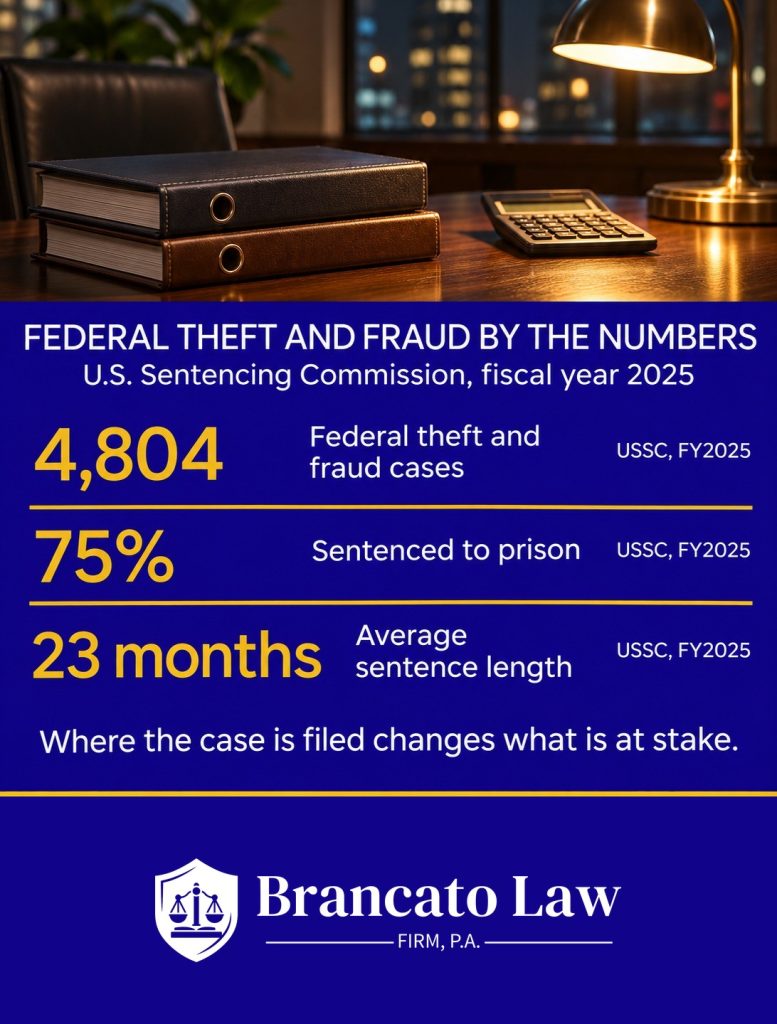
Yes, when the money belongs to a bank, a federally funded program, or the scheme uses interstate wires or mail, federal prosecutors can bring the case instead of the state. Federal theft and fraud sentences are significant: in fiscal year 2025, 4,804 federal cases involved theft, property destruction, and fraud, 75% of those sentenced went to prison, and the average sentence was 23 months, according to the U.S. Sentencing Commission. Most workplace embezzlement in the Tampa area is still prosecuted in state court under section 812.014.
What should you do if your employer accuses you of embezzlement?
If your employer accuses you of taking money, do not explain, sign, or repay anything until you talk to a lawyer. A written confession or a signed repayment agreement is often the State’s best evidence of intent. Our attorneys provide representation before charges are filed so the first version of events the prosecutor hears comes from your side.
- Do not sign a promissory note or confession prepared by the employer or its lawyer.
- Do not answer a detective’s questions without counsel, even if you think the misunderstanding is easy to explain.
- Do not delete emails, texts, or files. Deleting records can look like consciousness of guilt and can become a separate problem.
- Write down who approved what. Names, dates, and the business’s usual practices support a good faith or authorization defense.
- Keep your own pay records, commission agreements, and expense approvals.
If you are arrested, the case moves to first appearance within 24 hours, where bond is set. Our guide to the stages of a Florida criminal case explains what happens next. For lower-value first offenses, our attorneys also look at diversion, explained in our guide to the Hillsborough County PTI program, and at whether restitution can resolve the case without a felony conviction.
Frequently asked questions about embezzlement charges in Florida
Can embezzlement charges be dropped in Florida?
Yes. Prosecutors drop or reduce embezzlement charges when the records show authorization, a good faith dispute over pay, shared access, or a lower value than the employer claimed. The Brancato Law Firm presents that evidence before the filing decision whenever possible, and our Tampa embezzlement defense attorneys also negotiate restitution-based resolutions when the facts call for it.
Is it embezzlement if I planned to pay the money back?
It can be. Florida theft covers intent to deprive the owner “temporarily or permanently,” so a plan to repay is not a defense by itself, though it can support a good faith or authorization argument. Our attorneys at The Brancato Law Firm look at whether the business allowed advances or loans in practice, which often changes how the prosecutor sees the case.
Is a dispute over unpaid commissions or wages a crime?
Usually not, if you honestly believed the money was owed to you. An honest, good faith belief in a right to the property is a complete defense under Florida’s standard theft instruction, as Philippoussi v. State confirms. The Brancato Law Firm gathers the pay plans, emails, and past practice that show the belief was real.
Should I sign the repayment agreement my employer is offering?
Not before a lawyer reviews it. Many employer repayment agreements include admissions that prosecutors later use to prove intent, and signing does not stop the employer from going to police. Our attorneys at The Brancato Law Firm can negotiate repayment terms through our pre-file advocacy work without handing the State a confession.
How does the State prove the value in an embezzlement case?
The State usually relies on bank records and an employer’s spreadsheet, and it may add separate transactions together if they were part of one scheme. The Brancato Law Firm rebuilds those numbers line by line, and our guide to how the State proves value in a grand theft case explains the rules.
Will I go to jail for a first embezzlement charge in Hillsborough County?
Not necessarily. Below $100,000, a first offender’s theft count alone does not score to mandatory state prison, so probation, restitution, or diversion may be possible. Our attorneys at The Brancato Law Firm build the mitigation and restitution plan early, because the first offer is often shaped by what the prosecutor sees in the first weeks.
For more about our defense strategies, visit our White Collar Crime page.
Before you answer your employer, a detective, or a demand letter, get advice on what each step means for a criminal case. Call The Brancato Law Firm, P.A., founded by Tampa Criminal Defense Attorney Rocky Brancato, at (813) 727-7159; we are available 24/7 and two blocks from the courthouse. Our firm has Spanish-speaking staff, and attorney Jean-Luc Adrien speaks Spanish, Haitian Creole, and French.
The Brancato Law Firm, P.A.
620 E. Twiggs Street, Suite 205, Tampa, FL 33602
(813) 727-7159
Serving Hillsborough, Pinellas, and Pasco Counties
The Brancato Law Firm, P.A. is a Tampa-based criminal defense practice. We are not affiliated with any other Brancato-named law firms.
Visit Us

Tampa, FL 33602

Contact Us Now
Free Legal Consultation (813) 727-7159
