

From First DUI to Death Penalty



How to Fight Battery on a Law Enforcement Officer in Florida? (2026)


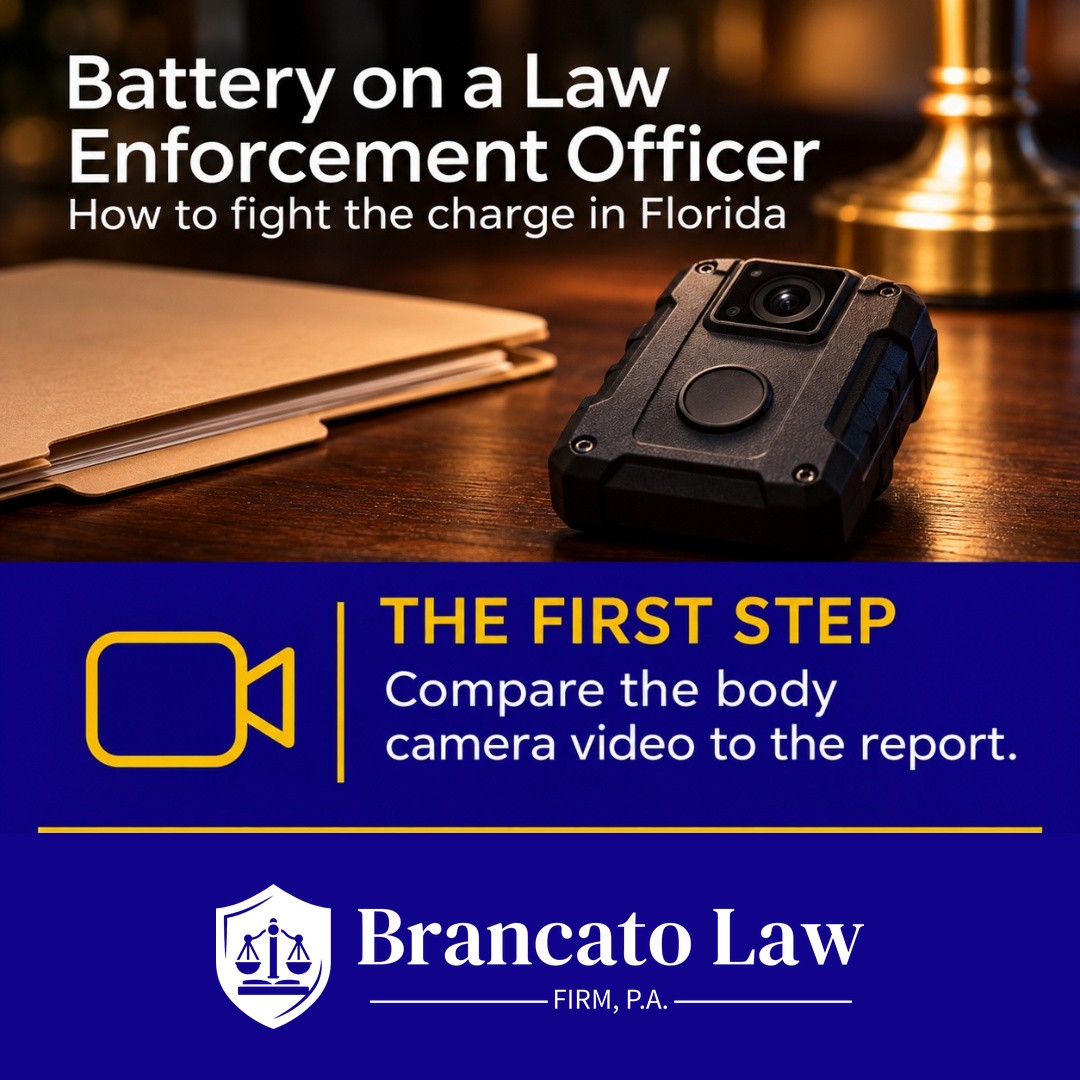
To fight a battery on a law enforcement officer charge in Florida, the defense tests the elements that turn a misdemeanor touch into a felony under section 784.07: that the person knew the victim was an officer, that the officer was performing official duties, and that an intentional, unwanted touch or strike happened at all. Battery on a law enforcement officer is a third-degree felony punishable by up to 5 years in prison, even with no injury. Since June 16, 2026, the Officer Jason Raynor Act scores it at Level 5 and narrows the defense of resisting an unlawful detention. Body camera video, witness recordings, and the officer’s own report usually decide whether the charge holds, drops to simple battery, or is dismissed.
Battery on a law enforcement officer cases are usually decided by the body camera video, and the video often tells a different story than the arrest report. I learned how officers are trained to write those reports as a former police academy instructor, and I’m Rocky Brancato, founder of The Brancato Law Firm, P.A., a Tampa criminal defense firm. I have spent more than 25 years in Hillsborough County courtrooms and tried more than 150 jury trials to verdict, and our attorneys start every officer battery case by getting every recording of the encounter before it is overwritten or buried in discovery.
What is battery on a law enforcement officer in Florida?
Battery on a law enforcement officer is a simple battery committed knowingly against an officer who is performing official duties, which Florida reclassifies from a misdemeanor to a felony. A battery under section 784.03 is any intentional touch or strike against a person’s will, or intentionally causing bodily harm. Section 784.07(2)(b), Florida Statutes, reclassifies that battery “from a misdemeanor of the first degree to a felony of the third degree” when it is knowingly committed on a law enforcement officer engaged in the performance of official duties. No injury is required.
The same statute protects more than police officers. It covers correctional and probation officers, firefighters, emergency medical care providers, hospital personnel, traffic and parking enforcement officers, uniformed licensed security officers, and utility workers on critical infrastructure, among others. Our attorneys defend these charges as part of our Tampa violent crime lawyer practice.
A battery can be very minor contact. In State v. Hearns, 961 So. 2d 211 (Fla. 2007), the Florida Supreme Court held that battery on a law enforcement officer is not a forcible felony for violent career criminal sentencing because it “may be committed with only nominal contact,” such as tapping an officer on the shoulder or a child hitting a school officer with a spitball. Spitting on an officer, pulling away from a grip, or a flailing arm during a struggle can all be charged.
What changed in 2026 under the Officer Jason Raynor Act?
The Officer Jason Raynor Act, Chapter 2026-144, Laws of Florida, took effect on June 16, 2026, and made three changes that matter in officer battery cases. It is named for a Daytona Beach police officer who was shot in 2021 and later died.
- The “lawful performance” wording is gone. Before the Act, section 784.07(2) applied when the officer was “engaged in the lawful performance of his or her duties.” The current statute requires only that the officer be “engaged in the performance of his or her official duties.”
- Resisting a good-faith detention is no longer justified. Section 776.051 now says a person may not use or threaten force to resist “any arrest or detention” by a known officer acting in good faith, defined as “sincere and reasonable efforts to comply with legal requirements, even if the arrest, detention, or other act is later found to have been unlawful.”
- The offense scores higher. The offense severity chart in section 921.0022 now lists battery on a law enforcement officer at Level 5, up from Level 4.
The change matters because of older case law. In Tillman v. State, 934 So. 2d 1263 (Fla. 2006), the Florida Supreme Court held that the State had to prove the officer was acting lawfully when the alleged battery happened outside an arrest. The Second District applied that rule in C.B. v. State, 979 So. 2d 391 (Fla. 2d DCA 2008), where a teenager spat on an officer while being restrained during a detention that had no lawful basis. The court reduced the felony to simple battery. For incidents on or after June 16, 2026, the new good-faith rule narrows that defense. For incidents before that date, the law in effect at the time of the offense still controls, so the date of the arrest is one of the first things our attorneys check.
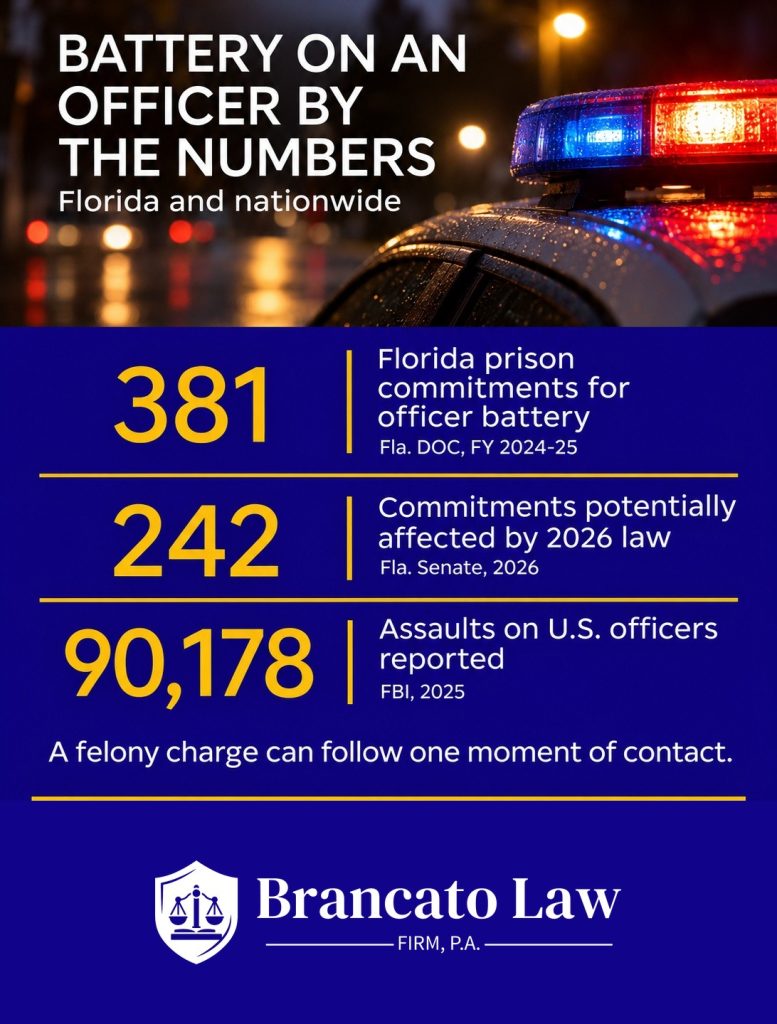
The Legislature expected the change to affect a real number of cases. The Florida Senate bill analysis for SB 156 reported 381 new prison commitments under section 784.07 in fiscal year 2024-25, and estimated that 242 of them would potentially be affected by the bill. Assaults on officers are also rising nationally: in 2025, agencies reporting to the FBI counted 90,178 assaults on law enforcement officers, a rate of 13.8 per 100 officers, according to the FBI’s preliminary Officers Killed and Assaulted in the Line of Duty, 2025 report.
What are the penalties for battery on a law enforcement officer in Florida?
Battery on a law enforcement officer is a third-degree felony punishable by up to 5 years in prison under section 775.082 and a $5,000 fine. Level 5 scores 28 primary offense points under section 921.0024. With no prior record and no other charges, that total stays under the 44-point line, so the lowest permissible sentence is a nonstate prison sanction such as probation. Prior convictions and additional charges such as resisting with violence can push the score over 44 and create a minimum prison term.
The table shows how section 784.07 raises each assault and battery charge when the victim is a law enforcement officer.
| Underlying charge | Charge when the victim is an officer | Mandatory minimum |
|---|---|---|
| Assault (second-degree misdemeanor) | First-degree misdemeanor | None |
| Battery (first-degree misdemeanor) | Third-degree felony, Level 5 | None, except 6 months if committed in furtherance of a riot |
| Battery while possessing a firearm or destructive device | Third-degree felony | 3 years in prison; 8 years with a semiautomatic firearm and high-capacity magazine or a machine gun |
| Aggravated assault (third-degree felony) | Second-degree felony | 3 years in prison |
| Aggravated battery (second-degree felony) | First-degree felony | 5 years in prison |
Two other rules raise the stakes. First, a battery on a law enforcement officer that results in bodily injury is a listed Prison Releasee Reoffender offense under section 775.082(9), which means a mandatory 5-year prison sentence, served at 100 percent, if the offense happened within 3 years of release from prison and the State seeks it. Our Prison Releasee Reoffender page explains that statute. Second, a conviction for battery on an officer becomes a prior that turns any later simple battery into a felony under section 784.03(2), which our firm explains in our post on how to fight a battery charge in Florida.
Does the State have to prove you knew the person was an officer?
Yes. Knowledge that the victim was a law enforcement officer is an essential element the State must prove. In Polite v. State, 973 So. 2d 1107 (Fla. 2007), an undercover Miami-Dade officer in a plaid shirt tried to grab a man he saw tampering with a parking meter, and the man pulled away and swung at him. The Florida Supreme Court reversed the resisting with violence conviction and ordered a new trial because the jury was not told the State had to prove he knew the man was an officer. The Court noted it had already held that knowledge of the officer’s status is an essential element of battery on a law enforcement officer.
Knowledge is a real issue when the officer was in plain clothes, the encounter happened in the dark, the person was woken from sleep, or a struggle started before anyone identified themselves. Body camera audio often shows exactly when, or whether, an officer announced who they were.
How do our attorneys fight a battery on a law enforcement officer charge?
Our attorneys fight these charges by testing each element against the recordings and the officer’s own words. These are the six defenses we raise most often.
1. Compare the body camera video to the arrest report
Arrest reports in officer battery cases are written after a struggle, often hours later, and the video frequently shows the contact differently. Research on cameras supports why the footage matters: in a 12-month randomized trial in Rialto, California, published in the Journal of Quantitative Criminology in 2015, the likelihood of police use of force on shifts without cameras was roughly twice that on shifts with cameras. We request every officer’s body camera, dash camera, and jail booking video, and we look at the seconds before the alleged battery as closely as the contact itself.
2. Challenge intent and accidental contact
Battery requires an intentional touch or strike. A person who stumbles while handcuffed, jerks away from pain, flails during a medical emergency, or makes contact while being taken to the ground has not necessarily committed an intentional battery. We use the video and medical records to show the jury what the body was doing and why.
3. Contest knowledge of the officer’s status
Under Polite, the State must prove the accused knew the victim was an officer. We examine uniforms, lighting, announcements, and the order of events. When the evidence on knowledge fails, the charge falls to simple battery, a first-degree misdemeanor.
4. Test whether the officer was performing official duties
The State still must prove the officer was engaged in official duties. For incidents before June 16, 2026, the older “lawful performance” element and cases like C.B. still apply, so an unlawful stop or detention can defeat the felony. For later incidents, we examine whether the officer was acting in good faith under the new section 776.051 and whether the conduct fit the officer’s duties at all. The new wording is recent, and our attorneys follow the appellate decisions applying it.
5. Raise self-defense against excessive force
Section 776.051 bars force used to resist an arrest or detention by a known officer acting in good faith, but it does not require a person to accept excessive force. Whether that defense applies depends on the facts and the timing, which our firm explains in our post on Stand Your Ground versus self-defense in Florida.
6. Negotiate a reduction to a misdemeanor
When the video is mixed, a reduction to simple battery or resisting an officer without violence removes the felony and the Level 5 score. In one case, our firm resolved a three-year-old warrant for battery on a law enforcement officer as a misdemeanor with credit for time served. Past results do not guarantee future outcomes.
What happens after a battery on an officer arrest in Hillsborough County?
After an arrest for battery on a law enforcement officer in Hillsborough County, the person is booked into jail and sees a judge at first appearance within 24 hours under Florida Rule of Criminal Procedure 3.130. In Hillsborough, the judge sits downtown and the arrested person appears by video from the jail, and the judge reads an arrest affidavit written by the officer who is also the alleged victim. Our post on Hillsborough County first appearance explains that hearing, and our Hillsborough County criminal defense page covers the local courts.
These charges often come with other counts from the same encounter, such as resisting with violence under section 843.01, which the Officer Jason Raynor Act also amended. Our post on how to fight resisting an officer with violence in Florida covers that charge. The State Attorney’s Office then decides what to file, and the case moves through the stages on our Florida criminal case process page. Representation before charges are filed gives our attorneys a chance to put the video in front of the prosecutor before the filing decision is made.
What should you do after a battery on an officer arrest?
The first days after the arrest are when recordings are easiest to find. These steps protect the defense:
- Do not discuss the arrest on recorded jail calls or social media.
- Write down the names of witnesses and anyone who filmed the encounter, and ask them to save the video.
- Note every injury you suffered and get medical care; keep the records and photographs.
- Do not contact the officer or file a complaint without talking to a lawyer first, since your statement can be used in the criminal case.
- Call a defense lawyer before giving any statement to investigators.
Frequently asked questions about battery on a law enforcement officer
Can battery on a law enforcement officer charges be dropped in Florida?
Yes, prosecutors can drop or reduce the charge when video contradicts the report, when the State cannot prove the person knew the victim was an officer, or when the contact was accidental. Our attorneys at The Brancato Law Firm build that case with recordings and witness statements, and our violent crimes defense page explains our approach.
Is spitting on a police officer a felony in Florida?
Yes, intentionally spitting on an officer who is performing official duties can be charged as battery on a law enforcement officer, a third-degree felony, because spitting is an unwanted touch. The Brancato Law Firm looks closely at whether the spitting was intentional and whether the State can prove the other elements, as the Second District required in C.B. v. State.
Is battery on a law enforcement officer a forcible felony in Florida?
No, the Florida Supreme Court held in State v. Hearns that it is not a forcible felony for violent career criminal sentencing, because it can be committed with nominal contact. Our team at The Brancato Law Firm uses that holding when the State tries to treat a minor touch as a violent crime at sentencing.
Can I resist an unlawful arrest in Florida after the 2026 law change?
For incidents on or after June 16, 2026, section 776.051 says force is not justified to resist an arrest or detention by a known officer acting in good faith, even if the arrest is later found unlawful. The Brancato Law Firm checks the incident date first, because earlier cases are still governed by the older statute and case law like Tillman.
Does battery on a firefighter, nurse, or paramedic count as battery on an officer?
Yes, section 784.07 applies the same felony reclassification to firefighters, emergency medical care providers, hospital personnel, and other listed workers performing their duties. Our attorneys at The Brancato Law Firm defend these cases the same way as officer cases, and when a charge arises from a patient in crisis in an emergency room, we use the medical records to explain what happened.
Can I get a withhold of adjudication for battery on a law enforcement officer?
A judge may be able to withhold adjudication on a battery on an officer charge without a firearm, but section 784.07(3) bars a withhold when the person possessed a firearm or destructive device during the battery. The Brancato Law Firm explains the options for each client, including pre-file advocacy aimed at a lesser filing before that question ever arises.
For more about our defense strategies, visit our Violent Crimes page.
Body camera footage and bystander videos are easiest to secure in the first days after an arrest, and our attorneys will start there. Call The Brancato Law Firm, P.A., founded by Tampa Criminal Defense Attorney Rocky Brancato, at (813) 727-7159, and call us at any hour. Our firm has Spanish-speaking staff, and attorney Jean-Luc Adrien speaks Spanish, Haitian Creole, and French.
The Brancato Law Firm, P.A.
620 E. Twiggs Street, Suite 205, Tampa, FL 33602
(813) 727-7159
Serving Hillsborough, Pinellas, and Pasco Counties
The Brancato Law Firm, P.A. is a Tampa-based criminal defense practice. We are not affiliated with any other Brancato-named law firms.
Visit Us

Tampa, FL 33602

Contact Us Now
Free Legal Consultation (813) 727-7159
