- Free Consultation 24/7: (813) 727-7159 Tap Here To Call Us


From First DUI to Death Penalty



What Is the Difference Between Second-Degree Murder and Manslaughter in Florida?



Published September 8, 2026.
| One element: a “depraved mind.” Second-degree murder requires proof that the killing was done with ill will, hatred, spite, or an evil intent. Manslaughter does not — it covers a killing by an intentional act, or by culpable negligence, without that malice. The difference is the difference between a first-degree felony punishable by life and a second-degree felony punishable by up to fifteen years. And on September 2, 2026, Florida’s First District Court of Appeal in Peoples v. State threw out a second-degree murder conviction and ordered a manslaughter judgment instead, holding that a man who shot an unarmed, raging aggressor charging him with balled fists showed “an impulsive overreaction to an attack or a perceived threat” — not a depraved mind. |
I’m Rocky Brancato, founder of The Brancato Law Firm, P.A., a Tampa criminal defense firm. I came to the defense bar from the other side of the aisle, with Major Crimes Unit experience and years as chief operating officer of the Hillsborough County Public Defender’s Office, and the depraved-mind element is the single most litigated question in the homicide cases our attorneys handle. Juries are asked to decide it in a sentence; appellate courts write twenty pages about it. Peoples is one of the clearest recent explanations of where the line sits.
What Does Florida Law Say Second-Degree Murder Is?
An unpremeditated killing committed by an act “imminently dangerous to another and evincing a depraved mind regardless of human life.” That is the language of section 782.04(2), Florida Statutes, and it is a first-degree felony punishable by up to life in prison. Second-degree murder does not require the State to prove the defendant planned to kill anyone — that is what separates it from first-degree murder. What it does require is the “depraved mind,” which Florida courts have consistently defined as ill will, hatred, spite, or an evil intent toward the victim.
That definition is where most second-degree murder trials are actually fought. The State does not have to prove a motive, but it has to prove malice in this legal sense, and it usually tries to do so circumstantially: what the defendant said before and after, whether there was a history between the two, whether the defendant went looking for the confrontation, and whether the force used was wildly out of proportion to anything that provoked it.
What Is Manslaughter in Florida?

A killing “by the act, procurement, or culpable negligence of another, without lawful justification,” that is neither murder nor excusable homicide. That is section 782.07(1), Florida Statutes, and standing alone it is a second-degree felony punishable by up to fifteen years. Manslaughter is Florida’s residual homicide offense: if a death was unlawful but the evidence does not reach the depraved mind of second-degree murder or the premeditation of first-degree murder, manslaughter is what remains.
Judge Winokur’s concurrence in Agee v. State, No. 1D2023-3321 (Fla. 1st DCA Sept. 2, 2026) — decided the same day as Peoples — lays out the structure cleanly: under the statute and the common law it incorporates, manslaughter “comes in three forms”: voluntary manslaughter by act or procurement, involuntary manslaughter by act, and involuntary manslaughter by culpable negligence. They are not separate crimes, just different ways of committing the same one. (Read the opinion.) The practical point for a client is that “manslaughter” covers everything from an intentional killing in the heat of a sudden fight to a death caused by reckless disregard with no intent to hurt anyone at all.
| Second-degree murder | Manslaughter | |
|---|---|---|
| Statute | § 782.04(2) | § 782.07(1) |
| Mental state | Act imminently dangerous, evincing a depraved mind — ill will, hatred, spite, or evil intent | Intentional act, procurement, or culpable negligence — no malice required |
| Premeditation | Not required | Not required |
| Base offense level | First-degree felony | Second-degree felony |
| Maximum sentence | Life | 15 years (30 if reclassified for a firearm) |
| 10-20-Life mandatory minimum | Applies — murder is an enumerated offense | Does not apply — manslaughter is not on the list |
| Typical fact pattern | Prior animosity, hunting the victim down, stated intent to kill, gratuitous force | Sudden confrontation, impulsive overreaction, reckless conduct |
What Did the First DCA Decide in Peoples v. State?
That fear is not malice, and that a disproportionate response to a real threat is manslaughter, not murder. The facts in Peoples v. State, No. 1D2025-2335 (Fla. 1st DCA Sept. 2, 2026), read like a domestic emergency because they were one. (Read the opinion.)
Matthew Peoples lived with his mother in Bonifay, next door to his sister and her on-and-off boyfriend, Tyler Pate — the father of her young autistic son. The two men had no history of animosity; the families had gone camping together a week earlier. On the night of the shooting Pate, whose blood-alcohol level was later measured at .192, became belligerent, argued with the sister, and began destroying the house: he threw a fan, an ashtray, and a DVD player, smashed a fifty-five-inch television, busted a light fixture, knocked pictures off the walls, punched through a pantry wall, and kicked in a bathroom door. The child was struck by a lit cigarette from the overturned ashtray and nearly hit by the television.
Peoples’s mother heard her daughter screaming on the phone and ran next door with Peoples behind her. Peoples got his sister and nephew out and back to the mother’s house, where the family dead-bolted the door and called police. He told his mother to put in earplugs because if Pate broke through the locked door, he would shoot him. He loaded his firearm and stood by the door. Nothing happened. About ten minutes later the sister went back to retrieve clothing, expecting Pate to have left; he had not, and he followed her back toward the mother’s house, screaming. Peoples told him to go home, warned him not to come onto the property, and said he was armed — the gun still undrawn in his waistband. Pate threatened him, called him a name, crossed onto the property, and charged at him with balled fists. Peoples drew and fired once. Pate, unarmed, fell dead eight to ten feet away. Peoples went inside, unloaded the gun, came back out, and surrendered with his hands raised.
A jury convicted him of second-degree murder. The First District reversed. The State’s depraved-mind theory rested on three things: the earplugs statement, Peoples’s remark that Pate was “lucky you didn’t put your hands on my sister,” and the fact that he let his sister walk back unescorted. The court held that even viewed in the State’s favor, that evidence “does not establish the ill will, hatred, spite, or evil intent that the depraved-mind element demands.” The earplugs statement was “a statement of conditional intent to protect one’s family against a feared forced entry,” a contingency that never happened — “It is evidence of fear.” Peoples’s first responses had been to remove his family from danger and call the police, which “are not escalation.” And the final shot came when an intoxicated aggressor charged him on his own property. The court’s rule: “When the evidence shows no more than an impulsive overreaction to an attack or a perceived threat, it supports a conviction for manslaughter, not second-degree murder.” It reversed and remanded for entry of judgment for manslaughter with a firearm.
What Kind of Evidence Turns Manslaughter Into Murder?
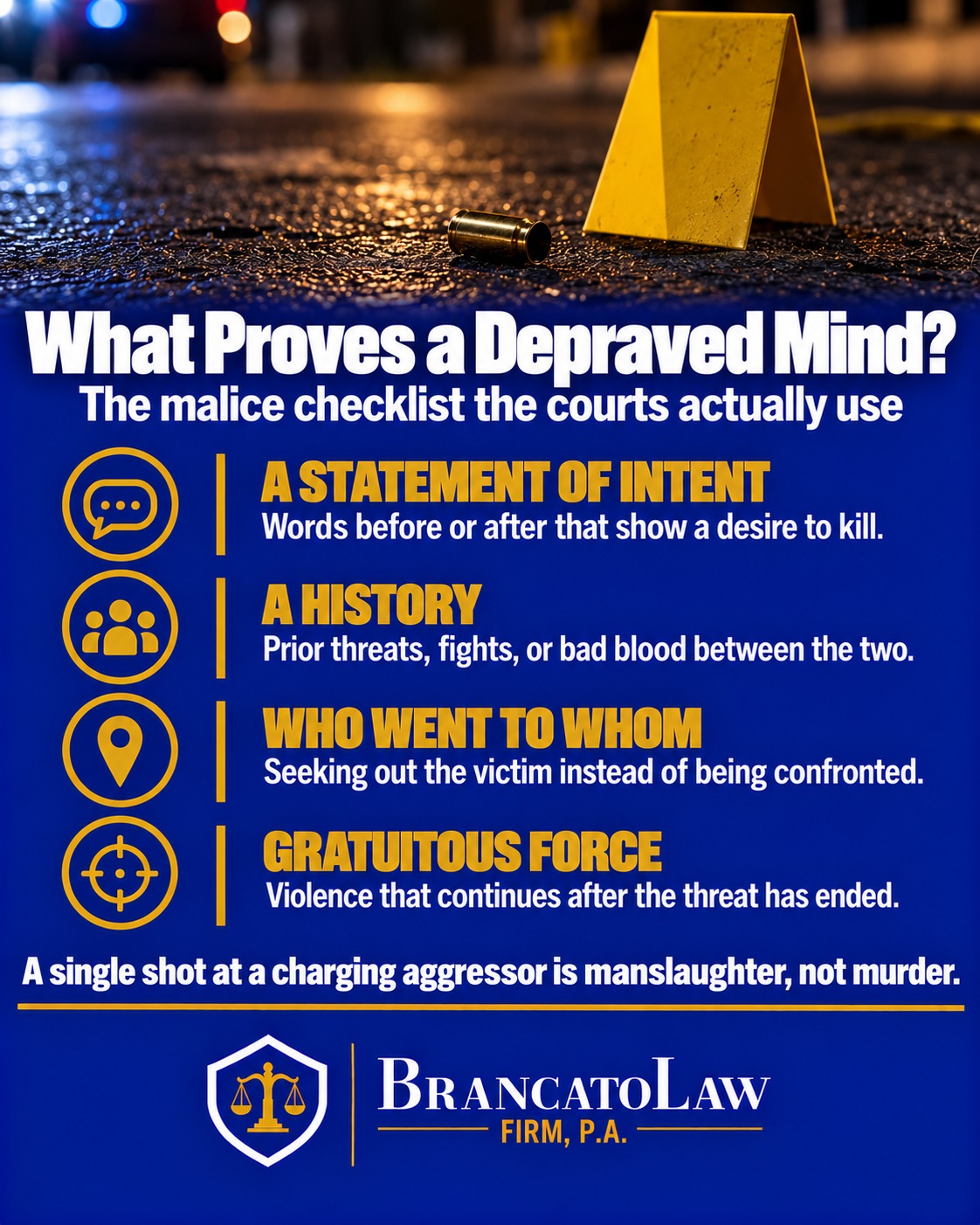
Evidence of malice beyond the act itself — and Peoples catalogs what that looks like. The court explained that where Florida appellate courts have upheld depraved-mind findings after a sudden confrontation, “the record has typically contained some circumstantial evidence of malice beyond the act itself”: a contemporaneous statement expressing intent to kill (the defendant in one prior case told the victim “I should have killed you” right after shooting him), or evidence that the defendant sought out the victim with lethal intent before the confrontation began (a defendant who told witnesses hours earlier that he was going to kill someone, against a backdrop of prior animosity). Absent that kind of evidence, the court said, a defendant who “armed himself against an unarmed victim and used lethal force in the heat of a confrontation he did not provoke” has committed manslaughter.
For the defense, that passage is a checklist. In every second-degree murder case our attorneys ask: Is there a statement of intent, before or after? Is there a history between these two people? Who went to whom? Did the defendant have a chance to walk away and choose not to? Was the force gratuitous — multiple shots, a beating that continued after the threat ended — or a single act in the moment? When the honest answers are “no, none, the victim came to him, and one shot,” the State is trying a manslaughter case under a murder caption.
Does Heat of Passion Reduce Murder to Manslaughter in Florida?
It can, but the provocation has to be sudden and sufficient, and the passion has to still be running when the killing happens. Judge Winokur’s Agee concurrence walks through the doctrine: voluntary manslaughter is “the intentional killing of another, mitigated by a sudden and sufficient provocation like heat of passion,” and heat of passion “can provide a partial defense to both first-degree, premeditated murder and second-degree murder.” Two limits matter. First, “a ‘passion for revenge,’ of course, will not do” — the defendant in Agee admitted he sought revenge, which is why the concurrence found the failure to instruct on heat of passion was not fundamental error there. Second, a cooling-off period defeats the defense; passion that has had time to become a plan is premeditation.
Peoples illustrates the favorable side of the same line. The court expressly noted that the earlier confrontation, the ten-minute interval, and the final charge did not add up to a resolved plan — the shooting was a reaction to Pate “crossing onto Peoples’s property and charging at him with his fists balled.” That is the difference between a man who was still in the moment and one who had left it and come back.
How Does Self-Defense Fit Into This?
It is the acquittal argument; the depraved-mind argument is the fallback that turns a life sentence into a determinate one. Peoples raised self-defense and lost it with the jury — and the First District did not disturb that, because a person who uses deadly force against an unarmed man may have used more force than the law allows even if the fear was real. What the court held is that using too much force in response to a genuine, unprovoked attack is manslaughter, not murder. The two defenses are therefore layered: our attorneys try the justification case first, and build the record for the lesser-included offense at the same time, because the same facts that show a real threat also negate malice. Our full discussion of the justification side is in how to claim self-defense in a Florida criminal case and the immunity procedure in Stand Your Ground immunity in Florida.
What Are the Penalties for Second-Degree Murder and Manslaughter in Florida?

The gap is enormous, and the firearm makes it wider on both sides:
| Offense | Degree | Maximum | Mandatory minimum |
|---|---|---|---|
| Second-degree murder | First-degree felony (life) | Life | 10-20-Life applies: 10 years for possession, 20 for discharge, 25 to life if the discharge causes death or great bodily harm |
| Manslaughter | Second-degree felony | 15 years | None under 10-20-Life — not an enumerated offense |
| Manslaughter with a firearm | Reclassified to first-degree felony under § 775.087(1) | 30 years | None under 10-20-Life, though sentencing guidelines score the death and the weapon |
| Aggravated manslaughter (child, elderly or disabled adult, officer/firefighter/EMT) | First-degree felony | 30 years | Guidelines-driven |
Section 775.087, Florida Statutes, does two different things here, and clients often conflate them. Subsection (1) reclassifies the degree of a felony committed with a firearm — which is why Peoples’s manslaughter becomes a first-degree felony on remand. Subsection (2) imposes the 10-20-Life mandatory minimums, but only for the felonies it lists, and manslaughter is not among them. So the reduction from second-degree murder to manslaughter with a firearm in a shooting death moves a client from a mandatory twenty-five years to life down to a guidelines sentence capped at thirty — with a judge who has discretion again.
For a broader map of every homicide offense and where these two sit, see our complete guide to homicide charges in Florida. For more about our defense strategies, visit our Hillsborough County criminal defense page.
How Do Our Attorneys Fight a Second-Degree Murder Charge?
By making the State prove the depraved mind and by making sure the record preserves the argument if it cannot. Concretely:
- The motion for judgment of acquittal on the depraved-mind element. Peoples was won on exactly this motion, renewed at the close of the evidence and then on appeal. If the State’s malice evidence is a single ambiguous statement and a bad outcome, we say so on the record, in those words.
- The sequence of events, minute by minute. Who called 911. Who retreated. Who came back. How long the interval was. In Peoples the court cared that his “first response to the disturbance was to remove his sister and her child from danger and to call the police.” That timeline came from witnesses and phone records, not from the defendant’s testimony.
- The absence of history. No prior fights, no threats, families who camped together the week before. The State’s malice case is often built on relationship history; where there is none, we prove there is none.
- The physics of the shot. One casing, one wound, no soot or stippling, a body eight to ten feet away — physical evidence consistent with a single shot at an advancing man, not an execution.
- The lesser-included instruction and the heat-of-passion instruction. Both must be requested and both must be in the record. Agee is a reminder that a missing instruction is not fundamental error unless the evidence would have supported it.
- What the State gets to say about intoxication. In Peoples the court rejected the argument that it was fundamental error for the State to present evidence the defendant was under the influence of marijuana and argue it affected his perception and reaction time. Expect that evidence, and be ready to answer it rather than hoping it is excluded.
What Should You Do If You Are Facing a Homicide Charge After a Confrontation?
Say nothing to anyone but your lawyer, and preserve everything about the minutes before. The State’s depraved-mind case is built from your words — to police, to family, to friends, on the phone from the jail. Every one of those is a potential “earplugs statement,” and the State will read it in the worst light. Meanwhile the evidence that helps you is the most perishable: the 911 timestamps, the neighbors who heard the rampage, the damage inside the house, the phone records showing who called whom and when. Our attorneys send a preservation team to the scene in the first days of a homicide case for exactly that reason.
Frequently Asked Questions About Second-Degree Murder and Manslaughter in Florida
Does second-degree murder require intent to kill?
No. Neither second-degree murder nor manslaughter requires premeditation or a specific intent to kill. Second-degree murder requires an act imminently dangerous to another that shows a depraved mind — ill will, hatred, spite, or evil intent. That is a mental state directed at the victim, but it is not the same thing as a plan to kill.
Can a single gunshot be manslaughter instead of murder?
Yes, and Peoples is a September 2026 example: a single shot at an unarmed man charging the shooter, with no prior history between them, was held to be manslaughter as a matter of law. The number of shots is not dispositive by itself, but a single act in the heat of a confrontation is the classic manslaughter fact pattern.
What does “depraved mind” actually mean to a jury?
The standard instruction tells jurors it means an act that a person of ordinary judgment would know is reasonably certain to kill or do serious bodily injury, done from ill will, hatred, spite, or an evil intent, and indifferent to human life. In practice the fight is over the middle clause — whether the defendant’s state of mind toward this victim was malice or fear.
If I acted in self-defense, why would I be convicted of anything?
Because juries sometimes find that the threat was real but the force was excessive. When that happens, the legally correct verdict is manslaughter, not second-degree murder — a real fear that produces a disproportionate response is the opposite of a depraved mind. Which is why we build both arguments from the first day.
Does 10-20-Life apply to manslaughter?
No. The mandatory minimums in section 775.087(2) apply only to the felonies the statute lists, and manslaughter is not one of them. A firearm still reclassifies manslaughter from a second-degree to a first-degree felony, raising the maximum from fifteen to thirty years, but the judge retains sentencing discretion.
Is heat of passion a complete defense in Florida?
No. It is a partial defense that can reduce first- or second-degree murder to manslaughter. It requires a sudden and sufficient provocation, a killing while the passion is still running, and a motive other than revenge. Whether the jury is instructed on it depends on whether the evidence supports it — which is a fight worth having before trial, not after.
If you or a family member is facing a second-degree murder or manslaughter charge anywhere in Tampa Bay, the attorneys of The Brancato Law Firm, P.A. — founded by Tampa Criminal Defense Attorney Rocky Brancato — will look at the minutes before the shot before anyone else gets to characterize them. Call (813) 727-7159. The difference between murder and manslaughter is one element, and it is the element the State has to prove.
The Brancato Law Firm, P.A.
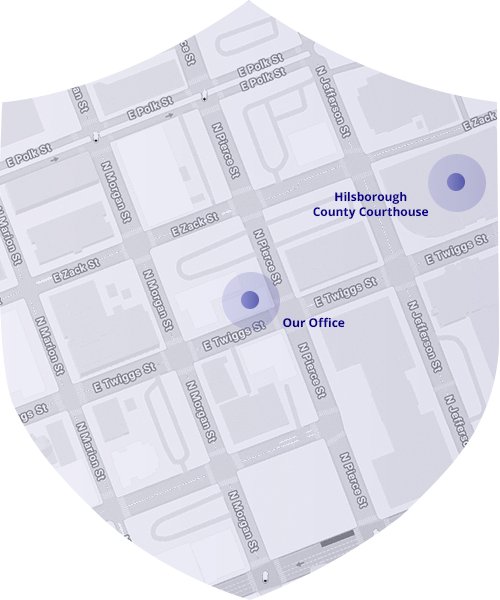
620 E. Twiggs Street, Suite 205, Tampa, FL 33602
(813) 727-7159
Serving Hillsborough, Pinellas, and Pasco Counties
The Brancato Law Firm, P.A. is a Tampa-based criminal defense practice. We are not affiliated with any other Brancato-named law firms.
Visit Us
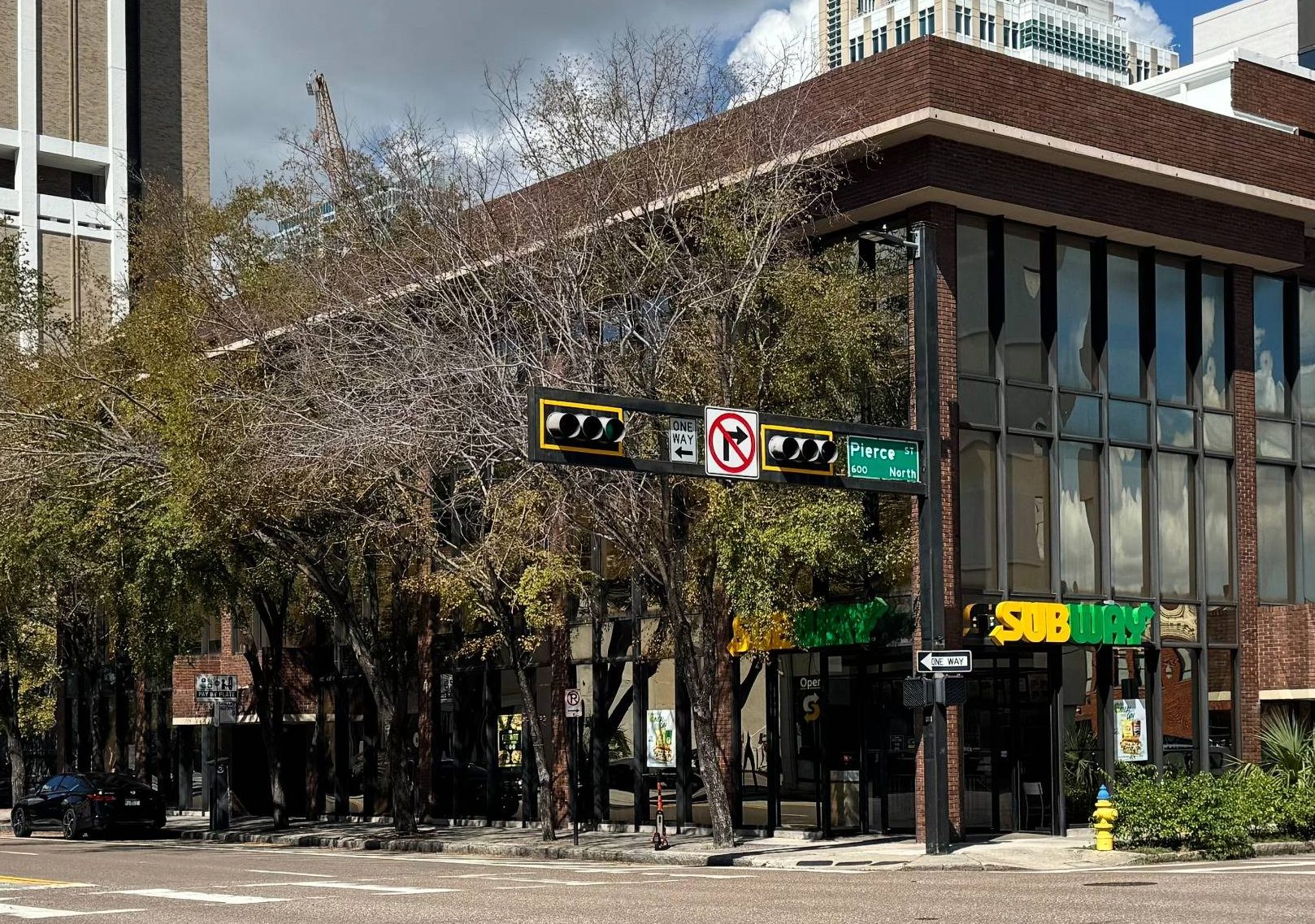
Tampa, FL 33602
Contact Us Now
Free Legal Consultation (813) 727-7159