

From First DUI to Death Penalty



What Happens If You Drive After a DUI Revocation in Florida? (2026)


What the law says
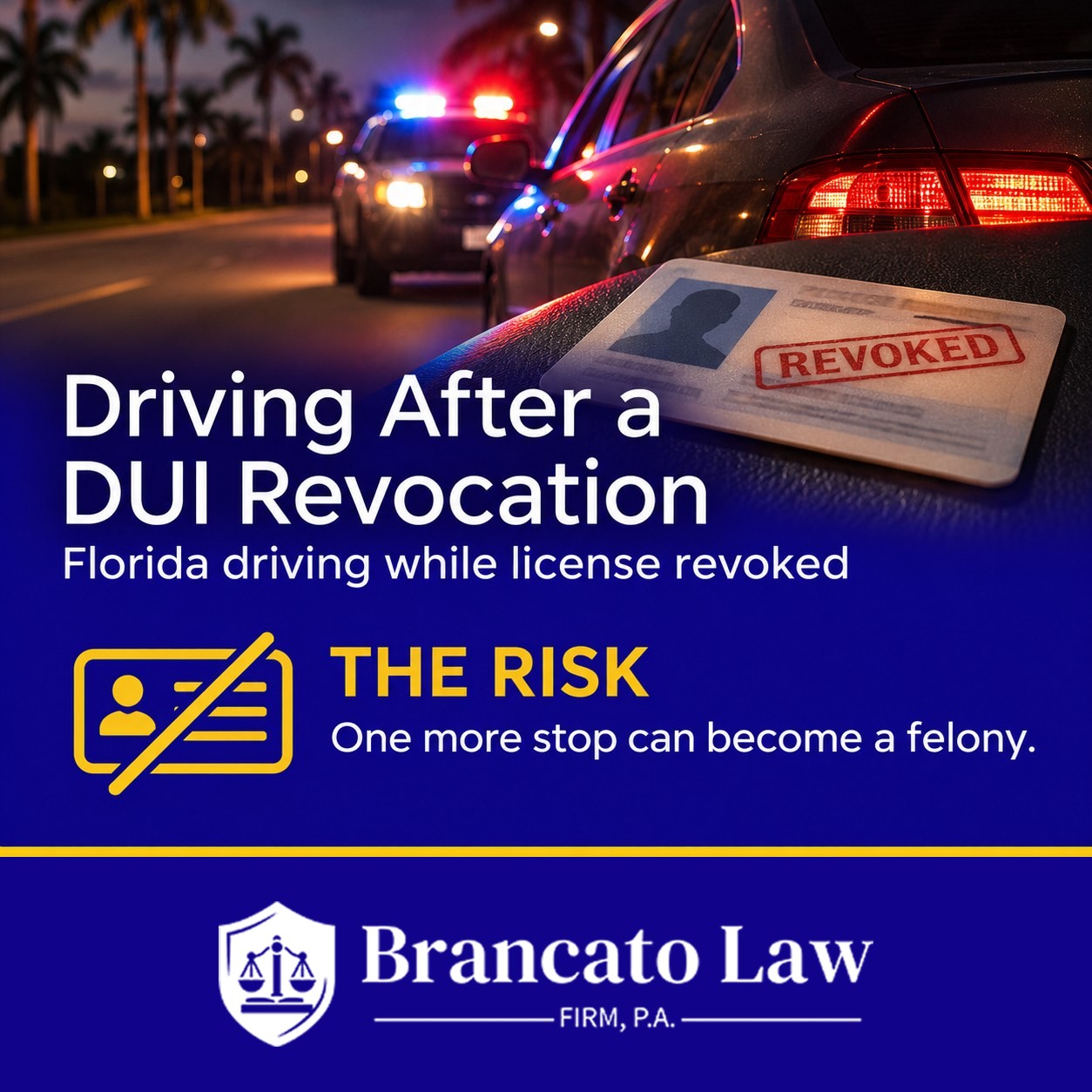
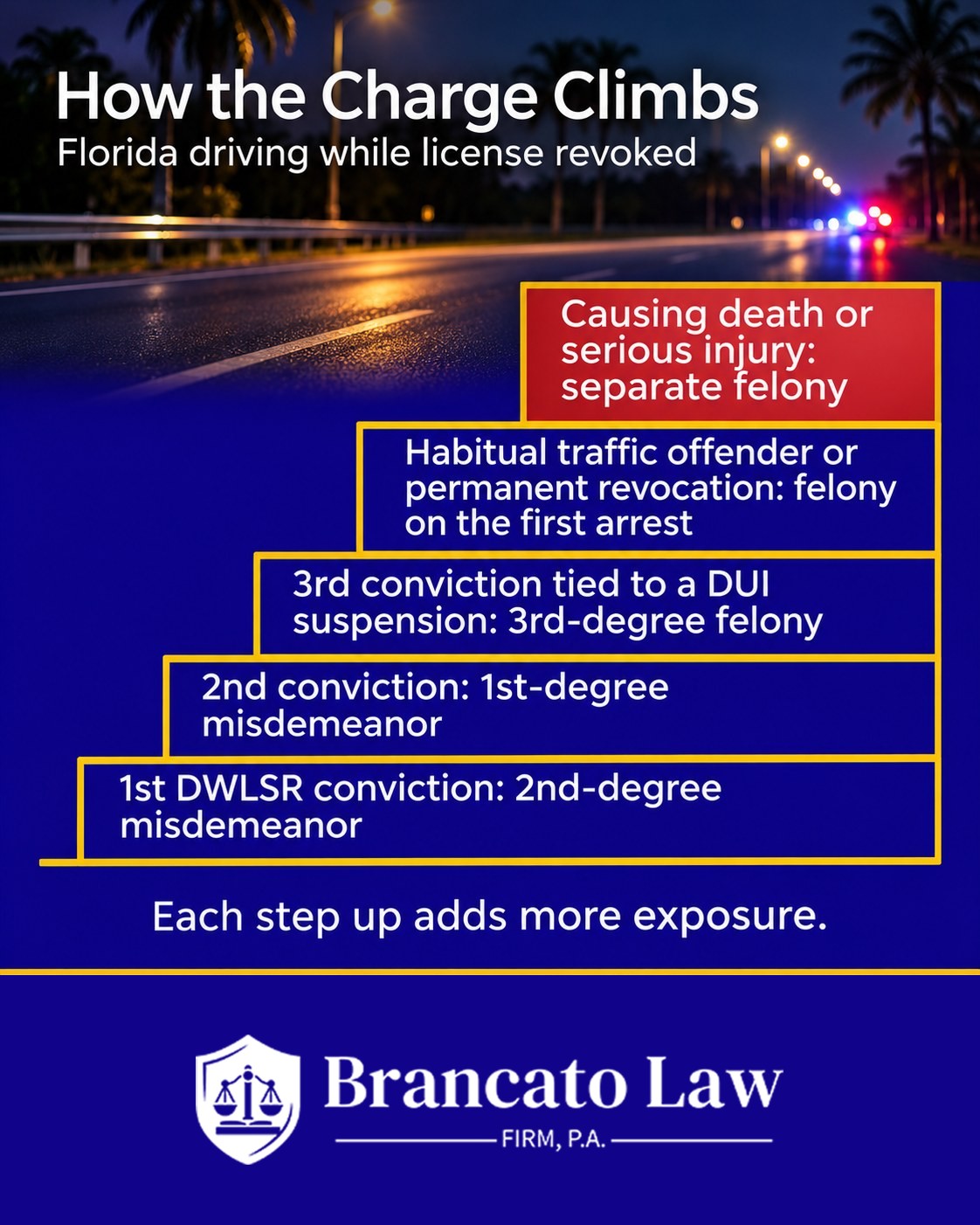
Driving after a DUI license revocation in Florida is a crime, and it can quickly become a felony. Knowingly driving while revoked is a second-degree misdemeanor on a first conviction and a first-degree misdemeanor on a second, but a third conviction is a third-degree felony when the current case or the most recent prior one involved a DUI-related suspension, under section 322.34(2)(c), Florida Statutes. Driving on a permanent revocation, or after being designated a habitual traffic offender, is a third-degree felony on the first arrest. If the driver causes a death or serious injury while revoked for DUI, section 322.34(6) adds a separate felony that can be charged on top of DUI manslaughter.
Prosecutors treat a driver stopped on a DUI revocation very differently from someone whose license lapsed over an unpaid ticket, because Florida law does. I am Rocky Brancato, founder of The Brancato Law Firm, P.A., a Tampa criminal defense firm; I am a member of the National College for DUI Defense, a former police academy instructor, and a lawyer with more than 25 years in Hillsborough County courtrooms. When a client is charged with driving after a DUI revocation, our attorneys start with the driving record itself, because the reason for the revocation, the dates of the prior convictions, and the proof of knowledge decide whether the case is a misdemeanor or a felony.
What happens if you drive after a DUI revocation in Florida?
You can be arrested for driving while license suspended or revoked (DWLSR), and the charge level depends on your record and the reason for the revocation. Section 322.34, Florida Statutes, covers most cases, and section 322.341, Florida Statutes, covers drivers whose licenses were permanently revoked. Our Tampa criminal traffic lawyer page covers the broader range of license charges, and our post on driving while license suspended in Florida explains the general offense. This post focuses on what changes when the revocation came from a DUI.
| Situation | Charge level | Maximum penalty | Statute |
|---|---|---|---|
| First knowing DWLSR conviction | Second-degree misdemeanor | 60 days in jail, $500 fine | s. 322.34(2)(a) |
| Second knowing DWLSR conviction | First-degree misdemeanor | 1 year in jail, $1,000 fine | s. 322.34(2)(b) |
| Third or later conviction, where the current or most recent prior DWLSR involved a DUI or refusal suspension | Third-degree felony | 5 years in prison, $5,000 fine | s. 322.34(2)(c) |
| Driving while designated a habitual traffic offender | Third-degree felony | 5 years in prison, $5,000 fine | s. 322.34(5) |
| Driving on a permanent revocation (four DUIs, or DUI manslaughter) | Third-degree felony | 5 years in prison, $5,000 fine | s. 322.341 |
| Causing death or serious bodily injury by careless or negligent driving while revoked for DUI | Third-degree felony | 5 years in prison, $5,000 fine | s. 322.34(6)(b) |
The maximum terms come from section 775.082, Florida Statutes, and the fines from section 775.083. A third misdemeanor DWLSR conviction that does not qualify as a felony still carries a mandatory minimum of 10 days in jail under section 322.34(2)(b)2.
Why does a DUI revocation make the charge more serious?
A DUI revocation makes the charge more serious because Florida’s statute singles out DUI-related suspensions for felony treatment. Under section 322.34(2)(c), a third or later DWLSR conviction becomes a felony only if the current violation or the most recent prior one is tied to a suspension for DUI, refusal to submit to a breath, blood, or urine test, a traffic offense causing death or serious bodily injury, or fleeing and eluding. A driver whose license was suspended for unpaid child support or a missed traffic fine can reach a third conviction and still face a misdemeanor. Section 322.34(10) goes further for those non-driving suspensions and caps many of them at lower penalties, but a DUI revocation is not on that list.
Two other DUI-specific rules matter. If a driver is arrested for a new DUI while the license is suspended or revoked because of a prior DUI conviction, the vehicle is subject to seizure and forfeiture under section 322.34(9)(a). And a DUI conviction is one of the offenses that count toward habitual traffic offender status under section 322.264, Florida Statutes: three DUI or DWLSR convictions arising from separate acts within five years produce a five-year habitual offender revocation. Our guide to fighting a habitual traffic offender designation covers that status in depth.
How long does a DUI revocation last in Florida?
A DUI revocation lasts from 180 days to permanently, depending on how many prior DUI convictions you have and when they happened. Section 322.28, Florida Statutes, sets the minimum revocation periods, and section 322.271, Florida Statutes, sets when a driver may apply for a restricted license for business or employment purposes. The table pairs the two.
| DUI conviction | Minimum revocation | Earliest hardship petition |
|---|---|---|
| First conviction (no death) | 180 days to 1 year | After completing DUI school and evaluation |
| Second conviction within 5 years of a prior | 5 years | 12 months after revocation |
| Third conviction within 10 years of a prior | 10 years | 24 months after revocation |
| Fourth conviction, any dates | Permanent | 5 years after the last conviction or release, whichever is later |
| DUI manslaughter | Permanent | 5 years after revocation or release, if no prior DUI-related convictions |
The 12-month and 24-month petitions under section 322.271(2)(c) require that the driver has not driven and has been drug free for at least 12 months before reinstatement, and has enrolled in DUI program supervision. Driving during the revocation does more than add a new charge: it can disqualify the driver from the hardship license that would have made driving legal. Our post on how long a Florida hardship license takes explains the process, and our guide to ignition interlock after a DUI covers the device requirements that often come with reinstatement.
A hardship license is a real, visible credential. A Florida business-purposes-only license is a reissue of the driver’s regular Class E card with red “BPO Until” and a date printed on it, so an officer who runs the card can see exactly what driving it allows. Our attorneys tell clients to drive only within those limits, because a trip outside them can be charged as driving while revoked.
How often are drivers charged with driving on a suspended or revoked license in Hillsborough County?
Often. In 2025, law enforcement in Hillsborough County wrote 7,440 criminal citations for driving while license suspended or revoked, according to the Florida Department of Highway Safety and Motor Vehicles’ Annual Uniform Traffic Citation Report. The Sheriff’s Office wrote 4,585 of them. Of the 6,680 citations resolved in 2025, prosecutors dropped 3,308 by nolle prosequi, courts dismissed 791, judges withheld adjudication on 398, and 2,180 ended in a guilty disposition. Those figures cover every kind of suspension, not only DUI revocations, and many dropped cases involve drivers who reinstated their licenses before court.
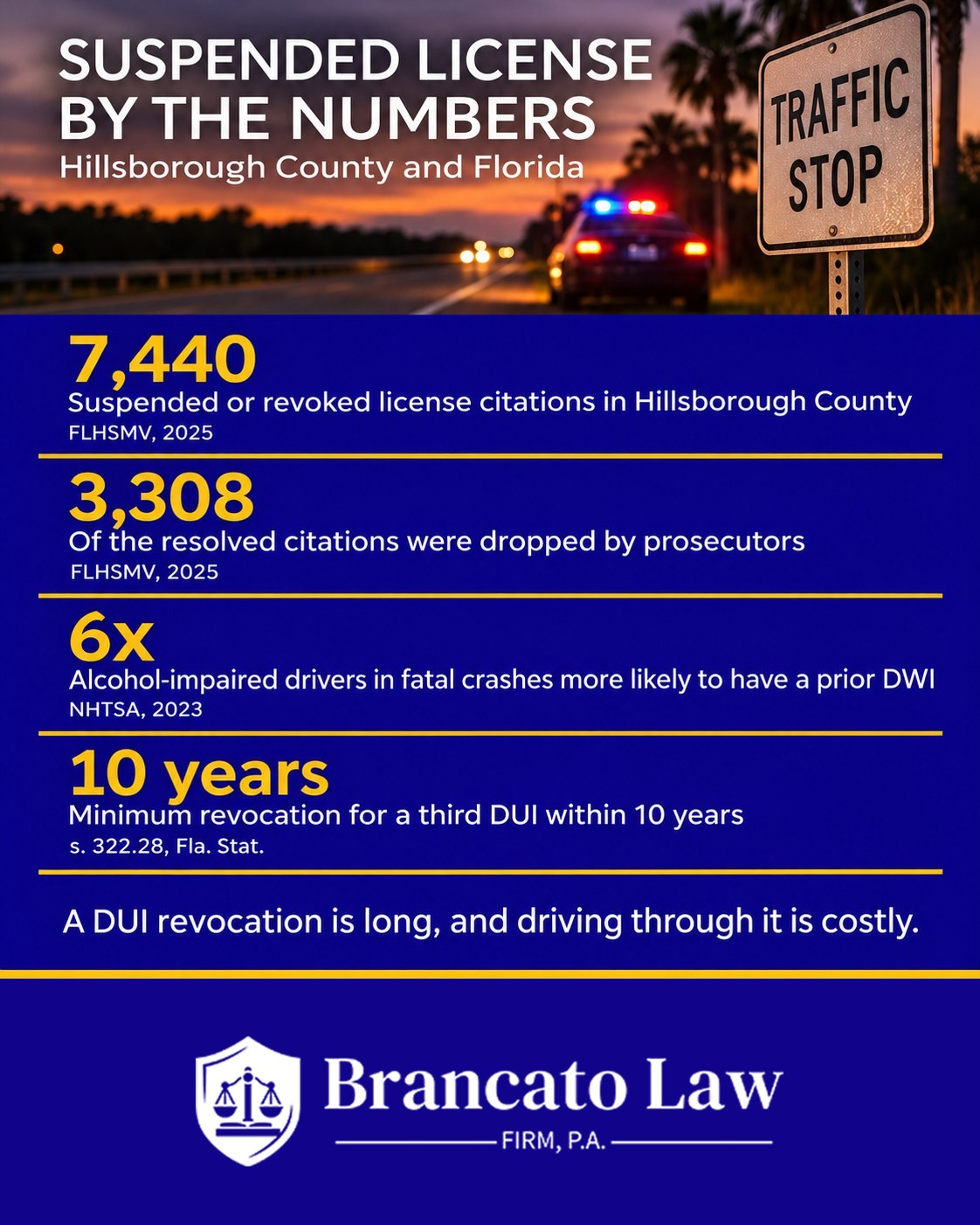
Repeat DUI drivers are overrepresented on the road. In 2023, alcohol-impaired drivers in fatal crashes were 6 times as likely as drivers with no alcohol to have a prior DWI conviction (6 percent compared with 1 percent), according to the National Highway Traffic Safety Administration’s Alcohol-Impaired Driving: 2023 Data (DOT HS 813 713). A 2009 NHTSA research report, Reasons for Driver License Suspension, Recidivism, and Crash Involvement Among Drivers With Suspended/Revoked Licenses (DOT HS 811 092), cited earlier research finding that 30 to 70 percent of Michigan drivers suspended for alcohol- or drug-related offenses kept driving (p. 1). With the stakes that high on both sides, our attorneys review the full driving record before advising on any plea.
Can you be charged with both DUI manslaughter and driving while revoked causing death?
Yes. Florida courts now allow separate convictions for DUI manslaughter or DUI with serious bodily injury and for driving while revoked causing the same death or injury. A Thanksgiving morning crash on I-95 in Palm Beach County shows how these charges stack: the Florida Highway Patrol said the wrong-way driver who killed a Palm Beach County Sheriff’s detective was intoxicated, had three prior DUI convictions, and had an active 10-year revocation, and listed charges including DUI manslaughter, vehicular homicide, and driving while license suspended or revoked causing death or serious bodily injury, as WFLX reported. Those are accusations, and the driver is presumed innocent.
For decades the answer would have been different. In State v. Cooper, 634 So. 2d 1074 (Fla. 1994), the Florida Supreme Court held that a driver convicted of DUI manslaughter could also be convicted of driving with a suspended license, but not of the suspended-license offense enhanced for causing the same death, because “there can be but one penalty imposed for causing the death of a single victim.” That “single homicide rule” ended in December 2020. In State v. Maisonet-Maldonado, 308 So. 3d 63 (Fla. 2020), an Orange County case where a fleeing driver killed two people, the Court held that the 1988 amendment to section 775.021 superseded the rule and that it “is no longer applicable under Florida law.” The same day, in State v. Marsh, 308 So. 3d 59 (Fla. 2020), a Polk County case where an impaired driver rear-ended a car and seriously injured two passengers, the Court held that dual convictions for DUI with serious bodily injury and driving while suspended with serious bodily injury do not violate double jeopardy, because one offense requires intoxication and the other requires a suspended license.
Since 2020, the license charge stands on its own instead of merging into the DUI charge. Each count can carry its own sentence on the scoresheet, and DUI manslaughter alone carries a 4-year mandatory minimum under section 316.193(3), Florida Statutes. Our Tampa homicide defense practice handles these cases, and our explainer on DUI manslaughter in Florida covers the elements.
Does the State have to prove you knew your license was revoked?
For most DWLSR charges, yes; for habitual traffic offender and permanent revocation charges, generally no. Section 322.34(2) requires proof that the driver knew of the revocation, and the statute says knowledge is satisfied if the driver was previously cited, admits knowing, or received notice. A court judgment or order in the department’s records creates a rebuttable presumption of knowledge. That presumption matters in DUI cases, because the criminal judgment that revokes the license is usually entered in open court with the driver present.
The habitual traffic offender felony works differently. In Robinson v. State, 329 So. 3d 103 (Fla. 2021), a Tarpon Springs officer stopped a Pinellas County driver who was later convicted of driving while revoked as a habitual traffic offender. The Florida Supreme Court held that proof the department mailed notice of the habitual offender revocation “is not an element” of the crime under section 322.34(5), approving the Second District’s en banc decision. For drivers in Tampa Bay, that means a defense built on “I never got the letter” will not defeat an HTO felony, although it may still matter to a charge under section 322.34(2).
How do our attorneys defend a driving-while-revoked charge after a DUI?
Our attorneys defend these cases by checking the driving record first and the stop second. The certified driving record decides the charge level, and errors in it are common enough that we never accept it at face value. This is the order we work in:
- Get the certified driving record and every judgment behind it. We confirm the revocation was actually in effect on the date of the stop and was not already eligible for reinstatement.
- Check the reason for each prior suspension. A felony under section 322.34(2)(c) requires that the current or most recent prior DWLSR be tied to a DUI-type suspension; if it was a financial suspension, the charge may be a misdemeanor.
- Count and date the prior convictions. Revocation periods depend on the 5-year and 10-year windows in section 322.28, and same-day convictions for separate offense dates are counted under section 322.28(2)(e).
- Challenge proof of knowledge under section 322.34(2) where the record supports it.
- Challenge the stop. Under Kansas v. Glover, 589 U.S. 376 (2020), an officer who runs a plate and learns the registered owner’s license is revoked may stop the car, but only if the officer has no information suggesting someone else is driving, such as a driver who plainly does not match the owner’s age or sex. A Tampa DUI defense attorney reviewing the video and the plate check may find the reason for the stop does not hold up.
- Pursue reinstatement or a hardship license while the case is pending, when the client is eligible, because a valid license changes how prosecutors view the case.
Say a driver with a 10-year DUI revocation, eligible for a hardship license after 24 months, is stopped on Dale Mabry Highway at month 30 without having applied. Hypothetically, if the record shows only one prior DWLSR and it came from a lapsed insurance suspension, the State may not be able to prove the felony version under section 322.34(2)(c), and an application for the hardship license filed right away gives the court a reason to treat the case as a licensing failure rather than defiance.
What should you do after an arrest for driving on a DUI revocation?
Stop driving, stay silent about the license, and get the record in front of a lawyer before first appearance if you can. A felony DWLSR arrest in Hillsborough County leads to a first appearance within 24 hours, where the judge sets bond and conditions with the prior record in mind. Our guide to the Florida criminal case process walks through that hearing and the stages that follow, and our Hillsborough County criminal defense attorney page explains how these cases move through the local courts. Any statement that you knew your license was revoked can satisfy the knowledge element on its own, so say nothing about it to the officer.
Frequently asked questions about driving after a DUI revocation in Florida
Is driving on a 10-year DUI revocation a felony in Florida?
Not automatically. It is a misdemeanor on a first or second DWLSR conviction, and a felony on a third or later conviction tied to a DUI suspension, or if the driver is also a habitual traffic offender. The Brancato Law Firm checks every prior on the record, because one miscounted conviction can turn a misdemeanor into a felony.
What is the penalty for driving on a permanently revoked license in Florida?
It is a third-degree felony punishable by up to 5 years in prison under section 322.341, even on a first arrest. Our attorneys at The Brancato Law Firm look first at whether a permanent revocation was properly imposed under section 322.28(2)(d), as explained on our criminal traffic defense page.
Can my car be taken if I get a DUI while my license is revoked for a prior DUI?
Yes. Section 322.34(9)(a) makes the vehicle subject to seizure and forfeiture in that situation. When a family member owns the car, The Brancato Law Firm raises the owner’s rights in the forfeiture case as soon as notice arrives.
Can I get a hardship license after a third DUI in Florida?
Yes, a driver with a 10-year revocation may petition 24 months after the revocation for a business-purposes license, but only after 12 months of no driving and no drug use, plus DUI program supervision. Driving during the revocation can wreck that eligibility, which is why the attorneys at The Brancato Law Firm raise hardship timing at the first meeting; our post on whether a third DUI is a felony in Florida covers the rest of the sentence.
Can a driving while license revoked charge be dropped in Florida?
Yes. In 2025, prosecutors in Hillsborough County dropped 3,308 of the 6,680 suspended or revoked license citations resolved that year, according to FLHSMV; those figures include every type of suspension, not only DUI revocations. At The Brancato Law Firm, a record error, a weak stop, or missing proof of knowledge is where we look first for a dismissal.
Sources
- Section 322.34, Florida Statutes, section 322.341, section 322.28, section 322.271, and section 322.264
- Robinson v. State, 329 So. 3d 103 (Fla. 2021)
- State v. Maisonet-Maldonado, 308 So. 3d 63 (Fla. 2020) and State v. Marsh, 308 So. 3d 59 (Fla. 2020)
- State v. Cooper, 634 So. 2d 1074 (Fla. 1994)
- Florida Department of Highway Safety and Motor Vehicles, Annual Uniform Traffic Citation Report, Hillsborough County, 2025
- NHTSA, Alcohol-Impaired Driving: 2023 Data (DOT HS 813 713), and DOT HS 811 092 (2009)
For more about our defense strategies, visit our Criminal Traffic Defense page.
Charged with driving on a DUI revocation?
Before first appearance, the most useful thing you can bring a lawyer is your driving record, because it decides whether this is a misdemeanor or a felony. The Brancato Law Firm, P.A., founded by Tampa Criminal Defense Attorney Rocky Brancato, will pull the certified record and every judgment behind it as soon as you call (813) 727-7159. You can call us at any hour. Our firm has Spanish-speaking staff, and attorney Jean-Luc Adrien speaks Spanish, Haitian Creole, and French.
The Brancato Law Firm, P.A.
620 E. Twiggs Street, Suite 205, Tampa, FL 33602
(813) 727-7159
Serving Hillsborough, Pinellas, and Pasco Counties
The Brancato Law Firm, P.A. is a Tampa-based criminal defense practice. We are not affiliated with any other Brancato-named law firms.
Visit Us

Tampa, FL 33602

Contact Us Now
Free Legal Consultation (813) 727-7159
