

From First DUI to Death Penalty



Can Customs Search Your Phone When You Enter Florida? (2026)


Bottom line: Yes. When you fly into Tampa International Airport from abroad or come off an international cruise at Port Tampa Bay, U.S. Customs and Border Protection (CBP) can search your phone without a warrant. In Florida’s federal courts, the Eleventh Circuit has held that even a forensic search, where agents copy and analyze the phone’s data, needs no warrant, no probable cause, and no suspicion at all. CBP’s own policy is stricter than the court rule: officers need reasonable suspicion or a national security concern and a senior manager’s approval before an “advanced” search, and they may not use the phone to pull data stored only in the cloud.
If customs agents took your phone at the airport or the cruise terminal and told you it would be “examined,” the rules that apply are very different from the ones that protect your phone on a Tampa street. I’m Rocky Brancato, founder of The Brancato Law Firm, P.A., a Tampa criminal defense firm, and a former police academy instructor who taught officers the search and seizure rules they are supposed to follow. Over more than 25 years in Hillsborough County courtrooms, I have learned that border cases turn on details travelers rarely think to write down: who searched the phone, how, and why. Our attorneys build the defense from those details.
This guide is part of our series on police surveillance in Florida. For phone searches away from the border, including searches after an arrest and passcode disputes, see our guide to whether police can search your cell phone in Florida.
Why Can Customs Search Your Phone Without a Warrant?
Customs can search your phone without a warrant because of the border search exception, one of the oldest exceptions to the Fourth Amendment’s warrant requirement. The Supreme Court has long held that searches at the border are reasonable simply because a person or item is entering the country. That rule applies at international airports and seaports, which courts treat as the “functional equivalent” of the border, so it covers Tampa International Airport’s international arrivals and the cruise terminals at Port Tampa Bay.
The leading Eleventh Circuit case came out of a Tampa cruise. In United States v. Vergara, 884 F.3d 1309 (11th Cir. 2018), a man returned to the Port of Tampa from Cozumel, Mexico, with three phones. CBP had flagged him for secondary inspection because of a prior conviction, an officer looked through one phone for about five minutes, and Homeland Security agents then had all three phones forensically examined. The court held that the forensic searches “required neither a warrant nor probable cause,” and that the Supreme Court’s decision requiring warrants for phone searches after an arrest did not change the border rule.
What Is the Difference Between a Routine and a Forensic Phone Search?
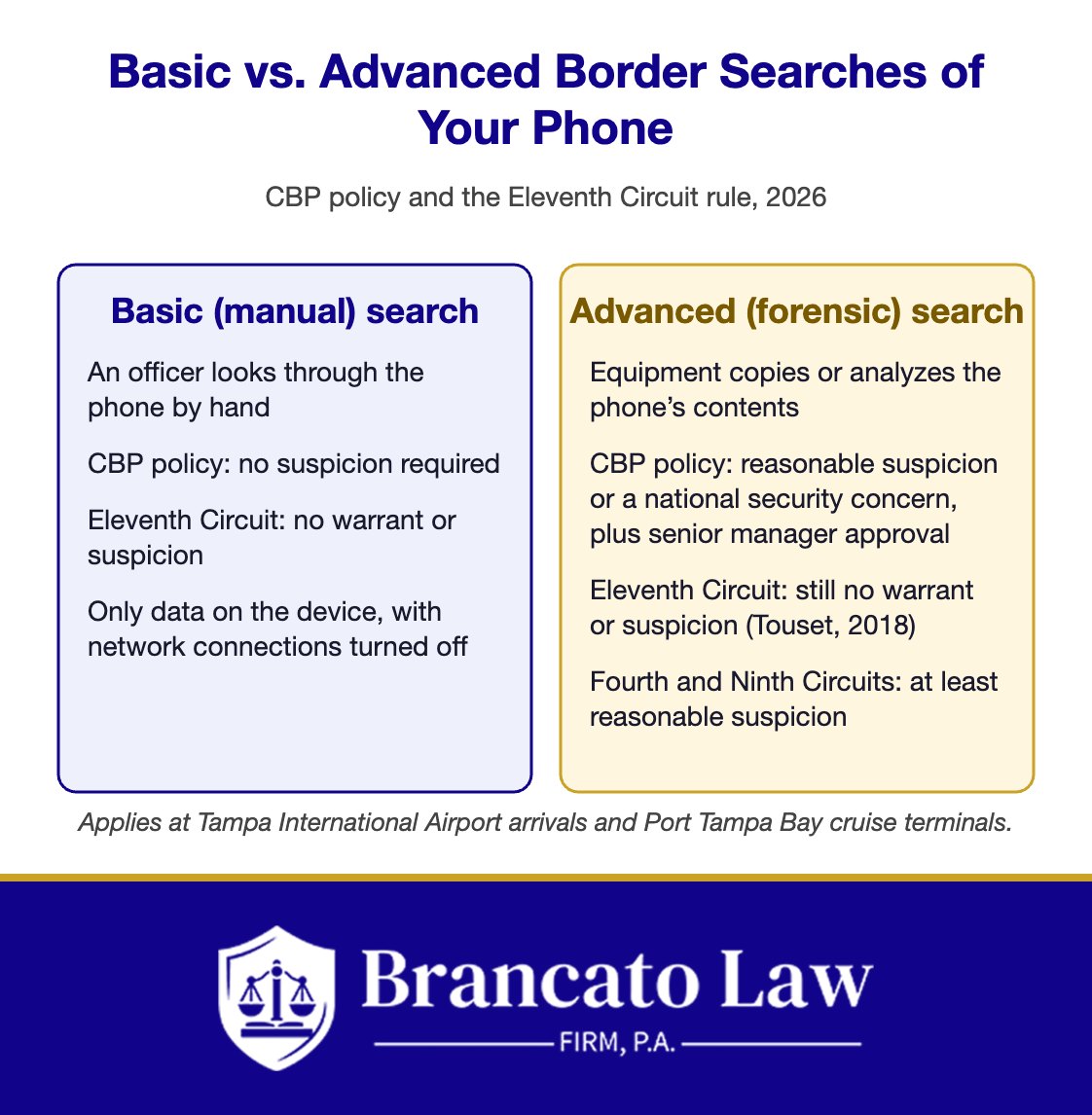
A routine, or “basic,” search is an officer scrolling through your phone by hand. A forensic, or “advanced,” search is one where the officer connects equipment to copy or analyze the phone’s contents. CBP’s policy, described on its page on the border search of electronic devices, draws the line at external equipment used to copy or analyze data; using equipment only to bypass a password or charge the device does not make a search advanced.
| Basic (manual) search | Advanced (forensic) search | |
|---|---|---|
| What happens | Officer reviews the phone by hand | Equipment copies or analyzes the phone’s contents |
| CBP policy standard | No suspicion required | Reasonable suspicion of a violation CBP enforces, or a national security concern, plus a senior manager’s approval |
| Eleventh Circuit constitutional rule | No warrant or suspicion | No warrant or suspicion (Touset, 2018) |
| Fourth and Ninth Circuit rule | No suspicion | At least reasonable suspicion |
| Cloud data | Only data on the device; officers disable network connections first | Same |
The policy and the constitutional rule are not the same thing. In United States v. Touset, 890 F.3d 1227 (11th Cir. 2018), agents at Atlanta’s airport detained a traveler’s laptops and hard drives and later found child sexual abuse material in forensic searches. The Eleventh Circuit held that “the Fourth Amendment does not require any suspicion for forensic searches of electronic devices at the border,” reasoning that a phone is property and that its precedents required reasonable suspicion only for highly intrusive searches of a person’s body, such as a strip search. It also held, in the alternative, that the agents had reasonable suspicion anyway. CBP’s policy is not the constitutional test in the Eleventh Circuit, but it shows what agents were supposed to do, and our attorneys use it to test their account of the search.
Do Other Courts Agree With the Eleventh Circuit?
No. Federal appeals courts are split on forensic phone searches at the border. The Fourth Circuit in United States v. Kolsuz, 890 F.3d 133 (4th Cir. 2018), a firearms export case, and the Ninth Circuit in United States v. Cano, 934 F.3d 1002 (9th Cir. 2019), a cocaine case from the San Ysidro port of entry, require at least reasonable suspicion for a forensic search, and Cano limits it to suspicion that the phone holds digital contraband. The Seventh Circuit described the split in United States v. Mendez, 103 F.4th 1303 (7th Cir. 2024), noting that the circuits agree a basic search needs no suspicion and differ only on forensic searches.
The Eleventh Circuit has moved the other way. In United States v. Pulido, 133 F.4th 1256 (11th Cir. 2025), an appeal from the Middle District of Florida, CBP seized a traveler’s iPhone and MacBook on his return from Mexico at a Homeland Security agent’s request, and an analyst copied all of their data. The court rejected the argument that border searches are limited to looking for contraband, writing that its earlier decisions use “categorical language.” An unpublished 2025 decision applied Pulido to a forensic extraction at Port Canaveral after a cruise in a human trafficking investigation.
A 2021 Congressional Research Service report on border searches, by Kelsey Y. Santamaria and Hillel R. Smith, notes that electronic devices often contain more personal and sensitive information than items like a wallet or briefcase, which is the point the dissent pressed in Vergara. Judge Jill Pryor would have required a warrant, writing that officers who want to forensically search a phone at the border should “get a warrant.” Until the Supreme Court takes up the split, the Eleventh Circuit rule controls federal cases in Tampa.
| Court | Case | Rule for a forensic search |
|---|---|---|
| Eleventh Circuit (Florida, Georgia, Alabama) | Touset (2018); Pulido (2025) | No warrant or suspicion; not limited to contraband |
| Fourth Circuit | Kolsuz (2018) | At least reasonable suspicion |
| Ninth Circuit | Cano (2019) | Reasonable suspicion that the phone holds digital contraband |
| Seventh Circuit | Mendez (2024) | Did not decide; basic searches need no suspicion |
How Often Does CBP Search Phones?
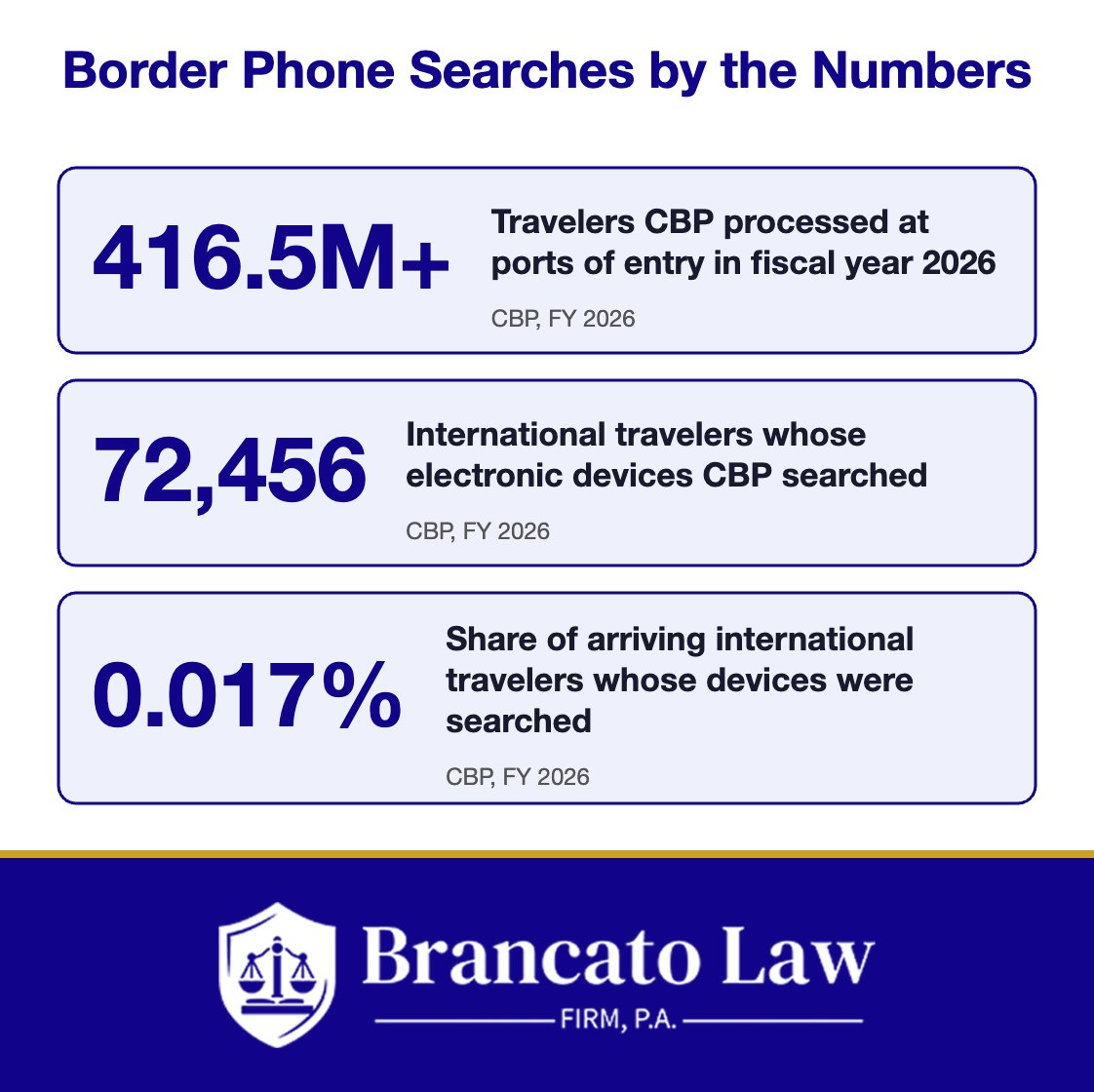
Rarely, measured against the number of travelers. In fiscal year 2026, CBP processed more than 416.5 million travelers at ports of entry and searched the electronic devices of 72,456 international travelers, which CBP says is 0.017% of arriving international travelers, according to CBP’s border search page.
Those searches are not random in the cases that reach our office. In Vergara, the traveler was on CBP’s daily “lookout” list because of a prior conviction. In Pulido, a Homeland Security agent asked CBP in advance to watch for the traveler and seize his devices. A border search is often the planned first step of an investigation that was already underway, which is why our attorneys ask whether agents used the border to avoid getting a warrant they could have sought.
What Happens If You Refuse to Unlock Your Phone?
A U.S. citizen cannot be denied entry for refusing, but CBP can keep the phone. CBP’s policy says travelers must present devices “in a condition that allows for the examination,” and a locked device “may be subject to exclusion, detention, or other appropriate action.” For a citizen, CBP states that the traveler “will not be denied entry into the United States” based on the inability to inspect the device. Foreign nationals face a different calculation, because CBP may consider the refusal in deciding whether to admit them.
Detention can last a while. In the unpublished Port Canaveral case, the Eleventh Circuit held that holding a phone for 47 days before a second, warrant-backed forensic search was not unreasonable on those facts. Whether to unlock a phone is a decision with consequences either way. If you can, call a lawyer before you decide, and if you are already in a criminal case, do not discuss the phone’s contents with agents.
Hypothetically, say a Brandon resident returns from a Western Caribbean cruise to Port Tampa Bay. CBP pulls him into secondary inspection, an officer scrolls through his photos, and then the phone is taken to be “imaged.” In Florida’s federal courts, the scroll and the imaging are both lawful without a warrant under Vergara and Touset. The defense questions become narrower and more practical: whether the search reached cloud data CBP says it does not touch, whether the detention lasted too long, whether agents went beyond the border search into a separate investigation without a warrant, and whether anything the traveler said in secondary inspection was obtained in violation of Miranda.
Can a Border Phone Search Be Challenged in Florida?
Yes, though the arguments are narrower than in other parts of the country. Under Touset and Pulido, a Florida federal judge will not suppress a forensic border search for lack of a warrant or suspicion. Our attorneys look for the issues that remain:
- Whether the search was really a border search, made at the border or its functional equivalent by agents acting under border authority.
- Whether officers accessed cloud or remote data, which CBP says it does not search and which raises separate warrant questions.
- How long the phone was held, and whether the delay before any later warrant was reasonable.
- Whether a later search went beyond the border search and needed its own warrant.
- Whether statements, passcodes, or consent were obtained in custody without Miranda warnings.
- Whether the case can be preserved for review if the Supreme Court resolves the circuit split.
When a border search leads to a Florida state charge, such as drug possession after a cruise, the case moves through the state system described in our guide to how a Florida criminal case moves from arrest to trial. Our post on what to do if you are arrested on a cruise ship in Tampa covers first appearance and the drug charges that most often follow a cruise terminal search. Our Tampa drug crimes attorney page explains how we challenge searches in those cases, and border searches that turn up images of minors are handled through our Tampa internet crimes attorney practice.
What Should You Do If Customs Takes Your Phone?
Stay calm, do not lie to officers, and write down everything as soon as you can: the date, the agents’ names or badge numbers, whether they looked at the phone by hand or took it away, and any receipt or tear sheet they gave you. CBP’s policy calls for officers to notify travelers before a device search, often with a printed tear sheet explaining the search and how to seek redress. Keep it.
If agents from Homeland Security Investigations want to interview you about what is on the phone, you can decline to answer and ask for a lawyer. A border search does not mean charges are coming, but if it does lead to an investigation, our representation before charges are filed lets our attorneys deal with agents before an arrest.
Frequently Asked Questions About Phone Searches at the Border in Florida
Do I have to unlock my phone for customs at Tampa International Airport?
You are expected to present it in a condition that allows inspection, but a U.S. citizen will not be denied entry for refusing, according to CBP’s policy. The phone can be detained, so The Brancato Law Firm advises travelers who expect legal trouble to talk to a lawyer before deciding.
Can customs search my iCloud or Google account at the border?
No, not under CBP’s own policy, which limits border searches to information on the device and requires officers to disable network connections first. If agents reached cloud data, our attorneys at The Brancato Law Firm treat that as a separate search that needed its own legal authority.
Does the border search rule apply when a cruise returns to Port Tampa Bay?
Yes. Vergara applied the border search exception to a passenger returning to the Port of Tampa from Cozumel. The Brancato Law Firm handles cases from the Tampa cruise terminals and checks whether each search actually happened under border authority.
How long can CBP keep my phone after a border search?
There is no fixed limit, and courts judge reasonableness case by case; the Eleventh Circuit found a 47-day detention reasonable on the facts of one unpublished Port Canaveral case. When a client’s phone has been held for weeks, The Brancato Law Firm presses for its return or a decision.
Can evidence from a border phone search be thrown out in Florida?
Sometimes, though not for lack of a warrant alone under Eleventh Circuit law. Our attorneys at The Brancato Law Firm look at cloud access, detention length, later searches, and statements, and raise those issues through our drug crimes defense and internet crimes practices.
Is a border phone search different from a police phone search after an arrest?
Yes. Away from the border, police generally need a warrant to search a phone after an arrest, while at the border the Eleventh Circuit requires none. The Brancato Law Firm’s guide to phone searches in Florida explains the non-border rules.
Sources
- United States v. Vergara, 884 F.3d 1309 (11th Cir. 2018)
- United States v. Touset, 890 F.3d 1227 (11th Cir. 2018)
- United States v. Pulido, 133 F.4th 1256 (11th Cir. 2025)
- United States v. Kolsuz, 890 F.3d 133 (4th Cir. 2018)
- United States v. Cano, 934 F.3d 1002 (9th Cir. 2019)
- United States v. Mendez, 103 F.4th 1303 (7th Cir. 2024)
- U.S. Customs and Border Protection, Border Search of Electronic Devices at Ports of Entry
- Congressional Research Service, Searches and Seizures at the Border and the Fourth Amendment (2021)
Talk to a Tampa Defense Attorney About a Border Phone Search
What you say in secondary inspection, and what you do about a detained phone in the following days, can shape the whole case. Our attorneys can contact agents, track the device, and look for the issues Eleventh Circuit law still leaves open. Call The Brancato Law Firm, P.A., founded by Tampa Criminal Defense Attorney Rocky Brancato, at (813) 727-7159, any hour; our office is two blocks from the courthouse. Our firm has Spanish-speaking staff, and attorney Jean-Luc Adrien speaks Spanish, Haitian Creole, and French, which helps travelers who were questioned at the border in a language other than English.
For more about our defense strategies, visit our Drug Crimes page.
The Brancato Law Firm, P.A.
620 E. Twiggs Street, Suite 205, Tampa, FL 33602
(813) 727-7159
Serving Hillsborough, Pinellas, and Pasco Counties
The Brancato Law Firm, P.A. is a Tampa-based criminal defense practice. We are not affiliated with any other Brancato-named law firms.
Visit Us

Tampa, FL 33602

Contact Us Now
Free Legal Consultation (813) 727-7159
