- Free Consultation 24/7: (813) 727-7159 Tap Here To Call Us


From First DUI to Death Penalty



Arrested on a Cruise Ship in Tampa? What to Do Next (2026)


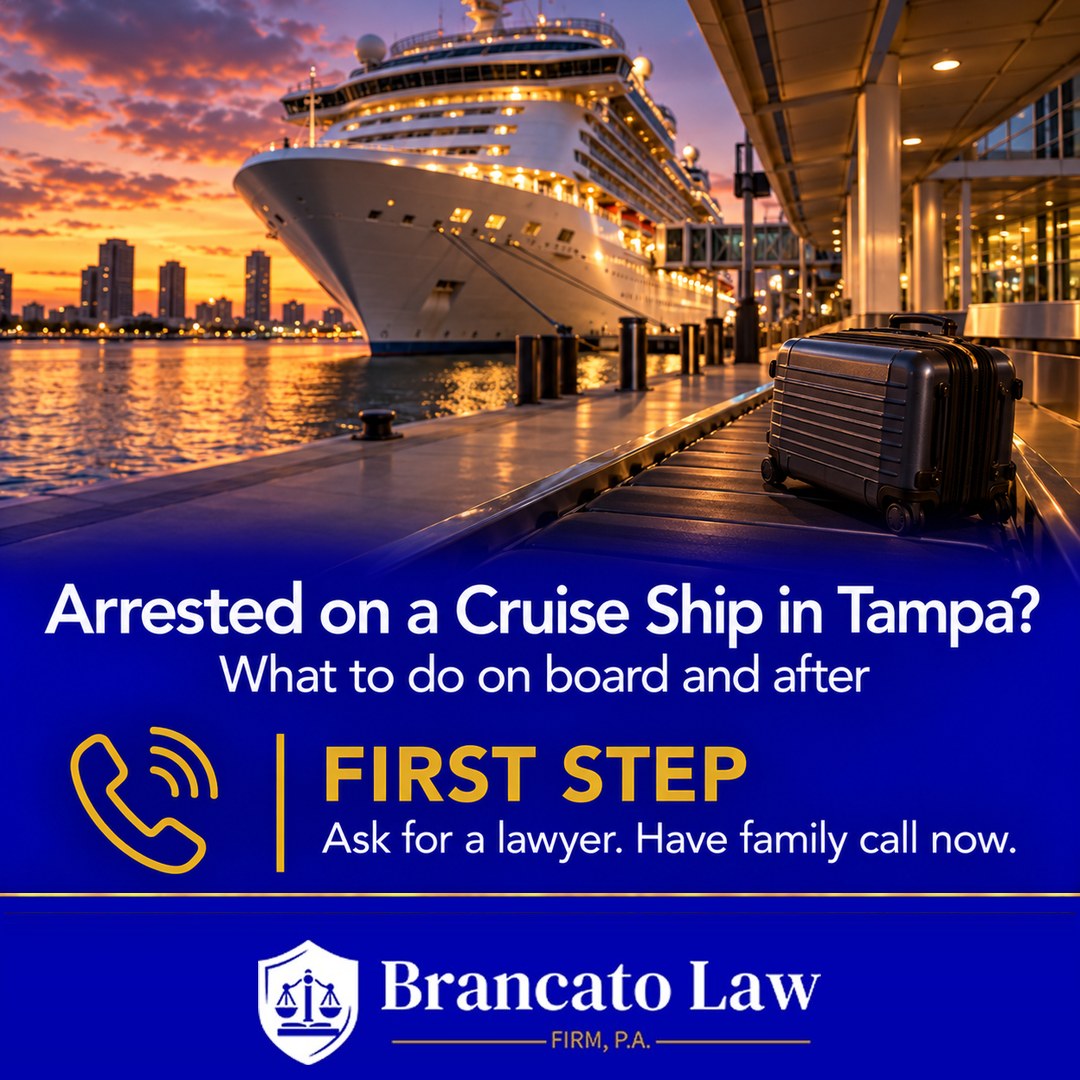
If you are arrested on a cruise ship in Tampa, stay calm, give your name, decline to answer questions, and ask for a lawyer. Have a family member call a criminal defense attorney while you are still on the ship or at the terminal. Marijuana, THC products, and some hemp products found at a Port Tampa Bay terminal are usually charged in Hillsborough County state court, while drugs found by U.S. Customs when the ship returns from a foreign port, or crimes committed at sea, can go to federal court.
If your husband, wife, or child was just walked off a cruise ship at Port Tampa Bay, the next 24 hours shape the whole case. I’m Rocky Brancato, founder of The Brancato Law Firm, P.A., a Tampa criminal defense firm, and a former Chief Operations Officer of the Hillsborough County Public Defender’s Office, where I oversaw a staff of over 100 attorneys. I have spent more than 25 years in Hillsborough County courtrooms. Our attorneys take these calls while the ship is still at the dock, and we can be mobilized and ready for your loved one’s first appearance.
Why do people get arrested at the Tampa cruise terminals?
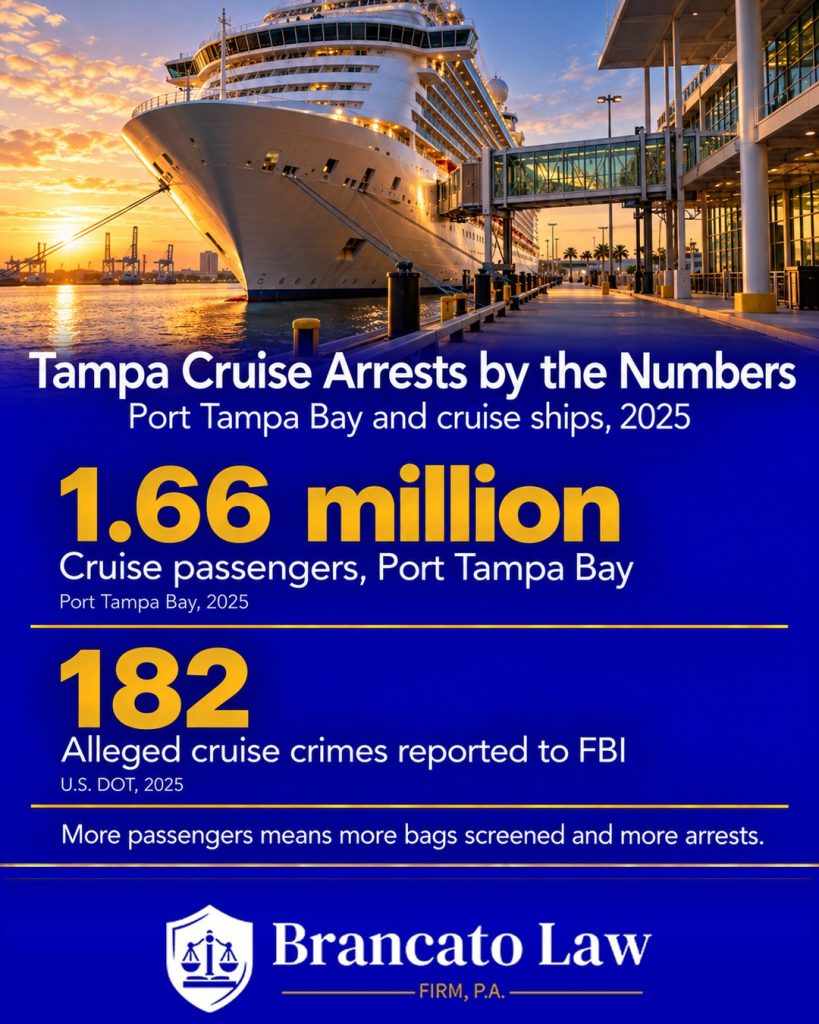
People get arrested at the Tampa cruise terminals because every bag is screened before boarding, and law enforcement officers work the terminals on cruise days. In 2025, Port Tampa Bay welcomed 1.66 million cruise passengers, the highest total in its history, according to Port Tampa Bay. The port says it is tracking toward 1.8 million passengers in 2026. More passengers means more luggage screened and more arrests.
In the cruise terminal cases our firm has handled, the arrest is made by an off-duty Hillsborough County Sheriff’s Office deputy working a paid detail at the terminal. Private security screens the luggage, flags a bag, and calls the deputy. The cruise terminals sit inside Tampa city limits, so a Tampa Police officer can make the same arrest. Either way, the case goes to the Hillsborough County State Attorney’s Office and the Hillsborough County criminal courts in the 13th Judicial Circuit.
Passengers are often already in their cabin when the bag is flagged. Ship security finds them on board, walks them off the ship, and turns them over to the deputy at the terminal.
Can you bring marijuana, CBD, or hemp on a cruise from Tampa?
No. Cruise lines ban marijuana on board, and the published policies of Carnival and Norwegian also ban CBD and THC products, including products sold as medical marijuana. A product that is legal at a Florida smoke shop can still get you removed from the ship and arrested at the terminal.
A Florida medical marijuana card does not change this. Florida’s medical marijuana law, section 381.986, Florida Statutes, excludes use or administration of marijuana “on any form of public transportation” from protected medical use, except for low-THC cannabis not in a form for smoking. Federal law does not recognize state medical marijuana programs at all. Our post on how to legally transport medical marijuana in Florida covers the rules on land.
Is hemp legal on a cruise ship?
Hemp is legal under Florida law, but that does not protect you on a cruise. Florida defines hemp in section 581.217, Florida Statutes as cannabis with a total delta-9 THC concentration that does not exceed 0.3 percent on a dry-weight basis. Florida’s drug statute, section 893.02, Florida Statutes, excludes that hemp from the definition of cannabis. The problem is proof. A deputy at the terminal cannot tell a lawful hemp gummy from a marijuana gummy by looking at it, so the passenger gets arrested and the lab sorts it out later.
Federal hemp law is also changing. Congress rewrote the federal definition of hemp in Public Law 119-37, enacted November 12, 2025, according to the Congressional Research Service. Under the new definition, final hemp-derived cannabinoid products with more than 0.4 milligrams of total THC per container are no longer hemp under federal law. Congress delayed that change to December 11, 2026, in H.R. 6500, signed September 2, 2026. Unless Congress acts again, intoxicating hemp gummies, drinks, and vapes over that limit will be treated as marijuana, a Schedule I controlled substance, under federal law. That matters when a ship returns to Tampa from a foreign port and passes through U.S. Customs.
Will a cruise ship arrest be in state court or federal court?
Where the case lands depends on where the drugs were found and who found them. Drugs found at the terminal before the ship sails are almost always a Hillsborough County state case. Drugs found by U.S. Customs and Border Protection when the ship returns from Mexico, Honduras, or the Bahamas can become a federal case, a federal civil penalty, or a state case referred to local deputies. Crimes committed against another person at sea are usually investigated by the FBI.
| Where it happens | Who usually handles it | Where the case goes |
|---|---|---|
| Luggage screening or boarding at the Tampa terminal | Off-duty HCSO deputy or Tampa Police | Hillsborough County state court |
| On board while docked in Tampa | Ship security, then HCSO or Tampa Police | Hillsborough County state court |
| Return to Tampa from a foreign port | U.S. Customs and Border Protection | Federal court, a federal civil penalty, or referral to state authorities |
| Assault, theft, or other crime at sea | FBI, after the cruise line reports it | Usually federal court in Tampa |
Federal jurisdiction over crimes at sea is broad. Under 18 U.S.C. § 7(8), the special maritime jurisdiction of the United States reaches any foreign vessel “during a voyage having a scheduled departure from or arrival in the United States” for offenses committed by or against a U.S. national, to the extent international law allows. Florida has its own special maritime jurisdiction statute, section 910.006, Florida Statutes, which covers acts against people and property aboard ships on voyages where over half of the passengers embarked and plan to disembark in Florida.
Cruise lines must report serious crimes to the FBI under the Cruise Vessel Security and Safety Act. In 2025, cruise lines reported 182 alleged crimes to the FBI across the four quarterly reports published by the U.S. Department of Transportation. Those reports cover assaults, sexual assaults, thefts over $10,000, and missing persons. They do not count drug offenses.
When a cruise ship case is charged federally in Tampa, the first court date is an initial appearance before a federal magistrate judge, and the charges come from federal statutes, not Florida’s. Our firm’s practice is Florida state court in Hillsborough, Pinellas, and Pasco Counties, where arrests made at the terminal before the ship sails are prosecuted.
What are the penalties for marijuana or THC found on a cruise ship?
In Florida, possession of 20 grams or less of cannabis flower is a first-degree misdemeanor, and possession of more than 20 grams is a third-degree felony under section 893.13, Florida Statutes. The 20-gram misdemeanor exception does not apply to resin or any “derivative, mixture, or preparation of such resin.” That means THC gummies, vape cartridges, and wax are charged as felonies in Florida regardless of weight, unless they qualify as lawful hemp.
Under federal law, simple possession under 21 U.S.C. § 844 carries up to one year in prison and a minimum $1,000 fine for a first offense. Bringing or possessing a Schedule I drug such as marijuana on board a vessel arriving in or departing from the United States is a separate federal crime under 21 U.S.C. § 955. For less than 50 kilograms of marijuana, 21 U.S.C. § 960 sends sentencing to 21 U.S.C. § 841(b)(1)(D), which allows up to five years. For small personal-use amounts, federal authorities can instead impose a civil penalty of up to $10,000 under 21 U.S.C. § 844a, which is not available to anyone with a prior drug conviction.
| Charge | Level | Maximum penalty |
|---|---|---|
| 20 grams or less of cannabis flower, § 893.13(6)(b), Fla. Stat. | First-degree misdemeanor | 1 year in jail, $1,000 fine |
| More than 20 grams of cannabis, or THC edibles, vapes, or wax, § 893.13(6)(a), Fla. Stat. | Third-degree felony | 5 years in prison, $5,000 fine |
| Federal simple possession, 21 U.S.C. § 844 (first offense) | Federal misdemeanor | 1 year in prison, minimum $1,000 fine |
| Drugs on board a vessel arriving in or leaving the U.S., 21 U.S.C. §§ 955, 960 (under 50 kg marijuana) | Federal felony | 5 years in prison |
| Federal civil penalty, 21 U.S.C. § 844a (personal-use amount) | Civil, not criminal | $10,000 per violation |
Our attorneys handle these cases through our Tampa drug crimes attorney practice, and the first question we ask is what exactly the officers found and how they tested it.
Can cruise security or customs search your cabin without a warrant?
Yes, in most situations. Two different rules apply depending on who does the searching and when.
Cruise line security is private. The Fourth Amendment limits government searches, and a search by the cruise line’s own security acting on its own generally falls outside it. Cruise ticket contracts typically give the cruise line the right to search cabins and luggage. Federal law adds a second layer. A House committee report on the Cruise Vessel Security and Safety Act noted that “American citizens who travel on cruise ships are subject to the laws of the vessel’s flag state,” which “may not afford them the same rights and protections” as U.S. law, per House Report 111-332.
Customs officers can search at the border without a warrant. In United States v. Hill, 939 F.2d 934 (11th Cir. 1991), customs agents watching a cruise ship at Port Everglades stopped a crew member’s ride inside the port and found cocaine after a dog alert. The Eleventh Circuit held that the port was the functional equivalent of the border, so no suspicion was required, and reversed the order suppressing the cocaine. In United States v. Alfaro-Moncada, 607 F.3d 720 (11th Cir. 2010), the same court upheld a suspicionless search of a crew member’s cabin on a foreign cargo ship docked in Miami.
A passenger’s cabin may deserve more protection. In United States v. Whitted, 541 F.3d 480 (3d Cir. 2008), customs officers searched a passenger’s stateroom when the Adventure of the Seas docked in St. Thomas. The Third Circuit held that searching a passenger’s private cabin at the border is a “nonroutine border search” that requires reasonable suspicion, though it found that suspicion existed and upheld the search. Florida is in the Eleventh Circuit, not the Third, and Alfaro-Moncada involved a crew cabin on a cargo ship. That difference gives the defense room to argue when customs searches a paying passenger’s stateroom.
Your phone is also open to inspection at the border. In United States v. Touset, 890 F.3d 1227 (11th Cir. 2018), the Eleventh Circuit held that “no suspicion is necessary to search electronic devices at the border,” including forensic searches. Texts about buying or packing marijuana can become evidence.
A lawful search does not end the case. The State still has to prove the substance is illegal and that you knowingly possessed it. Statements are a separate issue too: if deputies questioned you without proper Miranda warnings, our attorneys can file a motion to suppress those statements even when the search itself holds up.
What should you do if you are detained on the cruise ship?
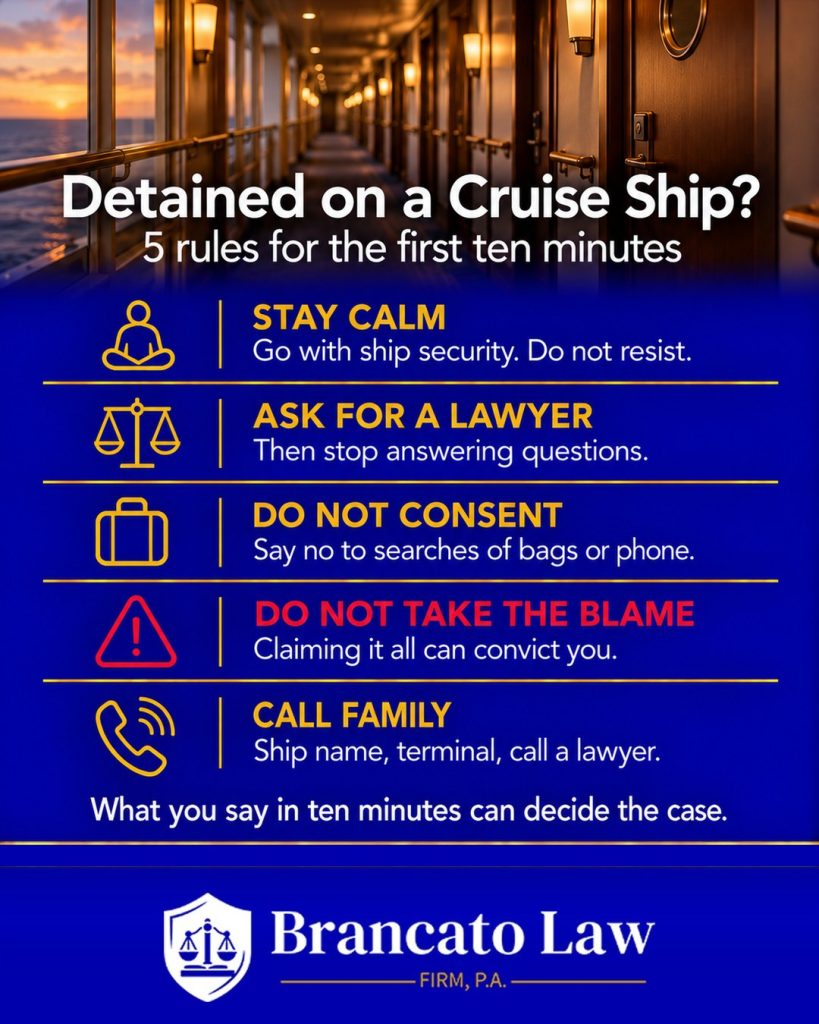
Stay calm, identify yourself, and stop talking about the bag. Many cruise terminal drug cases are built on what the passenger says in the first ten minutes. In a 2026 cruise terminal case our firm handled, where prosecutors ultimately filed no charges, the arrest affidavit relied on the husband’s and wife’s statements, made after Miranda warnings, that they both owned and possessed everything in the bag.
- Cooperate physically. Go with ship security when asked. Do not argue, resist, or try to stay on board.
- Give your name and identification. You must identify yourself. You do not have to explain what is in the bag.
- Ask for a lawyer and stop answering questions. Say, “I want to speak with a lawyer, and I am not answering questions.” Then stop. This applies to ship security, deputies, and customs officers.
- Do not consent to more searches. If asked for permission to search your cabin, other bags, your car, or your phone, say no. Officers may search anyway, but your refusal preserves the issue for your lawyer.
- Do not take the blame for someone else. Couples and friends often try to protect each other by claiming everything. That statement can convict you, and it rarely helps the other person.
- Do not get rid of anything. Flushing a vape or tossing a bag overboard can create a new charge.
- Do not sign a written statement. Politely decline to write or sign anything about the drugs until you have spoken with a lawyer.
- Get a message to family. Before your phone is taken, text one person the ship name, the terminal number, and the words “arrested, call a lawyer.”
What should your family do while you are still on the ship?
Your family should call a criminal defense attorney right away, while you are still on the ship or at the terminal. The early hours matter because our attorneys can start preparing for first appearance, track where you are being booked, and make sure you do not talk to anyone about the case on a recorded jail phone.
Have your family gather this information before they call:
- Your full legal name and date of birth
- The cruise line, ship name, and terminal number (Port Tampa Bay runs several terminals off Channelside Drive)
- The sail date and your home state
- The arresting agency, if known (HCSO or Tampa Police)
- What was found, if you were able to say
- Any medical marijuana card, hemp product receipts, or certificates of analysis
Once you are booked, your family can find you through the Hillsborough County jail inmate search and follow our step-by-step Hillsborough County bond walkthrough. Many cruise passengers are visiting from other states or countries. Our firm has Spanish-speaking staff, and attorney Jean-Luc Adrien speaks Spanish, Haitian Creole, and French, so family members can explain the situation in their own language.
What happens at first appearance after a cruise terminal arrest?
Every arrested person must be taken before a judge within 24 hours of arrest under Florida Rule of Criminal Procedure 3.130. In Hillsborough County, cruise terminal arrests are booked into the Orient Road Jail, and the first appearance judge decides bond and release conditions. If you have hired a lawyer, the rule requires the judge to give a reasonable time to send for counsel, which is one reason to call us before the hearing.
For cruise passengers, first appearance decides practical questions fast. Can an out-of-state passenger go home? What bond is fair for someone with no Florida ties? Will the judge order drug testing or other conditions that are hard to meet from another state? Our attorneys come to first appearance ready to answer those questions with facts: home address, employment, family, and the travel plans that were interrupted. Our guide on what to do after being arrested in Tampa explains the rest of the early process.
If a passenger was released at the terminal without an arrest and the deputy said the report would be sent to the State Attorney, you may not have a court date yet. That is the time for representation before charges are filed, when our attorneys can present lab questions and mitigation to the prosecutor before a charging decision is made.
How do our attorneys fight cruise ship drug charges?
Our attorneys attack cruise ship drug cases at five points: the testing, the possession, the statements, the search, and the classification of the charge.
- The testing. Field tests used at the terminals detect cannabinoids. They do not measure delta-9 THC concentration, which is what separates legal hemp from illegal cannabis under Florida law. In our 2026 cruise terminal case, the deputy’s field test reported THC gummies, joints, and flower as “synthetic cannabinoids.” We demand a laboratory analysis that actually quantifies THC before any plea is discussed.
- The possession. Shared luggage and shared cabins create real questions about who owned what. The State must prove each person knew about the drugs and had control over them.
- The statements. We review when Miranda warnings were given, who asked the questions, and whether ship security questioned the passenger first.
- The search. We identify who searched, when, and under what authority: private screeners, ship security, a deputy, or customs. Each has different rules.
- The classification. A felony charge for THC edibles or vapes depends on the product not qualifying as hemp. Flower under 20 grams is a misdemeanor. Getting the weight and the product type right can change the entire case.
For first-time offenders, pretrial diversion may also be available, which can lead to a dismissal after the program is completed. For more about our defense strategies, visit our Drug Crimes page.
Case result
| Case | Charge | Result |
|---|---|---|
| Husband and wife, out-of-state cruise passengers, arrested at a Port Tampa Bay cruise terminal (2026) | Felony possession of a controlled substance, § 893.13(6)(a), Fla. Stat., for each spouse (THC gummies, joints, cannabis flower, and a THC vape) | No charges filed against either spouse |
Past results do not guarantee future outcomes.
How fast do you need to act after a cruise ship arrest?
Act within hours, not days. The table below shows the timeline our attorneys work against in a typical terminal arrest in Hillsborough County.
| When | What happens | What to do |
|---|---|---|
| At the terminal | Ship security brings the passenger off; a deputy questions and arrests | Ask for a lawyer; stop talking |
| First few hours | Booking at the Orient Road Jail | Family calls a defense attorney |
| Within 24 hours | First appearance before a judge on bond and release | Have counsel present with home-state ties documented |
| Following weeks | State Attorney decides what to file | Lab testing and defense investigation begin |
Frequently asked questions
Can you bring CBD gummies on a cruise leaving Tampa?
No, because major cruise lines, including Carnival and Norwegian, list CBD and THC products as prohibited items even when they are legal in Florida. The Brancato Law Firm defends passengers whose hemp or CBD products were flagged at the terminal, starting with whether the product actually exceeds Florida’s 0.3 percent delta-9 THC limit under section 581.217, Florida Statutes.
Does a Florida medical marijuana card protect you on a cruise ship?
No, because Florida’s medical marijuana law does not protect use on public transportation, cruise lines ban medical marijuana, and federal law does not recognize state medical cards. Our attorneys at The Brancato Law Firm still use a valid card, and the dispensary records behind it, as mitigation when a card holder is charged at the terminal.
What happens if customs finds marijuana when a cruise returns to Tampa?
U.S. Customs and Border Protection can seize the marijuana and refer the case for federal prosecution, impose a federal civil penalty of up to $10,000, or turn the passenger over to local law enforcement. The Brancato Law Firm handles the cases that are referred to Hillsborough County state court and can explain the options when customs is involved.
Can cruise ship security search my cabin without a warrant?
Yes, in most cases, because cruise line security is private, ticket contracts typically allow searches, and customs officers can search at the border without a warrant. When a deputy or customs officer goes beyond those limits, The Brancato Law Firm challenges the search in a motion to suppress.
Can marijuana charges from a Tampa cruise terminal be dropped?
Yes, prosecutors can drop or dismiss cruise terminal drug charges when the lab cannot prove the substance is illegal, when possession of shared luggage cannot be proven, or when key statements are suppressed. The Brancato Law Firm represented a husband and wife arrested on felony possession charges at a Port Tampa Bay terminal in 2026, and the State Attorney’s Office filed no charges against either one. Our Tampa drug crimes defense lawyer page explains how we build these cases.
Do I have to come back to Florida for court after a cruise terminal arrest?
It depends on the charge and the judge, since some court dates can be handled through your attorney while others require you to appear in person or by video. The Brancato Law Firm asks the court at first appearance to let out-of-state clients go home and to handle as much of the case through counsel as the court allows.
Arrested at a Tampa cruise terminal? Call before first appearance
The best time to call is while your loved one is still at the terminal or being booked, before first appearance. The Brancato Law Firm, P.A., founded by Tampa Criminal Defense Attorney Rocky Brancato, defends cruise passengers charged in Hillsborough County, and we can be mobilized and ready for first appearance. Call (813) 727-7159. You can call us at any hour, and our office is two blocks from the courthouse. Our firm has Spanish-speaking staff, and attorney Jean-Luc Adrien speaks Spanish, Haitian Creole, and French.
The Brancato Law Firm, P.A.
620 E. Twiggs Street, Suite 205, Tampa, FL 33602
(813) 727-7159
Serving Hillsborough, Pinellas, and Pasco Counties
The Brancato Law Firm, P.A. is a Tampa-based criminal defense practice. We are not affiliated with any other Brancato-named law firms.
Visit Us

Tampa, FL 33602

Contact Us Now
Free Legal Consultation (813) 727-7159
