

From First DUI to Death Penalty



Can Co-Defendants Get Separate Trials in Florida? (2026)



Bottom line
Sometimes. Florida usually tries co-defendants together when they are charged with the same crimes, a conspiracy, or a common scheme, but a judge must order separate trials when a joint trial would prevent a fair determination of a defendant’s guilt or innocence. The clearest example is a co-defendant’s confession that names you when that co-defendant will not testify, which the U.S. Supreme Court barred in Bruton v. United States. Blaming each other is not enough by itself, and the motion generally has to be filed before trial.
A co-defendant’s statement to police can do more damage at a joint trial than an eyewitness, because the person who made it may never take the stand to be cross-examined. I’m Rocky Brancato, founder of The Brancato Law Firm, P.A., a Tampa criminal defense firm and a former Major Crimes Unit attorney, and I have tried more than 150 jury trials to verdict. In cases with more than one defendant, our attorneys start by finding out what every co-defendant has said, to whom, and whether the State plans to use it.
When can Florida try co-defendants together?
Florida can charge and try two or more defendants together when the case against them is tied to the same conduct. Under Florida Rule of Criminal Procedure 3.150(b), defendants may be joined when each is charged with accountability for each offense, when they are charged with conspiracy, or when the offenses are alleged to be part of a common scheme or plan, even if not every defendant is named in every count.
Joint trials are common because they save witnesses from testifying twice and let one jury hear the whole event. That efficiency is also the danger. Evidence that is admissible against one defendant may be inadmissible against another, and jurors are asked to keep it separate in their heads.
When must a Florida judge order separate trials for co-defendants?
A Florida judge must sever defendants when a joint trial would stand in the way of a fair verdict for any one of them. Rule 3.152(b) requires separate trials:
- Before trial, when severance is necessary to protect a defendant’s right to a speedy trial, or is appropriate to promote a fair determination of the guilt or innocence of one or more defendants.
- During trial, only with the defendant’s consent, when severance is necessary for that fair determination.
- When a co-defendant’s statement refers to the defendant but is not admissible against him, unless the State tries the case without the statement or with it properly edited (Rule 3.152(b)(2)).
- At the close of the State’s case or all the evidence, when the evidence does not prove the allegation that justified joining the defendants, unless severance is unnecessary for a fair determination (Rule 3.152(b)(3)).
| Situation | Is severance required? | Authority |
|---|---|---|
| Non-testifying co-defendant’s confession names you | Yes, unless the statement is left out or edited so it does not point to you | Bruton; Rule 3.152(b)(2) |
| Co-defendants blame each other | Not by itself; decided case by case | McCray |
| Co-defendant changes his account after the jury is sworn | Can require severance | Crum |
| Joint trial would delay your speedy trial | Yes, on motion before trial | Rule 3.152(b)(1)(A) |
| State’s evidence fails to prove the basis for joinder | Yes, unless unnecessary for a fair verdict | Rule 3.152(b)(3) |
What is a Bruton problem?
A Bruton problem arises when the State wants to use a co-defendant’s out-of-court confession that names you, and the co-defendant will not testify. In Bruton v. United States, 391 U.S. 123 (1968), the jury heard that co-defendant Evans had confessed and named Bruton as his accomplice. Evans did not testify, and the judge told the jury to consider the confession only against Evans. The U.S. Supreme Court reversed Bruton’s conviction, holding that “in the context of a joint trial we cannot accept limiting instructions as an adequate substitute for petitioner’s constitutional right of cross-examination.”
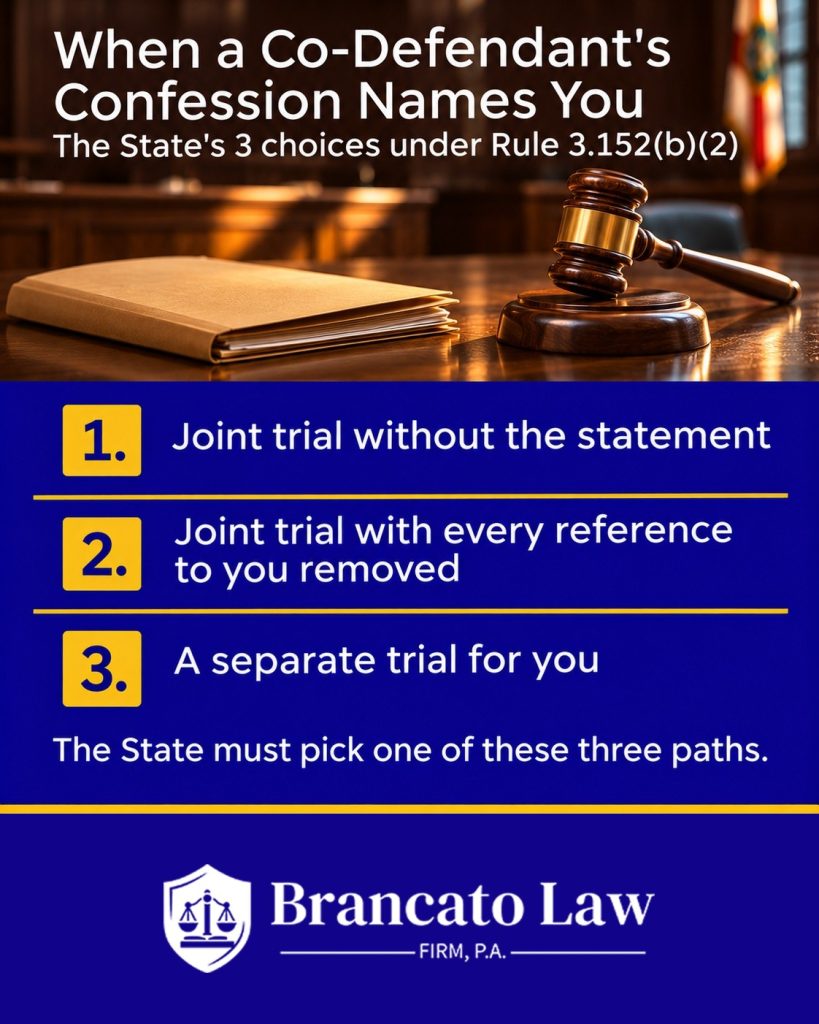
Florida wrote that protection into Rule 3.152(b)(2). When a defendant moves to sever because a co-defendant’s statement refers to him but is not admissible against him, the judge decides whether the State will offer it. If so, the State must choose a joint trial without the statement, a joint trial with every reference to the moving defendant removed (if the court finds no prejudice), or a separate trial.
Is editing the co-defendant’s confession enough to keep a joint trial?
Often, yes, if the edits leave no obvious gap pointing at you. The U.S. Supreme Court has drawn the line in three steps. In Richardson v. Marsh, 481 U.S. 200 (1987), it allowed a confession edited to remove any mention of the defendant. In Gray v. Maryland, 523 U.S. 185 (1998), it held that replacing the defendant’s name with “deleted” or a blank still violates Bruton. And in Samia v. United States, 599 U.S. 635 (2023), it approved a confession that referred to “the other person,” with a limiting instruction, even though other evidence suggested who that person was.
Florida courts apply the same approach. In Boatwright v. State, No. 4D2023-0975 (Fla. 4th DCA July 9, 2025), a Broward County murder and armed robbery case that went through an eight-week trial, a witness testified that a co-defendant said he saw the crime “with three other unnamed people.” The Fourth District held that the edited statement satisfied Rule 3.152(b)(2), did not directly accuse the defendant, and did not require severance, and it affirmed the conviction. When the State proposes an edited statement, our attorneys look at how it will sound alongside the rest of the evidence, because an edit that points to only one person in the courtroom is the kind Gray forbids.
Do co-defendants who blame each other get separate trials?
Not automatically. In McCray v. State, 416 So. 2d 804 (Fla. 1982), two co-defendants testified that McCray was the shooter in a murder, and McCray answered with his own testimony and two alibi witnesses. The Florida Supreme Court held that “hostility among defendants” or one defendant’s attempt to shift blame is not enough by itself to require severance, because the jury can sort out a swearing match when everyone testifies and is cross-examined. A better chance of acquittal in a separate trial is not enough either.
Timing and surprise can change the answer. In Crum v. State, 398 So. 2d 810 (Fla. 1981), one brother gave a statement consistent with the other’s account, then revealed after the jury was sworn that he would accuse his brother of the murder. The court held that the trial judge abused his discretion by refusing to sever. Our attorneys lock down co-defendants’ prior statements early for that reason, so a change of story becomes a ground for relief instead of an ambush.
Do joint trials make a conviction more likely?
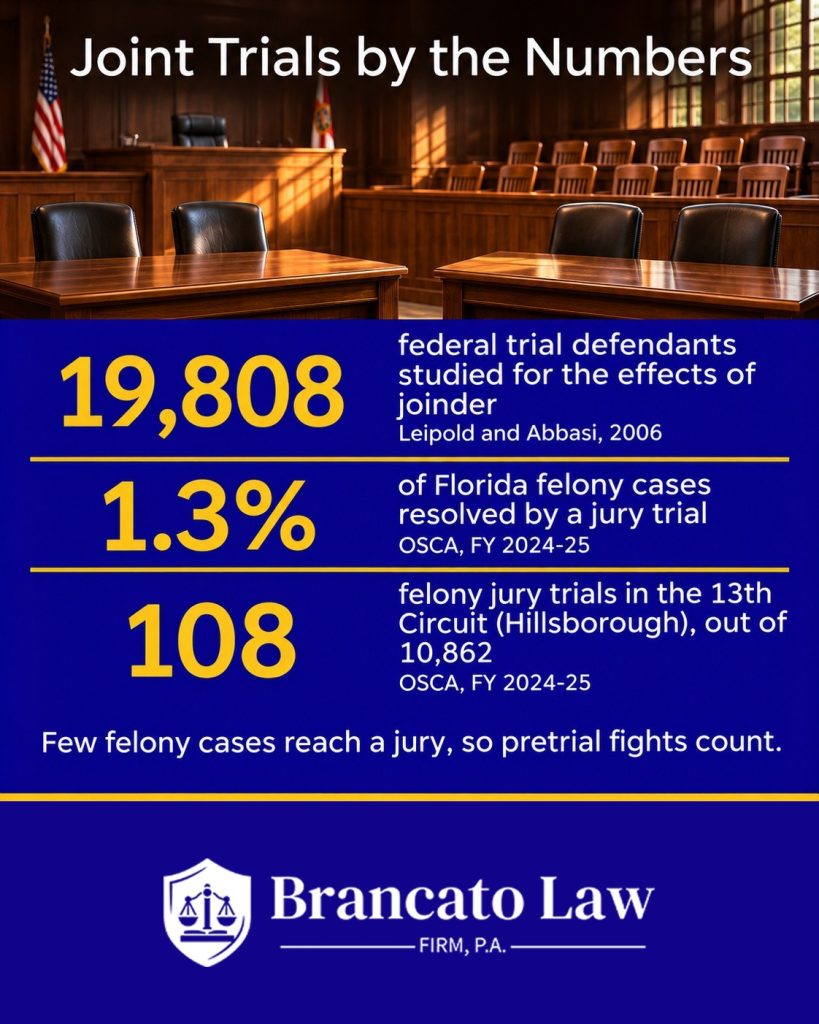
The best available data says joining co-defendants, unlike joining charges, does not raise conviction rates overall. In The Impact of Joinder and Severance on Federal Criminal Cases, 59 Vand. L. Rev. 349 (2006), Andrew Leipold and Hossein Abbasi studied Federal Judicial Center records for 19,808 federal trial defendants from fiscal years 1999 to 2003 and found that joining co-defendants in one trial had virtually no impact on the likelihood of conviction in the aggregate. Joining several charges against one defendant was different, and our post on severing criminal charges in Florida covers that side.
Aggregate numbers do not decide an individual case. The harm in a joint trial usually comes from one specific piece of evidence, like a confession, a jail call, or a text thread, that the jury should consider against only one defendant. Very few cases reach a jury at all: in fiscal year 2024-25, Florida circuit courts resolved 2,069 of 155,206 felony cases, about 1.3 percent, after a jury trial, and the Thirteenth Judicial Circuit in Hillsborough County resolved 108 of 10,862 that way, according to the Florida Office of the State Courts Administrator’s FY 2024-25 Statistical Reference Guide, Chapter 3.
What should you do if you have a co-defendant?
Stop talking about the case to anyone but your lawyer, starting now. Co-defendants often become witnesses for the State, and anything said to them, or in a recorded jail call, can end up in front of the jury. If you have not been charged but someone else has been arrested for the same incident, our representation before charges are filed can put a lawyer between you and the investigation early.
If a co-defendant or detective asks about the case
Say: “I’m not going to talk about the case. I want to speak with my lawyer.” Do not say: “He did it, not me,” “Let’s get our stories straight,” or anything about the case on a jail phone, in a text, or on social media. Do not sign a statement or agree to a recorded interview without your lawyer present.
Detectives sometimes tell one defendant that the other has already confessed. Our post on whether a detective can say you are guilty at trial explains how interrogation recordings are handled once a case reaches a jury.
When do you have to ask for separate trials?
Before trial. Rule 3.153(a) requires a motion to sever defendants to be filed before trial unless the defense had no earlier chance or did not know the grounds, and the right is waived if the motion is late. A denied motion can be renewed on the same grounds before or at the close of the evidence. On the Florida criminal case process timeline, severance motions belong in the pretrial motion stage, after discovery shows what each co-defendant has said.
Frequently asked questions about co-defendant trials in Florida
Can my co-defendant’s confession be used against me in Florida?
Not if the co-defendant will not testify and the confession names you. Under Bruton and Rule 3.152(b)(2), the State must drop it, edit it, or try you separately, and The Brancato Law Firm files the motion to force that choice before trial.
Will my co-defendant and I have the same jury?
Usually, if you are charged together and no one moves to sever. Some courts have used separate juries for each defendant in one courtroom, an approach discussed in a Florida Bar Journal article on multiple-jury trials, but the ordinary remedy in Florida is a separate trial, which our attorneys at The Brancato Law Firm request when a joint trial would expose a client to evidence that is not admissible against him.
Can my co-defendant testify against me?
Yes. A co-defendant who takes a plea deal or chooses to testify is a witness like any other, and you can cross-examine him about the deal and his prior statements. At The Brancato Law Firm, we gather those prior statements and plea terms in discovery so the jury hears why the co-defendant is testifying; our post on testifying at your own trial covers your side of that decision.
Is severance more likely in a murder case?
The rules are the same, but murder cases often involve recorded statements and co-defendants who cooperate, which is where Bruton issues arise. Our Tampa homicide defense attorney page explains how The Brancato Law Firm prepares multi-defendant homicide cases.
Sources
- Florida Rules of Criminal Procedure 3.150, 3.152, and 3.153 (The Florida Bar, July 2026 edition)
- Bruton v. United States, 391 U.S. 123 (1968)
- Richardson v. Marsh, 481 U.S. 200 (1987); Gray v. Maryland, 523 U.S. 185 (1998); Samia v. United States, 599 U.S. 635 (2023)
- McCray v. State, 416 So. 2d 804 (Fla. 1982); Crum v. State, 398 So. 2d 810 (Fla. 1981)
- Boatwright v. State, No. 4D2023-0975 (Fla. 4th DCA July 9, 2025)
- Leipold and Abbasi, The Impact of Joinder and Severance on Federal Criminal Cases, 59 Vand. L. Rev. 349 (2006)
- Florida OSCA, FY 2024-25 Statistical Reference Guide, Chapter 3: Circuit Criminal
If you were arrested along with someone else, what your co-defendant says in the next few weeks can shape your case. Call The Brancato Law Firm, P.A., founded by Tampa Criminal Defense Attorney Rocky Brancato, at (813) 727-7159, and our attorneys will find out what each co-defendant has told police and whether you should be tried alone. You can call us at any hour. Our firm has Spanish-speaking staff, and attorney Jean-Luc Adrien speaks Spanish, Haitian Creole, and French. For more about our defense of violent felony charges, visit our Tampa violent crime lawyer page.
The Brancato Law Firm, P.A.
620 E. Twiggs Street, Suite 205, Tampa, FL 33602
(813) 727-7159
Serving Hillsborough, Pinellas, and Pasco Counties
The Brancato Law Firm, P.A. is a Tampa-based criminal defense practice. We are not affiliated with any other Brancato-named law firms.
Visit Us

Tampa, FL 33602

Contact Us Now
Free Legal Consultation (813) 727-7159
