

From First DUI to Death Penalty



When Can You Sever Criminal Charges in Florida? (2026)



The rule in brief
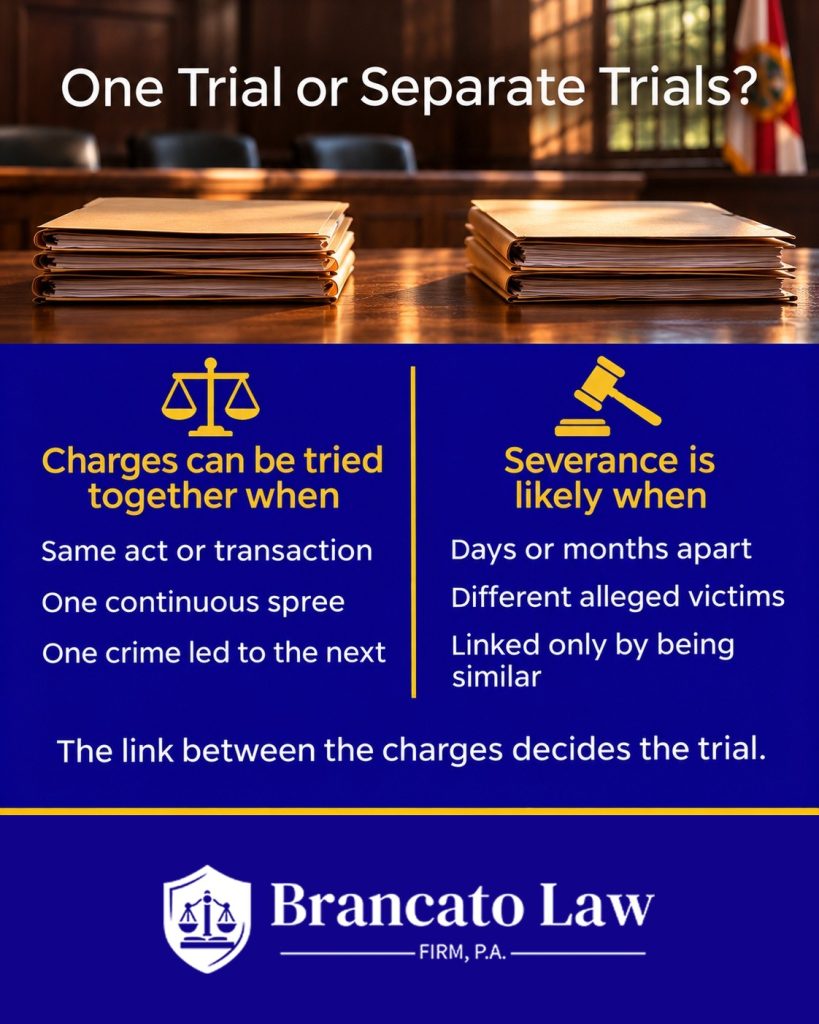
A Florida judge must sever charges that were never properly joined, and must also sever properly joined charges when separate trials are needed for a fair decision on each one. Charges can share one trial only when they come from the same act or transaction or from connected acts linked in an episodic sense. Similar crimes against different people at different times do not qualify, and the defense generally has to file the motion to sever before trial or lose it.
Trying five charges in front of one jury is a different case from trying one charge five times. As founder of The Brancato Law Firm, P.A., a Tampa criminal defense firm, and a former Chief Operations Officer of the Hillsborough County Public Defender’s Office, where I oversaw a staff of over 100 attorneys, I have seen how a single joinder ruling can shape a trial before the first witness testifies. When a client faces several counts, our attorneys look at how each count is connected to the others before deciding whether to move to sever.
What does it mean to join charges in Florida?
Joinder means the State charges several offenses in one information or indictment so that one jury hears them in one trial. Florida Rule of Criminal Procedure 3.150(a) allows that only when the offenses “are based on the same act or transaction or on 2 or more connected acts or transactions.” A severance is the opposite: an order splitting the counts into separate trials under Rule 3.152(a).
The same-act category is easy to spot. A robbery, the gun used in it, and the car taken to flee are usually one transaction. The harder fights involve the second category, “connected acts,” where the State links separate events that happened on different days.
When are separate criminal acts connected enough to try together?
Separate acts are connected only when they are linked in an episodic sense, and similarity alone is not enough. In Garcia v. State, 568 So. 2d 896 (Fla. 1990), Dade County prosecutors tried one man for four separate double murders spread over about three months. The Florida Supreme Court held that the episodes involved different victims, dates, and places with no temporal or geographical connection, reversed the convictions, vacated the death sentences, and ordered the episodes severed. The court added that practicality, expense, and judicial economy “do not outweigh the defendant’s right to a fair determination of guilt or innocence.”
Three years later, in Ellis v. State, 622 So. 2d 991 (Fla. 1993), the court reversed again where two murders three days apart and an attempted murder months later had been tried together. It said joined crimes “must be linked in some significant way,” such as a spree with no significant break or a causal link where one crime led to the next, and that general closeness in time and place is not enough by itself.
| Factor | Points toward one trial | Points toward severance |
|---|---|---|
| Time | Crimes in one continuous spree | Days or months between incidents |
| Place | Same location or a short path between scenes | Different neighborhoods or counties |
| Cause | One crime made the next one possible, or covered it up | Each crime stands alone |
| Victims | Same people involved throughout | Different alleged victims |
| Evidence | Same witnesses and same physical evidence | Separate witnesses and separate evidence for each count |
Why does trying charges together hurt the defense?
Joined charges raise the odds of conviction because jurors tend to treat several accusations as proof of each other. The best empirical work on the question is The Impact of Joinder and Severance on Federal Criminal Cases: An Empirical Study, 59 Vand. L. Rev. 349 (2006), by Andrew Leipold and Hossein Abbasi. Using Federal Judicial Center records for 19,808 federal trial defendants from fiscal years 1999 to 2003, the authors found that, after controlling for other factors, defendants tried on one count were convicted of the most serious charge 76 percent of the time, compared with 85 percent for defendants tried on multiple counts.
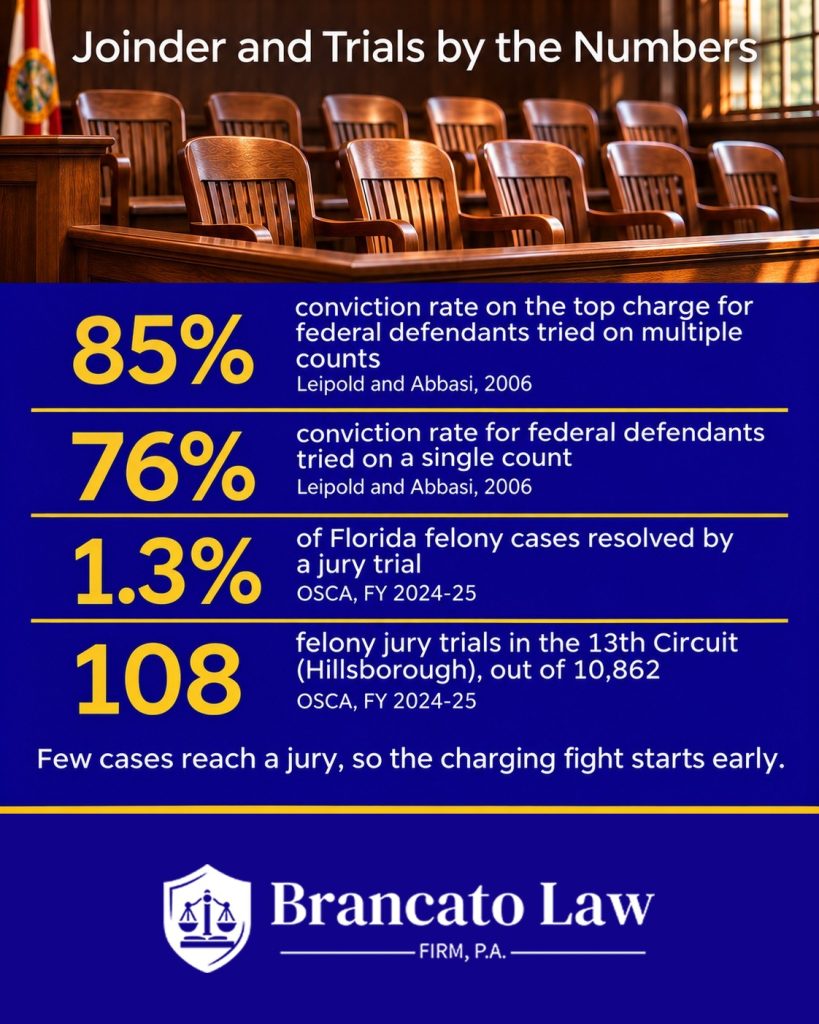
Few cases reach that point, which makes each trial count. In fiscal year 2024-25, only 2,069 of the 155,206 felony cases resolved in Florida circuit courts, about 1.3 percent, were decided after a jury trial, and the Thirteenth Judicial Circuit in Hillsborough County resolved 108 of its 10,862 felony cases that way, according to the Florida Office of the State Courts Administrator’s FY 2024-25 Statistical Reference Guide, Chapter 3. Our post on jury selection in a Florida criminal trial covers how those juries are chosen.
What happened in Bell v. State?
In Bell v. State, No. 3D23-0453 (Fla. 3d DCA Nov. 25, 2026), a Miami-Dade jury convicted the defendant of a long list of charges, including two counts of armed burglary, attempted armed robbery, carjacking, two counts of armed kidnapping, aggravated battery on a person 65 or older with a firearm, and armed robbery. The Third District affirmed in a short opinion that rejected each of his arguments by citing earlier cases.
On joinder, the court relied on two rules. Crimes that surface “during the course of an ongoing investigation, within a limited period of time and in a limited geographical area,” and that are “clearly connected in an episodic sense,” may be tried together. And when the evidence of each episode could have been admitted at a separate trial of the other as similar fact evidence, a judge’s refusal to sever is harmless error. The opinion also rejected a challenge to the six-person jury, noting that the U.S. Supreme Court is reconsidering the issue but that Florida courts remain bound until it rules.
When is the refusal to sever charges harmless error?
A wrongful refusal to sever is usually harmless when the jury would have heard about the other incident anyway. Under section 90.404(2)(a), Florida Statutes, evidence of other crimes is admissible “when relevant to prove a material fact in issue,” such as identity, plan, or motive, but inadmissible “when the evidence is relevant solely to prove bad character or propensity.” Florida lawyers call this Williams rule evidence.
That is why our attorneys fight on two fronts in a multi-count case: whether the counts were properly joined, and whether the evidence of one count could come in at a separate trial of the other. Winning the first argument does little if the State can bring every incident in through the second.
What about sex offense cases with more than one alleged victim?
Sex offense cases with different alleged victims, times, and places are the classic setting for severance. In Sandoval v. State, 414 So. 3d 392 (Fla. 5th DCA 2025), a Volusia County defendant was tried on 64 counts, including lewd molestation, four counts of using a child in a sexual performance, and dozens of possession counts. The Fifth District held that finding all the images in one search of his home did not link the charges episodically, and it reversed the denial of his claim that his lawyer was ineffective for not moving to sever, sending the case back for an evidentiary hearing.
Our case analysis of the Sandoval severance decision covers that ruling in more depth. For people facing sex offense charges in the Tampa Bay area, our Tampa sex crimes lawyer page explains how our attorneys approach multi-count cases from the start.
When do you have to file a motion to sever charges?
Before trial. Under Rule 3.153(a), a motion to sever offenses or defendants charged in one information must be made before trial unless the defense had no earlier opportunity or did not know the grounds, and the right is waived if the motion is not timely. If the judge denies a pretrial motion, Rule 3.153(b) lets the defense renew it on the same grounds before or at the close of all the evidence.
| Stage | What the rules allow | Practical point |
|---|---|---|
| Before trial | Motion to sever under Rule 3.152(a); severance if improperly joined, or if appropriate for a fair determination of guilt or innocence on each offense | File early, with the facts showing the counts are not episodically connected |
| Motion denied | Renew at or before the close of all evidence (Rule 3.153(b)) | Renewing preserves the issue for appeal |
| During trial | Severance only with the defendant’s consent and only if necessary for a fair determination (Rule 3.152(a)(2)(B)) | Mid-trial severance is rare |
| After conviction | Failure to move to sever can support an ineffective assistance claim (Sandoval) | Postconviction relief requires showing prejudice |
Severance fits between arraignment and trial on the case timeline in our Florida criminal case process guide. Separating co-defendants follows its own rules, covered in our post on whether co-defendants get separate trials in Florida. For violent felony cases, our Tampa violent crime lawyer page explains how our attorneys prepare.
Frequently asked questions about severing charges in Florida
Can the State charge me with crimes from different days in one case?
Only if the crimes are connected in an episodic sense, such as one continuous spree or one crime that caused the next. When the link is just that the crimes are similar, The Brancato Law Firm moves to sever them under the rule the Florida Supreme Court applied in Garcia.
Does a motion to sever charges get the case dismissed?
No. A severance splits the counts into separate trials; every charge stays pending. At The Brancato Law Firm, we use severance to keep the jury focused on the evidence for one accusation at a time, which can change how plea talks go on the rest.
Can I get separate trials if the State says the crimes show a pattern?
Sometimes. If the evidence of each crime would be admissible in a separate trial of the other under section 90.404(2)(a), an appeals court will likely treat a refusal to sever as harmless, as in Bell. That is why our attorneys at The Brancato Law Firm challenge the Williams rule evidence at the same time as the joinder itself.
What happens if my lawyer never moved to sever?
The right to sever is generally waived if the motion is not made before trial, but the failure can support a postconviction claim of ineffective assistance when the charges were not properly joined. The Brancato Law Firm reviews trial records for that issue, which is the claim the Fifth District sent back for a hearing in Sandoval.
Can a homicide charge be tried with other charges?
Yes, when the other charges are part of the same episode, such as a robbery during which the killing happened. When they are separate events, the defense can move to sever, as the defendant successfully did in Garcia; our Tampa homicide defense attorney page describes how The Brancato Law Firm handles those cases.
Sources
- Florida Rules of Criminal Procedure 3.150, 3.152, and 3.153 (The Florida Bar, July 2026 edition)
- Section 90.404, Florida Statutes (similar fact evidence)
- Bell v. State, No. 3D23-0453 (Fla. 3d DCA Nov. 25, 2026)
- Garcia v. State, 568 So. 2d 896 (Fla. 1990)
- Ellis v. State, 622 So. 2d 991 (Fla. 1993)
- Sandoval v. State, 414 So. 3d 392 (Fla. 5th DCA 2025)
- Leipold and Abbasi, The Impact of Joinder and Severance on Federal Criminal Cases, 59 Vand. L. Rev. 349 (2006)
- Florida OSCA, FY 2024-25 Statistical Reference Guide, Chapter 3: Circuit Criminal
A motion to sever has to be on file before trial, so the time to examine how your charges were joined is now. Our attorneys at The Brancato Law Firm, P.A., founded by Tampa Criminal Defense Attorney Rocky Brancato, will read the charging document, map the connection between every count, and decide whether separate trials would help your defense. Call (813) 727-7159; you can call us at any hour. Our firm has Spanish-speaking staff, and attorney Jean-Luc Adrien speaks Spanish, Haitian Creole, and French. For more on how a case moves from charge to verdict, visit our Florida criminal case process page.
The Brancato Law Firm, P.A.
620 E. Twiggs Street, Suite 205, Tampa, FL 33602
(813) 727-7159
Serving Hillsborough, Pinellas, and Pasco Counties
The Brancato Law Firm, P.A. is a Tampa-based criminal defense practice. We are not affiliated with any other Brancato-named law firms.
Visit Us

Tampa, FL 33602

Contact Us Now
Free Legal Consultation (813) 727-7159
