

From First DUI to Death Penalty



Can a Detective Say You’re Guilty at Trial in Florida? (2026)


The answer
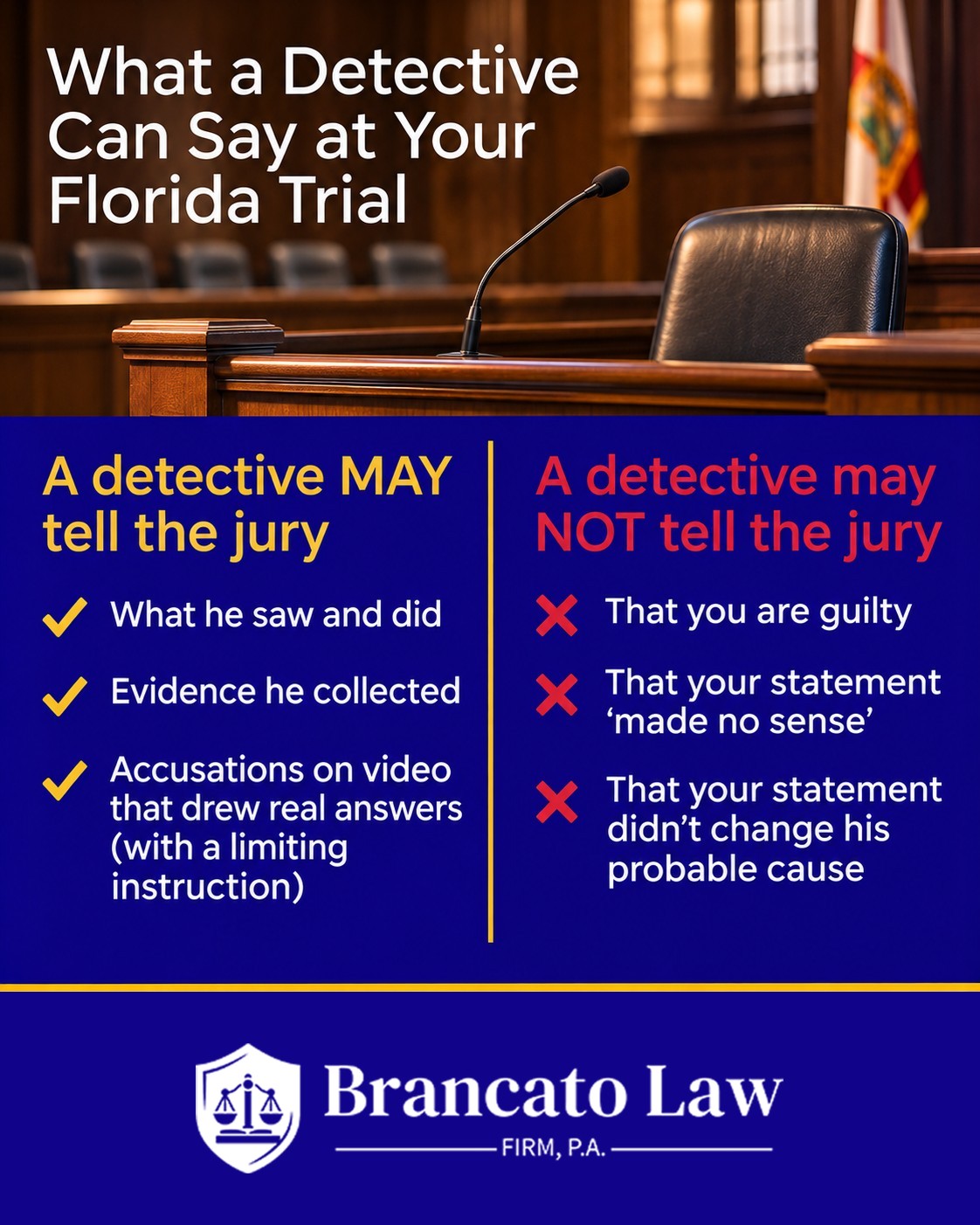
No. A Florida detective cannot tell a jury that he believes you are guilty, that your statement was a lie, or that your story “made no sense.” Florida courts treat that as improper opinion testimony because judging credibility is the jury’s job alone. On November 25, 2026, a Florida appeals court reversed a murder conviction in Burns v. State because a detective did exactly that while the State played the defendant’s recorded interview for the jury.
Jurors tend to believe detectives, and prosecutors know it. I’m Rocky Brancato, founder of The Brancato Law Firm, P.A., a Tampa criminal defense firm, and before I opened the firm I taught criminal procedure, criminal law, and courtroom testimony and demeanor at the police academy. I have spent more than 25 years in Hillsborough County courtrooms and tried more than 150 jury trials to verdict. When a recorded statement is part of the State’s case, our attorneys go through the recording line by line before trial to find the places where a detective’s opinion could reach the jury, and we move to keep it out.
Why can’t a detective give an opinion on guilt in Florida?
Because deciding guilt and judging who is telling the truth belong to the jury, and a witness who offers an opinion on either takes over that job. The Florida Supreme Court put it plainly in Martinez v. State, 761 So. 2d 1074 (Fla. 2000): “a witness’s opinion as to the guilt or innocence of the accused is not admissible.” In that case, the lead detective told the jury that after listening to a recorded conversation, “There was no doubt that he did it.” The Court reversed the convictions, vacated the sentences, and ordered a new trial.
The rule comes from Florida’s Evidence Code. Section 90.703, Florida Statutes, says an opinion is not objectionable just because it touches an ultimate issue, but the Court held in Martinez that guilt opinions are still excluded under section 90.403, which bars evidence whose probative value is substantially outweighed by unfair prejudice. A guilt opinion from the investigating officer carries a special danger: it suggests the officer knows something the jury never heard.
Police witnesses get extra scrutiny for a second reason. In Seibert v. State, 923 So. 2d 460 (Fla. 2006), the Florida Supreme Court said it is especially harmful for a police witness to give an opinion of a witness’s credibility “because of the great weight afforded an officer’s testimony.” Jurors see the badge as neutral. That is why the same comment that might be harmless from a neighbor can decide a case when it comes from the lead detective.
What happened in Burns v. State?
The Third District Court of Appeal reversed a first-degree felony murder conviction and life sentence because the trial judge let a detective tell the jury what he thought of the defendant’s recorded statement. The case is Burns v. State, No. 3D24-1767 (Fla. 3d DCA Nov. 25, 2026). In 2013, a confrontation outside a Miami-Dade shopping plaza ended in gunfire: one cousin was killed and the other wounded. The case went cold for four years until tips led police to Otis Burns. In a recorded interview, Burns admitted the shooting but said it was self-defense, that the cousins drew their guns first, and that he never tried to rob them. The surviving cousin said it was an attempted robbery. Security cameras did not capture the shooting itself.
At trial, Burns did not testify, so the State played his recorded statement through the detective. Prosecutors would play a clip, stop the recording, and ask the detective to comment. Over defense objections, the detective told the jury three things:
- Burns’s account of how the encounter started “Made no sense at all.”
- The physical evidence contradicted Burns’s claim that the cousins drew first.
- Nothing Burns said had any effect on the detective’s probable cause to arrest him.
The jury deliberated for more than seven hours and sent four notes, one of which said the decision was very difficult and that there were “uncertainties and inconsistencies.” It still convicted. On appeal, the Third District held that all three answers went to credibility and guilt, which only the jury may judge, and that the case was a credibility contest between the only two surviving witnesses. The court found the State could not prove the errors harmless beyond a reasonable doubt and ordered a new trial.
Can the State get the opinion in by calling it probable cause?
No, not when probable cause is not an issue at trial. The State argued in Burns that the detective’s answer only explained why he made the arrest. The Third District rejected that, explaining that probable cause can matter at first appearance or a bond hearing but is normally not a question for the jury at all. Telling jurors the defendant’s statement did not change the detective’s probable cause was, in substance, telling them the detective still thought he was guilty and did not believe his account.
The court summed up the point in one line: an officer’s opinion of guilt that is not admissible through the “front door” to prove guilt is not admissible through the “back door” of proving probable cause when probable cause is not at issue. The court also declined to follow a footnote in one of its own earlier opinions that had suggested a probable cause opinion would be acceptable, calling that footnote dicta. Questions like “Did you still arrest him?” and “Did his statement change your mind?” are the ones our attorneys at The Brancato Law Firm listen for at trial.
Can the jury hear the detective accusing you on the interrogation video?
Sometimes, but only to the extent the accusations drew a relevant response from you, and even then the judge must weigh the prejudice. Detectives are allowed to use accusation as an interrogation technique, and Florida courts let juries hear those statements when they give context to what the suspect said back. When the accusations are mostly the detective repeating that you did it and you keep denying it, the recording becomes a vehicle for the detective’s opinion.
The leading case is Jackson v. State, 107 So. 3d 328 (Fla. 2012), a Clay County murder case. The jury watched about 37 minutes of an interrogation in which detectives said things like “I know you did it” and “There’s no doubt in my mind you did it.” Jackson never confessed. The Florida Supreme Court held that most of the detectives’ statements did not provoke relevant responses, that their opinions invaded the province of the jury, and that the error was not harmless even though the State had DNA evidence. It reversed and ordered a new trial. The Fourth District followed Jackson in Roundtree v. State, 145 So. 3d 963 (Fla. 4th DCA 2014), a Palm Beach County robbery case where the officer kept telling the suspect “You did” and the suspect kept denying it; the court held the whole interrogation should have been excluded.
The line runs the other way in a Hillsborough County case. In Johnson v. State, 397 So. 3d 626 (Fla. 2024), the Florida Supreme Court upheld the admission of a shorter interrogation clip from a Hillsborough murder prosecution because the detectives confronted the defendant with specific evidence and his answers were relevant to key facts, including a timeline that shifted between interviews. The jury in Johnson was also told not to treat the detectives’ statements as true. Read together, the two cases mean that accusations which drew real answers can come in with a limiting instruction, while long stretches of accusation met only with denials should be cut.
| Testimony | Generally allowed? | Authority |
|---|---|---|
| What the detective saw, did, and collected | Yes | Ordinary fact testimony |
| “There was no doubt that he did it” | No | Martinez (Fla. 2000) |
| Your statement “made no sense” or was contradicted by the evidence | No | Burns (Fla. 3d DCA 2026) |
| Your statement did not change the detective’s probable cause | No, when probable cause is not an issue at trial | Burns (Fla. 3d DCA 2026) |
| Accusations on the interrogation video that drew relevant answers | Often yes, with a limiting instruction | Johnson (Fla. 2024) |
| Long stretches of “I know you did it” met only with denials | No | Jackson (Fla. 2012); Roundtree (Fla. 4th DCA 2014) |
| Your remarks about owning a gun years earlier or fighting as a youth | No, when the only point is propensity | Burns; section 90.404(2)(a) |
Can the State play the parts of your statement about old guns or past fights?
Not when their only purpose is to suggest you are a violent person. In Burns, the State also played the defendant saying he once owned a gun at 17 that his mother threw in a lake, and that he “just fought a lot” as a youth. The State said the gun remark impeached his claim about having a gun at the shooting; the court called that argument, “to put it mildly, not excellent.” Both remarks served only to show propensity, which section 90.404(2)(a), Florida Statutes, forbids. The court noted that collateral-act evidence offered to show bad character is presumed harmful.
Interviews wander. People talk about their childhood, old arrests, and things they owned years ago, and none of it becomes admissible just because the detective recorded it. A recorded statement is not all-or-nothing; the defense can ask the court to redact the portions that are irrelevant or unfairly prejudicial before the jury ever hears the recording.
Why do jurors give so much weight to recorded statements and police opinions?
Because research shows a defendant’s own words are the most persuasive evidence a jury hears, and a detective’s gloss on those words borrows that weight. In a 1997 study published in Law and Human Behavior, psychologists Saul Kassin and Katherine Neumann ran three mock-juror experiments comparing confessions with eyewitness identifications and character testimony. Confessions produced the highest conviction rates, and mock jurors rated them the most incriminating evidence. The authors called confessions “uniquely potent.”
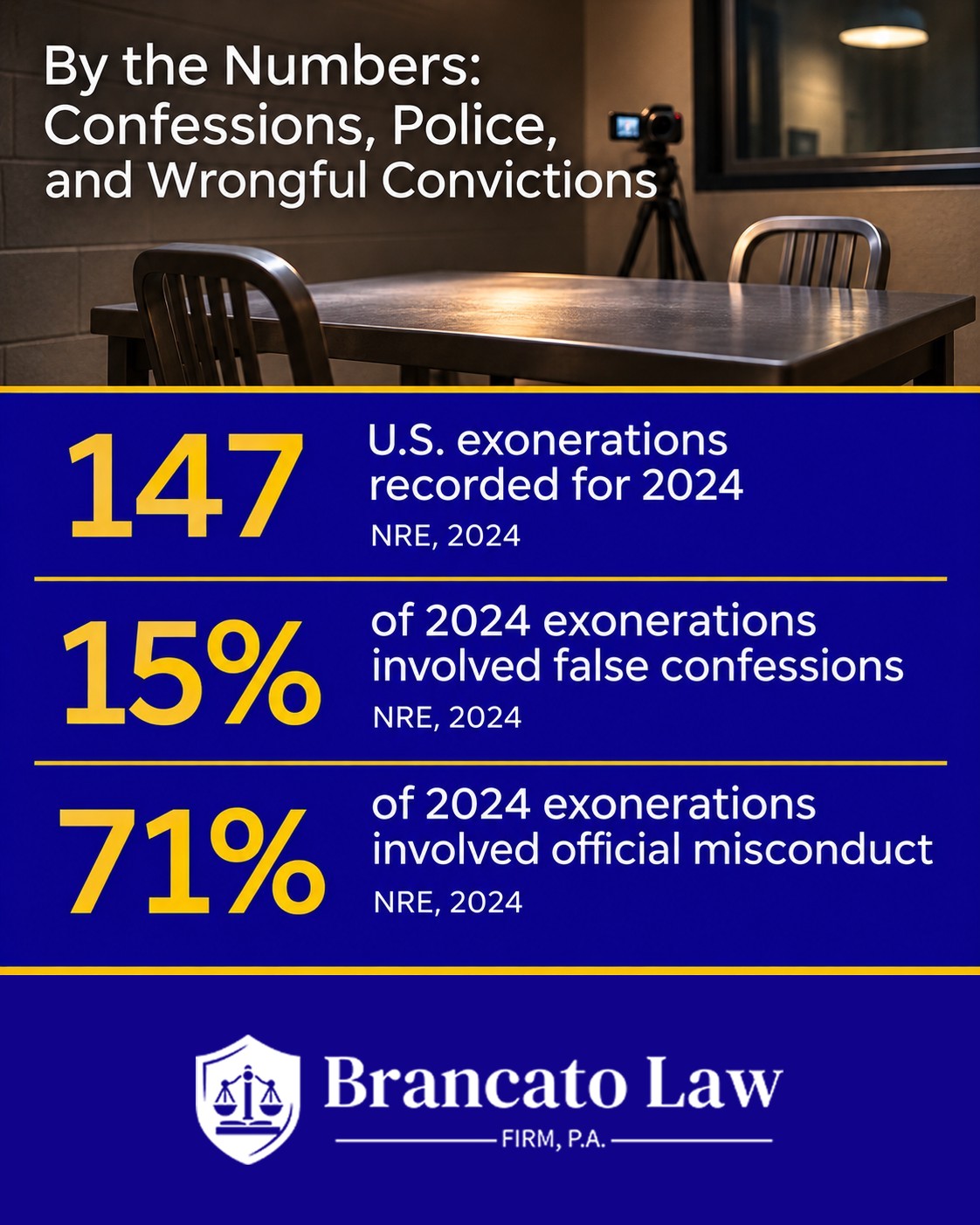
Wrongful conviction data shows what happens when that trust is misplaced. According to the National Registry of Exonerations 2024 Annual Report, the Registry recorded 147 exonerations that occurred in 2024. Twenty-two of them (15%) involved false confessions, and official misconduct was present in 104 (71%). Perjury by an official actor appeared in 39 of those exonerations. The Registry is an academic database, not a government dataset, and it counts only cases that were later overturned, so it shows patterns rather than rates.
When is a detective’s opinion considered harmless error?
Rarely, when the case turns on credibility. Under State v. DiGuilio, 491 So. 2d 1129 (Fla. 1986), the State must prove beyond a reasonable doubt that the error did not contribute to the verdict. In Burns, the Third District said that when a trial comes down to the victim’s version against the defendant’s, an officer’s opinion on guilt or credibility is normally harmful error. The jury notes about “uncertainties and inconsistencies” made the point for the court. In Martinez, the lack of physical evidence and the prosecutor’s repetition of the detective’s opinion in closing did the same.
| Factor | Points toward reversal | Example |
|---|---|---|
| Nature of the case | One person’s word against another’s | Burns |
| Independent evidence | No video of the event, no physical evidence tying the defendant to it | Burns; Martinez |
| Who gave the opinion | The lead investigating officer | Martinez |
| How much the jury heard | Repeated opinions over a long recording | Jackson |
| Closing argument | The prosecutor repeated the officer’s view | Martinez |
| Signs of a close jury | Long deliberations and notes describing doubt | Burns |
How does a defense lawyer keep a detective’s opinion away from the jury?
By working on the recording before trial and objecting the moment the opinion is asked for. The steps our attorneys at The Brancato Law Firm follow in a case built around a recorded statement:
- Get the complete recording and a transcript early. The written report summarizes the interview; the recording shows exactly what was said, including the detective’s commentary.
- File a motion in limine to redact. We identify the detective’s opinions of guilt, accusations that drew no relevant answer, and remarks about unrelated guns, fights, or arrests, and ask the judge to cut them under sections 90.403 and 90.404.
- Object at the moment the question is asked. In Burns, the defense objected that the question “invades the province of the Jury,” and objected again as “Opinion” on the probable cause question. Those objections preserved the issue for appeal.
- Ask for a limiting instruction if any accusatory portion is played, telling jurors the detective’s statements are not evidence of truth.
- Watch closing argument. A prosecutor who repeats the officer’s belief in guilt compounds the error, as in Martinez.
Those objections also protect the appeal. An appellate court usually will not reverse for an error no one objected to, a rule we explain in our post on why your lawyer must object at trial in Florida. Recorded statements are most common in serious felony cases, and our Tampa homicide defense attorneys treat the interview recording as one of the first pieces of discovery to break down. Where this fits in the life of a case is mapped on our Florida criminal case process page, from investigation through trial.
From the courtroom. I taught courtroom testimony and demeanor at the police academy, so I know how officers are prepared to take the stand. Proper officer testimony covers what the officer saw, heard, and did. Whether the defendant is guilty or truthful is the jury’s call, and when the State asks an officer to make it for them, that is the moment to object.
Already talked to a detective? What should you do now?
Stop talking, and get a lawyer involved before any second interview. A recorded statement is often the centerpiece of the State’s case, and every additional conversation gives the detective more material to characterize. If you have not been charged yet, our representation before charges are filed can put a lawyer between you and the investigation while the State is still deciding what to do. If you believe your statement was pressured or unreliable, our posts on how a coerced confession was challenged in a Tampa case and on the corpus delicti defense cover the other tools for attacking a statement.
Frequently asked questions
Can a police officer testify that I was lying in my interview in Florida?
No. An officer may not tell the jury your statement was false or did not make sense, because credibility is for the jury, as the Third District held in Burns v. State (Fla. 3d DCA Nov. 25, 2026). The Brancato Law Firm raises this issue in a motion in limine before trial so the jury never hears it.
Can the prosecutor play my whole interrogation video to the jury?
Not automatically. The judge can exclude or redact portions that are irrelevant, unfairly prejudicial, or full of detective opinions that drew no relevant response, under Jackson v. State, 107 So. 3d 328 (Fla. 2012). At The Brancato Law Firm, our attorneys mark every segment we want cut before the trial date.
Does a detective’s opinion on guilt mean my conviction will be reversed?
Not always. The error has to be preserved by objection, and the State can still win on appeal if it proves the error was harmless beyond a reasonable doubt. That is why The Brancato Law Firm’s trial attorneys object on the record at the moment the opinion is asked for, the same way the objections in Burns were made.
Can a detective say the physical evidence contradicts my story?
Not as a general verdict on your credibility. In Burns, the court held it was error to let the detective tell jurors the physical evidence contradicted the defendant’s self-defense account, because that also went to credibility. A detective can describe the evidence itself, and our attorneys at The Brancato Law Firm make sure the jury draws its own conclusions from it, which is a core part of our homicide defense practice.
Should I talk to a detective who calls me about an investigation in Tampa?
Not before you speak with a lawyer. Anything you say can be recorded, played at trial, and characterized by the detective who took it. When a detective calls, The Brancato Law Firm can contact the detective for you through our pre-file advocacy and decide, case by case, what information, if any, to provide.
Sources
- Burns v. State, No. 3D24-1767 (Fla. 3d DCA Nov. 25, 2026)
- Martinez v. State, 761 So. 2d 1074 (Fla. 2000)
- Seibert v. State, 923 So. 2d 460 (Fla. 2006)
- Jackson v. State, 107 So. 3d 328 (Fla. 2012)
- Roundtree v. State, 145 So. 3d 963 (Fla. 4th DCA 2014)
- Johnson v. State, 397 So. 3d 626 (Fla. 2024)
- State v. DiGuilio, 491 So. 2d 1129 (Fla. 1986)
- Sections 90.403, 90.404, and 90.703, Florida Statutes
- Kassin & Neumann, “On the Power of Confession Evidence,” 21 Law and Human Behavior 469 (1997)
- National Registry of Exonerations, 2024 Annual Report (2025)
A detective’s recorded interview can shape a case from the first day, so the time to plan for it is well before trial. Call The Brancato Law Firm, P.A., founded by Tampa Criminal Defense Attorney Rocky Brancato, at (813) 727-7159; you can call us at any hour, and our office is two blocks from the courthouse. Our firm has Spanish-speaking staff, and attorney Jean-Luc Adrien speaks Spanish, Haitian Creole, and French. For more about our defense strategies, visit our Homicide Defense page.
The Brancato Law Firm, P.A.
620 E. Twiggs Street, Suite 205, Tampa, FL 33602
(813) 727-7159
Serving Hillsborough, Pinellas, and Pasco Counties
The Brancato Law Firm, P.A. is a Tampa-based criminal defense practice. We are not affiliated with any other Brancato-named law firms.
Visit Us

Tampa, FL 33602

Contact Us Now
Free Legal Consultation (813) 727-7159
