- Free Consultation 24/7: (813) 727-7159 Tap Here To Call Us


From First DUI to Death Penalty



Did AI Write Your Arrest Report in Florida? (2026)


Some Florida police reports are now drafted by artificial intelligence. Tools such as Axon Draft One turn body camera audio into a written narrative that the officer edits and signs. The Hillsborough County Sheriff’s Office announced in February 2026 that deputies may use Draft One for non-criminal calls for service, and Florida law does not require officers to tell you when AI helped write a report. Judges rely on these reports to decide probable cause, bond, license suspensions, risk protection orders, and whether a child stays in shelter care, so the question of who actually wrote the facts can decide a case.
A Florida judge deciding whether you stay in jail, lose your license, or go home to your children usually reads the officer’s written report and very little else. As founder of The Brancato Law Firm, P.A., a Tampa criminal defense firm, and a former police academy instructor who taught officers criminal procedure and courtroom testimony, I have spent more than 25 years in Hillsborough County courtrooms testing what officers put in writing against what they actually saw. Our attorneys now ask a new question in every case: who, or what, wrote the narrative.
Can Police Use AI to Write Your Arrest Report in Florida?
Yes. No Florida statute bars officers from using artificial intelligence to draft a report, and no Florida statute requires them to disclose it. As WMNF reported in October 2026, Florida does not require police to disclose which reports were AI-generated. The officer still signs the report and is responsible for it, but the first draft of the facts may have come from software.
The most common tool is Axon Draft One. According to the Hillsborough County Sheriff’s Office announcement of February 26, 2026, Draft One generates a preliminary narrative from the audio of a deputy’s body-worn camera. Deputies must review, edit, and approve every report, and the system prompts them where more detail is needed. Because the tool works only from audio, deputies have to describe out loud, on camera, what they see.
Is the Hillsborough County Sheriff’s Office Using AI Police Reports?
Yes, for now on non-criminal calls only. HCSO’s February 2026 announcement limited Draft One to non-criminal calls for service, and Creative Loafing Tampa reported that an HCSO representative said the office was reviewing its disclosure policy. Our attorneys treat the scope of an agency’s AI use as a discovery question in every case, because a policy announced in February is not a promise about the report in your file.
Hillsborough is not alone in Tampa Bay. In October 2026, the Lakeland City Commission approved an Axon contract that includes Draft One for the Lakeland Police Department, according to WMNF. Agencies that buy body cameras from Axon can add the feature, so the list of departments using it will grow.
A non-criminal report still matters. A welfare check, a family disturbance with no arrest, a mental health call, or a missing-child report can be the document a judge reads weeks later in a dependency case, an injunction hearing, or a risk protection order petition. A report written as “non-criminal” on Monday can become the main evidence in a court case by Friday.
Why Did an Arizona Judge Release a DUI Suspect Over an AI Report?
An Arizona court could not tell which facts the officer wrote and which facts the AI wrote, so it could not find probable cause. The ABA Journal reported on November 16, 2026 that a Maricopa County Superior Court commissioner, Daniel Fenzel, released a man arrested on October 29 for DUI, speeding over 100 mph, and an open container. The trooper’s probable cause statement ended with a disclosure that it was “generated with assistance from Truleo AI.”
The commissioner wrote that he was “unable to meaningfully weigh” whether the factual allegations were authored in whole or in part by generative AI, and his release order said the court could not determine probable cause. Arizona law is different from Florida law, and that order binds no Florida court. The reasoning still travels: a judge deciding probable cause is supposed to weigh an officer’s sworn observations, and an AI-drafted narrative makes it harder to know whose observations are on the page.
What Do Judges Rely On a Police Report to Decide?
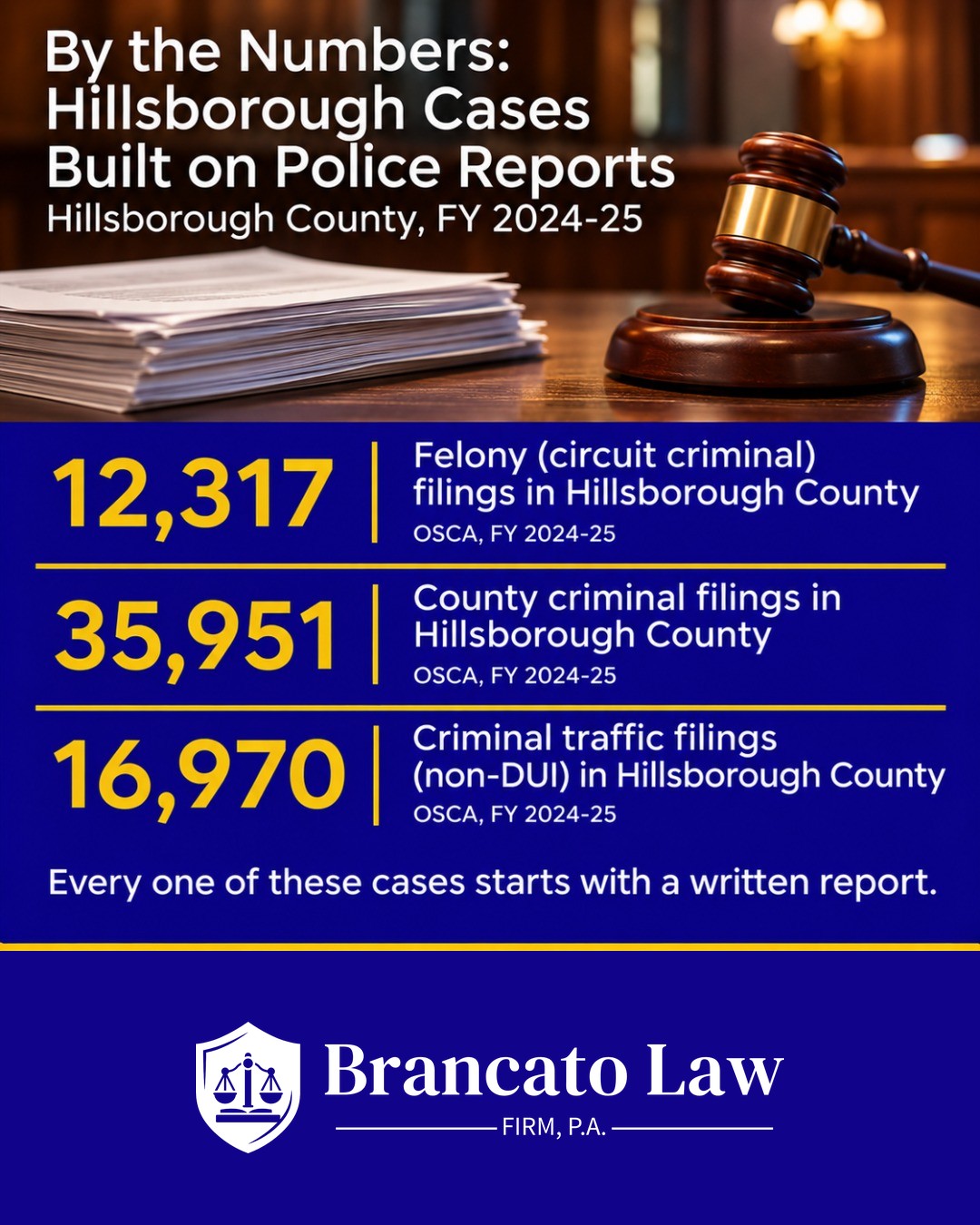
Judges rely on the written report at almost every stage before trial. In fiscal year 2024-25, Hillsborough County courts received 12,317 circuit criminal (felony) filings, per the Florida Office of the State Courts Administrator’s Statistical Reference Guide (chapter 3, page 7), and 35,951 county criminal filings, including 16,970 criminal traffic cases and 4,008 DUI cases, per the same guide’s county criminal chapter (chapter 7, page 7). Nearly every one of those cases began with an officer’s written narrative.
The U.S. Supreme Court held in Gerstein v. Pugh, 420 U.S. 103 (1975) that a person arrested without a warrant is entitled to a prompt judicial finding of probable cause, and that the finding may be made informally, on hearsay and written testimony, without the officer in the room. That is how first appearance works in Florida. The judge reads the arrest affidavit and decides. Our post on what happens at first appearance in Hillsborough County walks through that hearing.
| Proceeding | What the judge or hearing officer decides | What they usually read | Is the officer there? |
|---|---|---|---|
| First appearance (within 24 hours of arrest) | Probable cause and pretrial release conditions | Arrest affidavit or complaint affidavit | Usually not |
| Arrest or search warrant | Whether to issue the warrant | The officer’s sworn affidavit | No; it is reviewed on paper |
| DMV license suspension review | Whether the suspension stands | Officer’s affidavit, breath results, crash report, video | Only if subpoenaed |
| Criminal traffic case | Probable cause and the charge itself | The officer’s citation and report | Only at trial |
| DCF shelter hearing | Whether a child stays out of the home | Shelter petition plus law enforcement and hotline reports | Usually not |
| Risk protection order (temporary, ex parte) | Whether to take a person’s guns before a hearing | Sworn petition and affidavit, often built from incident reports | No; the respondent is not notified |
| Violation of probation warrant | Whether to issue a warrant | Probation officer’s affidavit, often citing police reports | No |
Each of those decisions happens before a jury ever hears the case. That is why Northwestern University law professor Andrew Guthrie Ferguson argues in Generative Suspicion and the Risks of AI-Assisted Police Reports, 120 Nw. U. L. Rev. 299 (2025) that the greatest effect of AI-drafted reports will fall on misdemeanor and low-level felony cases, where there is little independent investigation to catch errors. Those are the cases our attorneys handle every week, from criminal traffic tickets to felonies, and they are the cases where one report often is the whole file.
How Does an AI Police Report Affect a DUI Case and Your License?
An AI-drafted narrative can decide your driver’s license before your criminal case even starts. Under section 322.2615, Florida Statutes, you have 10 days from the notice of suspension to request a review. The officer must send the Department of Highway Safety and Motor Vehicles an affidavit stating the grounds for believing you were impaired, and an informal review “shall consist solely of an examination” of the submitted materials, with no officer or witness required. In that setting, the officer’s written words are the evidence.
The criminal case moves slower but leans on the same report. In Hillsborough County, DUI arrestees taken by HCSO or Tampa Police go to Central Breath Testing, where the breath test is requested, and on a misdemeanor DUI the State Attorney’s Office often files its formal charge weeks after the arrest. Until then, the citation and the officer’s report are the only charging documents. Our Tampa DUI lawyer team compares every word of that report to the body camera audio before the license hearing, because a phrase like “slurred speech” or “strong odor of alcohol” should appear in the audio if the officer said it, and an AI summary can add or polish phrases that were never spoken. Our guide on protecting your license after a DUI arrest explains the 10-day deadline in detail.
Can a Police Report Decide Whether DCF Keeps Your Child?
Yes. When the Department of Children and Families removes a child, a judge must hold a shelter hearing, and under section 39.402, Florida Statutes a child may not be held in shelter longer than 24 hours without a court order entered after that hearing. At the hearing, the department must give the court copies of any available law enforcement, medical, or other professional reports, and the judge decides whether there is probable cause to keep the child out of the home.
That is a decision about your family made in a matter of hours, often from paper. A deputy’s report from a “non-criminal” family disturbance or welfare check can be one of those papers. If an AI tool summarized a chaotic scene, with children crying, adults talking over each other, and words in Spanish or Haitian Creole, the summary may not match what anyone actually said. Our attorneys defend parents in the criminal case that often runs alongside a DCF case, and our Tampa child abuse defense attorney page explains how the two cases interact.
The same is true of mental health calls. Under section 394.463, Florida Statutes, an officer who takes a person for an involuntary examination under the Baker Act must execute a written report detailing the circumstances, and that report becomes part of the person’s clinical record. Those records can resurface later in a criminal case, a firearm question, or a custody dispute. Our criminal mental health defense attorneys review those reports with the same care as an arrest affidavit.
Can an AI Police Report Be Used Against You at Trial in Florida?
Usually not as evidence by itself. Florida’s public-records hearsay exception, section 90.803(8), Florida Statutes, excludes “in criminal cases matters observed by a police officer or other law enforcement personnel,” with a narrow exception for breath and blood test affidavits. That means the officer has to come to court and testify, and the report becomes the document our attorneys use to cross-examine the officer.
This is where AI drafting can help the defense. If the report says something the body camera audio does not support, the officer has to explain where it came from. An officer who answers “the software wrote that and I signed it” has a credibility problem in front of a jury. An officer who claims to remember a detail the audio does not contain has a different problem. Either way, the gap between the audio and the report is fair ground for cross-examination.
What Happens If an AI Report Contains a False Statement?
The officer who signed it owns it. In Franks v. Delaware, 438 U.S. 154 (1978), the U.S. Supreme Court held that a defendant who makes a substantial preliminary showing that an affiant included a false statement knowingly and intentionally, or with reckless disregard for the truth, and that the statement was necessary to probable cause, is entitled to a hearing. If the falsehood is proven and the rest of the affidavit does not establish probable cause, the warrant is voided and the evidence is suppressed.
The Court also said that “allegations of negligence or innocent mistake are insufficient.” That is the open question with AI. Signing a sworn narrative without checking it against the audio that produced it may be argued as reckless disregard for the truth, and our attorneys make that argument through a forensic and digital evidence review of the recording itself. Separately, a document verified under section 92.525, Florida Statutes with the words “under penalties of perjury” carries criminal exposure for a knowingly false declaration, which is a third-degree felony.
Do Other States Require Police to Disclose AI-Written Reports?
Two states do, and Florida is not one of them. Utah was the first state to require disclosure, and California followed when Governor Gavin Newsom signed SB 524 on October 10, 2025, according to the Electronic Frontier Foundation. Axon has said it does not keep the original AI draft, which Creative Loafing Tampa quoted an Axon product manager describing as “by design”.
| State | Disclosure required? | First AI draft kept? | Source |
|---|---|---|---|
| Florida | No statute requires it | No requirement; Axon says it does not store the original draft | WMNF; Creative Loafing Tampa |
| California (SB 524, signed Oct. 10, 2025) | Yes; AI-assisted reports must be marked | Yes; agencies must retain the first draft | Electronic Frontier Foundation |
| Utah | Yes; first state to require disclosure | Not addressed in our sources | Electronic Frontier Foundation |
How Our Attorneys Test an AI-Drafted Police Report
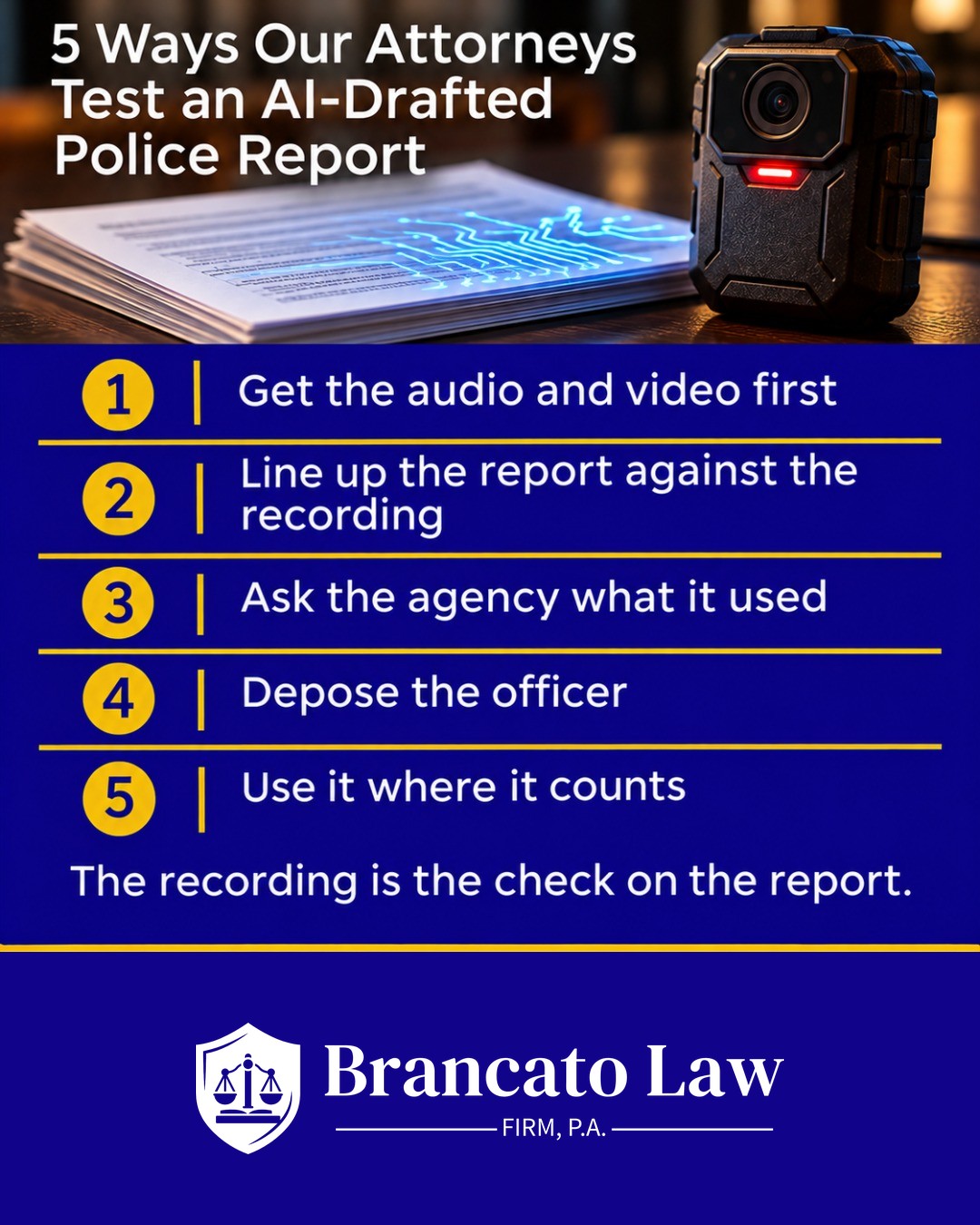
Our attorneys test the report against its source. Because Draft One drafts from body camera audio, the audio is the best evidence of what the officer actually observed and said. These are the steps our firm takes:
- Get the audio and video first. We request every body-worn camera recording from every officer on scene, not only the arresting officer.
- Line up the report against the recording. Every observation in the narrative should trace to something the officer saw, said, or recorded. Phrases with no source in the audio get flagged.
- Ask the agency what it used. We request the agency’s AI report-writing policy and ask whether Draft One or a similar tool drafted the narrative, which edits the officer made, and whether any audit trail exists.
- Depose the officer. Florida’s discovery rules allow defense depositions of officers in felony cases, and in misdemeanor and criminal traffic cases with the court’s permission. We ask the officer, under oath, which words are his or hers and which came from the software.
- Use it where it counts. That record supports a motion to suppress, a challenge at the license review, a request for pretrial release, or cross-examination at trial.
Language matters here too. Body camera audio from a traffic stop or family call often includes Spanish or Haitian Creole, and a transcription tool can miss or mistranslate it. Our firm has Spanish-speaking staff, and attorney Jean-Luc Adrien speaks Spanish, Haitian Creole, and French, so we can check what was actually said in the language it was said in.
What Should You Do If You Think AI Wrote Your Police Report?
Act before the first deadline in your case passes. The license review deadline is 10 days in a DUI case, a shelter hearing happens within 24 hours, and first appearance happens within 24 hours of arrest. If you are under investigation and have not been charged, representation before charges are filed lets our attorneys get the recordings and present the other side before the State Attorney’s Office decides. Our overview of the Florida criminal case process shows where each of those deadlines falls.
- Do not argue with the report on social media or with the officer. Save it for your lawyer.
- Write down what you remember about the encounter today, including who was present and what language was spoken.
- Keep every document you were given: the citation, the notice of suspension, any DCF paperwork, any injunction or order.
- Do not contact the officer or the agency yourself to ask whether AI was used. Let your attorney make that request in a way that preserves the record.
Surveillance technology is changing how cases are built. Our related guides cover arrests based on facial recognition in Florida and Flock cameras and license plate readers in Tampa.
Frequently Asked Questions
Does the Hillsborough County Sheriff’s Office use AI to write police reports?
Yes, on a limited basis: HCSO announced on February 26, 2026 that deputies may use Axon Draft One for non-criminal calls for service, with each deputy reviewing and approving the report. The Brancato Law Firm asks in discovery whether AI drafted any report in a client’s file, because a non-criminal report can still end up in front of a judge.
Do Florida police have to tell you if AI wrote the police report?
No: as of November 2026, Florida has no statute requiring officers to disclose that AI helped draft a report, unlike Utah and California. Our attorneys at The Brancato Law Firm ask the question directly in depositions and records requests, because the report itself may not say.
Can an AI-written police report get a DUI case dismissed in Florida?
Not automatically, because AI drafting alone is not a ground for dismissal in Florida, but errors the AI introduced and the officer signed can support a motion to suppress, a challenge at the license review, or cross-examination that leads to an acquittal or a reduced charge. The Brancato Law Firm compares every DUI report to the body camera audio, and our DUI defense attorneys in Tampa explain the options after that review.
Can I get the body camera audio an AI used to write my police report?
Yes, through your criminal case, because body camera recordings are evidence the State must disclose through discovery after charges are filed. The Brancato Law Firm requests every recording from every officer on scene, since the audio is the raw material the AI used.
Can DCF use a police report to keep my child out of my home in Florida?
Yes: under section 39.402, DCF must give the judge any available law enforcement reports at the shelter hearing, and the judge decides probable cause from the petition and those reports. Our attorneys at The Brancato Law Firm defend parents in the related criminal case and make sure the report is tested against what was actually recorded.
Is the officer responsible for mistakes in an AI-drafted police report?
Yes, because the officer reviews, edits, and signs the final report, and under Franks v. Delaware a knowing or reckless false statement in a sworn affidavit can void a warrant. The Brancato Law Firm uses the gap between the audio and the signed report to challenge the officer’s credibility at hearings and at trial.
Talk to a Tampa Defense Attorney About Your Police Report
The report in your case was written within hours of your arrest, and the first decisions based on it come just as fast. Call The Brancato Law Firm, P.A., founded by Tampa Criminal Defense Attorney Rocky Brancato, at (813) 727-7159. Our attorneys will get the recordings, line them up against the report, and tell you where it does not hold up. You can call us at any hour. Our firm has Spanish-speaking staff, and attorney Jean-Luc Adrien speaks Spanish, Haitian Creole, and French. For more about our defense strategies, visit our Tampa DUI defense page, or our Hillsborough County criminal defense page.
The Brancato Law Firm, P.A.
620 E. Twiggs Street, Suite 205, Tampa, FL 33602
(813) 727-7159
Serving Hillsborough, Pinellas, and Pasco Counties
The Brancato Law Firm, P.A. is a Tampa-based criminal defense practice. We are not affiliated with any other Brancato-named law firms.
Visit Us

Tampa, FL 33602

Contact Us Now
Free Legal Consultation (813) 727-7159
